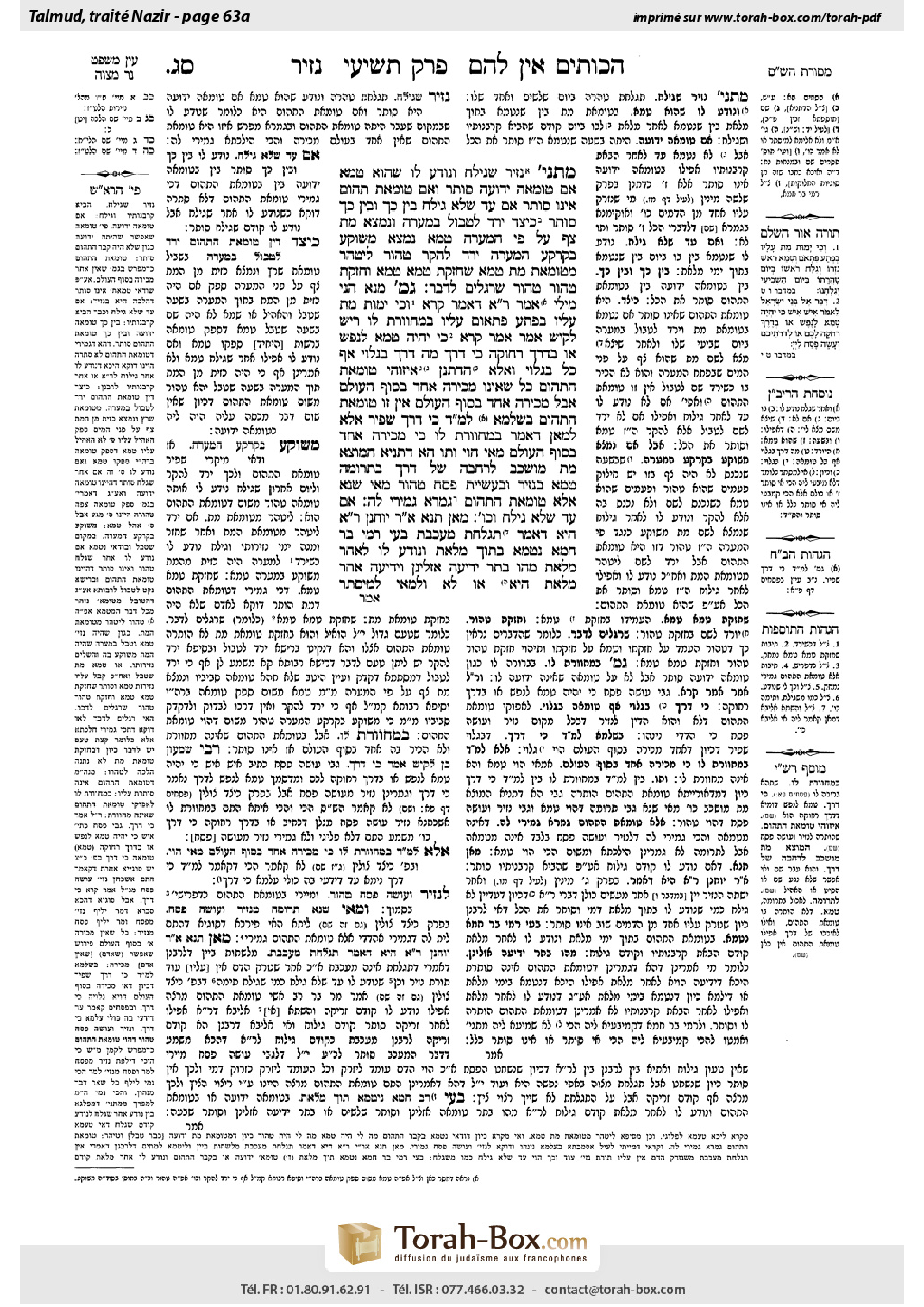
Nazir 63a: Talmud study for Daf Yomi
Daf Yomi is the daily study of one Talmud folio. Explore 37 tractates with scans, Hebrew text, Sefaria English and AI-generated French translations where annotated.
Passage selection and English or AI-generated French translation are available where the scan has annotations. Daf Study is independent of Torah-Box and Sefaria.
Browse Nazir · נזיר · All tractatesNazir 63a text and translations
This page of Nazir includes the Aramaic text, an English translation and an AI-generated French translation, alongside the scan above.
נזיר ס״ג א · Aramaic and Hebrew text
מַתְנִי׳ נָזִיר שֶׁגִּילַּח, וְנוֹדַע לוֹ שֶׁהוּא טָמֵא, אִם טוּמְאָה יְדוּעָה — סוֹתֵר, וְאִם טוּמְאַת תְּהוֹם — אֵינוֹ סוֹתֵר. אִם עַד שֶׁלֹּא גִּילַּח, בֵּין כָּךְ וּבֵין כָּךְ — סוֹתֵר.
כֵּיצַד? יָרַד לִטְבּוֹל בִּמְעָרָה וְנִמְצָא מֵת צָף עַל פִּי הַמְעָרָה — טָמֵא, נִמְצָא מְשׁוּקָּע בְּקַרְקַע הַמְּעָרָה,
יָרַד לְהָקֵר — טָהוֹר. לִיטָּהֵר מִטּוּמְאַת מֵת — טָמֵא. שֶׁחֶזְקַת טָמֵא — טָמֵא, וְחֶזְקַת טָהוֹר — טָהוֹר, שֶׁרַגְלַיִם לַדָּבָר.
גְּמָ׳ מְנָא הָנֵי מִילֵּי? אָמַר רַבִּי אֱלִיעֶזֶר, דְּאָמַר קְרָא: ״וְכִי יָמוּת מֵת עָלָיו בְּפֶתַע פִּתְאֹם״, ״עָלָיו״ — בִּמְחֻוֶּורֶת לוֹ.
רֵישׁ לָקִישׁ אָמַר: אָמַר קְרָא ״כִּי יִהְיֶה טָמֵא לָנֶפֶשׁ אוֹ בְדֶרֶךְ רְחֹקָה״. כִּי דֶרֶךְ: מָה דֶּרֶךְ בְּגִלּוּי, אַף כֹּל בְּגִלּוּי.
וְאֶלָּא הָדִתְנַן: אֵיזוֹהִי טוּמְאַת הַתְּהוֹם — כֹּל שֶׁאֵינוֹ מַכִּירָהּ אֶחָד בְּסוֹף הָעוֹלָם. אֲבָל מַכִּירָהּ אֶחָד בְּסוֹף הָעוֹלָם — אֵין זוֹ טוּמְאַת הַתְּהוֹם.
בִּשְׁלָמָא לְמַאן דְּאָמַר כִּי דֶרֶךְ — שַׁפִּיר. אֶלָּא לְמַאן דְּאָמַר — בִּמְחֻוֶּורֶת לוֹ, כִּי מַכִּירָהּ אֶחָד בְּסוֹף הָעוֹלָם מַאי הָוֵי?
וְתוּ, הָא דְּתַנְיָא: הַמּוֹצֵא מֵת מוּשְׁכָּב לְרׇחְבָּהּ שֶׁל דֶּרֶךְ, בִּתְרוּמָה — טָמֵא, בְּנָזִיר וּבַעֲשִׂיַּית פֶּסַח — טָהוֹר. מַאי שְׁנָא? אֶלָּא טוּמְאַת הַתְּהוֹם גְּמָרָא גְּמִירִי לַהּ.
אִם עַד שֶׁלֹּא גִּילַּח וְכוּ׳. מַאן תַּנָּא? אָמַר רַבִּי יוֹחָנָן: רַבִּי אֱלִיעֶזֶר הִיא, דְּאָמַר: תִּגְלַחַת מְעַכֶּבֶת.
בָּעֵי רָמֵי בַּר חָמָא: נִטְמָא בְּתוֹךְ מְלֹאת וְנוֹדַע לוֹ לְאַחַר מְלֹאת, מַהוּ? בָּתַר יְדִיעָה אָזְלִינַן, וִידִיעָה אַחַר מְלֹאת הִיא, אוֹ לָא? וּלְמַאי: לְמִיסְתַּר?
Nazir 63a · English translation
MISHNA: With regard to a nazirite who shaved for the conclusion of his naziriteship, and it later became known to him that during his naziriteship he was ritually impure from a corpse, if it was a known impurity, i.e., people were aware of the impurity when he became impure, he negates his entire naziriteship. And if it was ritual impurity imparted by a grave in the depths, one that was unknown at the time, he does not negate his naziriteship. If he discovered he was impure before he shaved, he negates his naziriteship in either case.
The mishna asks: How does one differentiate between a known and an unknown impurity? If a nazirite descended to immerse in a cave, and a corpse was found floating at the mouth of the cave, he is impure, as an openly visible corpse is a known impurity. What, then, is an impurity of the depths? This is referring to a case where the corpse was found sunk into the ground of the cave in such a manner that it was unknown.
However, even here the circumstances of the case must be taken into account. If one descended not to immerse himself in the water, as he was ritually pure, but to cool himself, he remains pure. If he was impure and entered the water to purify himself from the impurity from a corpse, he is impure. The reason is that something that has the presumptive status of impurity remains impure, and something that has the presumptive status of purity is pure, as there is a basis for the matter. It is reasonable that items or people retain their presumptive status.
GEMARA: The Gemara asks: From where are these matters derived, that there is a difference between known and unknown impurity? Rabbi Eliezer said that the verse states with regard to a nazirite: “And if any man shall die very suddenly beside him” (Numbers 6:9). The emphasis provided by the term “beside him” indicates that it is clear to him that he has become impure. However, one is not impure if the presence of the corpse is unknown.
Reish Lakish said a different source: The verse states with regard to the Paschal offering: “Any man of you who shall be ritually impure due to a corpse or on a road far away” (Numbers 9:10). The word “road” is juxtaposed in the verse to the term “ritually impure,” indicating that the impurity is like a road. Just as a road is in the open, so too, every impurity is in the open. It must be a known impurity.
The Gemara objects: But consider that which we learned in the Tosefta (Zavim 2:9): Which is the ritual impurity imparted by a grave in the depths? It is impurity imparted by any corpse of which no one is aware, even at the end of the earth. This type of impurity is permitted for both a nazirite and one who sacrifices the Paschal offering. However, if even one person is aware of it, even at the end of the earth, this is not impurity imparted by a grave in the depths.
The Gemara states its question: Granted, according to the one who says that this halakha is derived from the verse that states that ritual impurity is like a road, it is fine, as an item known to someone in the world can be compared to a road. However, according to the one who says that this halakha is derived from the term “beside him,” i.e., it is referring to an impurity that is clear to him, if one person at the other end of the earth is aware of this impurity, what of it? It was unknown to the nazirite himself.
And furthermore, consider that which is taught in another baraita (Tosefta, Zavim 2:8): In the case of one who finds a corpse lying across the width of a road, i.e., it had been buried there in such a way that it was impossible for the passerby to avoid becoming impure by passing over the corpse, then with regard to teruma, the passerby is impure. Therefore, if he is a priest, he may not eat teruma. However, with regard to both being a nazirite and being one performing the ritual of the Paschal offering, the passerby is pure. What is different about these situations? Rather, it must be that the halakha of impurity imparted by a grave in the depths is learned as a tradition and not from the verses, which are cited merely in support.
§ The mishna taught that if a nazirite discovered he was ritually impure before he shaved, he negates his naziriteship even if he was rendered impure by impurity of the depths. The Gemara asks: Who is the tanna who taught this opinion? Rabbi Yoḥanan says: It is Rabbi Eliezer, who says that shaving is indispensable to the completion of one’s naziriteship. Consequently, if he discovered he was impure before he shaved, he became impure during his naziriteship, and he negates the period he has observed.
Rami bar Ḥama raised a dilemma: What is the halakha with regard to one who became impure during the full term of the regular days of his naziriteship but his impurity became known to him only after the full term but before he shaved? Perhaps we go according to his knowledge, and it is a case of knowledge after the full term, or perhaps the halakha is not determined by the time of his awareness but by the actual time of the impurity, which occurred during his naziriteship. The Gemara adds: And with regard to what issue was this dilemma raised? It was with regard to his possible negation of the period he observed as a nazirite: Does he negate his naziriteship, or is he considered to have contracted impurity after the completion of his term, in which case he need not start his naziriteship afresh?
Nazir 63a · Traduction française (IA)
MICHNA : À propos d’un nazir qui s’est rasé à la fin de son naziréat, puis a appris qu’il avait été rituellement impur à cause d’un cadavre pendant son naziréat : si cette impureté était connue, c’est-à-dire que des gens en avaient connaissance au moment où il était devenu impur, il annule tout son naziréat. Si, en revanche, il s’agissait d’une impureté due à un tombeau des profondeurs, inconnue à ce moment-là, il n’annule pas son naziréat. S’il découvre son impureté avant de se raser, il annule son naziréat dans les deux cas.
La Michna demande : Comment distingue-t-on une impureté connue d’une impureté inconnue ? Si un nazir est descendu pour s’immerger dans une grotte et qu’un cadavre a été trouvé flottant à l’entrée de la grotte, il est impur, car un cadavre visible au grand jour constitue une impureté connue. Qu’est-ce donc qu’une impureté des profondeurs ? Il s’agit du cas où le cadavre a été trouvé enfoncé dans le sol de la grotte, de sorte que sa présence était inconnue.
Toutefois, même dans ce cas, il faut tenir compte des circonstances. S’il est descendu non pas pour s’immerger dans l’eau, puisqu’il était rituellement pur, mais pour se rafraîchir, il reste pur. S’il était impur et est entré dans l’eau pour se purifier de l’impureté due à un cadavre, il est impur. En effet, ce qui a un statut présumé d’impureté reste impur, et ce qui a un statut présumé de pureté reste pur, car il y a un fondement à cette présomption. Il est raisonnable que les objets ou les personnes conservent leur statut présumé.
GUEMARA : La Guemara demande : D’où tire-t-on ces règles, selon lesquelles il existe une différence entre une impureté connue et une impureté inconnue ? Rabbi Eliezer dit que le verset concernant le nazir déclare : « Si un homme meurt très soudainement près de lui » (Nombres 6, 9). L’expression « près de lui » souligne qu’il sait clairement qu’il est devenu impur. En revanche, il n’est pas impur lorsque la présence du cadavre lui est inconnue.
Reich Lakich propose une autre source : au sujet de l’offrande pascale, le verset déclare : « Tout homme parmi vous qui sera rituellement impur à cause d’un cadavre ou qui sera sur une route lointaine » (Nombres 9, 10). Le mot « route » est rapproché dans le verset de l’expression « rituellement impur », ce qui indique que l’impureté est comme une route. De même qu’une route est à découvert, toute impureté doit être à découvert : elle doit être connue.
La Guemara objecte : Mais que dire de ce que nous avons appris dans la Tossefta (Zavim 2, 9) : Qu’est-ce que l’impureté due à un tombeau des profondeurs ? C’est l’impureté due à tout cadavre dont personne n’a connaissance, même à l’autre bout du monde. Ce type d’impureté est considéré comme sans effet aussi bien pour un nazir que pour celui qui offre le sacrifice pascal. En revanche, si une seule personne en a connaissance, même à l’autre bout du monde, il ne s’agit pas d’une impureté due à un tombeau des profondeurs.
La Guemara précise sa question : certes, selon celui qui dit que cette halakha est déduite du verset qui assimile l’impureté rituelle à une route, cela convient, car une chose connue de quelqu’un dans le monde peut être comparée à une route. Cependant, selon celui qui dit que cette halakha est déduite de l’expression « près de lui », c’est-à-dire qu’elle désigne une impureté qui lui est clairement connue, qu’importe-t-il qu’une personne, à l’autre bout du monde, ait connaissance de cette impureté ? Le nazir lui-même n’en avait pas connaissance.
Et de plus, considérons ce qui est enseigné dans une autre baraïta (Tossefta, Zavim 2, 8) : si quelqu’un trouve un cadavre étendu en travers de toute la largeur d’une route, c’est-à-dire enterré de telle sorte qu’un passant ne puisse éviter de devenir impur en passant au-dessus, alors, en ce qui concerne la terouma, le passant est impur. Par conséquent, s’il est prêtre, il ne peut pas manger de terouma. Cependant, qu’il s’agisse de devenir nazir ou d’accomplir le rituel de l’offrande pascale, le passant est pur. Quelle différence y a-t-il entre ces situations ? Il faut donc conclure que la halakha concernant l’impureté due à un tombeau des profondeurs est transmise par tradition et non déduite des versets, qui ne sont cités qu’à l’appui.
§ La Michna a enseigné que si un nazir découvre qu’il est rituellement impur avant de se raser, il annule son naziréat même si son impureté est due à une impureté des profondeurs. La Guemara demande : Quel est le tanna qui a enseigné cette opinion ? Rabbi Yoḥanan dit : C’est Rabbi Eliezer, qui affirme que le rasage est indispensable à l’achèvement du naziréat. Par conséquent, s’il découvre son impureté avant de se raser, il a été rendu impur pendant son naziréat et annule la période qu’il a observée.
Rami bar Ḥama soulève un dilemme : quelle est la halakha concernant celui qui a été rendu impur pendant la durée complète des jours ordinaires de son naziréat, mais n’a appris son impureté qu’après cette durée complète, avant de se raser ? Peut-être faut-il se fonder sur le moment où il en a pris connaissance : il s’agit alors d’une prise de connaissance après la durée complète. Ou peut-être la halakha ne dépend-elle pas du moment où il en a pris connaissance, mais du moment où l’impureté s’est effectivement produite, qui se situe pendant son naziréat. La Guemara ajoute : À propos de quelle question ce dilemme a-t-il été soulevé ? À propos de l’éventuelle annulation de la période qu’il a observée comme nazir : annule-t-il son naziréat, ou est-il considéré comme ayant contracté l’impureté après l’achèvement de sa période, auquel cas il n’a pas à recommencer son naziréat depuis le début ?
Traduction française générée par IA à partir de l’édition anglaise de Sefaria. Vérifie toujours un passage avec le texte source.
Text from Sefaria: William Davidson Edition - Vocalized Aramaic (CC BY NC); William Davidson Edition - English (CC BY NC).