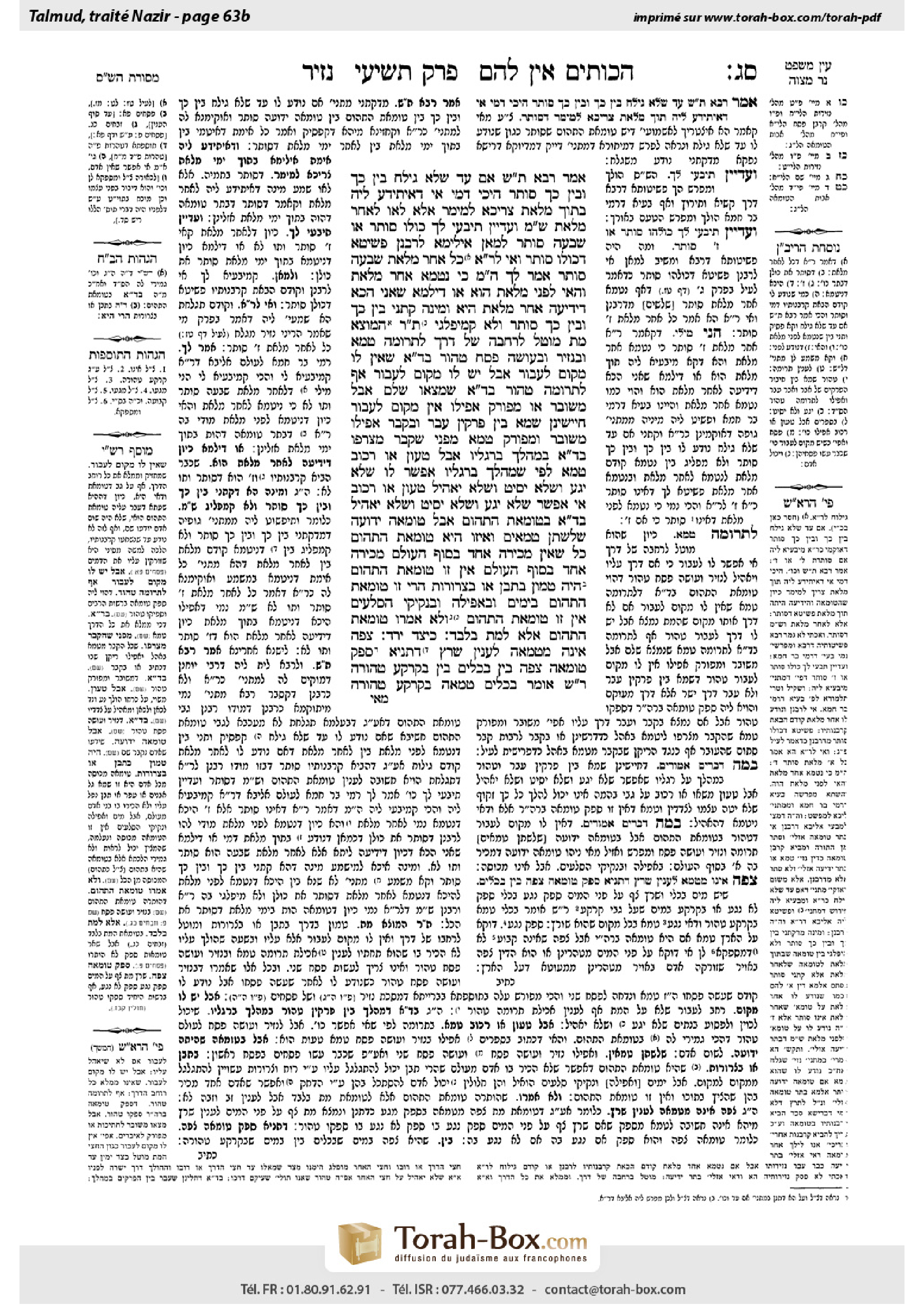
Nazir 63b: Talmud study for Daf Yomi
Daf Yomi is the daily study of one Talmud folio. Explore 37 tractates with scans, Hebrew text, Sefaria English and AI-generated French translations where annotated.
Passage selection and English or AI-generated French translation are available where the scan has annotations. Daf Study is independent of Torah-Box and Sefaria.
Browse Nazir · נזיר · All tractatesNazir 63b text and translations
This page of Nazir includes the Aramaic text, an English translation and an AI-generated French translation, alongside the scan above.
נזיר ס״ג ב · Aramaic and Hebrew text
אָמַר רָבָא, תָּא שְׁמַע: אִם עַד שֶׁלֹּא גִּילַּח — בֵּין כָּךְ וּבֵין כָּךְ סוֹתֵר. הֵיכִי דָמֵי? אִי דְּאִיתְיְדַע לֵיהּ בְּתוֹךְ מְלֹאת — צְרִיכָא לְמֵימַר? אֶלָּא לָאו, לְאַחַר מְלֹאת, שְׁמַע מִינַּהּ.
וַעֲדַיִין תִּיבְּעֵי לָךְ: כּוּלּוֹ סוֹתֵר אוֹ שִׁבְעָה סוֹתֵר? לְמַאן? אִילֵּימָא לְרַבָּנַן — פְּשִׁיטָא דְּכוּלּוֹ סוֹתֵר. וְאִי לְרַבִּי אֱלִיעֶזֶר: כׇּל אַחַר מְלֹאת — שִׁבְעָה סוֹתֵר!
אָמַר לְךָ: הָנֵי מִילֵּי, כִּי נִטְמָא אַחַר מְלֹאת, וְהַאי לִפְנֵי מְלֹאת הוּא. אוֹ דִילְמָא: שָׁאנֵי הָכָא דִּידִיעָה אַחַר מְלֹאת הִיא?
וּמִינַּהּ: קָתָנֵי בֵּין כָּךְ וּבֵין כָּךְ סוֹתֵר, וְלָא קָמִיפַּלְגִי.
תָּנוּ רַבָּנַן: הַמּוֹצֵא מֵת מוּטָל לְרׇחְבָּהּ שֶׁל דֶּרֶךְ, לִתְרוּמָה — טָמֵא, וּבְנָזִיר וּבְעוֹשֵׂה פֶסַח — טָהוֹר. בַּמֶּה דְּבָרִים אֲמוּרִים — שֶׁאֵין לוֹ מָקוֹם לַעֲבוֹר,
אֲבָל יֵשׁ לוֹ מָקוֹם לַעֲבוֹר — אַף לִתְרוּמָה טָהוֹר.
בַּמֶּה דְּבָרִים אֲמוּרִים — שֶׁמְּצָאוֹ שָׁלֵם. אֲבָל מְשׁוּבָּר אוֹ מְפוֹרָק, אֲפִילּוּ אֵין מָקוֹם לַעֲבוֹר חָיְישִׁינַן שֶׁמָּא בֵּין פִּרְקִין עָבַר. וּבְקֶבֶר, אֲפִילּוּ מְשׁוּבָּר וּמְפוֹרָק — טָמֵא, מִפְּנֵי שֶׁקֶּבֶר מְצָרְפוֹ.
בַּמֶּה דְּבָרִים אֲמוּרִים — בִּמְהַלֵּךְ בְּרַגְלָיו. אֲבָל טָעוּן אוֹ רָכוּב — טָמֵא. לְפִי שֶׁמְּהַלֵּךְ בְּרַגְלָיו — אֶפְשָׁר לוֹ שֶׁלֹּא יִגַּע וְשֶׁלֹּא יָסִיט וְשֶׁלֹּא יַאֲהִיל. טָעוּן אוֹ רָכוּב — אִי אֶפְשָׁר שֶׁלֹּא יִגַּע וְשֶׁלֹּא יָסִיט וְשֶׁלֹּא יַאֲהִיל.
בַּמֶּה דְּבָרִים אֲמוּרִים — בְּטוּמְאַת הַתְּהוֹם. אֲבָל טוּמְאָה יְדוּעָה — שְׁלׇשְׁתָּן טְמֵאִים.
וְאֵיזוֹ הִיא טוּמְאַת הַתְּהוֹם — כֹּל שֶׁאֵין מַכִּירָהּ אֶחָד בְּסוֹף הָעוֹלָם. מַכִּירָהּ אֶחָד בְּסוֹף הָעוֹלָם — אֵין זוֹ טוּמְאַת הַתְּהוֹם.
הָיָה טָמוּן בְּתֶבֶן אוֹ בִּצְרוֹרוֹת — הֲרֵי זוֹ טוּמְאַת הַתְּהוֹם. בַּיַּמִּים וּבָאֲפֵילָה וּבִנְקִיקֵי הַסְּלָעִים — אֵין זוֹ טוּמְאַת הַתְּהוֹם.
וְלֹא אָמְרוּ טוּמְאַת הַתְּהוֹם אֶלָּא לְמֵת בִּלְבַד.
כֵּיצַד יָרַד. צָפָה אֵינָהּ מְטַמְּאָה לְעִנְיַן שֶׁרֶץ, דְּתַנְיָא: סְפֵק טוּמְאָה צָפָה, בֵּין בְּכֵלִים, בֵּין בְּקַרְקַע — טְהוֹרָה. רַבִּי שִׁמְעוֹן אוֹמֵר: בְּכֵלִים טְמֵאָה, בְּקַרְקַע טְהוֹרָה.
Nazir 63b · English translation
Rava said: Come and hear a resolution to this dilemma from the mishna: If he discovered he was impure before he shaved, he negates the days of his naziriteship in either case. The Gemara seeks to clarify this: What are the circumstances of this case? When exactly did he find out about the impurity? If it became known to him during the full term of his naziriteship, need this be said, that he negates the previous days? After all, he has yet to complete his naziriteship vow. Rather, is it not referring to a case when the impurity was discovered after the full term of his naziriteship? Conclude from the mishna that he negates the days of his naziriteship even if he discovered the impurity after the completion of his term.
The Gemara continues to analyze the aforementioned case. And you can still raise the dilemma: Does he negate the entire period of his naziriteship or does he negate just seven days? The Gemara asks: According to whom is this dilemma raised? If we say this dilemma is referring to the opinion of the Rabbis (see 16b), it is obvious that he negates it all, as they maintain that even a nazirite who becomes impure after the completion of his naziriteship must observe another thirty days. And if it is referring to the opinion of Rabbi Eliezer, his ruling with regard to any impurity after the full term of his term is that one negates only seven days.
The Gemara responds: The one who raised this dilemma could have said to you: This statement of Rabbi Eliezer that a nazirite negates a mere seven days applies only if he became impure after the full term of his naziriteship, but this one became impure before the end of the full term, and therefore he negates the entire period. Or perhaps it is different here, as it is a case of knowledge that came to light after the full term of his naziriteship.
The Gemara answers: And one can resolve the dilemma from this mishna itself. The mishna teaches that if the nazirite discovered he was impure before he shaved he negates his naziriteship in either case. And it does not distinguish between cases where this happened before the end of the full term or after it. This indicates that in any case he negates only seven days.
§ The Sages taught (Tosefta, Zavim 2:8): In the case of one who finds a corpse lying across the width of a road, with regard to teruma the passerby is impure. But with regard to both a nazirite and one performing the ritual of the Paschal offering, the passerby is pure, as it is considered impurity imparted by a grave in the depths. In what case is this statement said, that one is impure with regard to partaking of teruma? It is said in a case where he does not have space to pass by on the road without passing over the corpse.
But if he has space to pass by, then even with regard to teruma he is pure. This is because it is possible that the passerby did not become ritually impure, and there is a principle that if an uncertainty arises concerning the ritual purity of a person or item in the public domain, the person or item is considered pure.
Similarly, in what case is this statement said? It is said in a case where one finds the corpse whole. However, if it is broken or dismembered he is pure, even if there is no space to pass by. The reason is that we suspect that perhaps he passed between the parts of the corpse and did not touch or pass over any of them. This applies when he finds the corpse out in the open. But if he finds it in a grave, even if it is broken or dismembered, he is impure. This is because the grave joins the parts into one unit and renders him impure if he passed over any part of the grave, even if he did not pass over part of the corpse.
The baraita adds: In what case is this statement said, i.e., that if the corpse was dismembered the passerby is pure? It is said with regard to a passerby who travels by foot. However, if he was loaded with a heavy burden or was riding an animal, he is impure. This is because in the case of one who travels by foot, it is possible that he will not touch the corpse and will not move it and will not pass over it, whereas in the case of one who is loaded with a heavy burden and therefore does not walk in a straight line, or one riding an animal, it is impossible that he will not touch the corpse and will not move it and will not pass over it.
In what case is this statement said, that a nazirite and one bringing a Paschal offering are considered pure? It is said with regard to impurity imparted by a grave in the depths. However, if the source of impurity was known to others but not to the individual who became impure, all three of them, i.e., a nazirite, one performing the ritual of the Paschal offering, and the one who wishes to partake of teruma, are impure.
The baraita continues: And which corpse is considered to impart impurity of the depths? Any corpse of which no one is aware, even at the end of the earth. But if even one individual is aware of it, even if that person is at the end of the earth, this is not considered impurity imparted by a grave in the depths.
The baraita continues: To ascertain whether anyone ever knew about the corpse, its condition is taken into account. If the body was concealed in hay or in pebbles, so the person might have died in an avalanche, it is likely that the corpse had never been found; this is impurity imparted by a grave in the depths. However, if it was found in water, or in a dark place, or in the clefts of the rocks, this is not impurity imparted by a grave in the depths. Although these are places where people do not often go, with the passage of time the corpse is likely to be discovered, and it is quite possible that someone already passed by and saw it.
The baraita concludes: And the Sages said that the leniency of impurity imparted by a grave in the depths applies only with regard to a corpse, but not with regard to other sources of impurity.
§ The mishna taught: How does one differentiate between a known and an unknown impurity? If a nazirite descended to immerse in a cave, and a corpse was found floating at the mouth of the cave, he is impure. The Gemara comments: A floating impurity does not render a person or item impure in the case of a carcass of a creeping animal. As it is taught in a baraita (Tosefta, Teharot 5:6): With regard to the case of uncertain impurity, where an item might have touched something impure that was floating, either in water in a vessel or in water in the ground, e.g., a well, the item is pure. Rabbi Shimon says: If the impurity was floating in water that was in a vessel, the item is impure; if the impurity was in water in the ground, it is pure.
Nazir 63b · Traduction française (IA)
Rava dit : « Viens et entends la réponse à cette difficulté à partir de la Michna : s’il découvre qu’il était impur avant de se raser, il annule les jours de son naziréat dans les deux cas. » La Guemara cherche à préciser : dans quelles circonstances cela se produit-il ? À quel moment exactement a-t-il découvert son impureté ? Si celle-ci lui a été révélée pendant la durée complète de son naziréat, est-il nécessaire de dire qu’il annule les jours précédents ? Après tout, il n’a pas encore achevé son vœu de naziréat. Ne faut-il pas plutôt comprendre qu’il a découvert son impureté après la durée complète de son naziréat ? Déduis de la Michna qu’il annule les jours de son naziréat même s’il a découvert son impureté après l’achèvement de son terme.
La Guemara poursuit l’analyse du cas mentionné précédemment. On peut encore soulever la difficulté suivante : annule-t-il toute la période de son naziréat, ou seulement sept jours ? La Guemara demande : Selon qui cette difficulté est-elle soulevée ? Si l’on dit qu’elle porte sur l’opinion des Sages (voir 16b), il est évident qu’il annule toute la période, car ils soutiennent que même un nazir devenu impur après l’achèvement de son naziréat doit observer trente jours supplémentaires. Et si elle porte sur l’opinion de Rabbi Éliézer, celui-ci statue que, pour toute impureté survenue après la durée complète de son naziréat, on n’annule que sept jours.
La Guemara répond : Celui qui a soulevé cette difficulté aurait pu te dire : cette déclaration de Rabbi Éliézer, selon laquelle un nazir n’annule que sept jours, ne s’applique que s’il est devenu impur après la durée complète de son naziréat. Mais cet homme est devenu impur avant la fin de cette durée et annule donc toute la période. Ou peut-être le cas présent est-il différent, puisqu’il s’agit d’une impureté qui ne lui a été révélée qu’après la durée complète de son naziréat.
La Guemara répond : On peut résoudre la difficulté à partir de cette Michna elle-même. La Michna enseigne que si le nazir a découvert son impureté avant de se raser, il annule son naziréat dans les deux cas. Elle ne distingue pas entre les cas où cela s’est produit avant la fin de la durée complète et ceux où cela s’est produit après. Cela indique que, dans tous les cas, il n’annule que sept jours.
§ Les Sages ont enseigné (Tossefta, Zavim 2:8) : si quelqu’un trouve un cadavre étendu en travers de la largeur d’une route, le passant est impur en ce qui concerne la terouma. En revanche, un nazir et celui qui accomplit le rituel de l’offrande pascale sont purs, car il s’agit d’une impureté provenant d’une tombe enfouie dans les profondeurs. Dans quelles circonstances cette déclaration, selon laquelle le passant est impur en ce qui concerne la consommation de terouma, s’applique-t-elle ? Elle s’applique lorsqu’il n’a pas assez de place pour passer sur la route sans passer au-dessus du cadavre.
Mais s’il a assez de place pour passer à côté, il est pur même en ce qui concerne la terouma. En effet, il est possible que le passant ne soit pas devenu rituellement impur, et un principe veut que, lorsqu’un doute concernant la pureté rituelle d’une personne ou d’un objet survient dans le domaine public, cette personne ou cet objet soit considéré comme pur.
De même, dans quelles circonstances cette déclaration s’applique-t-elle ? Elle concerne le cas où l’on trouve le cadavre intact. Toutefois, s’il est brisé ou démembré, le passant est pur, même s’il n’a pas la place de passer à côté. En effet, on suppose qu’il est peut-être passé entre les parties du cadavre, sans en toucher ni en franchir aucune. Cela s’applique lorsqu’il trouve le cadavre à l’air libre. Mais s’il le trouve dans une tombe, même s’il est brisé ou démembré, il est impur. En effet, la tombe réunit les parties en un seul ensemble et le rend impur s’il est passé au-dessus d’une partie quelconque de la tombe, même s’il n’est pas passé au-dessus d’une partie du cadavre.
La baraïta ajoute : dans quelles circonstances cette déclaration, selon laquelle le passant est pur si le cadavre a été démembré, s’applique-t-elle ? Elle concerne un passant qui se déplace à pied. En revanche, s’il portait une lourde charge ou chevauchait un animal, il est impur. En effet, celui qui se déplace à pied peut ne pas toucher le cadavre, ne pas le déplacer et ne pas passer au-dessus de lui. Mais celui qui porte une lourde charge et ne marche donc pas en ligne droite, ou celui qui chevauche un animal, ne peut manquer de toucher le cadavre, de le déplacer et de passer au-dessus de lui.
Dans quelles circonstances cette déclaration, selon laquelle un nazir et celui qui apporte une offrande pascale sont considérés comme purs, s’applique-t-elle ? Elle concerne une impureté provenant d’une tombe enfouie dans les profondeurs. En revanche, si la source de l’impureté était connue d’autres personnes, mais pas de l’individu devenu impur, les trois personnes — un nazir, celui qui accomplit le rituel de l’offrande pascale et celui qui souhaite consommer de la terouma — sont impures.
La baraïta poursuit : quel cadavre est considéré comme transmettant une impureté provenant d’une tombe enfouie dans les profondeurs ? Tout cadavre dont personne n’a connaissance, même à l’autre bout du monde. Mais si une seule personne en a connaissance, même si elle se trouve à l’autre bout du monde, il ne s’agit pas d’une impureté provenant d’une tombe enfouie dans les profondeurs.
La baraïta poursuit : pour déterminer si quelqu’un a jamais eu connaissance du cadavre, on tient compte de son emplacement. Si le corps était dissimulé sous du foin ou des cailloux, de sorte que la personne a pu mourir dans une avalanche, il est probable que le cadavre n’ait jamais été découvert ; il s’agit alors d’une impureté provenant d’une tombe enfouie dans les profondeurs. En revanche, s’il a été trouvé dans l’eau, dans un endroit sombre ou dans les fissures des rochers, il ne s’agit pas d’une impureté provenant d’une tombe enfouie dans les profondeurs. Bien que les gens fréquentent rarement ces endroits, le cadavre sera probablement découvert avec le temps, et il est tout à fait possible que quelqu’un soit déjà passé à côté et l’ait vu.
La baraïta conclut : les Sages ont dit que l’allègement relatif à l’impureté provenant d’une tombe enfouie dans les profondeurs ne s’applique qu’à un cadavre, et non aux autres sources d’impureté.
§ La Michna a enseigné : comment distingue-t-on une impureté connue d’une impureté inconnue ? Si un nazir est descendu pour s’immerger dans une grotte et qu’un cadavre a été découvert flottant à l’entrée de la grotte, il est impur. La Guemara fait remarquer qu’une impureté flottante ne rend pas une personne ou un objet impur lorsqu’il s’agit de la carcasse d’un animal rampant. En effet, il est enseigné dans une baraïta (Tossefta, Teharot 5:6) : dans le cas d’une impureté incertaine, où un objet a peut-être touché quelque chose d’impur qui flottait, soit dans l’eau d’un récipient, soit dans l’eau à même le sol, par exemple celle d’un puits, l’objet est pur. Rabbi Shimon dit : si l’impureté flottait dans de l’eau contenue dans un récipient, l’objet est impur ; si elle se trouvait dans l’eau à même le sol, il est pur.
Traduction française générée par IA à partir de l’édition anglaise de Sefaria. Vérifie toujours un passage avec le texte source.
Text from Sefaria: William Davidson Edition - Vocalized Aramaic (CC BY NC); William Davidson Edition - English (CC BY NC).