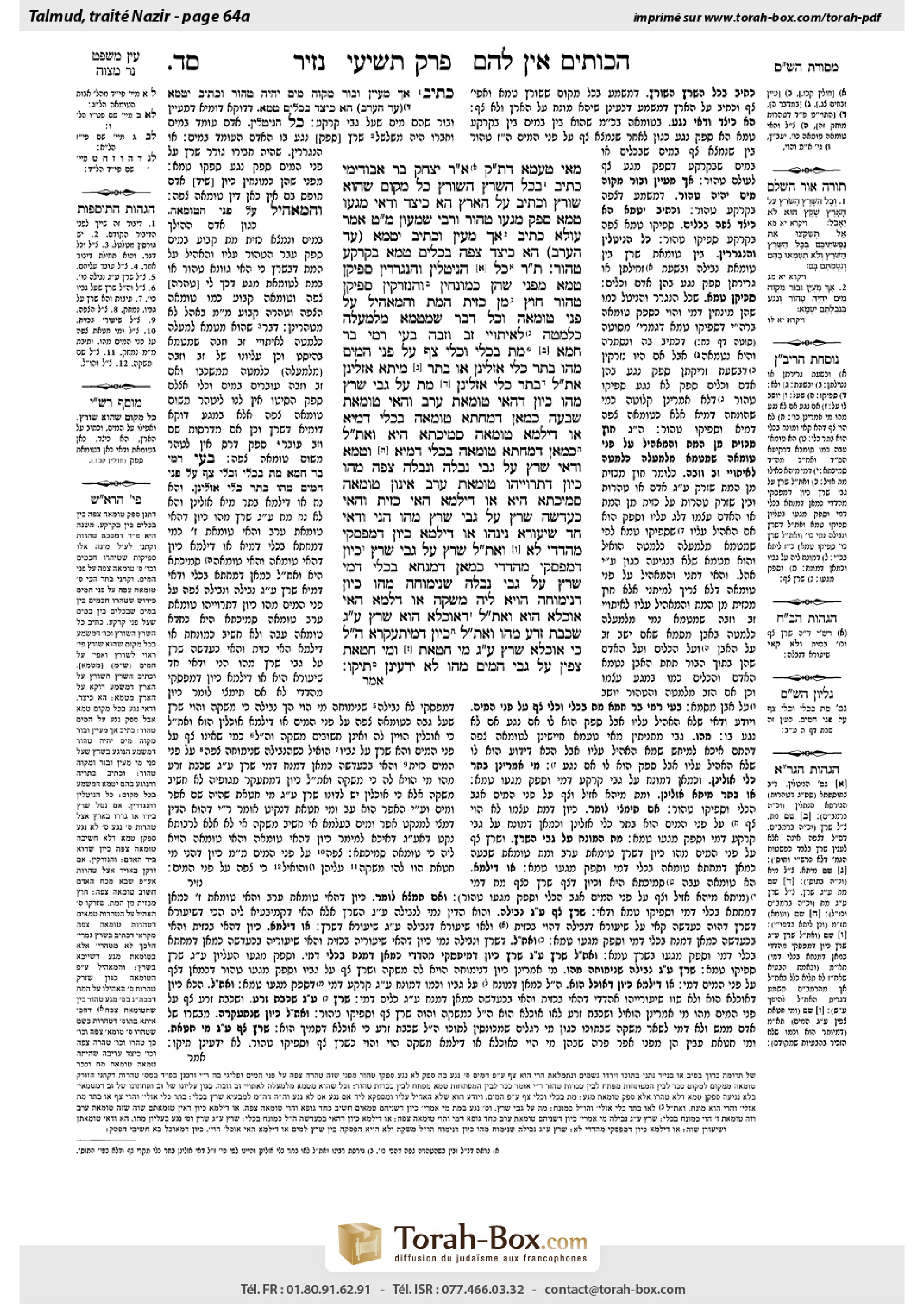
Nazir 64a: Talmud study for Daf Yomi
Daf Yomi is the daily study of one Talmud folio. Explore 37 tractates with scans, Hebrew text, Sefaria English and AI-generated French translations where annotated.
Passage selection and English or AI-generated French translation are available where the scan has annotations. Daf Study is independent of Torah-Box and Sefaria.
Browse Nazir · נזיר · All tractatesNazir 64a text and translations
This page of Nazir includes the Aramaic text, an English translation and an AI-generated French translation, alongside the scan above.
נזיר ס״ד א · Aramaic and Hebrew text
מַאי טַעְמָא דְּתַנָּא קַמָּא? אָמַר רַבִּי יִצְחָק בַּר אֲבוּדִימִי, כְּתִיב: ״בְּכׇל הַשֶּׁרֶץ הַשֹּׁרֵץ״, כׇּל מָקוֹם שֶׁהוּא שׁוֹרֵץ, וּכְתִיב ״עַל הָאָרֶץ״. הָא כֵּיצַד? וַדַּאי מַגָּעוֹ — טָמֵא, סְפֵק מַגָּעוֹ — טָהוֹר.
וְרַבִּי שִׁמְעוֹן מַאי טַעְמָא? אָמַר עוּלָּא: כְּתִיב ״אַךְ מַעְיָן״, וּכְתִיב ״יִטְמָא״ (עַד הָעָרֶב), הָא כֵּיצַד? צָפָה בְּכֵלִים — טָמֵא, בְּקַרְקַע — טָהוֹר.
תָּנוּ רַבָּנַן: כׇּל הַנִּיטָּלִין וְהַנִּגְרָרִין — סְפֵיקָן טָמֵא, מִפְּנֵי שֶׁהֵן כְּמוּנָּחִין. וְהַנִּזְרָקִין — סְפֵיקָן טָהוֹר.
חוּץ מִן כְּזַיִת הַמֵּת, וְהַמַּאֲהִיל עַל פְּנֵי טוּמְאָה, וְכׇל דָּבָר שֶׁמְּטַמֵּא מִלְּמַעְלָה כִּלְמַטָּה. לְאֵיתוֹיֵי זָב וְזָבָה.
בָּעֵי רָמֵי בַּר חָמָא: מֵת בִּכְלִי, וּכְלִי צָף עַל פְּנֵי הַמַּיִם, מַהוּ? בָּתַר כְּלִי אָזְלִינַן, אוֹ בָּתַר מִיתָא אָזְלִינַן?
אִם תִּמְצֵי לוֹמַר בָּתַר כְּלִי אָזְלִינַן: מֵת עַל גַּבֵּי שֶׁרֶץ, מַהוּ? כֵּיוָן דְּהַאי טוּמְאַת עֶרֶב, וְהַאי טוּמְאַת שִׁבְעָה, כְּמַאן דְּמַחֲתָא טוּמְאָה בִּכְלִי דָּמְיָא, אוֹ דִילְמָא טוּמְאָה סְמִיכְתָּא הִיא.
וְאִם תִּמְצֵי לוֹמַר כְּמַאן דְּמַחֲתָא טוּמְאָה בִּכְלִי דָּמְיָא, וְטָמֵא וַדַּאי. שֶׁרֶץ עַל גַּבֵּי נְבֵלָה, וּנְבֵלָה צָפָה, מַהוּ? כֵּיוָן דְּתַרְוַיְיהוּ טוּמְאַת עֶרֶב אִינּוּן — טוּמְאָה סְמִיכְתָּא הִיא. אוֹ דִילְמָא: הַאי כְּזַיִת וְהַאי כַּעֲדָשָׁה?
שֶׁרֶץ עַל גַּבֵּי שֶׁרֶץ מַהוּ? הָנֵי וַדַּאי חַד שִׁיעוּרָא נִינְהוּ, אוֹ דִילְמָא כֵּיוָן דְּמִפַּסְקִי מֵהֲדָדֵי — לָא.
וְאִם תִּמְצֵי לוֹמַר: שֶׁרֶץ עַל גַּבֵּי שֶׁרֶץ כֵּיוָן דְּמִפַּסְקִי מֵהֲדָדֵי כְּמַאן דְּמַנְּחָא בִּכְלִי דָּמֵי, שֶׁרֶץ עַל גַּבֵּי נְבֵלָה שֶׁנִּימּוֹחָה, מַהוּ? כֵּיוָן דְּנִימּוֹחָה הָוְיָא לַיהּ מַשְׁקֶה, אוֹ דִּלְמָא הַאי אוּכְלָא הוּא.
וְאִם תִּמְצֵי לוֹמַר דְּאוּכְלָא הוּא, שֶׁרֶץ עַל גַּבֵּי שִׁכְבַת זֶרַע, מַהוּ? וְאִם תִּמְצֵי לוֹמַר כֵּיוָן דְּמִיתְעַקְּרָא הָוְיָא לַהּ כִּי אוּכְלָא, שֶׁרֶץ עַל גַּבֵּי מֵי חַטָּאת וּמֵי חַטָּאת צָפִין עַל גַּבֵּי הַמַּיִם, מַהוּ? לָא יָדְעִינַן, תֵּיקוּ.
Nazir 64a · English translation
What is the reason of the first tanna for declaring that in all uncertain cases of floating impurity the person or item remains pure? Rabbi Yitzḥak bar Avudimi says: In the passage dealing with the impurity of creeping animals and the prohibition of eating them it is written: “With any swarming thing that swarms” (Leviticus 11:43), indicating that a carcass of a creeping animal renders items impure in any place where it swarms. And it is written: “All swarming things that swarm upon the earth” (Leviticus 11:42), indicating that it transmits impurity only if it is on the earth. How so? How can one reconcile these two verses? Definite contact with it renders one impure; one who has uncertain contact with it, e.g., the impurity is floating, remains pure.
The Gemara asks: And Rabbi Shimon, what is the reason for his opinion? Ulla said that as it is written: “Nevertheless a fountain or a cistern in which there is a gathering of water shall be pure” (Leviticus 11:36), this indicates that a creeping animal found in one of these places does not impart impurity. And it is written in the same verse: “He who touches their carcass shall be impure until evening,” which indicates that it does render one impure. How so? If the impurity was floating in water contained in vessels, the item it touched is rendered impure, but if the water was in the ground itself, e.g., in a spring or pit, the item it touched is pure.
The Sages taught (Tosefta, Teharot 3:13): All items that impart impurity that are carried by human hand or that are dragged along are not considered floating impurities, despite the fact that they are in motion. Rather, in a case where there is uncertainty whether a carried or dragged item affected a person, the individual is rendered impure, because the items are considered as though they were at rest. And in the case of items that are thrown by people, in uncertain cases that pertain to them, the individual remains pure.
This is the halakha, except for an olive-bulk from a corpse, which transmits impurity through uncertain contact even if it was thrown; and that which overlies impurity when thrown, i.e., an item that might have been positioned over a corpse when it was thrown; and anything that renders items above it impure like it renders those below it impure. To what does this last clause refer? It comes to include a zav and a zava, who render items placed above and below them impure even without contact. If something thrown or floating might have come into contact with a zav or zava, it is impure.
With regard to this halakha of a floating impurity, Rami bar Ḥama raises a dilemma: If there is a corpse in a vessel and the vessel is floating on water, and one did not overlie it but might have touched it, what is the halakha? Do we go according to the floating vessel or do we go according to the corpse, which is resting on a solid surface?
If you say that we go according to the vessel and one is rendered ritually impure, the following question arises: If a corpse is placed on top of the carcass of a creeping animal, which is floating on water, what is the halakha? Do we say that since this impurity of a creeping animal is an impurity for an evening, i.e., it lasts one day, and this impurity imparted by a corpse is an impurity for seven days, it is considered as though the impurity imparted by a corpse were placed in a vessel, and he is impure? Or, perhaps the fact that both a corpse and a creeping animal impart impurity means that it is one solid impurity, and because the creeping animal is floating he is pure.
And if you say that due to their different levels of impurity it is considered as though the impurity were placed in a vessel and therefore one is definitely impure, one can raise an additional dilemma. If a creeping animal is atop an unslaughtered animal carcass and the animal carcass is floating, then what is the halakha? Do we say that since they are both examples of an impurity for an evening, it is considered a single solid impurity, or perhaps here too they are different, as this one, the carcass, renders items impure when it is the amount of an olive-bulk, and this one, the creeping animal, does so when it is the amount of a lentil-bulk. In that case, the animal carcass and the creeping animal should be considered separate items, and it is as though the impurity is placed in a vessel, and he is impure.
If in that case they are considered separate, then one can also ask: If a creeping animal is positioned atop another creeping animal, what is the halakha? Do we say that these certainly have the same measurement with regard to transmitting impurity, and that they consequently should be viewed as a single floating items, which means he is pure? Or, perhaps, since they are separate from each other and are not in fact a single item, they are not considered as one unit.
And if you say that in the case of a creeping animal atop a creeping animal, since they are separate from each other, it is considered as though the impurity were placed in a vessel and is not floating, one can raise an additional dilemma. If a creeping animal was placed atop an animal carcass that has dissolved, what is the halakha? Do we say that since it has dissolved it has become like liquid, and therefore it is as though the creeping animal were floating on liquid? Or, perhaps this carcass is still considered food, rather than a liquid, and the creeping animal is on a solid surface.
And if you say that a dissolved animal carcasses is considered food, one can raise an additional dilemma. If a creeping animal was placed on top of semen, which is certainly liquid, what is the halakha? Is this creeping animal considered a floating impurity? And if you say that once semen is ejaculated from the body it is considered like food rather than drink, as it is viscous, one can raise an additional dilemma. If a creeping animal was placed atop waters of purification, i.e., the water into which the ashes of the red heifer are mixed, which becomes highly viscous, and the waters of purification are floating on water, what is the halakha? The Gemara responds: We do not know the answer to any of these questions, and therefore the dilemmas shall stand unresolved.
Nazir 64a · Traduction française (IA)
Quelle est la raison pour laquelle le premier tanna déclare que, dans tous les cas où l’on doute qu’une impureté flottante soit en cause, la personne ou l’objet reste pur ? Rabbi Yitzḥak bar Avudimi dit : À propos de l’impureté des animaux rampants et de l’interdiction de les manger, il est écrit : « Avec toute créature grouillante qui rampe » (Lévitique 11:43), ce qui indique que la carcasse d’un animal rampant rend impurs les objets en tout lieu où elle rampe. Et il est écrit : « Toutes les créatures grouillantes qui rampent sur la terre » (Lévitique 11:42), ce qui indique qu’elle ne transmet l’impureté que si elle se trouve sur la terre. Comment concilier ces deux versets ? Un contact certain avec elle rend impur ; celui dont le contact avec elle est incertain, par exemple parce que l’impureté flotte, reste pur.
La Guemara demande : Et quelle est la raison de l’opinion de Rabbi Shimon ? Oulla dit : Il est écrit : « Toutefois, une source ou une citerne où se trouve une masse d’eau sera pure » (Lévitique 11:36), ce qui indique qu’un animal rampant trouvé dans l’un de ces endroits ne transmet pas l’impureté. Or, il est également écrit dans le même verset : « Celui qui touche leur carcasse sera impur jusqu’au soir », ce qui indique qu’elle transmet bien l’impureté. Comment concilier ces deux indications ? Si l’impureté flotte dans de l’eau contenue dans des récipients, l’objet qu’elle touche devient impur ; mais si l’eau se trouve dans le sol même, par exemple dans une source ou une fosse, l’objet qu’elle touche reste pur.
Les Sages ont enseigné (Tosefta, Teharot 3:13) : Tous les objets qui transmettent l’impureté et qui sont portés par une personne ou traînés ne sont pas considérés comme des impuretés flottantes, bien qu’ils soient en mouvement. Par conséquent, lorsqu’on doute qu’un objet porté ou traîné ait affecté une personne, celle-ci devient impure, car ces objets sont considérés comme s’ils étaient au repos. En revanche, dans le cas d’objets lancés par des personnes, si l’on doute qu’ils aient affecté une personne, celle-ci reste pure.
Telle est la halakha, à l’exception d’un volume d’olive provenant d’un cadavre, qui transmet l’impureté en cas de contact incertain, même s’il a été lancé ; de ce qui recouvre une source d’impureté lorsqu’on le lance, c’est-à-dire d’un objet qui pourrait s’être trouvé au-dessus d’un cadavre au moment où il a été lancé ; et de tout ce qui rend impurs les objets placés au-dessus de lui comme ceux placés au-dessous de lui. À quoi se rapporte cette dernière clause ? Elle inclut le zav et la zava, qui rendent impurs les objets placés au-dessus et au-dessous d’eux, même sans contact. Si un objet lancé ou flottant a pu entrer en contact avec un zav ou une zava, il est impur.
À propos de cette halakha relative à une impureté flottante, Rami bar Ḥama soulève une question : S’il y a un cadavre dans un récipient et que le récipient flotte sur l’eau, et qu’une personne ne l’a pas recouvert, mais a pu le toucher, quelle est la halakha ? Faut-il se fonder sur le récipient flottant ou sur le cadavre, qui repose sur une surface solide ?
Si tu dis qu’il faut se fonder sur le récipient et que la personne est rendue impure, la question suivante se pose : si un cadavre est placé au-dessus de la carcasse d’un animal rampant qui flotte sur l’eau, quelle est la halakha ? Disons-nous que, puisque l’impureté de cet animal rampant dure jusqu’au soir, c’est-à-dire un jour, tandis que l’impureté transmise par un cadavre dure sept jours, on considère que l’impureté transmise par le cadavre a été placée dans un récipient, et que la personne est impure ? Ou peut-être le fait que le cadavre et l’animal rampant transmettent tous deux l’impureté signifie-t-il qu’ils forment une seule impureté solide ; et puisque l’animal rampant flotte, la personne reste pure.
Et si tu dis qu’en raison de leurs degrés d’impureté différents, on considère que l’impureté a été placée dans un récipient et que la personne est donc certainement impure, une autre question se pose. Si un animal rampant se trouve au-dessus de la carcasse d’un animal qui n’a pas été abattu rituellement, et que cette carcasse flotte, quelle est la halakha ? Disons-nous que, puisqu’ils relèvent tous deux d’une impureté qui dure jusqu’au soir, ils sont considérés comme une seule impureté solide ? Ou peut-être sont-ils également différents dans ce cas, car l’un, la carcasse, rend les objets impurs à partir d’un volume d’olive, tandis que l’autre, l’animal rampant, le fait à partir d’un volume de lentille. Dans ce cas, la carcasse et l’animal rampant devraient être considérés comme des objets distincts ; ce serait donc comme si l’impureté avait été placée dans un récipient, et la personne serait impure.
Si, dans ce cas, ils sont considérés comme distincts, on peut également demander : si un animal rampant est placé au-dessus d’un autre animal rampant, quelle est la halakha ? Disons-nous que ceux-ci ont certainement la même mesure pour transmettre l’impureté et qu’ils doivent donc être considérés comme un seul objet flottant, ce qui signifie que la personne reste pure ? Ou peut-être, puisqu’ils sont distincts l’un de l’autre et ne forment pas réellement un seul objet, ne sont-ils pas considérés comme une seule unité ?
Et si tu dis que, dans le cas d’un animal rampant placé au-dessus d’un autre animal rampant, puisqu’ils sont distincts l’un de l’autre, on considère que l’impureté a été placée dans un récipient et qu’elle ne flotte pas, une autre question se pose. Si un animal rampant a été placé au-dessus de la carcasse dissoute d’un animal, quelle est la halakha ? Disons-nous que, puisqu’elle s’est dissoute, elle est devenue semblable à un liquide et que l’animal rampant flotte donc sur un liquide ? Ou peut-être cette carcasse est-elle encore considérée comme de la nourriture plutôt que comme un liquide, et l’animal rampant se trouve alors sur une surface solide ?
Et si tu dis que la carcasse dissoute d’un animal est considérée comme de la nourriture, une autre question se pose. Si un animal rampant a été placé sur du sperme, qui est certainement liquide, quelle est la halakha ? Cet animal rampant est-il considéré comme une impureté flottante ? Et si tu dis qu’une fois expulsé du corps, le sperme est considéré comme de la nourriture plutôt que comme une boisson, puisqu’il est visqueux, une autre question se pose. Si un animal rampant a été placé au-dessus des eaux de purification, c’est-à-dire de l’eau dans laquelle on mélange les cendres de la vache rousse, qui devient très visqueuse, et que les eaux de purification flottent sur l’eau, quelle est la halakha ? La Guemara répond : Nous ne connaissons la réponse à aucune de ces questions ; elles restent donc sans réponse.
Traduction française générée par IA à partir de l’édition anglaise de Sefaria. Vérifie toujours un passage avec le texte source.
Text from Sefaria: William Davidson Edition - Vocalized Aramaic (CC BY NC); William Davidson Edition - English (CC BY NC).