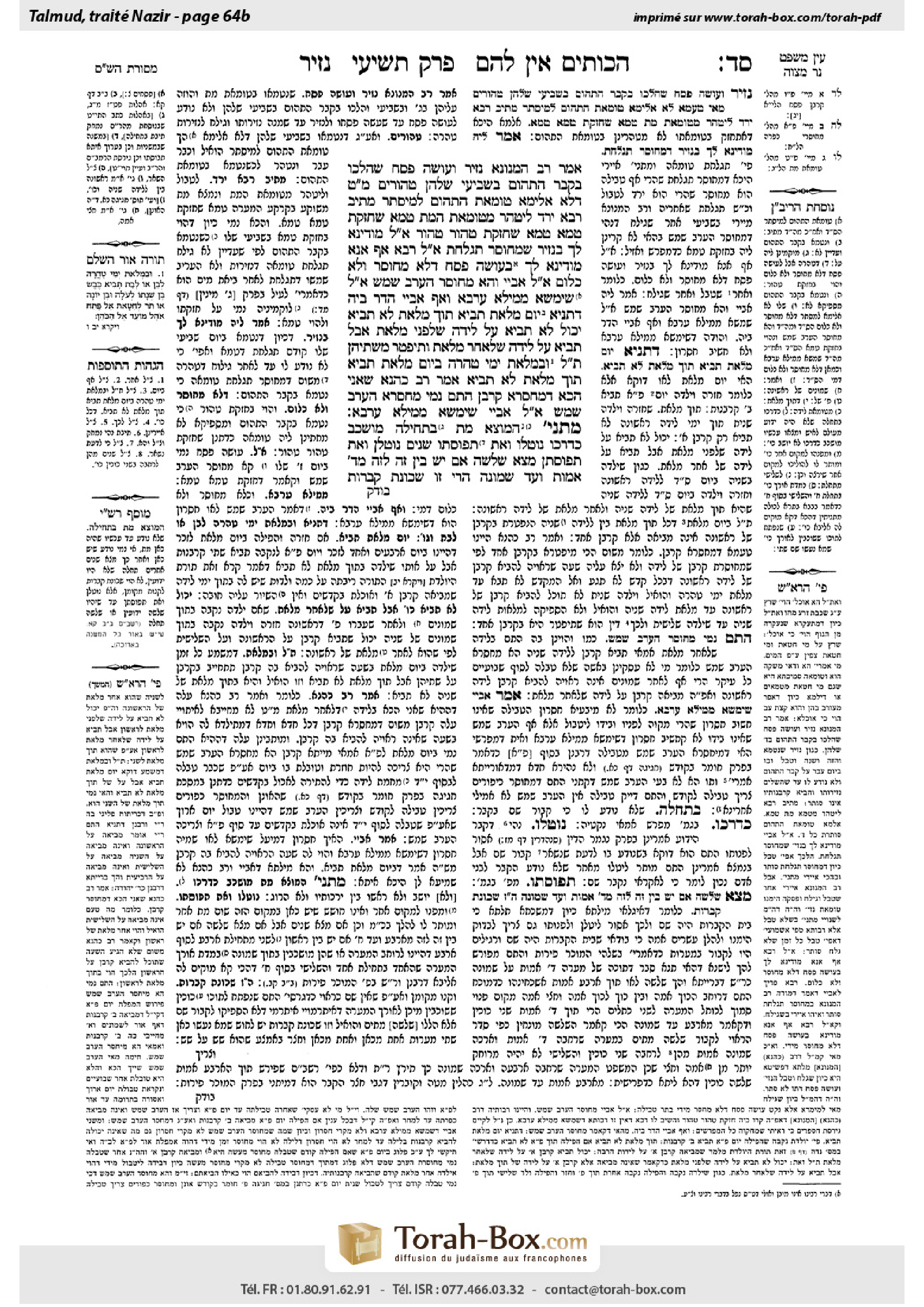
Nazir 64b: Talmud study for Daf Yomi
Daf Yomi is the daily study of one Talmud folio. Explore 37 tractates with scans, Hebrew text, Sefaria English and AI-generated French translations where annotated.
Passage selection and English or AI-generated French translation are available where the scan has annotations. Daf Study is independent of Torah-Box and Sefaria.
Browse Nazir · נזיר · All tractatesNazir 64b text and translations
This page of Nazir includes the Aramaic text, an English translation and an AI-generated French translation, alongside the scan above.
נזיר ס״ד ב · Aramaic and Hebrew text
אָמַר רַב הַמְנוּנָא: נָזִיר וְעוֹשֵׂה פֶסַח שֶׁהָלְכוּ בְּקֶבֶר הַתְּהוֹם בַּשְּׁבִיעִי שֶׁלָּהֶן — טְהוֹרִים. מַאי טַעְמָא — דְּלָא אַלִּימָא טוּמְאַת הַתְּהוֹם לְמִיסְתַּר.
מֵתִיב רָבָא: יָרַד לִיטָּהֵר מִטּוּמְאַת הַמֵּת — טָמֵא, שֶׁחֶזְקַת טָמֵא — טָמֵא, שֶׁחֶזְקַת טָהוֹר — טָהוֹר.
אֲמַר לֵיהּ: מוֹדֵינָא לָךְ בְּנָזִיר, שֶׁמְחוּסָּר תִּגְלַחַת.
אֲמַר לֵיהּ רָבָא: אַף אֲנָא מוֹדֵינָא לָךְ בְּעוֹשֵׂה פֶסַח, דְּלָא מְחוּסָּר וְלָא כְלוּם. אֲמַר לֵיהּ אַבָּיֵי: וְהָא מְחוּסָּר הֶעֱרֵב שֶׁמֶשׁ! אֲמַר לֵיהּ: שִׁימְשָׁא מִמֵּילָא עָרְבָא.
וְאַף אַבָּיֵי הֲדַר בֵּיהּ. דְּתַנְיָא:
יוֹם מְלֹאת — תָּבִיא. תּוֹךְ מְלֹאת — לֹא תָּבִיא.
יָכוֹל לֹא תָּבִיא עַל לֵידָה שֶׁלִּפְנֵי מְלֹאת, אֲבָל תָּבִיא עַל לֵידָה שֶׁלְּאַחַר מְלֹאת, וְתִיפָּטֵר מִשְּׁתֵּיהֶן —
תַּלְמוּד לוֹמַר: ״וּבִמְלֹאת יְמֵי טׇהֳרָה״. בְּיוֹם מְלֹאת — תָּבִיא, תּוֹךְ מְלֹאת — לֹא תָּבִיא.
אָמַר רַב כָּהֲנָא: שָׁאנֵי הָכָא, דִּמְחַסְּרָא קׇרְבָּן. הָתָם נָמֵי, מְחַסְּרָא הֶעֱרֵב שֶׁמֶשׁ!
אֲמַר לֵיהּ אַבָּיֵי: שִׁימְשָׁא מִמֵּילָא עָרְבָא.
מַתְנִי׳ הַמּוֹצֵא מֵת בַּתְּחִילָּה, מוּשְׁכָּב כְּדַרְכּוֹ — נוֹטְלוֹ וְאֶת תְּפוּסָתוֹ.
שְׁנַיִם — נוֹטְלָן וְאֶת תְּפוּסָתָן. מָצָא שְׁלֹשָׁה, אִם יֵשׁ בֵּין זֶה לָזֶה מֵאַרְבַּע אַמּוֹת וְעַד שְׁמוֹנֶה — הֲרֵי זוֹ שְׁכוּנַת קְבָרוֹת.
Nazir 64b · English translation
Rav Hamnuna says: In the case of a nazirite and one performing the ritual of the Paschal offering who walked by a grave in the depths, i.e., an unknown grave, on their seventh day of their purification, i.e., seven days after they were sprinkled with the purification waters after having contracted ritual impurity imparted by a corpse, they are pure. If the nazirite shaved for his impurity and completed his naziriteship in purity or if the one performing the ritual of the Paschal offering sacrificed his offering, then when he eventually discovers the impurity, it is considered as though he were pure all along. What is the reason for this lenient ruling? It is because the ritual impurity imparted by a grave in the depths is not strong enough to negate their actions, i.e., the nazirite offerings or the Paschal offering.
Rava raised an objection to this ruling from the statement of the mishna that if there is one whose impurity imparted by a grave in the depths is uncertain and he descended to purify himself from the ritual impurity imparted by a corpse, he is impure, as a person or item that has the presumptive status of impurity remains impure, and one that has the presumptive status of purity remains pure. Here too, the nazirite and the one performing the ritual of the Paschal offering had not completed their purification at the time, as the seventh day following their being sprinkled had not ended. As their presumptive status is impure, they are retroactively rendered impure, even by an impurity of the depths.
Rav Hamnuna said to Rava: I agree with you with regard to a nazirite who descended to purify himself and who is lacking the act of shaving. He has yet to shave his head for his impurity and is therefore not completely pure. Consequently, he follows his prior presumptive status of impurity.
Rava said to him: I, too, agree with you with regard to one performing the ritual of the Paschal offering that he is pure, as he is not lacking anything. Since he does not have to perform any action on his body before he can bring an offering, one can say that he already has a presumptive status of purity on the seventh day. Abaye said to him: But he is still lacking sunset, i.e., he is not fully pure until the sun sets on the seventh day. Rava said to Abaye: The sun sets by itself, and therefore this cannot be seen as a deficiency involving an action.
The Gemara comments: And even Abaye accepted Rava’s answer and retracted, as can be seen from that which is taught in a baraita. By Torah law, a woman who gives birth to a boy is ritually impure for seven days, and a woman who gives birth to a girl is impure for fourteen days. At that point, the woman immerses in a ritual bath and is purified. Any blood that emerges from the woman during her days of purity, i.e., for forty days following the birth of a male and eighty days following the birth of a female, does not render her impure. She cannot bring the offering brought by a woman who has given birth or miscarried until she has immersed at the end of these days (see Leviticus, chapter 12). The baraita discusses a case where a woman who had given birth became pregnant and miscarried before she had brought her offering for the first birth.
The baraita teaches: If a woman miscarried on the day of the fulfillment of her purity, on the eighty-first day after a female, she must bring a separate offering for the miscarried fetus, as she was obligated to bring one offering before her miscarriage. If she miscarried during the fulfillment, i.e., before the conclusion of the eighty days for the birth of a daughter, she does not bring two offerings but only one, just as is the halakha in the case of one who gives birth to twins.
The baraita continues: One might have thought that she should not bring an offering for her childbirth, i.e., miscarriage, that occurred before the fulfillment of the days of her purity but she should bring for her childbirth that occurred after its completion. In other words, if she had yet another miscarriage, after the days of her purity for her initial birth but within the eighty days of purity following her first miscarriage, she should bring an extra offering and thereby discharge both obligations, of her birth and her final miscarriage.
Therefore, to counteract this possibility, the verse states: “And when the days of her purity are fulfilled…she shall bring” (Leviticus 12:6). This teaches that it is only if she miscarried on the day of the fulfillment itself that she must bring an offering for a miscarriage, but if she miscarried before the fulfillment of the days of her purity of the earlier miscarriage, even if this occurred more than eighty days after the first birth, she does not bring another offering.
Rav Kahana said in explanation: Here it is different. The reason why she does not bring an offering for a miscarriage during her days of purity is that she lacks the possibility of bringing her offering. Since she cannot bring her offering until the end of her term of purity, she cannot incur another obligation during this period, no matter how many births occur within eighty days of the previous one. However, this leads Rav Kahana to ask: There too, if she had a miscarriage on the day of the completion of her term, she cannot bring her offering either, as she lacks sunset. Why, then, must she bring an additional offering?
Abaye said to Rav Kahana: The sun sets by itself and is not considered a deficiency with regard to her purity. This discussion shows that Abaye accepted Rava’s reasoning, as he submitted the same argument himself in a different context.
MISHNA: One who finds a corpse for the first time, i.e., he discovers a single corpse in a place that was not previously established as a cemetery, if the corpse is lying in the usual manner of Jewish burial, he removes it from there and also its surrounding earth. It is assumed that this corpse was buried there alone. There is no concern that this area is a cemetery and therefore the corpse may not be moved, nor does one take into account the possibility that another corpse may be buried in the vicinity.
Similarly, if he found two corpses, he removes them and their surrounding earth. In a case where he found three corpses, if there is a space between this corpse and that corpse of four to eight cubits, in a standard design, this is a graveyard. There is a concern that this might be an ancient cemetery.
Nazir 64b · Traduction française (IA)
Rav Hamnouna dit : Dans le cas d’un nazir et d’une personne qui accomplit le rituel de l’offrande pascale, s’ils sont passés près d’une tombe dans les profondeurs, c’est-à-dire une tombe inconnue, le septième jour de leur purification — soit sept jours après avoir reçu l’aspersion des eaux de purification à la suite d’une impureté rituelle contractée au contact d’un cadavre —, ils sont purs. Si le nazir s’est rasé en raison de son impureté et a achevé son naziréat en état de pureté, ou si la personne accomplissant le rituel de l’offrande pascale a sacrifié son offrande, alors, lorsqu’elle découvre finalement l’impureté, c’est comme si elle avait toujours été pure. Quelle est la raison de cette décision indulgente ? C’est que l’impureté rituelle provenant d’une tombe dans les profondeurs n’est pas assez forte pour annuler leurs actes, c’est-à-dire les sacrifices du nazir ou l’offrande pascale.
Rava soulève une objection à cette décision à partir de l’énoncé de la Michna : si quelqu’un dont l’impureté provenant d’une tombe dans les profondeurs est incertaine est descendu pour se purifier de l’impureté rituelle contractée au contact d’un cadavre, il est impur, car une personne ou un objet ayant un statut présomptif d’impureté demeure impur, et celui qui a un statut présomptif de pureté demeure pur. Ici aussi, le nazir et la personne accomplissant le rituel de l’offrande pascale n’avaient pas encore achevé leur purification, puisque le septième jour suivant l’aspersion n’était pas terminé. Leur statut présomptif étant impur, ils sont donc rétroactivement déclarés impurs, même en raison d’une impureté des profondeurs.
Rav Hamnouna dit à Rava : Je suis d’accord avec toi au sujet d’un nazir qui est descendu pour se purifier et à qui il manque encore l’acte du rasage. Il ne s’est pas encore rasé la tête en raison de son impureté et n’est donc pas complètement pur. Par conséquent, son statut présomptif antérieur d’impureté prévaut.
Rava lui dit : Moi aussi, je suis d’accord avec toi au sujet de la personne qui accomplit le rituel de l’offrande pascale : elle est pure, car il ne lui manque rien. Puisqu’elle n’a aucune action à accomplir sur son corps avant de pouvoir apporter une offrande, on peut dire qu’elle a déjà un statut présomptif de pureté le septième jour. Abayé lui dit : Mais il lui manque encore le coucher du soleil, c’est-à-dire qu’elle n’est pleinement pure qu’au coucher du soleil du septième jour. Rava dit à Abayé : Le soleil se couche de lui-même ; cela ne peut donc pas être considéré comme une lacune nécessitant une action.
La Guemara fait remarquer : Abayé aussi accepta la réponse de Rava et se rétracta, comme le montre une baraïta qui enseigne ce qui suit. Selon la Torah écrite, une femme qui donne naissance à un garçon est rituellement impure pendant sept jours, et une femme qui donne naissance à une fille est impure pendant quatorze jours. À ce moment-là, la femme s’immerge dans un bain rituel et est purifiée. Tout sang qui s’écoule de la femme pendant ses jours de pureté — soit pendant les quarante jours suivant la naissance d’un garçon et les quatre-vingts jours suivant celle d’une fille — ne la rend pas impure. Elle ne peut apporter le sacrifice d’une femme qui a accouché ou fait une fausse couche qu’après s’être immergée à la fin de ces jours (voir Lévitique, chapitre 12). La baraïta traite du cas d’une femme qui, après avoir accouché, est tombée enceinte et a fait une fausse couche avant d’avoir apporté son sacrifice pour la première naissance.
La baraïta enseigne : Si une femme fait une fausse couche le jour où s’achèvent ses jours de pureté, soit le quatre-vingt-unième jour après la naissance d’une fille, elle doit apporter un sacrifice distinct pour le fœtus avorté, car elle était tenue d’apporter un sacrifice avant sa fausse couche. Si elle fait une fausse couche pendant cette période, c’est-à-dire avant la fin des quatre-vingts jours suivant la naissance d’une fille, elle n’apporte pas deux sacrifices, mais un seul, conformément à la halakha applicable à celle qui donne naissance à des jumeaux.
La baraïta poursuit : On aurait pu penser qu’elle ne doit pas apporter de sacrifice pour l’accouchement — c’est-à-dire la fausse couche — survenu avant l’achèvement de ses jours de pureté, mais qu’elle doit en apporter un pour l’accouchement survenu après leur achèvement. Autrement dit, si elle faisait encore une fausse couche après ses jours de pureté suivant sa première naissance, mais avant la fin des quatre-vingts jours de pureté qui suivent sa première fausse couche, elle devrait apporter un sacrifice supplémentaire et s’acquitter ainsi de ses deux obligations, celle liée à sa naissance et celle liée à sa dernière fausse couche.
Par conséquent, pour écarter cette possibilité, le verset dit : « Et lorsque les jours de sa pureté seront accomplis… elle apportera » (Lévitique 12,6). Cela enseigne que c’est uniquement si elle fait une fausse couche le jour même où ses jours de pureté s’achèvent qu’elle doit apporter un sacrifice pour cette fausse couche ; mais si elle fait une fausse couche avant l’achèvement des jours de pureté liés à la fausse couche précédente, même si cela survient plus de quatre-vingts jours après la première naissance, elle n’apporte pas un autre sacrifice.
Rav Kahana explique : Ici, le cas est différent. La raison pour laquelle elle n’apporte pas de sacrifice pour une fausse couche pendant ses jours de pureté est qu’elle n’a pas la possibilité d’apporter son sacrifice. Puisqu’elle ne peut l’apporter qu’à la fin de sa période de pureté, elle ne peut contracter une nouvelle obligation pendant cette période, quel que soit le nombre de naissances survenant au cours des quatre-vingts jours qui suivent la précédente. Toutefois, cela amène Rav Kahana à demander : Là aussi, si elle faisait une fausse couche le jour où sa période s’achève, elle ne peut pas non plus apporter son sacrifice, car il lui manque le coucher du soleil. Pourquoi doit-elle alors apporter un sacrifice supplémentaire ?
Abayé dit à Rav Kahana : Le soleil se couche de lui-même et cela n’est pas considéré comme une lacune concernant sa pureté. Cette discussion montre qu’Abayé a accepté le raisonnement de Rava, puisqu’il a lui-même présenté le même argument dans un autre contexte.
MICHNA : Celui qui trouve un cadavre pour la première fois, c’est-à-dire qui découvre un seul cadavre dans un endroit qui n’avait pas été préalablement reconnu comme un cimetière, l’enlève avec la terre qui l’entoure si le cadavre repose selon les usages habituels de l’inhumation juive. On suppose que ce cadavre y a été enterré seul. On ne craint pas que cet endroit soit un cimetière, auquel cas le cadavre ne pourrait pas être déplacé ; on ne tient pas non plus compte de la possibilité qu’un autre cadavre soit enterré à proximité.
De même, s’il trouve deux cadavres, il les enlève avec la terre qui les entoure. S’il en trouve trois, et qu’il y a entre l’un et l’autre un espace de quatre à huit coudées, selon un agencement standard, il s’agit d’un cimetière. Il y a lieu de craindre qu’il s’agisse d’un ancien cimetière.
Traduction française générée par IA à partir de l’édition anglaise de Sefaria. Vérifie toujours un passage avec le texte source.
Text from Sefaria: William Davidson Edition - Vocalized Aramaic (CC BY NC); William Davidson Edition - English (CC BY NC).