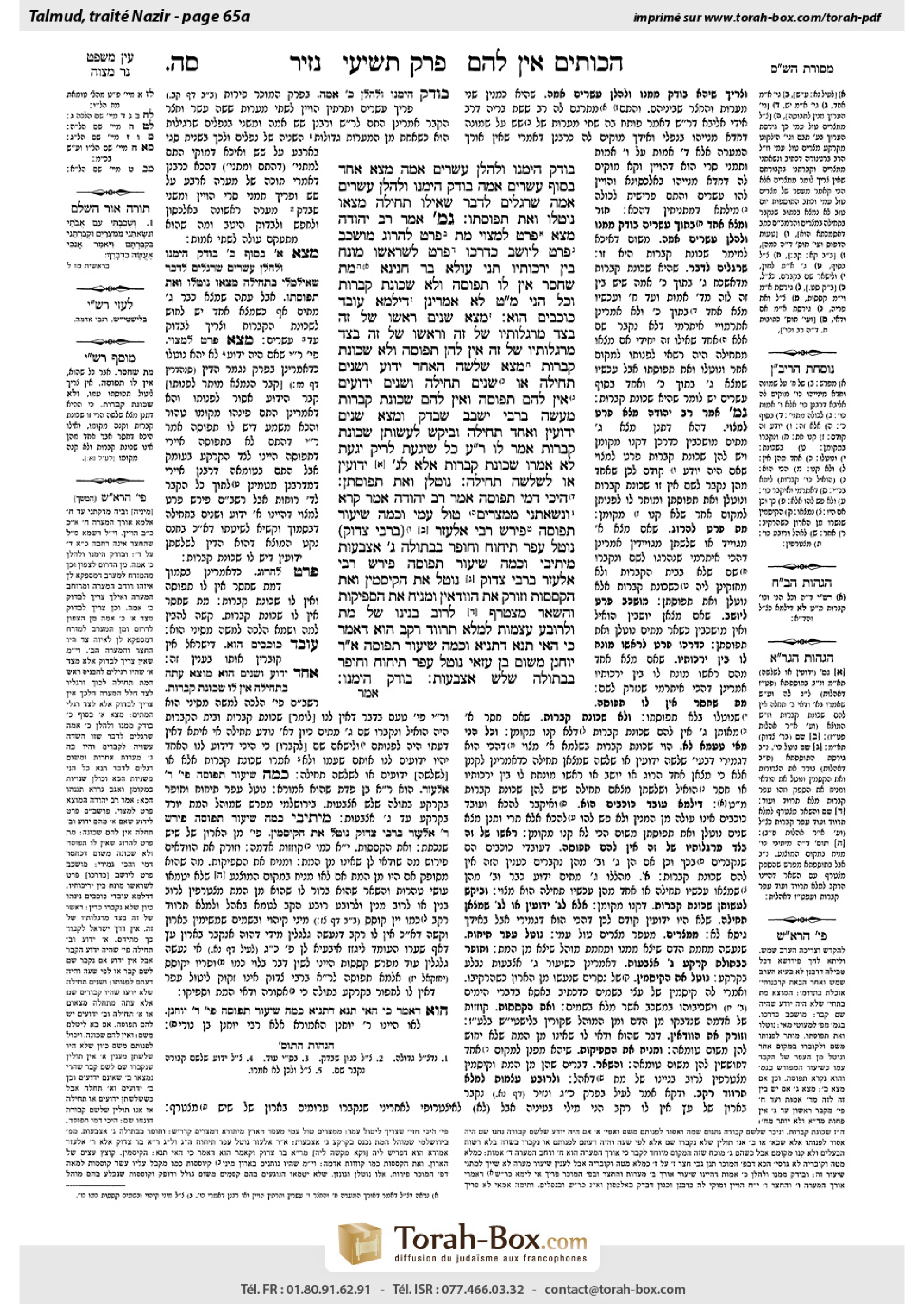
Nazir 65a: Talmud study for Daf Yomi
Daf Yomi is the daily study of one Talmud folio. Explore 37 tractates with scans, Hebrew text, Sefaria English and AI-generated French translations where annotated.
Passage selection and English or AI-generated French translation are available where the scan has annotations. Daf Study is independent of Torah-Box and Sefaria.
Browse Nazir · נזיר · All tractatesNazir 65a text and translations
This page of Nazir includes the Aramaic text, an English translation and an AI-generated French translation, alongside the scan above.
נזיר ס״ה א · Aramaic and Hebrew text
בּוֹדֵק הֵימֶנּוּ וּלְהַלָּן עֶשְׂרִים אַמָּה, מָצָא אֶחָד בְּסוֹף עֶשְׂרִים אַמָּה — בּוֹדֵק הֵימֶנּוּ וּלְהַלָּן עֶשְׂרִים אַמָּה. שֶׁרַגְלַיִם לַדָּבָר. שֶׁאִילּוּ תְּחִילָּה מְצָאוֹ — נוֹטְלוֹ וְאֶת תְּפוּסָתוֹ.
גְּמָ׳ אָמַר רַב יְהוּדָה: מָצָא — פְּרָט לְמָצוּי. מֵת — פְּרָט לְהָרוּג. מוּשְׁכָּב — פְּרָט לְיוֹשֵׁב. כְּדַרְכּוֹ — פְּרָט לְשֶׁרֹאשׁוֹ מוּנָּח בֵּין יַרְכוֹתָיו.
תָּנֵי עוּלָּא בַּר חֲנִינָא: מֵת שֶׁחָסַר, אֵין לוֹ תְּפוּסָה וְלֹא שְׁכוּנַת קְבָרוֹת. וְכׇל הָנֵי מַאי טַעְמָא לָא? אָמְרִינַן דִּילְמָא גּוֹי הוּא.
מָצָא שְׁנַיִם, רֹאשׁוֹ שֶׁל זֶה בְּצַד מַרְגְּלוֹתָיו שֶׁל זֶה, וְרֹאשׁוֹ שֶׁל זֶה בְּצַד מַרְגְּלוֹתָיו שֶׁל זֶה — אֵין לָהֶן תְּפוּסָה וְלֹא שְׁכוּנַת קְבָרוֹת. מָצָא שְׁלֹשָׁה, הָאֶחָד יָדוּעַ וּשְׁנַיִם תְּחִילָּה, אוֹ שְׁנַיִם תְּחִילָּה וּשְׁנַיִם יְדוּעִים — אֵין לָהֶם תְּפוּסָה, וְאֵין לָהֶם שְׁכוּנַת קְבָרוֹת.
מַעֲשֶׂה בְּרַבִּי יְשֵׁבָב שֶׁבָּדַק וּמָצָא שְׁנַיִם יְדוּעִין וְאֶחָד תְּחִילָּה, וּבִיקֵּשׁ לַעֲשׂוֹתָן שְׁכוּנַת קְבָרוֹת. אָמַר לוֹ רַבִּי עֲקִיבָא: כׇּל שֶׁיָּגַעְתָּ — לָרִיק יָגַעְתָּ. לֹא אָמְרוּ שְׁכוּנַת קְבָרוֹת אֶלָּא לִשְׁלֹשָׁה יְדוּעִין, אוֹ לִשְׁלֹשָׁה תְּחִילָּה.
נוֹטְלָן וְאֶת תְּפוּסָתָן. הֵיכִי דָּמֵי תְּפוּסָה? אָמַר רַב יְהוּדָה: אָמַר קְרָא ״וּנְשָׂאתַנִי מִמִּצְרַיִם״ — טוֹל עִמִּי.
וְכַמָּה שִׁיעוּר תְּפוּסָה? פֵּירֵשׁ רַבִּי אֶלְעָזָר (בְּרַבִּי צָדוֹק): נוֹטֵל עָפָר תִּיחוּחַ, וְחוֹפֵר בַּבְּתוּלָה שָׁלֹשׁ אֶצְבָּעוֹת.
מֵיתִיבִי: וְכַמָּה שִׁיעוּר תְּפוּסָה? פֵּירֵשׁ רַבִּי אֶלְעָזָר בְּרַבִּי צָדוֹק: נוֹטֵל אֶת הַקֵּיסָמִין וְאֶת הַקְּסָסוֹת.
וְזוֹרֵק אֶת הַוַּודָּאִין וּמַנִּיחַ אֶת הַסְּפֵיקוֹת. וְהַשְּׁאָר מִצְטָרֵף לְרוֹב בִּנְיָנוֹ שֶׁל מֵת, וּלְרוֹבַע עֲצָמוֹת, לִמְלֹא תַּרְווֹד רָקָב.
הוּא דְּאָמַר כִּי הַאי תַּנָּא, דְּתַנְיָא: וְכַמָּה שִׁיעוּר תְּפוּסָה? אָמַר רַבִּי יוֹחָנָן מִשּׁוּם בֶּן עַזַּאי: נוֹטֵל עָפָר תִּיחוּחַ, וְחוֹפֵר בַּבְּתוּלָה שָׁלֹשׁ אֶצְבָּעוֹת.
בּוֹדֵק הֵימֶנּוּ.
Nazir 65a · English translation
One must therefore examine from that spot outward for twenty cubits. If one finds another corpse at the end of twenty cubits, he examines from that spot outward twenty cubits, as there is a basis for anticipating the matter. It is likely that he has stumbled upon an ancient gravesite. He is not permitted to relocate the corpses, despite the fact that if he had found the single corpse by itself at first he could have removed it and its surrounding earth.
GEMARA: Rav Yehuda said the following inferences from the mishna: The phrase: He found, excludes a corpse that already had been found. If it was known that there was one corpse buried in a certain place, the discovery of two previously unknown corpses does not raise the concern that perhaps it is a forgotten graveyard. Similarly, the term corpse [met] excludes a killed [harug] person. Even if there were three corpses found, if there are signs that these people were killed, the area is not assumed to be a graveyard, as they may have been buried where they were found killed. Likewise, the term lying excludes a sitting person, as Jews were not generally buried in a seated position. The phrase: In the usual manner, excludes one whose head was placed between his thighs, as that is not the way Jews are buried.
Ulla bar Ḥanina taught a baraita (Tosefta, Oholot 16:2): A corpse that is lacking a part of his body indispensable to life has no halakha of surrounding earth, i.e., there is no need to remove the nearby earth along with the corpse. Nor does it have the halakha of a graveyard, i.e., it does not join with two other corpses to establish this site as a cemetery. The Gemara asks: And with regard to all these listed above, i.e., a corpse that was buried in a sitting position or with its head between its thighs, what is the reason that they are not considered part of a graveyard? The Gemara answers: We say that perhaps the deceased was a gentile, as Jews are not usually buried in these ways.
The baraita further states: If one found two corpses, with the head of this one by the feet of that one and the head of that one by the feet of this one, they do not have the halakha of surrounding earth, nor do they have the halakha of a graveyard. This is not the way Jews are buried, as corpses in a Jewish cemetery always face the same direction. If one found three corpses, one of which was previously known, while the other two were found for the first time now, or if one found two for the first time and two that were known, they do not have the halakha of surrounding earth, and they also do not have the halakha of a graveyard. One does not view these corpses as connected.
The baraita relates: An incident occurred involving Rabbi Yeshevav, who examined and found two known corpses and one corpse discovered for the first time, and he wished to deem the three corpses a graveyard. Rabbi Akiva said to him: All your toil is in vain. They said it is a graveyard only in a case of three known corpses buried in one spot or three corpses found for the first time. However, if some were known and others were discovered for the first time, one does not combine them.
§ The mishna taught that he removes them and their surrounding earth. The Gemara asks: What are the circumstances of surrounding earth? Rav Yehuda said: The verse states with regard to Jacob’s instruction to Joseph to transfer his remains to Eretz Yisrael: “You shall carry me out from Egypt” (Genesis 47:30), which indicates: Take some earth out from Egypt with me, i.e., take the earth that is near the corpse.
The Gemara further asks: And what is the measure of surrounding earth? Rabbi Elazar, son of Rabbi Tzadok, explained: One takes loose dirt from near the corpse, as it is assumed it has been loosened by the blood and moisture from the corpse, and digs virgin, uncultivated, ground to a depth of three fingerbreadths, in case this earth has absorbed the blood.
The Gemara raises an objection to this ruling from a different baraita: And what is the measure of surrounding earth? Rabbi Elazar, son of Rabbi Tzadok, explained: One takes wood chips found nearby, which might have been part of the coffin, and lumps of earth that might have absorbed the blood and moisture from a corpse.
And he discards that which is certainly not from the corpse, e.g., stones. And he sets aside the items with regard to which it is uncertain if they have a connection with the corpse. And the rest, i.e., anything that is apparently from the corpse, combine to reach the amount of the majority of the structure of a corpse, or of a quarter-kav of bones, or of a full ladle of dust from a corpse. The remains of a corpse impart ritual impurity in a tent only if they meet one of those three qualifications. Anything which is apparently the remains of the corpse is considered dust of a corpse with regard to this halakha. In any event, it is clear that this baraita presents a different definition of surrounding earth.
The Gemara answers: With regard to the first statement of Rabbi Elazar, it was he who said in accordance with the opinion of that tanna, ben Azzai, as it is taught in a baraita: And how much is the measure of surrounding earth? Rabbi Yoḥanan says in the name of ben Azzai: One takes loose earth and digs virgin ground to a depth of three fingerbreadths.
§ The mishna taught that one must examine the ground for up to twenty cubits from that spot where a corpse was found.
Nazir 65a · Traduction française (IA)
Il faut donc examiner le terrain à partir de cet endroit, sur une distance de vingt coudées. Si l’on trouve un autre cadavre au bout de vingt coudées, on examine le terrain à partir de cet endroit, sur une distance de vingt coudées, car il y a lieu de le présumer. Il est probable que l’on ait découvert un ancien cimetière. Il n’est pas permis de déplacer les cadavres, bien que, s’il avait trouvé le premier cadavre isolément, il aurait pu l’enlever avec la terre qui l’entoure.
GUEMARA : Rav Yehouda tire les déductions suivantes de la Michna. L’expression « il trouva » exclut un cadavre qui avait déjà été découvert. Si l’on savait qu’un cadavre était enterré en un certain endroit, la découverte de deux cadavres jusque-là inconnus ne fait pas craindre qu’il s’agisse d’un cimetière oublié. De même, le terme « cadavre » [met] exclut une personne tuée [harug]. Même si l’on a trouvé trois cadavres, s’il existe des signes indiquant que ces personnes ont été tuées, on ne présume pas qu’il s’agit d’un cimetière, car elles ont pu être enterrées là où elles ont été tuées. De même, le terme « couché » exclut une personne assise, car les Juifs n’étaient généralement pas enterrés en position assise. L’expression « selon la manière habituelle » exclut une personne dont la tête était placée entre les cuisses, car ce n’est pas ainsi que les Juifs sont enterrés.
Oulla bar Ḥanina enseigna une baraïta (Tosefta, Oholot 16:2) : Un cadavre auquel manque une partie du corps indispensable à la vie n’a pas le statut de dépouille entourée de terre, c’est-à-dire qu’il n’est pas nécessaire d’enlever la terre voisine avec le cadavre. Il n’a pas non plus le statut de cadavre faisant partie d’un cimetière, c’est-à-dire qu’il ne s’ajoute pas à deux autres cadavres pour établir que l’endroit est un cimetière. La Guemara demande : Et, pour tous les cas énumérés ci-dessus, c’est-à-dire un cadavre enterré en position assise ou avec la tête entre les cuisses, pourquoi ne sont-ils pas considérés comme faisant partie d’un cimetière ? La Guemara répond : On dit que le défunt était peut-être un non-Juif, car les Juifs ne sont généralement pas enterrés de cette manière.
La baraïta ajoute : Si l’on trouve deux cadavres, la tête de l’un près des pieds de l’autre et la tête de l’autre près des pieds du premier, ils n’ont pas le statut de dépouilles entourées de terre et ne sont pas non plus considérés comme faisant partie d’un cimetière. Ce n’est pas ainsi que les Juifs sont enterrés, car, dans un cimetière juif, les cadavres sont toujours orientés dans la même direction. Si l’on trouve trois cadavres, dont l’un était déjà connu tandis que les deux autres viennent d’être découverts pour la première fois, ou si l’on en trouve deux pour la première fois et deux qui étaient déjà connus, ils n’ont pas le statut de dépouilles entourées de terre et ne sont pas non plus considérés comme faisant partie d’un cimetière. On ne considère pas que ces cadavres sont liés entre eux.
La baraïta rapporte : Un incident eut lieu impliquant Rabbi Yeshevav, qui examina le terrain et trouva deux cadavres déjà connus ainsi qu’un cadavre découvert pour la première fois ; il voulut considérer les trois cadavres comme formant un cimetière. Rabbi Akiva lui dit : Tout ton travail est vain. On ne parle d’un cimetière que dans le cas de trois cadavres déjà connus, enterrés au même endroit, ou de trois cadavres découverts pour la première fois. En revanche, si certains étaient connus et que les autres viennent d’être découverts pour la première fois, on ne les regroupe pas.
§ La Michna enseignait qu’on les enlève avec la terre qui les entoure. La Guemara demande : Que désigne la terre qui les entoure ? Rav Yehouda dit : À propos de l’instruction de Jacob à Joseph de transférer ses restes en terre d’Israël, le verset dit : « Tu me feras sortir d’Égypte » (Genèse 47:30), ce qui indique : Fais sortir avec moi un peu de terre d’Égypte, c’est-à-dire emporte la terre qui se trouve près du cadavre.
La Guemara demande ensuite : Quelle quantité de terre faut-il prendre autour du cadavre ? Rabbi Elazar, fils de Rabbi Tzadok, explique : On prend la terre meuble qui se trouve près du cadavre, car on suppose qu’elle a été ameublie par le sang et l’humidité du cadavre, et l’on creuse dans le sol vierge, non cultivé, jusqu’à une profondeur de trois largeurs de doigt, au cas où cette terre aurait absorbé du sang.
La Guemara soulève une objection à cette décision à partir d’une autre baraïta : Quelle quantité de terre faut-il prendre autour du cadavre ? Rabbi Elazar, fils de Rabbi Tzadok, explique : On prend les copeaux de bois trouvés à proximité, qui ont pu faire partie du cercueil, ainsi que les mottes de terre qui ont pu absorber le sang et l’humidité d’un cadavre.
On écarte ce qui ne provient certainement pas du cadavre, par exemple les pierres, et l’on met de côté les éléments dont on ne sait pas s’ils ont un lien avec le cadavre. Quant au reste, c’est-à-dire tout ce qui semble provenir du cadavre, ces éléments s’additionnent jusqu’à atteindre la quantité correspondant à la majeure partie de la structure d’un cadavre, à un quart de kav d’ossements ou à une pleine louche de poussière provenant d’un cadavre. Les restes d’un cadavre ne transmettent l’impureté rituelle sous une tente que s’ils satisfont à l’une de ces trois conditions. Tout ce qui semble être un reste du cadavre est considéré comme de la poussière provenant d’un cadavre pour cette halakha. Quoi qu’il en soit, il est clair que cette baraïta donne une autre définition de la terre qui entoure le cadavre.
La Guemara répond : Pour sa première déclaration, Rabbi Elazar a suivi l’opinion de ce tanna, ben Azzai, comme il est enseigné dans une baraïta : Quelle quantité de terre faut-il prendre autour du cadavre ? Rabbi Yoḥanan dit au nom de ben Azzai : On prend la terre meuble et l’on creuse dans le sol vierge jusqu’à une profondeur de trois largeurs de doigt.
§ La Michna enseignait qu’il faut examiner le terrain jusqu’à une distance de vingt coudées à partir de l’endroit où l’on a trouvé un cadavre.
Traduction française générée par IA à partir de l’édition anglaise de Sefaria. Vérifie toujours un passage avec le texte source.
Text from Sefaria: William Davidson Edition - Vocalized Aramaic (CC BY NC); William Davidson Edition - English (CC BY NC).