Nazir 7a: Talmud study for Daf Yomi
Daf Yomi is the daily study of one Talmud folio. Explore 37 tractates with scans, Hebrew text, Sefaria English and AI-generated French translations where annotated.
Passage selection and English or AI-generated French translation are available where the scan has annotations. Daf Study is independent of Torah-Box and Sefaria.
Browse Nazir · נזיר · All tractatesNazir 7a text and translations
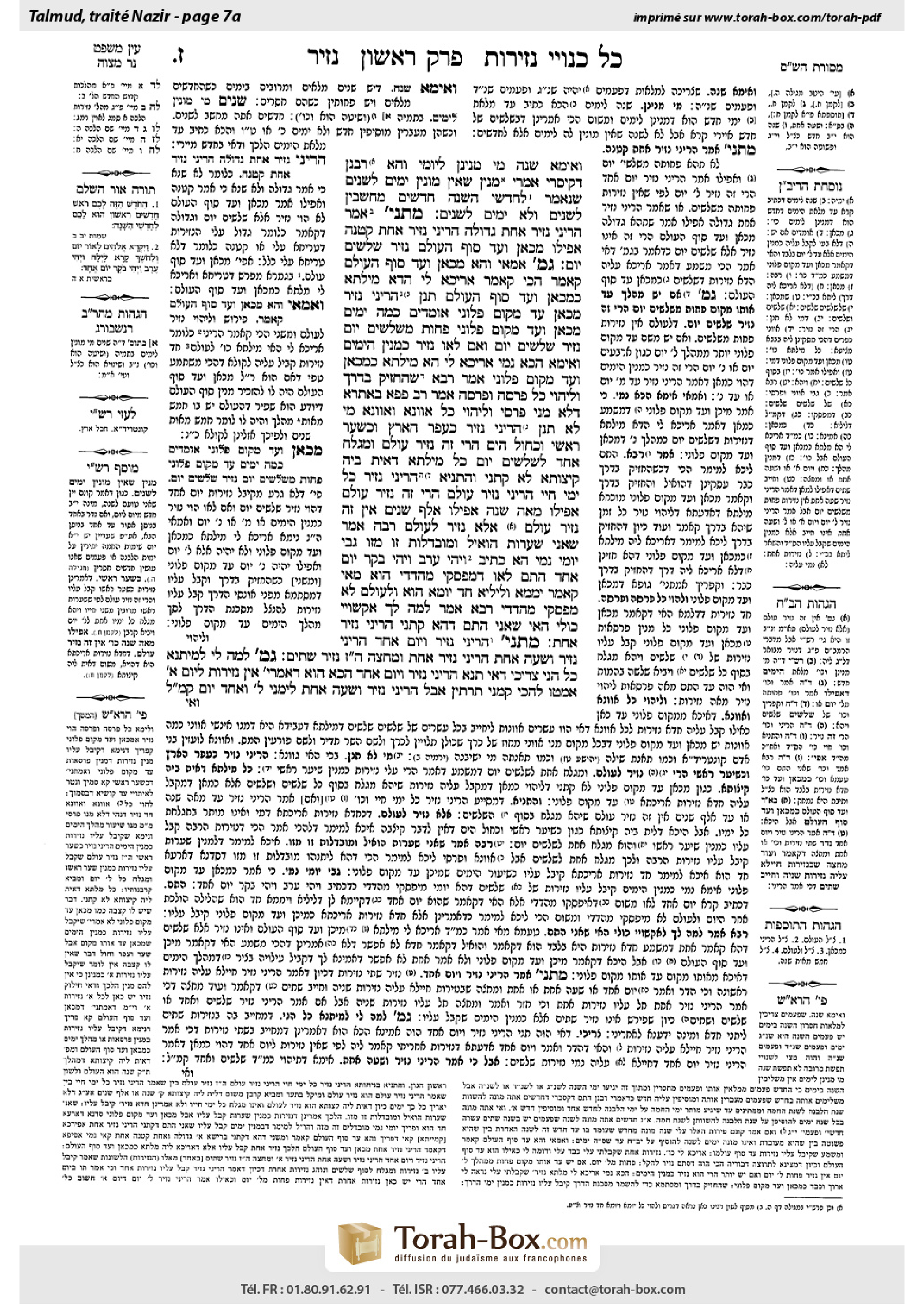
This page of Nazir includes the Aramaic text, an English translation and an AI-generated French translation, alongside the scan above.
נזיר ז׳ א · Aramaic and Hebrew text
וְאֵימָא שָׁנָה? מִי מָנֵינַן לְיוֹמֵי?! וְהָא רַבָּנַן דְּקֵיסָרִי אָמְרִי: מִנַּיִן שֶׁאֵין מוֹנִין יָמִים לְשָׁנִים — שֶׁנֶּאֱמַר: ״לְחׇדְשֵׁי הַשָּׁנָה״, חֳדָשִׁים מְחַשְּׁבִין לְשָׁנִים, וְלֹא יָמִים לְשָׁנִים.
מַתְנִי׳ אָמַר: ״הֲרֵינִי נָזִיר אַחַת גְּדוֹלָה״, ״הֲרֵינִי נָזִיר אַחַת קְטַנָּה״, אֲפִילּוּ: ״מִכָּאן וְעַד סוֹף הָעוֹלָם״ — נָזִיר שְׁלֹשִׁים יוֹם.
גְּמָ׳ אַמַּאי? וְהָא ״מִכָּאן וְעַד סוֹף הָעוֹלָם״ קָאָמַר! הָכִי קָאָמַר: אֲרִיכָא לִי הָדָא מִילְּתָא כְּמִכָּאן וְעַד סוֹף הָעוֹלָם.
תְּנַן: ״הֲרֵינִי נָזִיר מִכָּאן עַד מָקוֹם פְּלוֹנִי״ — אוֹמְדִים כַּמָּה יָמִים מִכָּאן וְעַד מָקוֹם פְּלוֹנִי, פָּחוֹת מִשְּׁלֹשִׁים יוֹם — נָזִיר שְׁלֹשִׁים יוֹם. וְאִם לָאו — נָזִיר כְּמִנְיַן הַיָּמִים. וְאֵימָא הָכָא נָמֵי: אֲרִיכָא לִי הָא מִילְּתָא כְּמִכָּאן וְעַד מָקוֹם פְּלוֹנִי!
אָמַר רָבָא: שֶׁהֶחְזִיק בַּדֶּרֶךְ. וְלִיהְוֵי כׇּל פַּרְסָה וּפַרְסָה! אָמַר רַב פָּפָּא: בְּאַתְרָא דְּלָא מָנֵי פַּרְסֵי.
וְלִיהְוֵי כׇּל אַוּוֹנָא וְאַוּוֹנָא! מִי לָא תְּנַן: ״הֲרֵינִי נָזִיר כַּעֲפַר הָאָרֶץ״, וְ״כִשְׂעַר רֹאשִׁי״, וּ״כְחוֹל הַיָּם״ — הֲרֵי זֶה נְזִיר עוֹלָם, וּמְגַלֵּחַ אֶחָד לִשְׁלשִׁים יוֹם?!
כׇּל מִילְּתָא דְּאִית בַּיהּ קִיצּוּתָא לָא קָתָנֵי.
וְהָתַנְיָא: ״הֲרֵינִי נָזִיר כׇּל יְמֵי חַיַּי״, ״הֲרֵינִי נְזִיר עוֹלָם״ — הֲרֵי זֶה נְזִיר עוֹלָם. אֲפִילּוּ מֵאָה שָׁנָה, אֲפִילּוּ אֶלֶף שָׁנִים — אֵין זֶה נְזִיר עוֹלָם, אֶלָּא נָזִיר לְעוֹלָם.
רַבָּה אָמַר: שָׁאנֵי שְׂעָרוֹת, הוֹאִיל וּמוּבְדָּלוֹת זוֹ מִזּוֹ.
גַּבֵּי יוֹמֵי נָמֵי, הָא כְּתִיב ״וַיְהִי עֶרֶב וַיְהִי בֹקֶר יוֹם אֶחָד״!
הָתָם לָאו דְּמִפַּסְקִי מֵהֲדָדֵי הוּא. מַאי קָאָמַר — יְמָמָא וְלֵילְיָא חַד יוֹמָא הוּא, וּלְעוֹלָם לָא מִפַּסְקִי מֵהֲדָדֵי.
רָבָא אָמַר: לְמָה לָךְ אַקְשׁוֹיֵי כּוּלֵּי הַאי, שָׁאנֵי הָתָם, דְּהָא קָתָנֵי ״הֲרֵינִי נָזִיר אַחַת״.
מַתְנִי׳ ״הֲרֵינִי נָזִיר וְיוֹם אֶחָד״, ״הֲרֵינִי נָזִיר וְשָׁעָה אַחַת״, ״הֲרֵינִי נָזִיר אַחַת וּמֶחֱצָה״ — הֲרֵי זֶה נָזִיר שְׁתַּיִם.
גְּמָ׳ לְמָה לִי לְמִיתְנָא כׇּל הָנֵי? צְרִיכִי, דְּאִי תְּנָא ״הֲרֵינִי נָזִיר וְיוֹם אֶחָד״, הָכָא הוּא דְּאָמְרִינַן: אֵין נְזִירוּת לְיוֹם אֶחָד, אַמְּטוּ לְהָכִי קָמָנֵי תַּרְתֵּין. אֲבָל ״הֲרֵינִי נָזִיר וְשָׁעָה אַחַת״ — לִימְנֵי שְׁלֹשִׁים וְאֶחָד יוֹם, קָא מַשְׁמַע לַן.
Nazir 7a · English translation
The Gemara asks further: But say it is referring to a year, which can also be full or lacking. The Gemara responds: Do we count years by days? Didn’t the Sages of Caesarea say: From where is it derived that one does not count days toward years, but that years are calculated according to months? As it is stated: “Of the months of the year” (Exodus 12:2). This teaches that months are calculated to comprise years, but days are not counted toward years. Therefore, only a month can be described as being completed by a particular day.
MISHNA: If one said: I am hereby a nazirite for one long term, or: I am hereby a nazirite for one short term, or even if one said: I am hereby a nazirite from now until the end of the world, in all these cases he is a nazirite for thirty days.
GEMARA: The mishna taught that even one who said: I am hereby a nazirite from now until the end of the world, becomes a nazirite for thirty days. The Gemara asks: Why does he become a nazirite for only thirty days? Didn’t he say: From now until the end of the world? The Gemara answers: This is what he is saying: Because of the difficulties it entails, it is as though this matter of naziriteship were as lengthy for me as the time from now until the end of the world.
The Gemara raises a difficulty: We learned in the mishna (8a): If one says: I am hereby a nazirite from here until such and such a place, one estimates how many days it takes to walk from here until such and such a place. If it is a distance of less than thirty days, he is a nazirite for thirty days, since this is the minimum term of naziriteship. And if not, i.e., if it takes more than thirty days to walk that distance, he is a nazirite in accordance with the number of days it takes to walk to that place. But here too, in that mishna, say that the individual intends to accept only a thirty-day term of naziriteship, and he means to say: This matter of naziriteship is as lengthy for me as the time it would take me to walk from here until such and such a place.
Rava said: That mishna is referring to one who had already set out on the way, so that it is apparent that his intention is to be a nazirite until he reaches his destination. The Gemara asks: Why is it assumed that he means to accept a single term of naziriteship that is the length of time it takes to travel to a certain destination? And let each and every parasang [parsa] be understood to refer to a separate term of naziriteship, such that the individual is understood to have accepted a separate term of naziriteship for each parasang that he must travel. Rav Pappa said: The mishna deals with a place where people do not measure distances in parasangs.
The Gemara asks further: And let each and every way station [avvana], where travelers lodge at night, be understood to refer to a separate term of naziriteship, such that the individual is understood to have accepted a separate term of naziriteship for each station that he passes along the way. Didn’t we learn in a mishna (8a): If one says: I am hereby a nazirite like the dust of the earth, or: Like the hair of my head, or: Like the sand of the sea, he is a nazirite forever, as it is understood that he accepted upon himself terms of naziriteship in accordance with the number of his hairs, or grains of dust, or sand, and he shaves once every thirty days?
The Gemara responds: Everything that has a fixed amount is not taught in this clause, which states that one is a nazirite forever. When one declares that he will be a nazirite for a length of time corresponding to an item that people consider infinite, e.g., the dust of the earth, his intention is not to define the length of a single term of naziriteship, as it is unknown how many grains of dust there are. However, when one mentions something that does have a fixed number, e.g., the number of days it takes to walk to a certain place, his intention is to define the length of a single term of naziriteship.
And similarly, it is taught in a baraita: If one says: I am hereby a nazirite all the days of my life, or: I am hereby a permanent nazirite, he is a permanent nazirite. However, if he said that he is a nazirite for a fixed period of time, even for one hundred years or even for one thousand years, he is not a permanent nazirite. Rather, he is a regular nazirite forever, since he will not live long enough to complete his term of naziriteship. This demonstrates that there is a difference between a naziriteship that lasts for a fixed time and a naziriteship that is unlimited.
Rabba said another reason for the distinction between one who accepts naziriteship based on the distance between places and one who accepts naziriteship based on the number of hairs on his head or the dust of the earth. Hairs are different, since they are separated from each other. Consequently, one who says: Like the hair of my head, is referring to distinct terms of naziriteship.
The Gemara asks: Also with regard to days, isn’t it written: “And there was evening and there was morning, one day” (Genesis 1:5), which indicates that each day is a separate unit? Consequently, one who vows to be a nazirite: From here until such and such a place, should be considered to have accepted upon himself distinct terms of naziriteship corresponding to the number of days it takes to travel to the designated destination.
The Gemara answers: The meaning of the verse there is not that days are separated from each other, because time is continuous. Rather, what it is saying is that the period of day and night is one calendar day, but actually days are not separate from each other.
The discussion above stemmed from the difficulty with the mishna’s case where one accepted naziriteship from now until the end of the world. Rava said: Why do you raise all these difficulties? It is different there, as it teaches that the individual said: I am hereby a nazirite for one long term. Since he specified that he is accepting one term of naziriteship, his statement is interpreted accordingly and is not interpreted as a reference to multiple terms of naziriteship.
MISHNA: If one said: I am hereby a nazirite and one day, or: I am hereby a nazirite and one hour, or: I am hereby a nazirite for one and a half, he becomes a nazirite for two consecutive terms of naziriteship. When he says: I am hereby a nazirite, he accepts upon himself one thirty-day term of naziriteship. When he subsequently adds an additional amount of time, e.g., an extra day, he thereby accepts upon himself an additional term of naziriteship, and the minimal term of naziriteship is thirty days.
GEMARA: The Gemara asks: Why do I need the mishna to teach all these cases rather than giving just one example of the mishna’s principle? The Gemara explains: All the cases are necessary, as, if the mishna had taught only the case where one said: I am hereby a nazirite and one day, one might have thought: It is here that we say that there is no naziriteship for one day, and therefore he must count two terms of naziriteship. However, if he said: I am hereby a nazirite and one hour, let him count thirty-one days. The mishna therefore teaches us that even in this latter case he must keep two terms of naziriteship.
Nazir 7a · Traduction française (IA)
La Guemara demande encore : Mais ne pourrait-on pas dire qu’il s’agit d’une année, qui peut elle aussi être complète ou incomplète ? La Guemara répond : Compte-t-on les années en jours ? Les Sages de Césarée n’ont-ils pas dit : D’où sait-on qu’on ne compte pas les jours pour les années, mais que les années se calculent en fonction des mois ? Comme il est dit : « Des mois de l’année » (Exode 12, 2). Cela enseigne que les mois sont pris en compte pour former les années, mais que les jours ne sont pas comptés pour les années. Par conséquent, seul un mois peut être décrit comme achevé à un jour précis.
MICHNA : Si quelqu’un dit : « Je suis naziréen pour une longue période », ou : « Je suis naziréen pour une courte période », ou même : « Je suis naziréen à partir de maintenant jusqu’à la fin du monde », dans tous ces cas, il est naziréen pendant trente jours.
GUEMARA : La Michna enseigne que même celui qui dit : « Je suis naziréen à partir de maintenant jusqu’à la fin du monde » devient naziréen pendant trente jours seulement. La Guemara demande : Pourquoi devient-il naziréen pendant trente jours seulement ? N’a-t-il pas dit : « À partir de maintenant jusqu’à la fin du monde » ? La Guemara répond : Voici ce qu’il veut dire : En raison des difficultés que cela implique, cette période de naziréat me semble aussi longue que le temps qui nous sépare de la fin du monde.
La Guemara soulève une difficulté : Nous avons appris dans la Michna (8a) : Si quelqu’un dit : « Je suis naziréen d’ici jusqu’à tel endroit », on estime le nombre de jours nécessaires pour aller d’ici jusqu’à cet endroit. Si la distance peut être parcourue en moins de trente jours, il est naziréen pendant trente jours, car c’est la durée minimale d’une période de naziréat. Sinon, c’est-à-dire si cette distance demande plus de trente jours de marche, il est naziréen pendant autant de jours qu’il en faut pour atteindre cet endroit. Mais ici aussi, dans cette Michna, ne pourrait-on pas dire que l’individu entend accepter une période de naziréat de trente jours seulement et veut dire : « Cette période de naziréat me semble aussi longue que le temps qu’il me faudrait pour aller d’ici jusqu’à tel endroit » ?
Rava a dit : Cette Michna concerne quelqu’un qui s’est déjà mis en route, de sorte qu’il est évident que son intention est d’être naziréen jusqu’à ce qu’il arrive à destination. La Guemara demande : Pourquoi suppose-t-on qu’il entend accepter une seule période de naziréat correspondant au temps nécessaire pour se rendre à une destination donnée ? Comprenons plutôt chaque parasange [parsa] comme une période distincte de naziréat, de sorte que l’on considère qu’il a accepté une période distincte pour chaque parasange qu’il doit parcourir. Rav Pappa a dit : La Michna traite d’un endroit où les gens ne mesurent pas les distances en parasanges.
La Guemara demande encore : Comprenons plutôt chaque étape [avvana], où les voyageurs passent la nuit, comme une période distincte de naziréat, de sorte que l’on considère qu’il a accepté une période distincte pour chaque étape qu’il franchit en chemin. N’avons-nous pas appris dans une Michna (8a) : Si quelqu’un dit : « Je suis naziréen comme la poussière de la terre », ou : « Comme les cheveux de ma tête », ou : « Comme le sable de la mer », il est naziréen pour toujours, car on comprend qu’il a accepté autant de périodes de naziréat qu’il y a de cheveux, de grains de poussière ou de grains de sable, et qu’il se rase une fois tous les trente jours ?
La Guemara répond : Tout ce qui a une quantité déterminée n’est pas enseigné dans cette clause, qui dit que l’on est naziréen pour toujours. Lorsqu’on déclare qu’on sera naziréen pendant une période correspondant à un élément que les gens considèrent comme infini, par exemple la poussière de la terre, on n’entend pas définir la durée d’une seule période de naziréat, puisqu’on ne sait pas combien il y a de grains de poussière. En revanche, lorsqu’on mentionne une chose dont le nombre est déterminé, par exemple le nombre de jours qu’il faut pour aller à un endroit donné, on entend définir la durée d’une seule période de naziréat.
Et de même, une baraïta enseigne : Si quelqu’un dit : « Je suis naziréen tous les jours de ma vie », ou : « Je suis naziréen de façon permanente », il est naziréen de façon permanente. Cependant, s’il dit qu’il est naziréen pour une période déterminée, même cent ans ou mille ans, il n’est pas naziréen de façon permanente. Il est plutôt un naziréen ordinaire pour toujours, puisqu’il ne vivra pas assez longtemps pour achever sa période de naziréat. Cela démontre qu’il y a une différence entre une période de naziréat d’une durée déterminée et une période de naziréat sans limite.
Rabba a donné une autre raison à la distinction entre celui qui accepte une période de naziréat en fonction de la distance entre deux endroits et celui qui l’accepte en fonction du nombre de cheveux sur sa tête ou de la poussière de la terre. Les cheveux sont différents, car ils sont séparés les uns des autres. Par conséquent, celui qui dit : « Comme les cheveux de ma tête » fait référence à des périodes distinctes de naziréat.
La Guemara demande : Les jours aussi, ne sont-ils pas évoqués dans le verset : « Il y eut un soir et il y eut un matin : un jour » (Genèse 1, 5), ce qui indique que chaque jour est une unité distincte ? Par conséquent, celui qui fait le vœu d’être naziréen « d’ici jusqu’à tel endroit » devrait être considéré comme ayant accepté des périodes distinctes de naziréat, correspondant au nombre de jours nécessaires pour se rendre à la destination désignée.
La Guemara répond : Le verset, là-bas, ne signifie pas que les jours sont séparés les uns des autres, car le temps est continu. Il signifie plutôt que la période de jour et de nuit constitue un jour calendaire ; en réalité, les jours ne sont pas séparés les uns des autres.
La discussion précédente découlait de la difficulté posée par le cas de la Michna où quelqu’un accepte une période de naziréat à partir de maintenant jusqu’à la fin du monde. Rava a dit : Pourquoi soulevez-vous toutes ces difficultés ? Ce cas est différent, car la Michna enseigne que l’individu a dit : « Je suis naziréen pour une longue période. » Puisqu’il a précisé qu’il acceptait une seule période de naziréat, sa déclaration est interprétée en conséquence et non comme une référence à plusieurs périodes de naziréat.
MICHNA : Si quelqu’un dit : « Je suis naziréen et un jour », ou : « Je suis naziréen et une heure », ou : « Je suis naziréen pour une période et demie », il devient naziréen pendant deux périodes consécutives de naziréat. Lorsqu’il dit : « Je suis naziréen », il accepte une période de naziréat de trente jours. Lorsqu’il ajoute ensuite une durée supplémentaire, par exemple un jour de plus, il accepte ainsi une période supplémentaire de naziréat, dont la durée minimale est de trente jours.
GUEMARA : La Guemara demande : Pourquoi la Michna doit-elle enseigner tous ces cas au lieu de donner un seul exemple de son principe ? La Guemara explique : Tous ces cas sont nécessaires, car si la Michna avait enseigné uniquement le cas où quelqu’un dit : « Je suis naziréen et un jour », on aurait pu penser que c’est seulement dans ce cas que l’on dit qu’il n’existe pas de période de naziréat d’un jour et qu’il doit donc compter deux périodes de naziréat. Mais s’il dit : « Je suis naziréen et une heure », qu’il compte trente et un jours. La Michna nous enseigne donc que même dans ce dernier cas, il doit observer deux périodes de naziréat.
Traduction française générée par IA à partir de l’édition anglaise de Sefaria. Vérifie toujours un passage avec le texte source.
Text from Sefaria: William Davidson Edition - Vocalized Aramaic (CC BY NC); William Davidson Edition - English (CC BY NC).