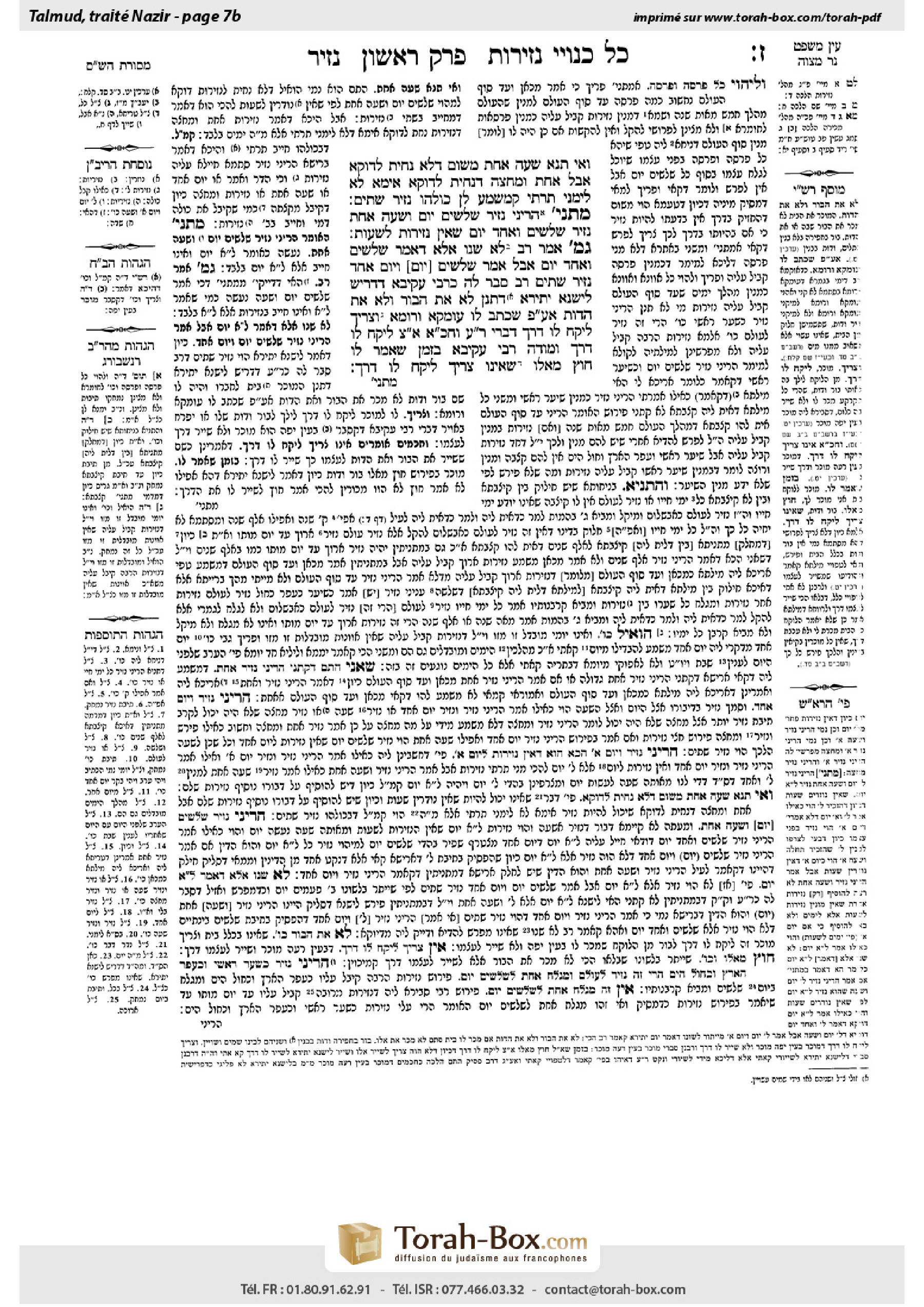
Nazir 7b: Talmud study for Daf Yomi
Daf Yomi is the daily study of one Talmud folio. Explore 37 tractates with scans, Hebrew text, Sefaria English and AI-generated French translations where annotated.
Passage selection and English or AI-generated French translation are available where the scan has annotations. Daf Study is independent of Torah-Box and Sefaria.
Browse Nazir · נזיר · All tractatesNazir 7b text and translations
This page of Nazir includes the Aramaic text, an English translation and an AI-generated French translation, alongside the scan above.
נזיר ז׳ ב · Aramaic and Hebrew text
וְאִי תְּנָא ״שָׁעָה אַחַת״, מִשּׁוּם דְּלָא נָחֵית לְדַוְקָא. אֲבָל אַחַת וּמֶחֱצָה, דְּנָחֵית לְדַוְקָא — אֵימָא לָא לִימְנֵי תַּרְתֵּי, קָמַשְׁמַע לַן כּוּלְּהוּ — נָזִיר שְׁתַּיִם.
מַתְנִי׳ ״הֲרֵינִי נָזִיר שְׁלֹשִׁים יוֹם וְשָׁעָה אַחַת״ — נָזִיר שְׁלֹשִׁים וְאֶחָד יוֹם, שֶׁאֵין נְזִירוּת לְשָׁעוֹת.
גְּמָ׳ אָמַר רַב: לֹא שָׁנוּ אֶלָּא דְּאָמַר ״שְׁלֹשִׁים וְאֶחָד יוֹם״, אֲבָל אָמַר ״שְׁלֹשִׁים [יוֹם] וְיוֹם אֶחָד״ — נָזִיר שְׁתַּיִם.
רַב סָבַר לַהּ כְּרַבִּי עֲקִיבָא, דְּדָרֵישׁ לִישָּׁנָא יַתִּירָא.
דִּתְנַן: לֹא אֶת הַבּוֹר וְלֹא אֶת הַדּוּת — אַף עַל פִּי שֶׁכָּתַב לוֹ עוּמְקָא וְרוּמָא. וְצָרִיךְ לִיקַּח לוֹ דֶּרֶךְ, דִּבְרֵי רַבִּי עֲקִיבָא.
וַחֲכָמִים אוֹמְרִים: אֵינוֹ צָרִיךְ לִיקַּח לוֹ דֶּרֶךְ. וּמוֹדֶה רַבִּי עֲקִיבָא בִּזְמַן שֶׁאָמַר לוֹ ״חוּץ מֵאֵלּוּ״ שֶׁאֵינוֹ צָרִיךְ לִיקַּח לוֹ דֶּרֶךְ.
Nazir 7b · English translation
And if the mishna taught only the case where one said: I am hereby a nazirite and one hour, one might have said that he is obligated in two periods of naziriteship because he did not go into specific detail [davka]. He merely stated that he accepts upon himself some part of a second term of naziriteship, and therefore he must observe a full second term of naziriteship. However, in the case of one who says he will be a nazirite for one and a half, where he does go into specific detail, one might say he should not have to count two full terms of naziriteship but rather forty-five days of naziriteship. The mishna therefore teaches us that in all these cases he is a nazirite for two full terms of naziriteship.
MISHNA: One who says: I am hereby a nazirite for thirty days and one hour, becomes a nazirite for thirty-one days, as there is no naziriteship for hours but only for full days.
GEMARA: Rav said: They taught that he is a nazirite for thirty-one days only when he said: Thirty-one days. But if he said: Thirty days and one day, he is a nazirite for two terms of naziriteship, since the thirty days are considered one term of naziriteship, and the additional day is the start of an additional term.
The Gemara comments: In this regard, Rav holds in accordance with the opinion of Rabbi Akiva, who derives meaning from superfluous language. Rabbi Akiva believes that if one uses unnecessary words, it is inferred that he intended to add something. In this case, since the individual said: Thirty days and one day, without combining them into one amount, he intended to accept an additional term of naziriteship.
As we learned in a mishna (Bava Batra 64a): According to Rabbi Akiva, if one sold his house to another without specification, he has sold neither the pit nor the cistern [dut] with it, although he wrote to him in the document of sale: With its depth and its height. This is because anything that is not part of the house, e.g., pits and cisterns, must be explicitly mentioned in the contract. And the seller must purchase a path through the property he sold along with the house in order to reach the pit or cistern that he kept for himself. This is the statement of Rabbi Akiva.
And the Rabbis say: He does not need to purchase a path, as it is assumed that just as he maintained his rights to the pit or cistern, he also maintained the right to walk through the rest of the property in order to access the pit or cistern. And Rabbi Akiva concedes that when he says to him in the document of sale: Apart from these, i.e., the pit and cistern, that he does not need to purchase a path. Rabbi Akiva’s reasoning is this: Since the seller unnecessarily stressed that the pit and cistern are not included in the sale, he must have intended to thereby reserve for himself the right of access. This proves that, according to Rabbi Akiva, if one adds a superfluous clause he must have had a specific meaning in mind, and something must be derived from his statement. Rav follows a similar line of reasoning with regard to the case of a nazirite.
Nazir 7b · Traduction française (IA)
Et si la Michna avait enseigné uniquement le cas où quelqu’un dit : « Me voici naziréen pour une heure de plus », on aurait pu penser qu’il est tenu d’observer deux périodes de naziréat parce qu’il n’a pas précisé [davka] sa formulation. Il a simplement déclaré qu’il acceptait sur lui une partie d’une deuxième période de naziréat ; il doit donc observer une deuxième période complète de naziréat. En revanche, dans le cas de quelqu’un qui dit qu’il sera naziréen pendant un an et demi, puisqu’il précise la durée, on aurait pu penser qu’il n’a pas à compter deux périodes complètes de naziréat, mais seulement quarante-cinq jours de naziréat. La Michna nous enseigne donc que, dans tous ces cas, il est naziréen pour deux périodes complètes de naziréat.
MICHNA : Celui qui dit : « Me voici naziréen pour trente jours et une heure » devient naziréen pour trente et un jours, car le naziréat ne se compte pas en heures, mais uniquement en journées entières.
GUEMARA : Rav dit : Ils ont enseigné qu’il est naziréen pour trente et un jours uniquement lorsqu’il a dit : « Trente et un jours ». Mais s’il a dit : « Trente jours et un jour », il est naziréen pour deux périodes de naziréat, puisque les trente jours sont considérés comme une période de naziréat et que le jour supplémentaire marque le début d’une période supplémentaire.
La Guemara fait remarquer : À cet égard, Rav suit l’opinion de Rabbi Akiva, qui attribue un sens aux mots superflus. Selon Rabbi Akiva, si quelqu’un emploie des mots inutiles, on en déduit qu’il avait l’intention d’ajouter quelque chose. Dans ce cas, puisque l’individu a dit : « Trente jours et un jour », sans les réunir en une seule durée, il entendait accepter une période supplémentaire de naziréat.
Comme nous l’avons appris dans une Michna (Bava Batra 64a) : Selon Rabbi Akiva, si quelqu’un vend sa maison à un autre sans précision, il ne lui a vendu ni la fosse ni la citerne [dut], même s’il a écrit dans l’acte de vente : « Avec sa profondeur et sa hauteur ». En effet, tout ce qui ne fait pas partie de la maison, par exemple les fosses et les citernes, doit être explicitement mentionné dans le contrat. Le vendeur doit alors acheter un droit de passage à travers le bien qu’il a vendu avec la maison, afin d’accéder à la fosse ou à la citerne qu’il s’est réservée. Telle est l’opinion de Rabbi Akiva.
Et les Sages disent : Il n’a pas besoin d’acheter un droit de passage, car on considère que, de même qu’il s’est réservé ses droits sur la fosse ou la citerne, il s’est également réservé le droit de traverser le reste du bien pour y accéder. Rabbi Akiva reconnaît que, lorsqu’il lui dit dans l’acte de vente : « À l’exception de ceux-ci », c’est-à-dire la fosse et la citerne, il n’a pas besoin d’acheter un droit de passage. Voici le raisonnement de Rabbi Akiva : puisque le vendeur a souligné inutilement que la fosse et la citerne ne faisaient pas partie de la vente, il faut qu’il ait voulu se réserver par là le droit d’accès. Cela prouve que, selon Rabbi Akiva, si quelqu’un ajoute une clause superflue, c’est qu’il avait une intention précise et qu’il faut tirer quelque chose de ses paroles. Rav suit un raisonnement semblable dans le cas du naziréen.
Traduction française générée par IA à partir de l’édition anglaise de Sefaria. Vérifie toujours un passage avec le texte source.
Text from Sefaria: William Davidson Edition - Vocalized Aramaic (CC BY NC); William Davidson Edition - English (CC BY NC).