Nazir 8a: Talmud study for Daf Yomi
Daf Yomi is the daily study of one Talmud folio. Explore 37 tractates with scans, Hebrew text, Sefaria English and AI-generated French translations where annotated.
Passage selection and English or AI-generated French translation are available where the scan has annotations. Daf Study is independent of Torah-Box and Sefaria.
Browse Nazir · נזיר · All tractatesNazir 8a text and translations
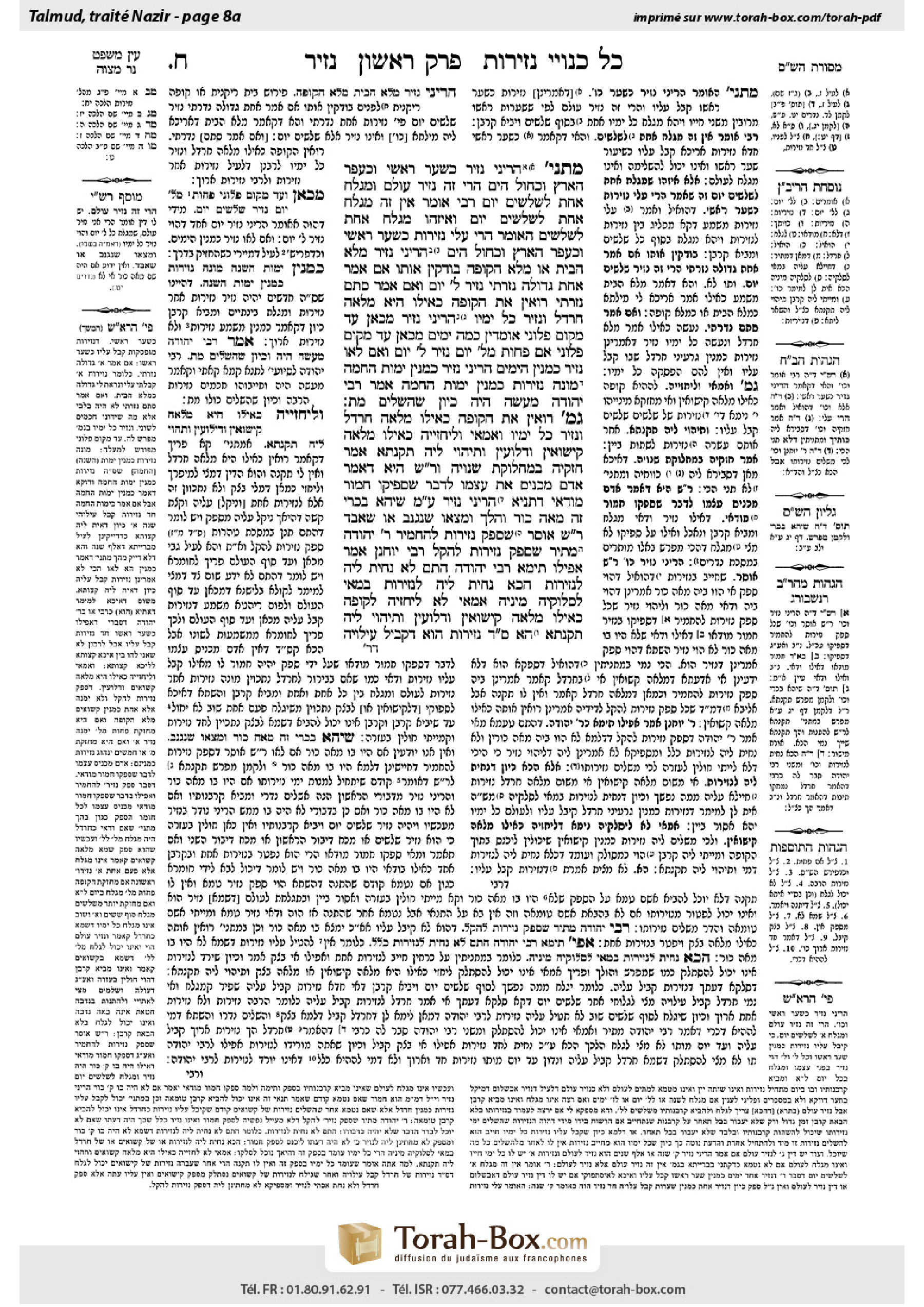
This page of Nazir includes the Aramaic text, an English translation and an AI-generated French translation, alongside the scan above.
נזיר ח׳ א · Aramaic and Hebrew text
מַתְנִי׳ ״הֲרֵינִי נָזִיר כִּשְׂעַר רֹאשִׁי״, וְ״כַעֲפַר הָאָרֶץ״, וּ״כְחוֹל הַיָּם״ — הֲרֵי זֶה נְזִיר עוֹלָם, וּמְגַלֵּחַ אַחַת לִשְׁלשִׁים יוֹם.
רַבִּי אוֹמֵר: אֵין זֶה מְגַלֵּחַ אַחַת לִשְׁלשִׁים יוֹם. וְאֵיזֶהוּ מְגַלֵּחַ אַחַת לִשְׁלשִׁים? הָאוֹמֵר: ״הֲרֵי עָלַי נְזִירוּת כִּשְׂעַר רֹאשִׁי״, וְ״כַעֲפַר הָאָרֶץ״, וּ״כְחוֹל הַיָּם״.
״הֲרֵינִי נָזִיר מְלֹא הַבַּיִת״, אוֹ ״מְלֹא הַקּוּפָּה״ — בּוֹדְקִין אוֹתוֹ, אִם אָמַר: אַחַת גְּדוֹלָה נָזַרְתִּי — נָזִיר שְׁלֹשִׁים יוֹם. וְאִם אָמַר: סְתָם נָזַרְתִּי — רוֹאִין אֶת הַקּוּפָּה כְּאִילּוּ הִיא מְלֵאָה חַרְדָּל, וְנָזִיר כׇּל יָמָיו.
״הֲרֵינִי נָזִיר מִכָּאן עַד מָקוֹם פְּלוֹנִי״ — אוֹמְדִין כַּמָּה יָמִים מִכָּאן עַד מָקוֹם פְּלוֹנִי, אִם פָּחוֹת מִשְּׁלֹשִׁים יוֹם — נָזִיר שְׁלֹשִׁים יוֹם. וְאִם לָאו — נָזִיר כְּמִנְיַן הַיָּמִים.
״הֲרֵינִי נָזִיר כְּמִנְיַן יְמוֹת הַחַמָּה״ — מוֹנֶה נְזִירוֹת כְּמִנְיַן יְמוֹת הַחַמָּה. אָמַר רַבִּי יְהוּדָה: מַעֲשֶׂה הָיָה, כֵּיוָן שֶׁהִשְׁלִים — מֵת.
גְּמָ׳ רוֹאִין אֶת הַקּוּפָּה כְּאִילּוּ מְלֵאָה חַרְדָּל וְנָזִיר כׇּל יָמָיו. וְאַמַּאי? וְלִיחְזְיַיהּ כְּאִילּוּ מְלֵאָה קִישּׁוּאִין וְדִלּוּעִין, וְתִיהְוֵי לֵיהּ תַּקַּנְתָּא!
אָמַר חִזְקִיָּה: בְּמַחֲלוֹקֶת שְׁנוּיָה. וְרַבִּי שִׁמְעוֹן הִיא, דְּאָמַר: אָדָם מַכְנִיס אֶת עַצְמוֹ לְדָבָר שֶׁסְּפֵיקוֹ חָמוּר מִוַּדַּאי.
דְּתַנְיָא: ״הֲרֵינִי נָזִיר עַל מְנָת שֶׁיְּהֵא בִּכְרִי זֶה מֵאָה כּוֹר״, וְהָלַךְ וּמְצָאוֹ שֶׁנִּגְנַב אוֹ שֶׁאָבַד — רַבִּי שִׁמְעוֹן אוֹסֵר, שֶׁסְּפֵק נְזִירוּת לְהַחְמִיר.
רַבִּי יְהוּדָה מַתִּיר, שֶׁסְּפֵק נְזִירוּת לְהָקֵל.
רַבִּי יוֹחָנָן אָמַר: אֲפִילּוּ תֵּימָא רַבִּי יְהוּדָה, הָתָם לָא נָחֵית לֵיהּ לִנְזִירוּת. הָכָא נָחֵית לֵיהּ לִנְזִירוּת, בְּמַאי לְסַלּוֹקֵיהּ מִינֵּיהּ?
אַמַּאי לָא? לִיחְזְיַהּ לְקוּפָּה כְּאִילּוּ מְלֵאָה קִישּׁוּאִין וְדִלּוּעִין, וְתִיהְוֵי לֵיהּ תַּקַּנְתָּא. הָא סָלְקָא דַּעְתִּין, נְזִירוּת הוּא דְּקַבֵּיל עִילָּוֵיהּ!
Nazir 8a · English translation
MISHNA: If one says: I am hereby a nazirite like the hair of my head, or: Like the dust of the earth, or: Like the sand of the sea, he is a nazirite forever. He has accepted a separate term of naziriteship for every hair or particle of dust or sand, which in practice means that he will be a nazirite forever. And he shaves his hair once every thirty days.
Rabbi Yehuda HaNasi says: This nazirite does not shave his hair once every thirty days, as he has accepted upon himself one long term of naziriteship lasting for as many days as there are hairs or particles of dust or sand. And who is the nazirite who shaves his hair once every thirty days? One who says: It is hereby incumbent upon me to observe naziriteships like the hair of my head, or: Like the dust of the earth, or: Like the sand of the sea. Since he used the plural term naziriteships, it is clear that he is accepting distinct terms of naziriteship.
If one says: I am hereby a nazirite in accordance with the capacity of the house, or: The capacity of the basket, one checks with him what he had in mind. If he said: My intention was to take a nazirite vow for one long term of naziriteship, he is a nazirite for only thirty days, in accordance with the ruling of the mishna that the words long or short are of no account when used in a nazirite vow (7a). And if he said: I took a nazirite vow without specification, it is assumed that he meant to accept upon himself terms of naziriteship corresponding to the number of items that fit into the basket, and the smallest items normally placed in baskets are used for this evaluation. Consequently, one views the basket as though it were full of mustard seeds, which are extremely small, and he is a nazirite for his entire life.
If one says: I am hereby a nazirite from here until such and such a place, one estimates how many days it takes to walk from here until such and such a place. If it is less than thirty days, he is a nazirite for thirty days, since this is the minimum term of naziriteship. And if not, i.e., if it takes more than thirty days to walk that distance, he is a nazirite in accordance with the number of days it takes to walk to that place.
If one says: I am hereby a nazirite in accordance with the number of days in a solar year, he counts 365 consecutive naziriteships, in accordance with the number of days in a solar year. Rabbi Yehuda said: There was an incident where someone took this vow and observed 365 consecutive terms of naziriteship. Once he completed all these terms of naziriteship, he died.
GEMARA: The mishna taught that if one said: I am hereby a nazirite in accordance with the capacity of the basket, and he did not specifically intend to accept one term of naziriteship, one views the basket as though it were full of mustard seeds, and he is a nazirite for his entire life. The Gemara asks: But why does one view the basket as though it were full of mustard seeds? Let us view it as though it were full of cucumbers or gourds, which are much larger. The basket would consequently hold fewer of them, and there would be a remedy for him, i.e., he would be able to complete his terms of naziriteship and resume living as a non-nazirite.
In response to this question, Ḥizkiyya said: This issue is taught as a dispute between tanna’im, and the mishna is in accordance with the opinion of Rabbi Shimon, who said: A person places himself in a state where the resulting uncertainty is more stringent than if there were certainty, i.e., an individual willingly accepts conditions that are ambiguous although this may cause him to have to keep more stringent halakhot if the uncertainty is not clarified.
This is as it is taught in a baraita: With regard to one who says: I am hereby a nazirite on the condition that this pile of grain will be found to contain at least one hundred kor, and he went to measure the pile and found that it was stolen or lost, making it impossible to determine whether it contained one hundred kor, Rabbi Shimon prohibits him to drink wine or cut his hair, as he holds that in a case of uncertain naziriteship one is required to act stringently. Similarly, in the case in the mishna, since it is not known whether one intended to accept naziriteship according to the number of mustard seeds in the basket or according to the number of gourds there, he must act stringently.
Conversely, Rabbi Yehuda permits him to drink wine or cut his hair, as he holds that in a case of uncertain naziriteship one is permitted to act leniently. The naziriteship does not take effect, since the pile might have contained less than one hundred kor.
Rabbi Yoḥanan said: You can even say that the mishna is in accordance with the opinion of Rabbi Yehuda because the cases in the mishna and in the baraita are not comparable. There, in the case discussed in the baraita, he does not necessarily even enter a state of naziriteship, as it is unclear whether the pile contained a kor of grain. Consequently, he retains his previous status and is not considered a nazirite. Conversely, in the case discussed here in the mishna, he certainly enters a state of naziriteship, since he undoubtedly vowed to be a nazirite for some period of time. Consequently, how is it possible to remove the state of naziriteship from him when it is uncertain when his terms end? Therefore, even Rabbi Yehuda would agree that he remains a nazirite indefinitely.
The Gemara asks: Why is it not possible to remove from him the status of naziriteship? Let us view the basket as though it were full of cucumbers or gourds, as he has accepted at least as many terms of naziriteship as the number of cucumbers or gourds that can fit in the basket, and in this way there will be a remedy for him. It entered our minds to say that it is distinct naziriteships that he accepted upon himself, and so once he has completed the minimal number of naziriteships, he should no longer be considered a nazirite unless it can be determined that he accepted more than this number of terms of naziriteship.
Nazir 8a · Traduction française (IA)
MICHNA : Si quelqu’un dit : « Me voici nazir comme les cheveux de ma tête », ou : « Comme la poussière de la terre », ou : « Comme le sable de la mer », il est nazir à vie. Il a accepté un terme distinct de naziréat pour chaque cheveu, chaque particule de poussière ou chaque grain de sable, ce qui signifie en pratique qu’il sera nazir à vie. Il se rase les cheveux une fois tous les trente jours.
Rabbi Yehouda HaNassi dit : Ce nazir ne se rase pas les cheveux une fois tous les trente jours, car il a accepté un seul long terme de naziréat, d’une durée égale au nombre de cheveux, de particules de poussière ou de grains de sable. Et quel est le nazir qui se rase les cheveux une fois tous les trente jours ? Celui qui dit : « Je m’engage à observer des périodes de naziréat aussi nombreuses que les cheveux de ma tête », ou : « Que les particules de poussière de la terre », ou : « Que les grains de sable de la mer ». Puisqu’il a employé le pluriel « périodes de naziréat », il est clair qu’il accepte des termes de naziréat distincts.
Si quelqu’un dit : « Me voici nazir selon la capacité de la maison », ou : « Selon celle du panier », on vérifie ce qu’il avait à l’esprit. S’il dit : « Mon intention était de prononcer un vœu de naziréat pour un seul long terme », il est nazir pour trente jours seulement, conformément à la règle de la Michna selon laquelle les mots « long » ou « court » n’ont aucune incidence lorsqu’ils sont employés dans un vœu de naziréat (7a). Et s’il dit : « J’ai prononcé un vœu de naziréat sans préciser », on considère qu’il entendait accepter des termes de naziréat correspondant au nombre d’objets pouvant tenir dans le panier ; pour cette évaluation, on retient les objets les plus petits qu’on y place habituellement. On considère donc le panier comme s’il était rempli de graines de moutarde, qui sont extrêmement petites, et il est nazir toute sa vie.
Si quelqu’un dit : « Me voici nazir d’ici jusqu’à tel endroit », on estime le nombre de jours nécessaires pour aller à pied d’ici jusqu’à cet endroit. Si le trajet prend moins de trente jours, il est nazir pendant trente jours, car c’est la durée minimale du naziréat. Sinon, c’est-à-dire s’il faut plus de trente jours pour parcourir cette distance à pied, il est nazir pendant le nombre de jours nécessaires pour se rendre à cet endroit.
Si quelqu’un dit : « Me voici nazir selon le nombre de jours d’une année solaire », il observe 365 termes consécutifs de naziréat, soit autant que de jours dans une année solaire. Rabbi Yehouda dit : Il arriva qu’un homme prononce ce vœu et observe 365 termes consécutifs de naziréat. Après avoir achevé tous ces termes de naziréat, il mourut.
GUEMARA : La Michna a enseigné que si quelqu’un dit : « Me voici nazir selon la capacité du panier », sans avoir expressément l’intention d’accepter un seul terme de naziréat, on considère le panier comme s’il était rempli de graines de moutarde, et il est nazir toute sa vie. La Guemara demande : Mais pourquoi le considérer comme s’il était rempli de graines de moutarde ? Considérons-le plutôt comme s’il était rempli de concombres ou de courges, qui sont beaucoup plus gros. Le panier en contiendrait donc moins, et il pourrait ainsi s’en sortir, c’est-à-dire achever ses termes de naziréat et reprendre une vie sans naziréat.
Pour répondre à cette question, Ḥizqiya dit : Cette question fait l’objet d’une controverse entre des tannaïm, et la Michna suit l’opinion de Rabbi Shimon, qui a dit : Une personne se place dans une situation où l’incertitude qui en résulte est plus contraignante que ne le serait une situation certaine ; autrement dit, un individu accepte délibérément des conditions ambiguës, même si cela peut l’obliger à observer des halakhot plus strictes lorsque l’incertitude n’est pas levée.
C’est ce qu’enseigne une baraïta : Celui qui dit : « Me voici nazir à condition que ce tas de grain contienne au moins cent kor », puis va mesurer le tas et constate qu’il a été volé ou perdu, de sorte qu’il est impossible de déterminer s’il contenait cent kor, Rabbi Shimon lui interdit de boire du vin ou de se couper les cheveux, car il considère qu’en cas de naziréat incertain, il faut agir avec rigueur. De même, dans le cas de la Michna, puisqu’on ne sait pas s’il entendait accepter des termes de naziréat selon le nombre de graines de moutarde contenues dans le panier ou selon le nombre de courges qu’il pouvait contenir, il doit agir avec rigueur.
À l’inverse, Rabbi Yehouda lui permet de boire du vin ou de se couper les cheveux, car il considère qu’en cas de naziréat incertain, il est permis d’agir avec indulgence. Le naziréat ne prend pas effet, puisque le tas pouvait contenir moins de cent kor.
Rabbi Yoḥanan dit : On peut même dire que la Michna suit l’opinion de Rabbi Yehouda, car les cas de la Michna et de la baraïta ne sont pas comparables. Dans le cas évoqué par la baraïta, il n’entre pas nécessairement dans un état de naziréat, puisqu’on ne sait pas si le tas contenait un kor de grain. Il conserve donc son statut antérieur et n’est pas considéré comme nazir. À l’inverse, dans le cas évoqué ici par la Michna, il entre certainement dans un état de naziréat, puisqu’il a sans aucun doute fait vœu d’être nazir pendant une certaine période. Dès lors, comment pourrait-on lui retirer son statut de nazir alors qu’on ne sait pas quand ses termes prennent fin ? Par conséquent, même Rabbi Yehouda conviendrait qu’il reste nazir indéfiniment.
La Guemara demande : Pourquoi ne pourrait-on pas lui retirer son statut de nazir ? Considérons le panier comme s’il était rempli de concombres ou de courges, puisqu’il a accepté au moins autant de termes de naziréat qu’il y a de concombres ou de courges pouvant tenir dans le panier ; il aurait ainsi un moyen de s’en sortir. Nous avions envisagé de dire qu’il avait accepté des termes de naziréat distincts et que, par conséquent, une fois le nombre minimal de termes de naziréat achevé, il ne devrait plus être considéré comme nazir, à moins qu’on puisse établir qu’il avait accepté un nombre de termes de naziréat supérieur à celui-ci.
Traduction française générée par IA à partir de l’édition anglaise de Sefaria. Vérifie toujours un passage avec le texte source.
Text from Sefaria: William Davidson Edition - Vocalized Aramaic (CC BY NC); William Davidson Edition - English (CC BY NC).