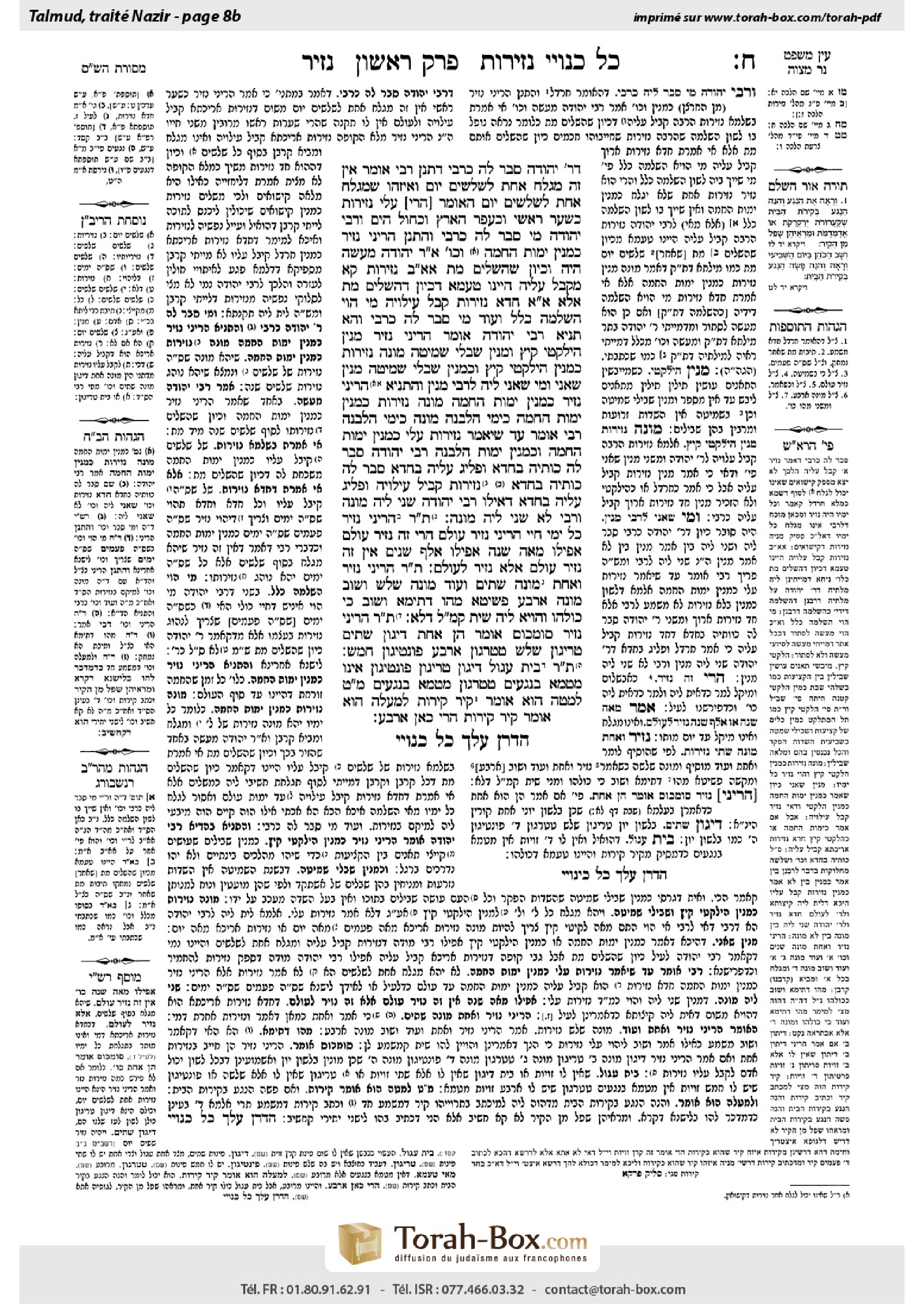
Nazir 8b: Talmud study for Daf Yomi
Daf Yomi is the daily study of one Talmud folio. Explore 37 tractates with scans, Hebrew text, Sefaria English and AI-generated French translations where annotated.
Passage selection and English or AI-generated French translation are available where the scan has annotations. Daf Study is independent of Torah-Box and Sefaria.
Browse Nazir · נזיר · All tractatesNazir 8b text and translations
This page of Nazir includes the Aramaic text, an English translation and an AI-generated French translation, alongside the scan above.
נזיר ח׳ ב · Aramaic and Hebrew text
דְּרַבִּי יְהוּדָה סָבַר לַהּ כְּרַבִּי. דִּתְנַן, רַבִּי אוֹמֵר: אֵין זֶה מְגַלֵּחַ אַחַת לִשְׁלשִׁים יוֹם. וְאֵיזֶהוּ שֶׁמְּגַלֵּח אַחַת לִשְׁלשִׁים יוֹם? הָאוֹמֵר ״[הֲרֵי] עָלַי נְזִירוֹת כִּשְׂעַר רֹאשִׁי״ וְ״כַעֲפַר הָאָרֶץ״ וּ״כְחוֹל הַיָּם״.
וְרַבִּי יְהוּדָה מִי סָבַר לַהּ כְּרַבִּי? וְהָתְנַן: הֲרֵינִי נָזִיר כְּמִנְיַן יְמוֹת הַחַמָּה וְכוּ׳. אָמַר רַבִּי יְהוּדָה: מַעֲשֶׂה הָיָה, וְכֵיוָן שֶׁהִשְׁלִים — מֵת.
אִי אָמְרַתְּ בִּשְׁלָמָא נְזִירוֹת קָא מְקַבֵּל עֲלֵיהּ, הַיְינוּ טַעְמָא דְּכֵיוָן דְּהִשְׁלִים — מֵת. אֶלָּא אִי אָמְרַתְּ חֲדָא נְזִירוּת קַבֵּל עִילָּוֵיהּ — מִי הָוֵי הַשְׁלָמָה כְּלָל?
וְעוֹד: מִי סָבַר לַהּ כְּרַבִּי? וְהָא תַּנְיָא, רַבִּי יְהוּדָה אוֹמֵר: ״הֲרֵינִי נָזִיר מִנְיַן הִילְקְטֵי קַיִץ״, וּ״מִנְיַן שְׁבִלֵי שְׁמִיטָּה״ — מוֹנֶה נְזִירוֹת כְּמִנְיַן הִילְקְטֵי קַיִץ וּכְמִנְיַן שְׁבִלֵי שְׁמִיטָּה!
״מִנְיָן״ שָׁאנֵי.
וּמִי שָׁאנֵי לֵיהּ לְרַבִּי מִנְיָן? וְהָתַנְיָא: ״הֲרֵינִי נָזִיר כְּמִנְיַן יְמוֹת הַחַמָּה״ — מוֹנֶה נְזִירוֹת כְּמִנְיַן יְמוֹת הַחַמָּה. ״כִּימֵי הַלְּבָנָה״ — מוֹנֶה כִּימֵי הַלְּבָנָה. רַבִּי אוֹמֵר: עַד שֶׁיֹּאמַר ״נְזִירוֹת עָלַי כְּמִנְיַן יְמוֹת הַחַמָּה וּכְמִנְיַן יְמוֹת הַלְּבָנָה״!
רַבִּי יְהוּדָה סָבַר לַהּ כְּוָתֵיהּ בַּחֲדָא וּפְלִיג עֲלֵיהּ בַּחֲדָא. סָבַר לַהּ כְּוָתֵיהּ בַּחֲדָא — נְזִירוּת קַבֵּיל עִילָּוֵיהּ. וּפְלִיג עֲלֵיהּ בַּחֲדָא — דְּאִילּוּ רַבִּי יְהוּדָה שָׁנֵי לֵיהּ מוֹנֶה, וְרַבִּי לָא שָׁנֵי לֵיהּ מוֹנֶה.
תָּנוּ רַבָּנַן: ״הֲרֵינִי נָזִיר כֹּל יְמֵי חַיַּי״, ״הֲרֵינִי נְזִיר עוֹלָם״ — הֲרֵי זֶה נְזִיר עוֹלָם. אֲפִילּוּ ״מֵאָה שָׁנָה״, אֲפִילּוּ ״אֶלֶף שָׁנִים״ — אֵין זֶה נְזִיר עוֹלָם, אֶלָּא נָזִיר לְעוֹלָם.
תָּנוּ רַבָּנַן: ״הֲרֵינִי נָזִיר וְאַחַת״ — מוֹנֶה שְׁתַּיִם. ״וְעוֹד״ — מוֹנֶה שָׁלֹשׁ. ״וְשׁוּב״ — מוֹנֶה אַרְבַּע. פְּשִׁיטָא? מַהוּ דְּתֵימָא: ״וְשׁוּב״ כִּי כּוּלְּהוּ, וְהָוְיָא לֵיהּ שֵׁית, קָא מַשְׁמַע לַן דְּלָא.
תָּנוּ רַבָּנַן: ״הֲרֵינִי נָזִיר״ — סוֹמְכוֹס אוֹמֵר: ״הֵן״ — אַחַת, ״דִּיגוֹן״ — שְׁתַּיִם, ״טְרִיגוֹן״ — שָׁלֹשׁ, ״טֶטְרָגוֹן״ — אַרְבַּע, ״פּוֹנְטִיגוֹן״ — חָמֵשׁ.
תָּנוּ רַבָּנַן: בֵּית עִגּוּל, דִּיגוֹן, טְרִיגוֹן, פּוֹנְטִיגוֹן — אֵינוֹ מִטַּמֵּא בִּנְגָעִים, טֶטְרָגוֹן — מִטַּמֵּא בִּנְגָעִים. מַאי טַעְמָא? לְמַטָּה הוּא אוֹמֵר ״קִיר״ ״קִירוֹת״. לְמַעְלָה הוּא אוֹמֵר ״קִיר״ ״קִירוֹת״. הֲרֵי כָּאן אַרְבַּע.
הַדְרָן עֲלָךְ כׇּל כִּינּוּיֵי
Nazir 8b · English translation
The Gemara answers: This is not possible, as Rabbi Yehuda holds in accordance with the opinion of Rabbi Yehuda HaNasi, as we learned in the mishna (8a) with regard to one who vows: I am hereby a nazirite like the hair of my head, Rabbi Yehuda HaNasi says: This nazirite does not shave his hair once every thirty days, as he is considered to have accepted one long term of naziriteship. And who is the nazirite who has accepted distinct terms of naziriteship and therefore shaves his hair once every thirty days? One who says: It is incumbent upon me to observe naziriteships like the hair of my head, or: Like the dust of the earth, or: Like the sand of the sea. Since Rabbi Yehuda agrees with Rabbi Yehuda HaNasi, he holds that one who uses a formulation similar to that used in the first case in the mishna and says: I am hereby a nazirite according to the capacity of the basket, has accepted one long term of naziriteship.
The Gemara asks: And does Rabbi Yehuda hold in accordance with the opinion of Rabbi Yehuda HaNasi? But didn’t we learn in the mishna that if one says: I am hereby a nazirite in accordance with the number of days in a solar year, he counts 365 consecutive naziriteships, in accordance with the number of days in a solar year. Rabbi Yehuda said: There was an incident where someone took this vow and observed 365 consecutive terms of naziriteship. Once he completed all these terms of naziriteship, he died.
The Gemara explains its question: Granted, if you say that he accepts upon himself many naziriteships, that is the reason for his statement that once he completed all these terms of naziriteship he died. However, if you say that Rabbi Yehuda does not agree with the unattributed opinion of the mishna and holds that he accepted upon himself one term of naziriteship lasting 365 days, is there completion here at all? Rabbi Yehuda would not have used this terminology in reference to the mishna’s previous statement if he himself holds that the individual accepted only one term of naziriteship.
And furthermore, does Rabbi Yehuda hold in accordance with the opinion of Rabbi Yehuda HaNasi? But isn’t it taught in a baraita that Rabbi Yehuda says: If one says: I am hereby a nazirite like the number of piles [helketei] of figs [kayitz] left to dry, or: Like the number of sheaves of the Sabbatical Year, he must count as many naziriteships as the number of piles of figs or as the number of sheaves of the Sabbatical Year? This proves that Rabbi Yehuda does not hold that the individual accepts only one long term of naziriteship.
The Gemara responds: This does not prove that Rabbi Yehuda does not agree with Rabbi Yehuda HaNasi, since one who specifies: Like the number, is different, as even Rabbi Yehuda HaNasi would agree that he is referring to distinct terms of naziriteship rather than one long term of naziriteship.
The Gemara asks: And is the case of one who says: Like the number, different according to Rabbi Yehuda HaNasi? But isn’t it taught in a baraita that if one says: I am hereby a nazirite like the number of days in a solar year, he counts naziriteships corresponding to the number of days in a solar year. If one says: Like the days in a lunar year, i.e., a year comprised of twelve lunar months, he counts terms of naziriteship corresponding to the days in a lunar year. Rabbi Yehuda HaNasi says: He is assumed to have accepted one term of naziriteship until he says: It is incumbent upon me to observe naziriteships like the number of days in a solar year, or: Like the number of days in a lunar year. This demonstrates that if one did not explicitly use the plural term naziriteships, he is assumed to have accepted a single term of naziriteship even if he said: Like the number.
The Gemara answers: Rabbi Yehuda holds in accordance with Rabbi Yehuda HaNasi’s opinion in one case and disagrees with him in one case. He holds in accordance with his opinion in one case, as follows: If one says: I am hereby a nazirite like the hairs of my head, he has accepted upon himself one term of naziriteship for as many days as the number of hairs on his head. And he disagrees with him in one case, as according to Rabbi Yehuda, the case of one who counts is different from the previous case, and so one who states: Like the number of hairs of my head, is considered to have accepted many distinct terms of naziriteship. However, according to Rabbi Yehuda HaNasi, one who counts is not different. He is assumed to have accepted a single term of naziriteship unless he explicitly uses the plural term naziriteships.
§ The Sages taught: If one says: I am hereby a nazirite all the days of my life, or: I am hereby a permanent nazirite, he is a permanent nazirite and he trims his hair on a yearly basis like Absalom. However, in the case of one who accepts upon himself naziriteship for a fixed amount of time, even if he says: One hundred years or even: One thousand years, he is not the specific type of nazirite known as a permanent nazirite. Rather, he is a regular nazirite forever, and he may never cut his hair.
§ The Sages taught in a baraita: If one said: I am hereby a nazirite and one, he counts two terms of naziriteship, since he first took a nazirite vow and then accepted an additional term of naziriteship. If one said: I am hereby a nazirite and one and more, he counts three terms of naziriteship. If he added to that statement: And again, he counts four. The Gemara asks: Isn’t this last halakha obvious? The Gemara answers: It is necessary to teach this halakha. Lest you say that the words and again are referring to terms of naziriteship equal in number to all the terms he has already accepted, and he has therefore accepted six terms of naziriteship altogether, the baraita therefore teaches us that this is not the correct interpretation of his statement.
The Sages taught in a baraita: If one said: I am hereby a nazirite, Sumakhos says: If he then added the word hen, which means one in Greek, he has accepted one term of naziriteship. If one said: Digon, which means two sides in Hebraicized Greek, he must observe two terms of naziriteship. If one said: Trigon, which means triangle in Hebraicized Greek, then he has accepted three terms of naziriteship. If he said: Tetragon, quadrilateral in Hebraicized Greek, then he has accepted four terms, and if he said: Puntigon, pentagon in Hebraicized Greek, then he has accepted five terms of naziriteship.
The Gemara cites another baraita dealing with these same expressions: The Sages taught: A round house, a two-sided house, a triangle-shaped house, and a pentagon-shaped house cannot become impure with leprosy, whereas a house shaped like a quadrilateral can become impure with leprosy. What is the reason for this? In the verse below it states, when referring to a wall, the plural term walls: “And, behold, if the plague has spread in the walls of the house” (Leviticus 14:39). Additionally, in the verse above it states, when referring to a wall, the plural term walls: “And behold, if the plague be in the walls of the house” (Leviticus 14:37). These plural terms are unnecessary, and it is therefore understood that there are four walls mentioned here in order to indicate that a house can become impure through leprosy only if it has four sides.
Nazir 8b · Traduction française (IA)
La Guemara répond : Cela n’est pas possible, car Rabbi Yehouda suit l’opinion de Rabbi Yehouda HaNassi, comme nous l’avons appris dans la Michna (8a) au sujet de celui qui fait le vœu suivant : « Je suis désormais naziréen comme les cheveux de ma tête. » Rabbi Yehouda HaNassi dit que ce naziréen ne se rase pas les cheveux tous les trente jours, car on considère qu’il a accepté une seule longue période de naziréat. Et quel est le naziréen qui a accepté des périodes de naziréat distinctes et qui, par conséquent, se rase les cheveux tous les trente jours ? Celui qui dit : « Je suis tenu d’observer autant de périodes de naziréat qu’il y a de cheveux sur ma tête », ou : « Qu’il y a de poussière sur la terre », ou : « Qu’il y a de grains de sable dans la mer. » Puisque Rabbi Yehouda est d’accord avec Rabbi Yehouda HaNassi, il estime que celui qui emploie une formulation semblable à celle du premier cas de la Michna et dit : « Je suis désormais naziréen selon la contenance du panier » a accepté une seule longue période de naziréat.
La Guemara demande : Rabbi Yehouda est-il vraiment d’accord avec Rabbi Yehouda HaNassi ? N’avons-nous pas appris dans la Michna que si quelqu’un dit : « Je suis désormais naziréen selon le nombre de jours d’une année solaire », il compte 365 périodes de naziréat consécutives, correspondant au nombre de jours d’une année solaire ? Rabbi Yehouda a dit : Il est arrivé qu’un homme prononce ce vœu et observe 365 périodes de naziréat consécutives. Une fois qu’il eut achevé toutes ces périodes de naziréat, il mourut.
La Guemara explique sa question : Il est compréhensible que, si l’on dit qu’il s’impose de nombreuses périodes de naziréat, cela explique pourquoi Rabbi Yehouda a déclaré qu’il mourut une fois toutes ces périodes achevées. Mais si l’on dit que Rabbi Yehouda n’est pas d’accord avec l’opinion anonyme de la Michna et estime que l’homme s’est imposé une seule période de naziréat de 365 jours, y a-t-il seulement un achèvement en l’occurrence ? Rabbi Yehouda n’aurait pas employé cette expression en référence à l’énoncé précédent de la Michna s’il estimait lui-même que l’individu n’avait accepté qu’une seule période de naziréat.
Et de plus, Rabbi Yehouda est-il d’accord avec Rabbi Yehouda HaNassi ? N’est-il pas enseigné dans une baraïta que Rabbi Yehouda dit : Si quelqu’un dit : « Je suis désormais naziréen comme le nombre de tas [helketei] de figues [kayitz] mis à sécher », ou : « Comme le nombre de gerbes de l’année de la Chemita », il doit compter autant de périodes de naziréat qu’il y a de tas de figues ou de gerbes de l’année de la Chemita. Cela prouve que Rabbi Yehouda ne considère pas que l’individu accepte une seule longue période de naziréat.
La Guemara répond : Cela ne prouve pas que Rabbi Yehouda soit en désaccord avec Rabbi Yehouda HaNassi, car le cas de celui qui précise « selon le nombre de » est différent : même Rabbi Yehouda HaNassi reconnaîtrait qu’il fait référence à des périodes de naziréat distinctes, et non à une seule longue période de naziréat.
La Guemara demande : Selon Rabbi Yehouda HaNassi, le cas de celui qui dit « selon le nombre de » est-il différent ? N’est-il pas enseigné dans une baraïta que si quelqu’un dit : « Je suis désormais naziréen comme le nombre de jours d’une année solaire », il compte autant de périodes de naziréat que de jours dans une année solaire ? S’il dit : « Comme le nombre de jours d’une année lunaire », c’est-à-dire d’une année composée de douze mois lunaires, il compte autant de périodes de naziréat que de jours dans une année lunaire. Rabbi Yehouda HaNassi dit : On considère qu’il a accepté une seule période de naziréat, jusqu’à ce qu’il dise : « Je suis tenu d’observer autant de périodes de naziréat qu’il y a de jours dans une année solaire », ou : « Qu’il y a de jours dans une année lunaire. » Cela montre que si quelqu’un n’a pas explicitement employé le terme pluriel « périodes de naziréat », on considère qu’il a accepté une seule période de naziréat, même s’il a dit : « Selon le nombre de ».
La Guemara répond : Rabbi Yehouda suit l’opinion de Rabbi Yehouda HaNassi dans un cas et est en désaccord avec lui dans un autre. Il suit son opinion dans le cas suivant : si quelqu’un dit : « Je suis désormais naziréen comme les cheveux de ma tête », il s’est imposé une seule période de naziréat d’une durée égale au nombre de cheveux de sa tête. Il est en désaccord avec lui dans un autre cas : selon Rabbi Yehouda, le cas de celui qui compte diffère du cas précédent ; ainsi, celui qui dit : « Comme le nombre de cheveux de ma tête » est considéré comme ayant accepté de nombreuses périodes de naziréat distinctes. En revanche, selon Rabbi Yehouda HaNassi, le cas de celui qui compte ne diffère pas. On considère qu’il a accepté une seule période de naziréat, à moins qu’il n’emploie explicitement le terme pluriel « périodes de naziréat ».
§ Les Sages ont enseigné : Si quelqu’un dit : « Je suis désormais naziréen tous les jours de ma vie », ou : « Je suis désormais naziréen à vie », il est un naziréen permanent et se coupe les cheveux une fois par an, à la manière d’Absalom. En revanche, celui qui s’impose une période de naziréat pour une durée déterminée, même s’il dit : « Cent ans », ou même : « Mille ans », n’est pas le type particulier de naziréen appelé naziréen permanent. Il est plutôt un naziréen ordinaire pour toujours et ne peut jamais se couper les cheveux.
§ Les Sages ont enseigné dans une baraïta : Si quelqu’un dit : « Je suis désormais naziréen, et un », il compte deux périodes de naziréat, puisqu’il a d’abord prononcé un vœu de naziréat, puis accepté une période supplémentaire. S’il dit : « Je suis désormais naziréen, et un, et plus », il compte trois périodes de naziréat. S’il ajoute : « Et encore », il en compte quatre. La Guemara demande : Cette dernière halakha n’est-elle pas évidente ? La Guemara répond : Il était nécessaire de l’enseigner. On aurait pu penser que les mots « et encore » renvoient à un nombre de périodes de naziréat égal à toutes celles qu’il a déjà acceptées, de sorte qu’il aurait accepté au total six périodes de naziréat. La baraïta nous enseigne donc que ce n’est pas la bonne interprétation de sa déclaration.
Les Sages ont enseigné dans une baraïta : Si quelqu’un dit : « Je suis désormais naziréen », Sumakhos dit que s’il ajoute ensuite le mot hen, qui signifie « un » en grec, il a accepté une période de naziréat. S’il dit digon, qui signifie « deux côtés » en grec hébraïsé, il doit observer deux périodes de naziréat. S’il dit trigon, qui signifie « triangle » en grec hébraïsé, il a accepté trois périodes de naziréat. S’il dit tetragon, « quadrilatère » en grec hébraïsé, il a accepté quatre périodes ; et s’il dit puntigon, « pentagone » en grec hébraïsé, il a accepté cinq périodes de naziréat.
La Guemara cite une autre baraïta portant sur ces mêmes expressions : Les Sages ont enseigné qu’une maison ronde, une maison à deux côtés, une maison triangulaire et une maison pentagonale ne peuvent pas être atteintes par la lèpre, tandis qu’une maison quadrilatérale peut l’être. Quelle en est la raison ? Dans le verset suivant, lorsqu’il est question d’un mur, le terme pluriel « murs » est employé : « Et voici, si la plaie s’est étendue sur les murs de la maison » (Lévitique 14:39). De plus, dans le verset précédent, lorsqu’il est question d’un mur, le terme pluriel « murs » est employé : « Et voici, si la plaie est sur les murs de la maison » (Lévitique 14:37). Ces pluriels sont superflus ; on comprend donc qu’ils indiquent qu’il est question ici de quatre murs, afin de signifier qu’une maison ne peut être atteinte par la lèpre que si elle a quatre côtés.
Traduction française générée par IA à partir de l’édition anglaise de Sefaria. Vérifie toujours un passage avec le texte source.
Text from Sefaria: William Davidson Edition - Vocalized Aramaic (CC BY NC); William Davidson Edition - English (CC BY NC).