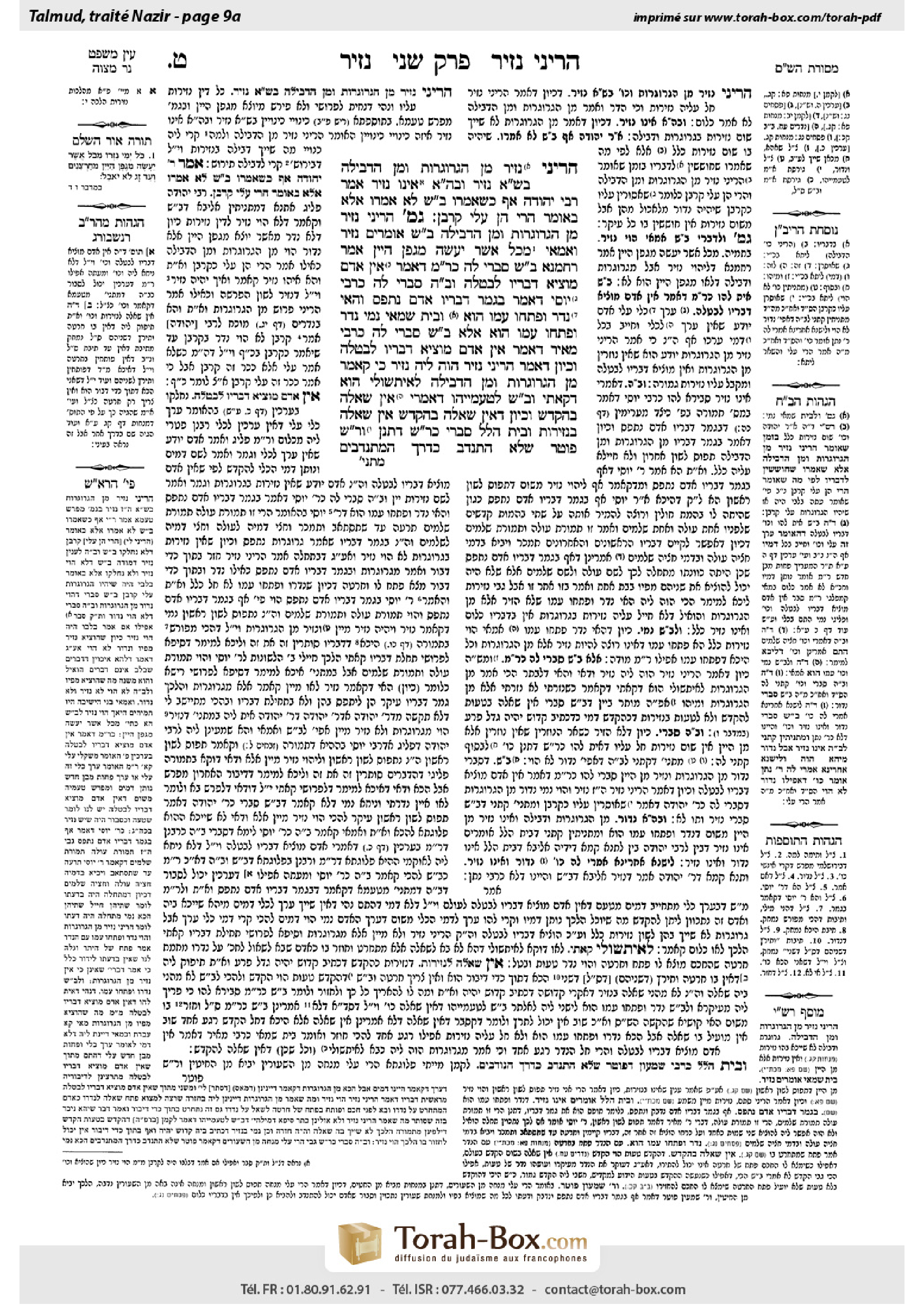
Nazir 9a: Talmud study for Daf Yomi
Daf Yomi is the daily study of one Talmud folio. Explore 37 tractates with scans, Hebrew text, Sefaria English and AI-generated French translations where annotated.
Passage selection and English or AI-generated French translation are available where the scan has annotations. Daf Study is independent of Torah-Box and Sefaria.
Browse Nazir · נזיר · All tractatesNazir 9a text and translations
This page of Nazir includes the Aramaic text, an English translation and an AI-generated French translation, alongside the scan above.
נזיר ט׳ א · Aramaic and Hebrew text
״הֲרֵינִי נָזִיר מִן הַגְּרוֹגְרוֹת וּמִן הַדְּבֵילָה״, בֵּית שַׁמַּאי אוֹמְרִים: נָזִיר. וּבֵית הִלֵּל אוֹמְרִים: אֵינוֹ נָזִיר. אָמַר רַבִּי יְהוּדָה: אַף כְּשֶׁאָמְרוּ בֵּית שַׁמַּאי, לֹא אָמְרוּ אֶלָּא בְּאוֹמֵר ״הֲרֵי הֵן עָלַי קׇרְבָּן״.
גְּמָ׳ ״הֲרֵינִי נָזִיר מִן הַגְּרוֹגְרוֹת וּמִן הַדְּבֵילָה״ — בֵּית שַׁמַּאי אוֹמְרִים: נָזִיר. וְאַמַּאי? ״מִכֹּל אֲשֶׁר יֵעָשֶׂה מִגֶּפֶן הַיַּיִן״ אָמַר רַחֲמָנָא! בֵּית שַׁמַּאי סָבְרִי לַהּ כְּרַבִּי מֵאִיר, דְּאָמַר: אֵין אָדָם מוֹצִיא דְּבָרָיו לְבַטָּלָה.
וּבֵית הִלֵּל סָבְרִי לַהּ כְּרַבִּי יוֹסֵי, דְּאָמַר: בִּגְמַר דְּבָרָיו אָדָם נִתְפָּס. וְהַאי נֶדֶר וּפִתְחוֹ עִמּוֹ הוּא.
וּבֵית שַׁמַּאי נָמֵי, נֶדֶר וּפִתְחוֹ עִמּוֹ הוּא!
אֶלָּא: בֵּית שַׁמַּאי סָבְרִי לַהּ כְּרַבִּי מֵאִיר, דְּאָמַר: אֵין אָדָם מוֹצִיא דְּבָרָיו לְבַטָּלָה. וְכֵיוָן דְּאָמַר ״הֲרֵינִי נָזִיר״ — הֲוָה לֵיהּ נָזִיר, כִּי קָאָמַר ״מִן הַגְּרוֹגְרוֹת וּמִן הַדְּבֵילָה״ — לְאִיתְּשׁוֹלֵי הוּא דְּקָאָתֵי. וּבֵית שַׁמַּאי לְטַעְמַיְיהוּ דְּאָמְרִי: אֵין שְׁאֵלָה בְּהֶקְדֵּשׁ. וְכֵיוָן דְּאֵין שְׁאֵלָה בְּהֶקְדֵּשׁ — אֵין שְׁאֵלָה בִּנְזִירוּת.
וּבֵית הִלֵּל סָבְרִי כְּרַבִּי שִׁמְעוֹן, דִּתְנַן: וְרַבִּי שִׁמְעוֹן פּוֹטֵר, שֶׁלֹּא הִתְנַדֵּב כְּדֶרֶךְ הַמִּתְנַדְּבִים.
Nazir 9a · English translation
MISHNA: If one says: I am hereby a nazirite and therefore will refrain from dried figs and from cakes of dried figs, Beit Shammai say: His statement renders him a full-fledged nazirite, and his addition: From dried figs, is insignificant, as this fruit is not included in the prohibitions of a nazirite, which include only products of the grapevine. And Beit Hillel say: He is not a nazirite, since he did not accept naziriteship upon himself. Rabbi Yehuda said: Even when Beit Shammai said that this vow takes effect, they said that only in a case where one said that he meant: They are hereby forbidden to me as an offering. In that case it is as though he took a vow rendering the figs forbidden to him. However, Beit Shammai concede that although the vow takes effect, it is not a vow of naziriteship.
GEMARA: It is stated in the mishna that if one says: I am hereby a nazirite and therefore will refrain from dried figs and from cakes of dried figs, Beit Shammai say: He is a nazirite. The Gemara asks: But why? The Merciful One states in the Torah in the passage dealing with naziriteship: “From anything that is made of the grapevine…he shall not eat” (Numbers 6:4). In naziriteship, only the fruit of the vine is prohibited. The Gemara answers: Beit Shammai hold in accordance with the opinion of Rabbi Meir, who says: A person does not utter a statement for naught. In other words, if one utters a statement that cannot be fulfilled as stated, his statement is interpreted in a manner that renders it relevant. Here too, Beit Shammai say that he misspoke and actually intended to take a vow of naziriteship.
And Beit Hillel hold in accordance with the opinion of Rabbi Yosei, who says: A person is also held accountable for the conclusion of his statement. If one states two irreconcilable clauses, e.g., this animal is a substitute for a burnt-offering, a substitute for a peace-offering; the second clause is not disregarded, and the animal assumes both statuses. And this is a vow with its inherent opening, i.e., reason for dissolution. Although he said: I am hereby a nazirite, by adding the words: From dried figs and from cakes of dried figs, he indicated that his intention was that the naziriteship would not take effect.
The Gemara asks: And according to Beit Shammai too, it is a vow with its inherent opening, and since they certainly agree that a vow of this kind does not take effect, why do they hold that this vow takes effect?
The Gemara explains the dispute: Rather, Beit Shammai hold in accordance with the opinion of Rabbi Meir, who said: A person does not utter a statement for naught, and once he said: I am hereby a nazirite, he is immediately rendered a nazirite. When he then says: And therefore I will refrain from dried figs and from cakes of dried figs, he is coming to request that a halakhic authority dissolve his vow, as he regrets having taken the vow and is now seeking to dissolve it. And Beit Shammai follow their standard line of reasoning, as they say: One cannot request that a halakhic authority dissolve a vow of consecrated property, which one can do for vows of prohibition. And since one cannot request that a halakhic authority dissolve a vow of consecrated property, likewise one cannot request that a halakhic authority dissolve a vow of naziriteship, as the legal status of a vow of naziriteship is like that of a vow of consecrated property in this regard.
And Beit Hillel hold in accordance with the opinion of Rabbi Shimon, as we learned in a mishna (Menaḥot 103a): If one vows to bring a meal-offering from barley, since voluntary meal-offerings are brought only from wheat, the Rabbis say: He must bring a meal-offering from wheat, and Rabbi Shimon exempts him entirely, as he did not donate in the manner typical of donors. Since he donated an offering that cannot be sacrificed, his vow is meaningless. Here too, since he took a vow of naziriteship stating that he therefore will refrain from dried figs rather than from wine, his statement is meaningless.
Nazir 9a · Traduction française (IA)
MICHNA : Si quelqu’un dit : « Me voici nazir et, par conséquent, je m’abstiendrai de figues sèches et de gâteaux de figues sèches », Beit Shammaï disent : Sa déclaration fait de lui un nazir à part entière, et l’ajout « de figues sèches » est sans importance, car ce fruit ne fait pas partie des interdits du nazir, qui ne concernent que les produits de la vigne. Beit Hillel disent : Il n’est pas nazir, puisqu’il n’a pas accepté le naziréat sur lui-même. Rabbi Yehouda dit : Même lorsque Beit Shammaï ont dit que ce vœu prend effet, ils ne l’ont dit que dans le cas où l’intéressé a précisé qu’il voulait dire : « Qu’elles me soient interdites comme une offrande. » Dans ce cas, c’est comme s’il avait prononcé un vœu rendant les figues interdites pour lui. Cependant, Beit Shammaï reconnaissent que, bien que le vœu prenne effet, il ne s’agit pas d’un vœu de naziréat.
GUEMARA : La Michna enseigne que si quelqu’un dit : « Me voici nazir et, par conséquent, je m’abstiendrai de figues sèches et de gâteaux de figues sèches », Beit Shammaï disent : Il est nazir. La Guemara demande : Mais pourquoi ? Le Miséricordieux dit dans la Torah, dans le passage consacré au naziréat : « De tout ce qui est fait de la vigne… il ne mangera pas » (Nombres 6:4). Dans le cadre du naziréat, seuls les fruits de la vigne sont interdits. La Guemara répond : Beit Shammaï suivent l’opinion de Rabbi Meïr, qui dit : Une personne ne prononce pas de paroles en vain. Autrement dit, si quelqu’un fait une déclaration qui ne peut être appliquée telle quelle, on l’interprète de manière à lui donner une portée. Ici aussi, Beit Shammaï disent qu’il s’est mal exprimé et qu’en réalité, il avait l’intention de prononcer un vœu de naziréat.
Beit Hillel, quant à eux, suivent l’opinion de Rabbi Yossi, qui dit : Une personne est également tenue responsable de la conclusion de sa déclaration. Si elle énonce deux clauses incompatibles, par exemple : « Cet animal est un substitut d’holocauste, un substitut de sacrifice de paix », la seconde clause n’est pas écartée et l’animal assume les deux statuts. Il s’agit là d’un vœu dont la formulation comporte en elle-même le motif de son annulation. Bien qu’il ait dit : « Me voici nazir », en ajoutant les mots « de figues sèches et de gâteaux de figues sèches », il a indiqué que son intention était que le naziréat ne prenne pas effet.
La Guemara demande : Selon Beit Shammaï aussi, il s’agit d’un vœu dont la formulation comporte en elle-même le motif de son annulation ; or, puisqu’ils reconnaissent certainement qu’un vœu de ce genre ne prend pas effet, pourquoi considèrent-ils que celui-ci prend effet ?
La Guemara explique le désaccord : En réalité, Beit Shammaï suivent l’opinion de Rabbi Meïr, qui a dit : Une personne ne prononce pas de paroles en vain. Dès qu’il a dit : « Me voici nazir », il est immédiatement devenu nazir. Lorsqu’il ajoute ensuite : « Et, par conséquent, je m’abstiendrai de figues sèches et de gâteaux de figues sèches », il demande à une autorité halakhique d’annuler son vœu, car il regrette de l’avoir prononcé et cherche maintenant à le faire annuler. Beit Shammaï suivent leur raisonnement habituel : ils disent qu’on ne peut pas demander à une autorité halakhique d’annuler un vœu portant sur un bien consacré, contrairement aux vœux d’interdiction. Et puisqu’on ne peut pas demander à une autorité halakhique d’annuler un vœu portant sur un bien consacré, de même, on ne peut pas lui demander d’annuler un vœu de naziréat, car, à cet égard, le statut juridique d’un vœu de naziréat est semblable à celui d’un vœu portant sur un bien consacré.
Beit Hillel, quant à eux, suivent l’opinion de Rabbi Shimon, comme nous l’avons appris dans une Michna (Menaḥot 103a) : Si quelqu’un fait le vœu d’apporter une offrande de farine d’orge, alors que les offrandes volontaires de farine sont apportées uniquement à partir de blé, les Sages disent : Il doit apporter une offrande de farine de blé. Rabbi Shimon l’en dispense entièrement, car il n’a pas fait son don de la manière habituelle des donateurs. Puisqu’il a fait le vœu d’apporter une offrande qui ne peut être sacrifiée, son vœu est sans effet. Ici aussi, puisqu’il a fait un vœu de naziréat en disant qu’il s’abstiendrait par conséquent de figues sèches plutôt que de vin, sa déclaration est sans effet.
Traduction française générée par IA à partir de l’édition anglaise de Sefaria. Vérifie toujours un passage avec le texte source.
Text from Sefaria: William Davidson Edition - Vocalized Aramaic (CC BY NC); William Davidson Edition - English (CC BY NC).