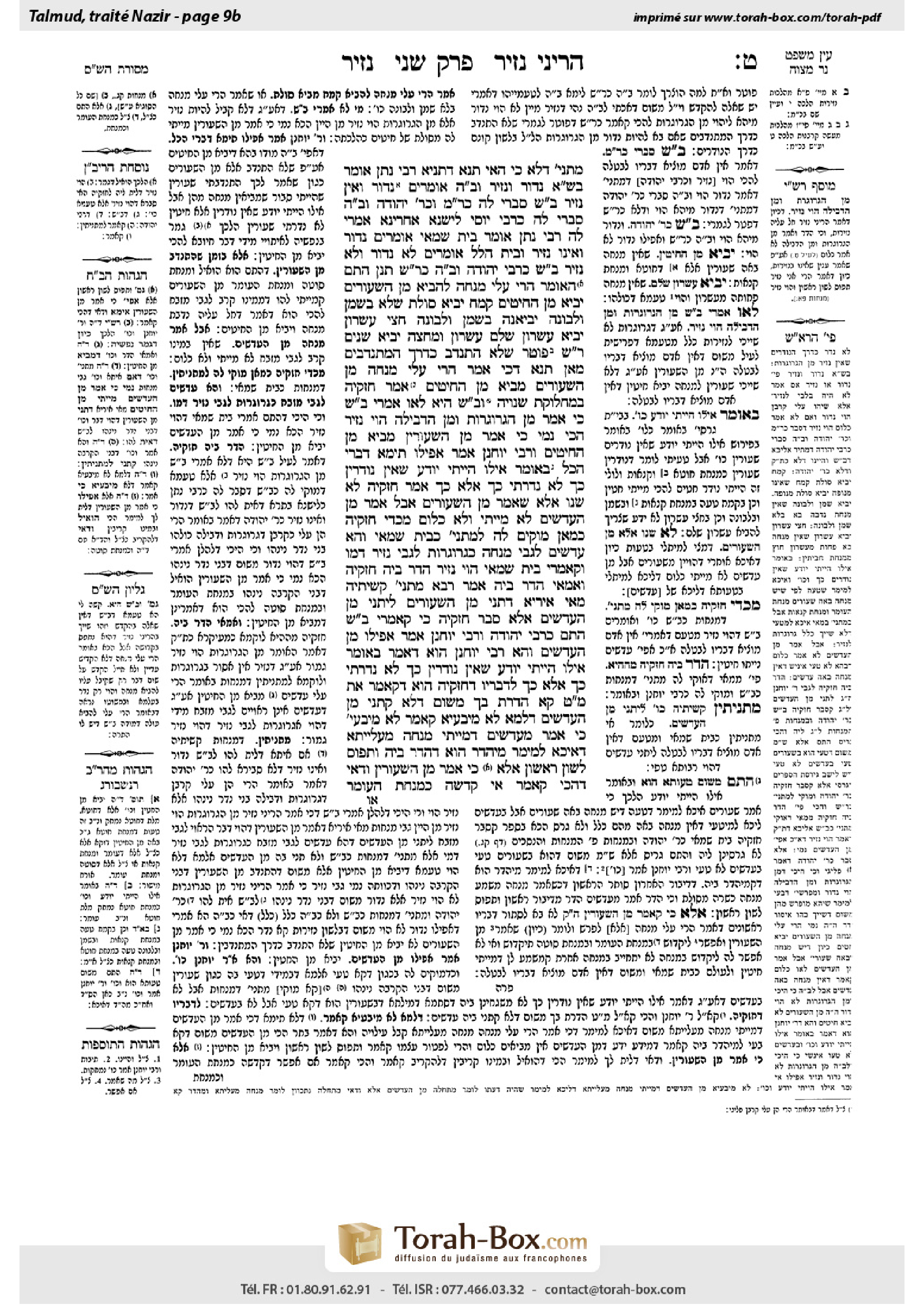
Nazir 9b: Talmud study for Daf Yomi
Daf Yomi is the daily study of one Talmud folio. Explore 37 tractates with scans, Hebrew text, Sefaria English and AI-generated French translations where annotated.
Passage selection and English or AI-generated French translation are available where the scan has annotations. Daf Study is independent of Torah-Box and Sefaria.
Browse Nazir · נזיר · All tractatesNazir 9b text and translations
This page of Nazir includes the Aramaic text, an English translation and an AI-generated French translation, alongside the scan above.
נזיר ט׳ ב · Aramaic and Hebrew text
מַתְנִיתִין דְּלָא כִּי הַאי תַּנָּא, דְּתַנְיָא רַבִּי נָתָן אוֹמֵר, בֵּית שַׁמַּאי אוֹמְרִים: נָדוּר וְנָזִיר, וּבֵית הִלֵּל אוֹמְרִים: נָדוּר וְאֵין נָזִיר. בֵּית שַׁמַּאי סָבְרִי לַהּ כְּרַבִּי מֵאִיר וּכְרַבִּי יְהוּדָה, וּבֵית הִלֵּל סָבְרִי לַהּ כְּרַבִּי יוֹסֵי.
לִישָּׁנָא אַחֲרִינָא אָמְרִי לַהּ: רַבִּי נָתָן אוֹמֵר, בֵּית שַׁמַּאי אוֹמְרִים: נָדוּר וְאֵינוֹ נָזִיר, וּבֵית הִלֵּל אוֹמְרִים: לֹא נָדוּר וְלֹא נָזִיר. בֵּית שַׁמַּאי כְּרַבִּי יְהוּדָה וּבֵית הִלֵּל כְּרַבִּי שִׁמְעוֹן.
תְּנַן הָתָם: הָאוֹמֵר ״הֲרֵי עָלַי מִנְחָה לְהָבִיא מִן הַשְּׂעוֹרִים״ — יָבִיא מִן הַחִיטִּים. ״קֶמַח״ — יָבִיא סוֹלֶת. ״שֶׁלֹּא בְּשֶׁמֶן וּלְבוֹנָה״ — יְבִיאֶנָּה בְּשֶׁמֶן וּלְבוֹנָה. ״חֲצִי עִשָּׂרוֹן״ — יָבִיא עִשָּׂרוֹן שָׁלֵם. ״עִשָּׂרוֹן וּמֶחֱצָה״ — יָבִיא שְׁנַיִם. רַבִּי שִׁמְעוֹן פּוֹטֵר, שֶׁלֹּא הִתְנַדֵּב כְּדֶרֶךְ הַמִּתְנַדְּבִים.
מַאן תַּנָּא דְּכִי אָמַר ״הֲרֵי עָלַי מִנְחָה מִן הַשְּׂעוֹרִים״ מֵבִיא מִן הַחִיטִּים? אָמַר חִזְקִיָּה: בְּמַחֲלוֹקֶת שְׁנוּיָה, וּבֵית שַׁמַּאי הִיא. לָאו אָמְרִי בֵּית שַׁמַּאי כִּי אָמַר ״מִן הַגְּרוֹגְרוֹת וּמִן הַדְּבֵילָה״ הָוֵי נָזִיר, הָכִי נָמֵי כִּי אָמַר ״מִן הַשְּׂעוֹרִין״ — מֵבִיא מִן הַחִיטִּים.
וְרַבִּי יוֹחָנָן אָמַר: אֲפִילּוּ תֵּימָא דִּבְרֵי הַכֹּל — בְּאוֹמֵר ״אִילּוּ הָיִיתִי יוֹדֵעַ שֶׁאֵין נוֹדְרִין כָּךְ, לֹא נָדַרְתִּי כָּךְ אֶלָּא כָּךְ״.
אָמַר חִזְקִיָּה: לֹא שָׁנוּ אֶלָּא שֶׁאָמַר ״מִן הַשְּׂעוֹרִים״, אֲבָל אָמַר ״מִן הָעֲדָשִׁים״ — לָא מַיְיתֵי וְלֹא כְּלוּם.
מִכְּדִי חִזְקִיָּה כְּמַאן מוֹקֵים לָהּ לְמַתְנִיתִין — כְּבֵית שַׁמַּאי, וְהָא עֲדָשִׁים לְגַבֵּי מִנְחָה כִּגְרוֹגְרוֹת לְגַבֵּי נָזִיר דָּמוּ, וְקָאָמְרִי בֵּית שַׁמַּאי הָוֵי נָזִיר! הֲדַר בֵּיהּ חִזְקִיָּה.
וְאַמַּאי הֲדַר בֵּיהּ? אֲמַר רָבָא, מַתְנִיתִין קְשִׁיתֵיהּ: מַאי אִירְיָא דְּתָנֵי ״מִן הַשְּׂעוֹרִים״? לִיתְנֵי ״מִן הָעֲדָשִׁים״! אֶלָּא סָבַר חִזְקִיָּה: כִּי קָאָמְרִי בֵּית שַׁמַּאי הָתָם — כְּרַבִּי יְהוּדָה.
וְרַבִּי יוֹחָנָן אָמַר: אֲפִילּוּ ״מִן הָעֲדָשִׁים״. וְהָא רַבִּי יוֹחָנָן הוּא דְּאָמַר, בְּאוֹמֵר ״אִילּוּ הָיִיתִי יוֹדֵעַ שֶׁאֵין נוֹדְרִין כָּךְ, לֹא נָדַרְתִּי כָּךְ אֶלָּא כָּךְ״! לִדְבָרָיו דְּחִזְקִיָּה הוּא דְּקָאָמַר.
אַתְּ מַאי טַעְמָא קָא הָדְרַתְּ בָּךְ — מִשּׁוּם דְּלָא קָתָנֵי ״מִן הָעֲדָשִׁים״. דִּלְמָא לָא מִיבַּעְיָא קָאָמַר: לָא מִיבַּעְיָא כִּי אָמַר ״מֵעֲדָשִׁים״, דְּמַיְיתֵי מִנְחָה מְעַלַּיְיתָא, דְּאִיכָּא לְמֵימַר מִיהְדָּר הוּא דַּהֲדַר בֵּיהּ, וּתְפוֹס לָשׁוֹן רִאשׁוֹן. אֶלָּא כִּי אָמַר ״מִן הַשְּׂעוֹרִין״, וַדַּאי דְּהָכִי קָאָמַר: אִי קָדְשָׁה כַּמִּנְחָת הָעוֹמֶר,
Nazir 9b · English translation
§ The Gemara comments: The mishna is not in accordance with the opinion of this tanna. As it is taught in a baraita: Rabbi Natan says that if one says: I am hereby a nazirite and therefore will refrain from dried figs, Beit Shammai say: He has rendered dried figs forbidden to himself by a vow, and he is also a nazirite; and Beit Hillel say: He has rendered dried figs forbidden to himself by a vow, but he is not a nazirite. According to Rabbi Natan, Beit Shammai hold in accordance with the opinion of Rabbi Meir that a person does not utter statements for naught and that he becomes a nazirite as soon as he says: I am hereby a nazirite; and he explains the opinion of Beit Shammai as Rabbi Yehuda does, i.e., that one in this situation has vowed that dried figs are forbidden to him, since the rest of his statement also has significance. And Beit Hillel hold in accordance with the opinion of Rabbi Yosei that one is held to the conclusion of his statement, and he has therefore vowed that dried figs are forbidden to him.
Some say a different version of the baraita: Rabbi Natan says that Beit Shammai say: He has rendered dried figs forbidden to himself by a vow and he is not a nazirite; and Beit Hillel say: He has not rendered dried figs forbidden to himself by a vow, and he is not a nazirite. According to this version, the opinion of Beit Shammai is as Rabbi Yehuda explained in the mishna, and Beit Hillel hold in accordance with the opinion of Rabbi Shimon, who maintains that a donation not performed in the manner typical of donors is not a donation.
§ The Gemara discusses a case mentioned earlier. We learned in a mishna there (Menaḥot 103a): With regard to one who says: It is incumbent upon me to bring a meal-offering from barley, since voluntary meal-offerings are made only with wheat he must bring a meal-offering from wheat. If one vows to bring a meal-offering from flour, since a standard meal-offering is made from fine flour he must bring one from fine flour. If one vows to bring a meal-offering without oil and frankincense, he must bring it with oil and frankincense, in accordance with the halakha. If one vows to bring a meal-offering with half of a tenth of an ephah of fine flour, he must bring a meal-offering with a full tenth, since a meal-offering cannot have less than one-tenth of an ephah of flour. If one vows to bring a meal-offering with a tenth and a half, he brings two units of a tenth of an ephah in his meal-offering. Since half of one-tenth of an ephah is the minimum, his vow is increased to two full tenths. Rabbi Shimon exempts him entirely in all these cases, as he did not donate in the manner typical of donors.
The Gemara asks: Who is the tanna who taught that when one said: It is incumbent upon me to bring a meal-offering from barley, he brings a meal-offering from wheat? Ḥizkiyya said that this halakha is taught as a dispute between tanna’im, and it is the opinion of Beit Shammai. He explains: Didn’t Beit Shammai say that when one said: I am hereby a nazirite and therefore will refrain from dried figs and from cakes of dried figs, he is a nazirite, indicating that he is held to only the first part of his statement, and the conflicting details are ignored? So too, when he said that he will bring a meal-offering from barley, he brings it from wheat, and the same analysis applies to the other cases listed in this mishna.
And Rabbi Yoḥanan said: You can even say that all, including Beit Hillel, agree with the opinion of the Rabbis of the mishna, as the mishna may be stated with regard to one who later says, to clarify his earlier statement: Had I known that one cannot vow in this manner, that one cannot bring a voluntary meal-offering from barley, I would not have vowed that way, only this way, to bring a meal-offering from wheat. Mentioning barley was an error on his part rather than a condition, and he actually meant to bring a standard meal-offering. In this case even Beit Hillel, who maintain in the mishna here that there is no vow at all, deem him liable to bring a proper meal-offering.
With regard to this ruling Ḥizkiyya says: They taught that he must bring a meal-offering from wheat only if he said that he will bring a meal-offering from barley. But if he said he will bring a meal-offering from lentils, he does not bring anything. The difference is that the meal-offerings of the omer and of a sota are made from barley, so if he said: From barley, he may have mistakenly believed that a voluntary meal-offering can be prepared from barley as well. As everyone knows that no meal-offering is made from lentils, his statement demonstrates that he never intended to bring a meal-offering.
The Gemara asks: Now consider, in accordance with whose opinion does Ḥizkiyya establish the mishna in Menaḥot? It is in accordance with the opinion of Beit Shammai. But lentils relative to a meal-offering are comparable to dried figs relative to a nazirite, as everyone is likewise aware that one cannot be a nazirite and therefore refrain from figs, and yet Beit Shammai say he is a nazirite. Why not say that one who vows to bring a meal-offering from lentils is obligated to bring a standard meal-offering? The Gemara answers: Ḥizkiyya retracted from it and no longer holds that the mishna in Menaḥot is in accordance with the opinion of Beit Shammai.
The Gemara asks: And why did he in fact retract from it? Rava said: The mishna caused him difficulty and demonstrated his error. If the mishna is in accordance with Beit Shammai’s opinion with regard to a nazirite, why does the tanna specifically teach the case of one who says that he will bring a meal-offering from barley? Let him teach a greater novelty, i.e., that even one who vowed to bring a meal-offering from lentils is obligated to bring a meal-offering made from wheat. Rather, Ḥizkiyya holds that when Beit Shammai stated their opinion there, i.e., in the mishna with regard to a nazirite, their intention was as explained by Rabbi Yehuda, that one’s statement is interpreted to be meaningful and it can have the meaning of creating a vow that dried figs are forbidden to him. In the case of the meal-offering, even they agree that since one’s vow has no meaning, as there cannot be a meal-offering made of lentils, no vow takes effect.
And Rabbi Yoḥanan said: Even one who vowed to bring a meal-offering from lentils must bring a meal-offering from wheat. The Gemara asks: But Rabbi Yoḥanan is he who said that the mishna is referring to a case of one who says: Had I known that one cannot vow in this manner, I would not have vowed that way, only this way? In the case of the lentils, it is not reasonable to say that he erred in thinking that one may vow to bring a meal-offering from lentils. The Gemara answers: He stated this ruling in accordance with the statement of Ḥizkiyya. Rabbi Yoḥanan was not stating his own opinion; he was challenging the ruling of Ḥizkiyya.
The Gemara explains his challenge: What is the reason you retracted your earlier opinion that the mishna is in accordance with the opinion of Beit Shammai? You did so because it does not teach: From lentils. That is not conclusive, as perhaps it is speaking utilizing the style of: It is not necessary, as follows: It is not necessary to say that when one says: It is incumbent upon me to bring a meal-offering from lentils, that he brings a proper meal-offering of wheat. In that situation it can be said that by saying: From lentils, he is retracting his first statement and now wants to rescind his vow. And yet Beit Shammai hold that he is held to the first part of his statement, and they do not allow the rescinding of a vow of consecration. But if he said: It is incumbent upon me to bring a meal-offering from barley, since it is possible to explain that certainly this is what he said: If this meal-offering that I have vowed to bring from barley is consecrated like the omer meal-offering,
Nazir 9b · Traduction française (IA)
§ La Guemara fait remarquer : La Michna n’est pas conforme à l’opinion de ce tanna. En effet, il est enseigné dans une baraïta : Rabbi Natan dit que si quelqu’un déclare : « Je suis désormais nazir et, par conséquent, je m’abstiendrai de figues sèches », Beit Shammaï disent : « Il s’est interdit les figues sèches par un vœu, et il est également nazir » ; Beit Hillel disent : « Il s’est interdit les figues sèches par un vœu, mais il n’est pas nazir. » Selon Rabbi Natan, Beit Shammaï suivent l’opinion de Rabbi Meïr, selon laquelle une personne ne prononce pas de paroles en vain et devient nazir dès qu’elle dit : « Je suis désormais nazir » ; il explique l’opinion de Beit Shammaï comme Rabbi Yehouda, c’est-à-dire qu’en l’occurrence, la personne a fait le vœu de s’interdire les figues sèches, puisque le reste de sa déclaration a également un sens. Beit Hillel suivent l’opinion de Rabbi Yossi, selon laquelle on s’en tient à la fin de la déclaration ; la personne a donc fait le vœu de s’interdire les figues sèches.
Selon une autre version de la baraïta, Rabbi Natan dit que Beit Shammaï disent : « Il s’est interdit les figues sèches par un vœu, mais il n’est pas nazir » ; Beit Hillel disent : « Il ne s’est pas interdit les figues sèches par un vœu et il n’est pas nazir. » Selon cette version, l’opinion de Beit Shammaï est celle que Rabbi Yehouda a exposée dans la Michna, et Beit Hillel suivent l’opinion de Rabbi Shimon, qui soutient qu’un don qui n’est pas fait selon la manière habituelle des donateurs ne constitue pas un don.
§ La Guemara examine un cas mentionné précédemment. Nous avons appris dans une Michna là-bas (Mena’hot 103a) : Celui qui dit : « Je suis tenu d’apporter une offrande de farine d’orge » doit apporter une offrande de farine de blé, puisque les offrandes de farine volontaires sont faites uniquement avec du blé. Si quelqu’un fait le vœu d’apporter une offrande de farine, il doit en apporter une faite de farine fine, puisque c’est ainsi qu’est faite une offrande de farine ordinaire. S’il fait le vœu d’apporter une offrande de farine sans huile ni encens, il doit l’apporter avec de l’huile et de l’encens, conformément à la halakha. S’il fait le vœu d’apporter une offrande de farine composée d’un demi-dixième d’épha de farine fine, il doit apporter une offrande de farine composée d’un dixième entier, car une offrande de farine ne peut contenir moins d’un dixième d’épha de farine. S’il fait le vœu d’apporter une offrande de farine composée d’un dixième et demi, il doit apporter une offrande de farine de deux dixièmes d’épha. Puisque la moitié d’un dixième d’épha est la quantité minimale, son vœu est porté à deux dixièmes entiers. Rabbi Shimon l’en exempte entièrement dans tous ces cas, car il n’a pas fait son don de la manière habituelle des donateurs.
La Guemara demande : Quel est le tanna qui a enseigné que, lorsque quelqu’un dit : « Je suis tenu d’apporter une offrande de farine d’orge », il doit apporter une offrande de farine de blé ? Hizkiya dit que cette halakha fait l’objet d’un désaccord entre des tanaïm et exprime l’opinion de Beit Shammaï. Il explique : Beit Shammaï n’ont-ils pas dit que, lorsque quelqu’un déclare : « Je suis désormais nazir et, par conséquent, je m’abstiendrai de figues sèches et de gâteaux de figues sèches », il est nazir, ce qui indique qu’on ne tient compte que de la première partie de sa déclaration et qu’on ignore les précisions contradictoires ? De même, s’il a dit qu’il apporterait une offrande de farine d’orge, il doit l’apporter de blé ; la même analyse s’applique aux autres cas énumérés dans cette Michna.
Et Rabbi Yo’hanan dit : On peut même dire que tous, y compris Beit Hillel, sont d’accord avec l’opinion des rabbins de la Michna, car la Michna peut porter sur le cas de quelqu’un qui précise ensuite sa déclaration précédente en disant : « Si j’avais su qu’on ne peut pas faire un vœu de cette manière, c’est-à-dire qu’on ne peut pas apporter d’offrande volontaire de farine d’orge, je n’aurais pas fait ce vœu de cette manière, mais uniquement de cette manière : apporter une offrande de farine de blé. » La mention de l’orge était une erreur de sa part, et non une condition ; en réalité, il voulait apporter une offrande de farine ordinaire. Dans ce cas, même Beit Hillel, qui soutiennent dans la Michna ici qu’aucun vœu ne prend effet, le considèrent comme tenu d’apporter une offrande de farine conforme aux règles.
À propos de cette décision, Hizkiya dit : Ils ont enseigné qu’il doit apporter une offrande de farine de blé uniquement s’il a dit qu’il apporterait une offrande de farine d’orge. Mais s’il a dit qu’il apporterait une offrande de farine de lentilles, il n’apporte rien. La différence est que les offrandes de farine de l’omer et d’une sota sont faites d’orge ; s’il a donc dit « d’orge », il a peut-être cru par erreur qu’une offrande de farine volontaire pouvait également être préparée avec de l’orge. Comme tout le monde sait qu’aucune offrande de farine n’est faite de lentilles, sa déclaration montre qu’il n’a jamais eu l’intention d’apporter une offrande de farine.
La Guemara demande : Selon l’opinion de qui Hizkiya établit-il donc la Michna de Mena’hot ? Selon celle de Beit Shammaï. Or, les lentilles par rapport à une offrande de farine sont comparables aux figues sèches par rapport au nazir, puisque tout le monde sait également qu’on ne peut pas être nazir et, par conséquent, s’abstenir de figues ; pourtant, Beit Shammaï disent qu’il est nazir. Pourquoi ne pas dire que celui qui fait le vœu d’apporter une offrande de farine de lentilles est tenu d’apporter une offrande de farine ordinaire ? La Guemara répond : Hizkiya s’est rétracté et ne soutient plus que la Michna de Mena’hot soit conforme à l’opinion de Beit Shammaï.
La Guemara demande : Et pourquoi s’est-il effectivement rétracté ? Rava dit : La Michna lui a posé une difficulté et lui a montré son erreur. Si la Michna est conforme à l’opinion de Beit Shammaï concernant le nazir, pourquoi le tanna enseigne-t-il précisément le cas de celui qui dit qu’il apportera une offrande de farine d’orge ? Qu’il enseigne une nouveauté plus importante, à savoir que même celui qui a fait le vœu d’apporter une offrande de farine de lentilles est tenu d’apporter une offrande de farine de blé. Hizkiya soutient donc que, lorsque Beit Shammaï ont exposé leur opinion là-bas, c’est-à-dire dans la Michna concernant le nazir, ils entendaient ce que Rabbi Yehouda a expliqué : la déclaration d’une personne est interprétée de manière à avoir un sens, et elle peut signifier qu’elle a fait le vœu de s’interdire les figues sèches. Dans le cas de l’offrande de farine, même Beit Shammaï conviennent que, puisque le vœu n’a pas de sens — car il ne peut exister d’offrande de farine faite de lentilles —, aucun vœu ne prend effet.
Et Rabbi Yo’hanan dit : Même celui qui a fait le vœu d’apporter une offrande de farine de lentilles doit apporter une offrande de farine de blé. La Guemara demande : Mais n’est-ce pas Rabbi Yo’hanan qui a dit que la Michna porte sur le cas de quelqu’un qui dit : « Si j’avais su qu’on ne peut pas faire un vœu de cette manière, je n’aurais pas fait ce vœu de cette manière, mais de cette autre manière » ? Dans le cas des lentilles, il n’est pas raisonnable de dire qu’il s’est trompé en pensant qu’on pouvait faire le vœu d’apporter une offrande de farine de lentilles. La Guemara répond : Il a énoncé cette décision conformément à l’affirmation de Hizkiya. Rabbi Yo’hanan n’exprimait pas sa propre opinion ; il contestait la décision de Hizkiya.
La Guemara expose sa contestation : Pour quelle raison t’es-tu rétracté de ton opinion précédente, selon laquelle la Michna est conforme à l’opinion de Beit Shammaï ? Parce qu’elle n’enseigne pas le cas « de lentilles ». Ce n’est pas une preuve décisive, car peut-être la Michna est-elle formulée selon le principe « il n’est pas nécessaire de dire », comme suit : Il n’est pas nécessaire de dire que, lorsque quelqu’un déclare : « Je suis tenu d’apporter une offrande de farine de lentilles », il doit apporter une offrande de farine ordinaire, faite de blé. Dans ce cas, on peut dire qu’en ajoutant « de lentilles », il revient sur sa première déclaration et veut maintenant annuler son vœu. Pourtant, Beit Shammaï soutiennent qu’on s’en tient à la première partie de sa déclaration et qu’ils ne permettent pas l’annulation d’un vœu de consécration. Mais s’il a dit : « Je suis tenu d’apporter une offrande de farine d’orge », puisqu’on peut raisonnablement expliquer qu’il a certainement voulu dire : « Si cette offrande de farine que j’ai fait le vœu d’apporter avec de l’orge est consacrée comme l’offrande de farine de l’omer… »
Traduction française générée par IA à partir de l’édition anglaise de Sefaria. Vérifie toujours un passage avec le texte source.
Text from Sefaria: William Davidson Edition - Vocalized Aramaic (CC BY NC); William Davidson Edition - English (CC BY NC).