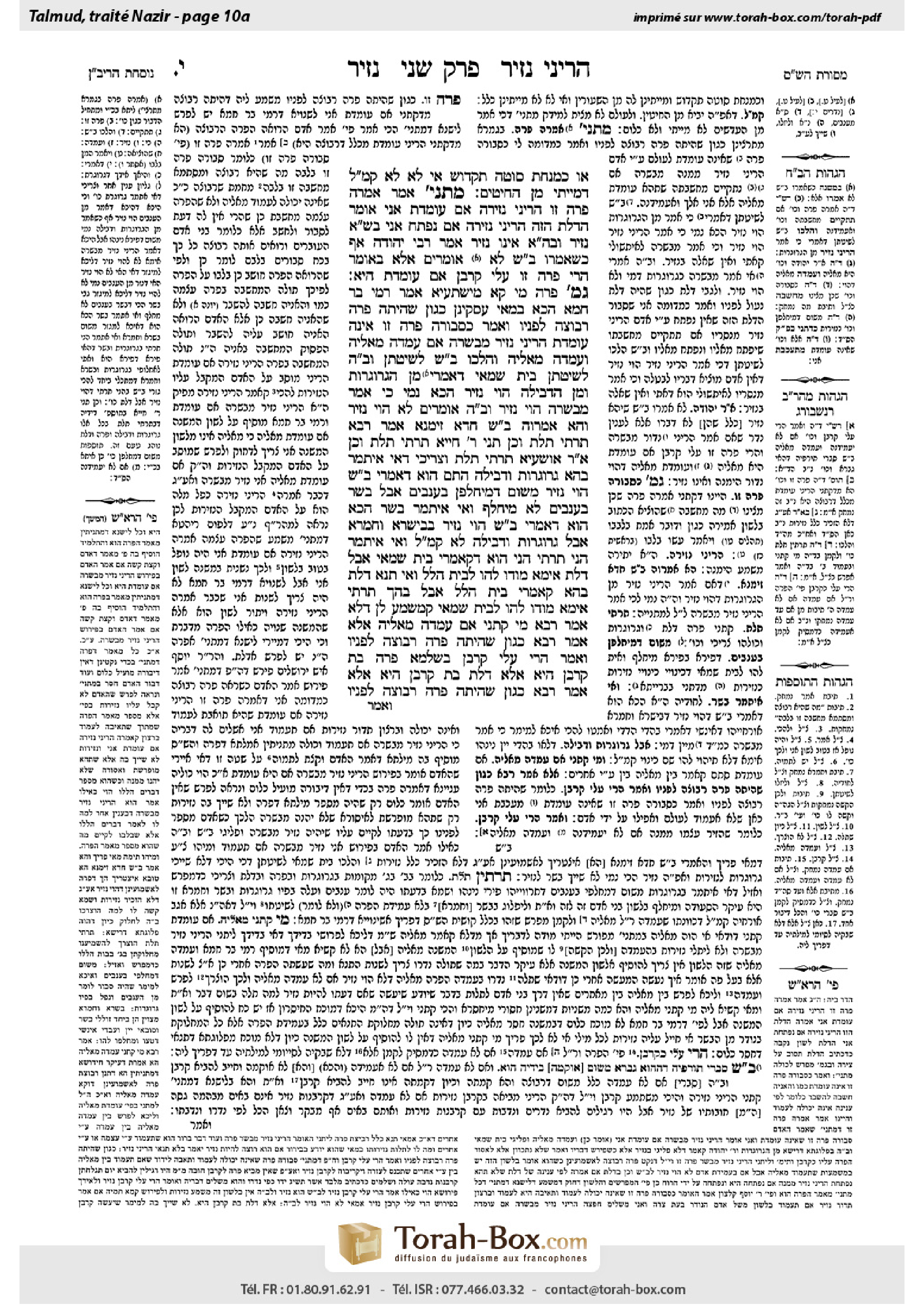
Nazir 10a: Talmud study for Daf Yomi
Daf Yomi is the daily study of one Talmud folio. Explore 37 tractates with scans, Hebrew text, Sefaria English and AI-generated French translations where annotated.
Passage selection and English or AI-generated French translation are available where the scan has annotations. Daf Study is independent of Torah-Box and Sefaria.
Browse Nazir · נזיר · All tractatesNazir 10a text and translations
This page of Nazir includes the Aramaic text, an English translation and an AI-generated French translation, alongside the scan above.
נזיר י׳ א · Aramaic and Hebrew text
אוֹ כְּמִנְחַת סוֹטָה — תִּקְדּוֹשׁ, אִי לָא — לָא. קָא מַשְׁמַע לַן דְּמַיְיתֵי מִן הַחִיטִּים.
מַתְנִי׳ אָמַר: ״אָמְרָה פָּרָה זוֹ הֲרֵינִי נְזִירָה אִם עוֹמֶדֶת אֲנִי״, ״אוֹמֵר הַדֶּלֶת הַזֶּה הֲרֵינִי נְזִירָה אִם נִפְתָּח אֲנִי״ — בֵּית שַׁמַּאי אוֹמְרִים: נָזִיר, וּבֵית הִלֵּל אוֹמְרִים: אֵינוֹ נָזִיר. אָמַר רַבִּי יְהוּדָה: אַף כְּשֶׁאָמְרוּ בֵּית שַׁמַּאי, לֹא אוֹמְרִים אֶלָּא בְּאוֹמֵר ״הֲרֵי פָּרָה זוֹ עָלַי קׇרְבָּן, אִם עוֹמֶדֶת הִיא״.
גְּמָ׳ פָּרָה מִי קָא מִישְׁתַּעְיָא? אָמַר רָמֵי בַּר חָמָא: הָכָא בְּמַאי עָסְקִינַן — כְּגוֹן שֶׁהָיְתָה פָּרָה רְבוּצָה לְפָנָיו, וְאָמַר: ״כִּסְבוּרָה פָּרָה זוֹ אֵינָהּ עוֹמֶדֶת — הֲרֵינִי נָזִיר מִבְּשָׂרָהּ אִם עָמְדָה מֵאֵלֶיהָ״. וְעָמְדָה מֵאֵלֶיהָ. וְהָלְכוּ בֵּית שַׁמַּאי לְשִׁיטָתָן וּבֵית הִלֵּל לְשִׁיטָתָן.
בֵּית שַׁמַּאי דְּאָמְרִי ״מִן הַגְּרוֹגְרוֹת וּמִן הַדְּבֵילָה״ — הָוֵי נָזִיר, הָכָא נָמֵי, כִּי אָמַר ״מִבְּשָׂרָהּ״ — הָוֵי נָזִיר. וּבֵית הִלֵּל אוֹמְרִים: לָא הָוֵי נָזִיר.
וְהָא אַמְרוּהָ בֵּית שַׁמַּאי חֲדָא זִימְנָא! אָמַר רָבָא: תַּרְתֵּי תְּלָת. וְכֵן תָּנֵי רַבִּי חִיָּיא תַּרְתֵּי תְּלָת. וְכֵן אָמַר רַבִּי אוֹשַׁעְיָא תַּרְתֵּי תְּלָת.
וּצְרִיכִי, דְּאִי אִיתְּמַר בְּהָא גְּרוֹגְרוֹת וּדְבֵילָה: הָתָם הוּא דְּאָמְרִי בֵּית שַׁמַּאי הָוֵי נָזִיר, מִשּׁוּם דְּמִיחַלְּפָן בַּעֲנָבִים. אֲבָל בָּשָׂר בַּעֲנָבִים — לָא מִיחַלַּף. וְאִי אִיתְּמַר בָּשָׂר: הָכָא הוּא דְּאָמְרִי בֵּית שַׁמַּאי הָוֵי נָזִיר בְּבִישְׂרָא וְחַמְרָא. אֲבָל גְּרוֹגְרוֹת וּדְבֵילָה — לָא, קָא מַשְׁמַע לַן.
וְאִי אִיתְּמַר הָנֵי תַּרְתֵּי: הָנֵי הוּא דְּקָאָמְרִי בֵּית שַׁמַּאי, אֲבָל דֶּלֶת אֵימָא מוֹדוּ לְהוּ לְבֵית הִלֵּל. וְאִי תַּנָּא דֶּלֶת: בְּהָא קָאָמְרִי בֵּית הִלֵּל, אֲבָל בְּהָךְ תַּרְתֵּי אֵימָא מוֹדוּ לְהוּ לְבֵית שַׁמַּאי, קָמַשְׁמַע לַן דְּלָא.
אָמַר רָבָא: מִי קָתָנֵי ״אִם עָמְדָה מֵאֵלֶיהָ״? אֶלָּא אָמַר רָבָא: כְּגוֹן שֶׁהָיְתָה פָּרָה רְבוּצָה לְפָנָיו, וְאָמַר: ״הֲרֵי עָלַי קׇרְבָּן״. בִּשְׁלָמָא פָּרָה — בַּת קׇרְבָּן הִיא, אֶלָּא דֶּלֶת — בַּת קׇרְבָּן הִיא?! אֶלָּא אָמַר רָבָא: כְּגוֹן שֶׁהָיְתָה פָּרָה רְבוּצָה לְפָנָיו,
Nazir 10a · English translation
or like the meal-offering of a sota, both of which are made of barley, it should become consecrated, and if it is not possible to volunteer a meal-offering from barley, it should not be a meal-offering at all. The mishna therefore teaches us that one nevertheless brings a meal-offering made from wheat. Rabbi Yoḥanan holds that the difficulty raised by Ḥizkiyya against his own explanation is inconclusive, and he need not have retracted it.
MISHNA: If one said: This cow said: I am hereby a nazirite if I stand up; or if he said: This door says: I am hereby a nazirite if I am opened, Beit Shammai say he is a nazirite, and Beit Hillel say he is not a nazirite. Rabbi Yehuda said: Even when Beit Shammai say that the vow is effective, they say so only with regard to one who said: This cow is hereby forbidden to me as an offering if it stands up. In that case it is as if he took a vow that the cow is forbidden. However, Beit Shammai concede that although the vow takes effect, it is not a vow of naziriteship.
GEMARA: The Gemara asks: Does a cow speak? What is the meaning of the statement: A cow said: I am hereby a nazirite? Rami bar Ḥama said: With what are we dealing here? We are dealing with a case where there was a prone cow before him, and he tried, without success, to cause it to stand, and he said: This cow thinks it will not stand; I am hereby a nazirite and therefore will refrain from its flesh if it stands of its own accord, and in fact it stood of its own accord. Beit Shammai follow their standard approach and Beit Hillel follow their standard approach.
The Gemara explains: Beit Shammai, who say that one who vows to be a nazirite and therefore will refrain from dried figs and from cakes of dried figs is a nazirite, say that here too, when he says: I am hereby a nazirite and therefore will refrain from its flesh, is a nazirite. Since one does not utter a statement for naught, he is held to the first part of his statement: I am hereby a nazirite, and the words: And therefore will refrain from its flesh, are disregarded. And Beit Hillel say: He is not a nazirite.
The Gemara raises a difficulty: But if Rami bar Ḥama is correct, didn’t Beit Shammai already say this halakha one time? According to Rami bar Ḥama’s explanation, this mishna and the previous one differ only with regard to the examples provided, but the principle is identical. Rava said: It is normal for the Sages to cite two or three examples from different cases that offer novel perspectives, although they essentially reflect the same principle. And Rabbi Ḥiyya also taught two or three examples with regard to this same issue. And Rabbi Oshaya also said two or three examples.
And all these cases are necessary, as, if it were stated only that he is a nazirite in this case of dried figs and cakes of dried figs, it could have been said that it is only there that Beit Shammai say he is a nazirite, since figs are confused with grapes, and it is reasonable to assume that he had grapes in mind. But meat is certainly not confused with grapes, and it could be that in the case of the mishna he is not a nazirite even according to Beit Shammai. And if it were stated only that he is a nazirite where he vowed that meat was forbidden to him, it could have been said that it is here that Beit Shammai say he is a nazirite because he was referring to the often-paired meat and wine, and it is reasonable to assume that he might have had wine in mind. But dried figs and cakes of dried figs are not paired with wine, so he should not be a nazirite. To counter that claim, the mishna teaches us that he is a nazirite in both cases.
And if it were stated only that he is a nazirite with regard to these two cases of figs and meat, it could be said: It is in these cases that Beit Shammai say he is a nazirite, but in the case of a door, I will say they concede to Beit Hillel that such a statement certainly does not constitute a vow of naziriteship. Therefore, this case had to be stated as well. And conversely, if it taught only the case of a door, the opposite could be said, i.e., that it is in this case that Beit Hillel say there is no naziriteship, but in these two earlier cases I will say they concede to Beit Shammai that the individual has taken a vow of naziriteship. The tanna therefore teaches us that this is not the case; in fact, Beit Shammai hold that he is a nazirite in all three cases, and Beit Hillel hold that he is not.
After providing the answer to one difficulty raised against Rami bar Ḥama’s explanation, Rava presents another problem. Rava said: Is the mishna teaching: If it stood of its own accord? The mishna states: If it stands, and does not mention the condition of: On its own accord. Rather, Rava said: The mishna is referring to a case where there was a prone cow before him, and he said: It is incumbent upon me to bring it as a nazirite offering, and in this way the individual accepts naziriteship upon himself. The Gemara raises a difficulty: Granted, a cow can be an offering, but can a door be an offering? How can his vow that a door should be an offering be considered an acceptance of naziriteship? Rather, Rava said it means the following: It is a case where there was a prone cow before him refusing to stand,
Nazir 10a · Traduction française (IA)
ou comme l’oblation d’une sota, toutes deux étant faites d’orge, elle serait consacrée ; et s’il n’est pas possible de faire don d’une oblation d’orge, il ne devrait pas y avoir d’oblation du tout. La Michna nous enseigne donc que l’on apporte néanmoins une oblation faite de blé. Rabbi Yoḥanan estime que la difficulté que Ḥizkiyya a soulevée contre sa propre explication ne permet pas de conclure et qu’il n’a pas eu à se rétracter.
MICHNA : Si quelqu’un dit : « Cette vache dit : “Me voici nazir si je me lève” », ou s’il dit : « Cette porte dit : “Me voici nazir si je m’ouvre” », Beit Shammaï disent qu’il est nazir, tandis que Beit Hillel disent qu’il ne l’est pas. Rabbi Yehouda dit : Même lorsque Beit Shammaï disent que le vœu prend effet, ils ne le disent qu’au sujet de celui qui a dit : « Cette vache me sera interdite comme une offrande si elle se lève. » Dans ce cas, c’est comme s’il avait fait vœu que la vache lui soit interdite. Toutefois, Beit Shammaï reconnaissent que, bien que le vœu prenne effet, ce n’est pas un vœu de naziréat.
GUEMARA : La Guemara demande : Une vache parle-t-elle ? Que signifie la déclaration : « Une vache a dit : “Me voici nazir” » ? Rami bar Ḥama dit : De quoi s’agit-il ici ? D’un cas où une vache couchée se trouvait devant lui. Il avait essayé sans succès de la faire se lever, puis avait dit : « Cette vache pense qu’elle ne se lèvera pas ; me voici nazir, et je m’abstiendrai donc de manger sa viande si elle se lève d’elle-même. » Or, elle s’est effectivement levée d’elle-même. Beit Shammaï suivent leur approche habituelle, et Beit Hillel suivent la leur.
La Guemara explique : Beit Shammaï, qui disent que celui qui fait vœu d’être nazir afin de s’abstenir de figues sèches et de gâteaux de figues sèches est nazir, disent également ici que, lorsqu’il dit : « Me voici nazir, et je m’abstiendrai donc de manger sa viande », il est nazir. Puisqu’on ne prononce pas de paroles en vain, il est tenu par la première partie de sa déclaration : « Me voici nazir » ; les mots « et je m’abstiendrai donc de manger sa viande » sont écartés. Beit Hillel, eux, disent qu’il n’est pas nazir.
La Guemara soulève une difficulté : Mais si Rami bar Ḥama a raison, Beit Shammaï n’ont-ils pas déjà énoncé cette halakha ? Selon l’explication de Rami bar Ḥama, cette Michna et la précédente ne diffèrent que par les exemples donnés ; le principe, lui, est identique. Rava dit : Il est courant que les Sages citent deux ou trois exemples tirés de cas différents et présentant des aspects nouveaux, bien qu’ils relèvent essentiellement du même principe. Rabbi Ḥiyya a lui aussi enseigné deux ou trois exemples au sujet de cette même question. Rabbi Oshaya a également cité deux ou trois exemples.
Tous ces cas sont nécessaires. En effet, si l’on avait mentionné uniquement le cas des figues sèches et des gâteaux de figues sèches, où il est nazir, on aurait pu dire que Beit Shammaï ne le considèrent nazir que dans ce cas, puisque les figues peuvent être confondues avec des raisins et qu’il est raisonnable de supposer qu’il avait des raisins en tête. Mais la viande ne peut certainement pas être confondue avec des raisins ; il se pourrait donc que, dans le cas de la Michna, il ne soit pas nazir, même selon Beit Shammaï. À l’inverse, si l’on avait mentionné uniquement le cas où il a fait vœu que la viande lui soit interdite, on aurait pu dire que Beit Shammaï ne le considèrent nazir que dans ce cas, parce qu’il faisait référence à la viande et au vin, souvent associés, et qu’il est raisonnable de supposer qu’il avait peut-être du vin en tête. Mais les figues sèches et les gâteaux de figues sèches ne sont pas associés au vin ; il ne devrait donc pas être nazir. Pour écarter cette possibilité, la Michna nous enseigne qu’il est nazir dans les deux cas.
Et si l’on avait mentionné uniquement ces deux cas, celui des figues et celui de la viande, on aurait pu dire : « C’est dans ces cas que Beit Shammaï disent qu’il est nazir ; mais, dans le cas d’une porte, je dirai qu’ils reconnaissent avec Beit Hillel qu’une telle déclaration ne constitue certainement pas un vœu de naziréat. » Il fallait donc également enseigner ce cas. Inversement, si l’on avait enseigné uniquement le cas de la porte, on aurait pu dire le contraire : c’est dans ce cas que Beit Hillel disent qu’il n’y a pas de naziréat, mais, dans les deux cas précédents, ils reconnaissent avec Beit Shammaï que la personne a fait vœu de naziréat. Le tanna nous enseigne donc qu’il n’en est pas ainsi : en réalité, Beit Shammaï considèrent qu’il est nazir dans les trois cas, et Beit Hillel considèrent qu’il ne l’est pas.
Après avoir répondu à une difficulté soulevée contre l’explication de Rami bar Ḥama, Rava en présente une autre. Rava dit : La Michna enseigne-t-elle : « Si elle se lève d’elle-même » ? La Michna dit : « Si elle se lève », sans mentionner la condition « d’elle-même ». Rava dit plutôt que la Michna fait référence à un cas où une vache couchée se trouvait devant lui et où il a dit : « Il m’incombe de l’apporter comme offrande de nazir » ; de cette façon, il s’impose le naziréat. La Guemara soulève une difficulté : Certes, une vache peut être offerte en sacrifice, mais une porte peut-elle l’être ? Comment le vœu de faire d’une porte une offrande peut-il être considéré comme une acceptation du naziréat ? Rava dit plutôt qu’il s’agit du cas où une vache couchée se trouvait devant lui et refusait de se lever,
Traduction française générée par IA à partir de l’édition anglaise de Sefaria. Vérifie toujours un passage avec le texte source.
Text from Sefaria: William Davidson Edition - Vocalized Aramaic (CC BY NC); William Davidson Edition - English (CC BY NC).