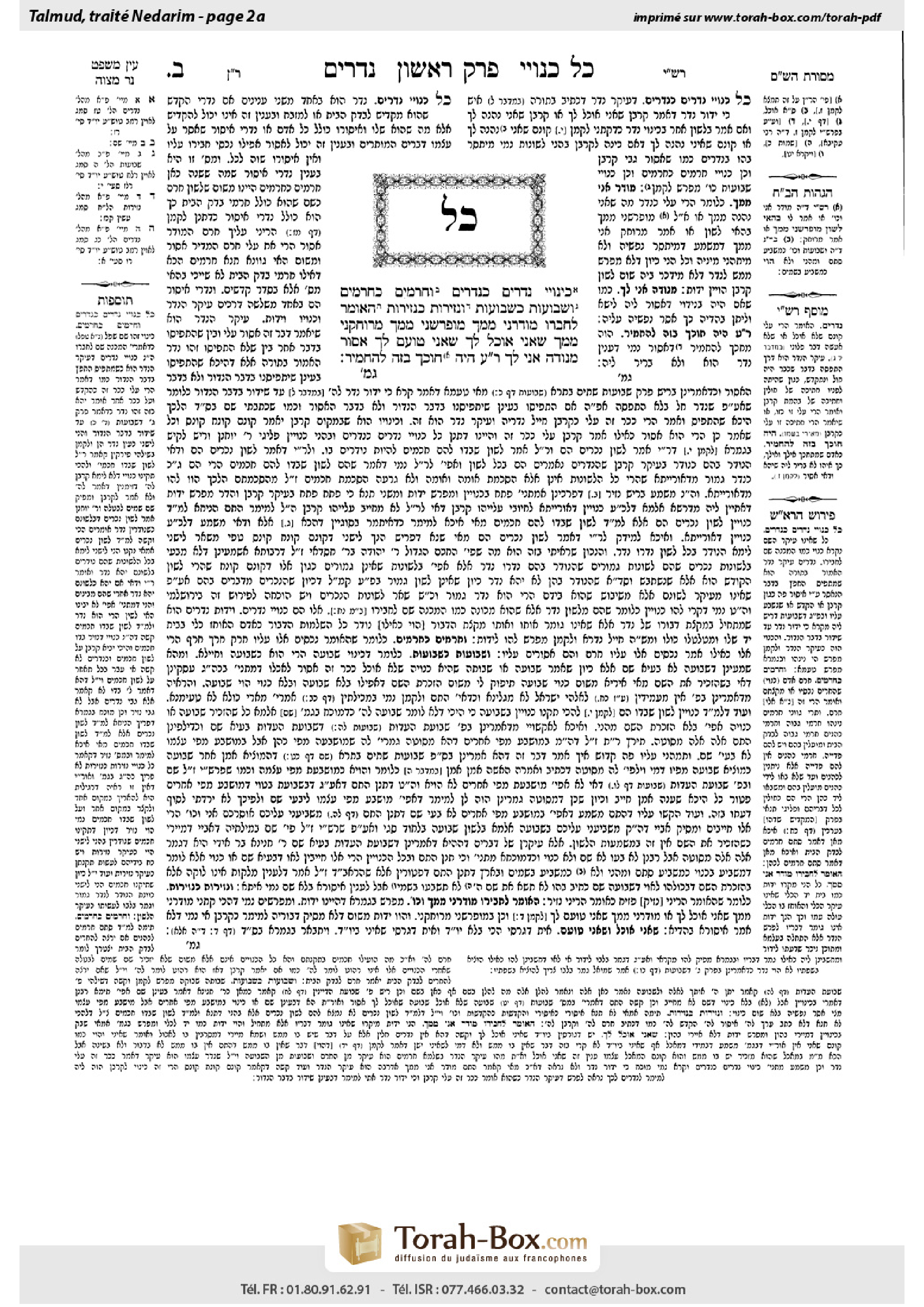
Nedarim 2a: Talmud study for Daf Yomi
Daf Yomi is the daily study of one Talmud folio. Explore 37 tractates with scans, Hebrew text, Sefaria English and AI-generated French translations where annotated.
Passage selection and English or AI-generated French translation are available where the scan has annotations. Daf Study is independent of Torah-Box and Sefaria.
Browse Nedarim · נדרים · All tractatesNedarim 2a text and translations
This page of Nedarim includes the Aramaic text, an English translation and an AI-generated French translation, alongside the scan above.
נדרים ב׳ א · Aramaic and Hebrew text
כָּל כִּינּוּיֵי נְדָרִים — כִּנְדָרִים,
וַחֲרָמִים — כַּחֲרָמִים, וּשְׁבוּעוֹת — כִּשְׁבוּעוֹת, וּנְזִירוּת — כִּנְזִירוּת.
הָאוֹמֵר לַחֲבֵרוֹ ״מוּדְּרַנִי מִמָּךְ״, ״מוּפְרְשַׁנִי מִמָּךְ״, ״מְרוּחֲקַנִי מִמָּךְ״, ״שֶׁאֲנִי אוֹכֵל לָךְ״, ״שֶׁאֲנִי טוֹעֵם לָךְ״ — אָסוּר.
״מְנוּדֶּה אֲנִי לָךְ״, רַבִּי עֲקִיבָא הָיָה חוֹכֵךְ בָּזֶה לְהַחְמִיר.
Nedarim 2a · English translation
MISHNA: When an individual takes a vow, he renders an object forbidden to himself or to others as though it were a sacrificial offering; this parallels the act of consecrating an offering, which also renders an item forbidden for personal use by means of a verbal declaration. The most direct expression of a vow is when an individual says: This object is forbidden to me, or to others, like an offering. Additionally, the mishna states that all substitutes for the language of vows are like vows. Consequently, if one states that an object is forbidden to him like a konam instead of like an offering [korban], the vow takes effect, as konam is a substitute term for the word korban (see 10a).
Similarly, substitutes for the language of dedications are like dedications, substitutes for the language of oaths are like oaths, and substitutes for the language of nazirite vows are like nazirite vows. Therefore, if one declared a ḥerekh instead of a dedication [ḥerem], a shevuta instead of an oath [shevua], or proclaimed that he was becoming a nazik instead of a nazirite [nazir], his statement takes effect.
With regard to one who says to another: I am avowed from you, or: I am separated from you, or: I am distanced from you, and he then says: That which I eat of yours, or: That which I taste of yours, even though he did not explicitly state that he is taking a vow or specify the nature of the vow, the object of his vow is nevertheless forbidden. His intention is understood based on his incomplete statement, known as an intimation of a vow, and his vow therefore takes effect.
However, if he says: I am ostracized from you, which does not clearly declare any matter to be prohibited, Rabbi Akiva was uncertain about this halakha but was inclined to rule stringently about this and consider it a vow prohibiting the speaker from deriving benefit from his fellow.
Nedarim 2a · Traduction française (IA)
MICHNA : Lorsqu’un individu prononce un vœu, il rend un objet interdit à lui-même ou à autrui, comme s’il s’agissait d’une offrande sacrificielle. Cela correspond à l’acte de consacrer une offrande, qui rend lui aussi un objet interdit à l’usage personnel au moyen d’une déclaration verbale. L’expression la plus directe d’un vœu est celle d’un individu qui dit : « Cet objet m’est interdit », ou « Cet objet est interdit à autrui », comme une offrande. En outre, la Michna enseigne que tous les substituts du langage des vœux sont assimilés à des vœux. Par conséquent, si quelqu’un déclare qu’un objet lui est interdit comme konam plutôt que comme une offrande [korban], le vœu prend effet, car konam est un terme substitutif du mot korban (voir 10a).
De même, les substituts du langage des consécrations sont assimilés à des consécrations, les substituts du langage des serments sont assimilés à des serments, et les substituts du langage des vœux de naziréat sont assimilés à des vœux de naziréat. Ainsi, si quelqu’un prononce ḥerekh au lieu d’une consécration [ḥerem], shevuta au lieu d’un serment [shevua], ou proclame qu’il devient un nazik au lieu d’un naziréen [nazir], sa déclaration prend effet.
À propos de celui qui dit à quelqu’un : « Je suis interdit à ton égard », ou : « Je suis séparé de toi », ou : « Je suis éloigné de toi », puis ajoute : « Ce que je mangerai de ce qui t’appartient » ou « Ce que je goûterai de ce qui t’appartient », même s’il n’a pas explicitement déclaré qu’il prononçait un vœu ni précisé la nature de celui-ci, l’objet de son vœu est néanmoins interdit. Son intention se comprend à partir de sa déclaration incomplète, appelée allusion à un vœu ; son vœu prend donc effet.
Cependant, s’il dit : « Je suis mis au ban de toi », formule qui ne déclare clairement rien d’interdit, Rabbi Akiva était incertain quant à cette halakha, mais était enclin à statuer avec rigueur et à considérer qu’il s’agissait d’un vœu interdisant à celui qui le prononce de tirer profit de son prochain.
Traduction française générée par IA à partir de l’édition anglaise de Sefaria. Vérifie toujours un passage avec le texte source.
Text from Sefaria: William Davidson Edition - Vocalized Aramaic (CC BY NC); William Davidson Edition - English (CC BY NC).