Nedarim 2b: Talmud study for Daf Yomi
Daf Yomi is the daily study of one Talmud folio. Explore 37 tractates with scans, Hebrew text, Sefaria English and AI-generated French translations where annotated.
Passage selection and English or AI-generated French translation are available where the scan has annotations. Daf Study is independent of Torah-Box and Sefaria.
Browse Nedarim · נדרים · All tractatesNedarim 2b text and translations
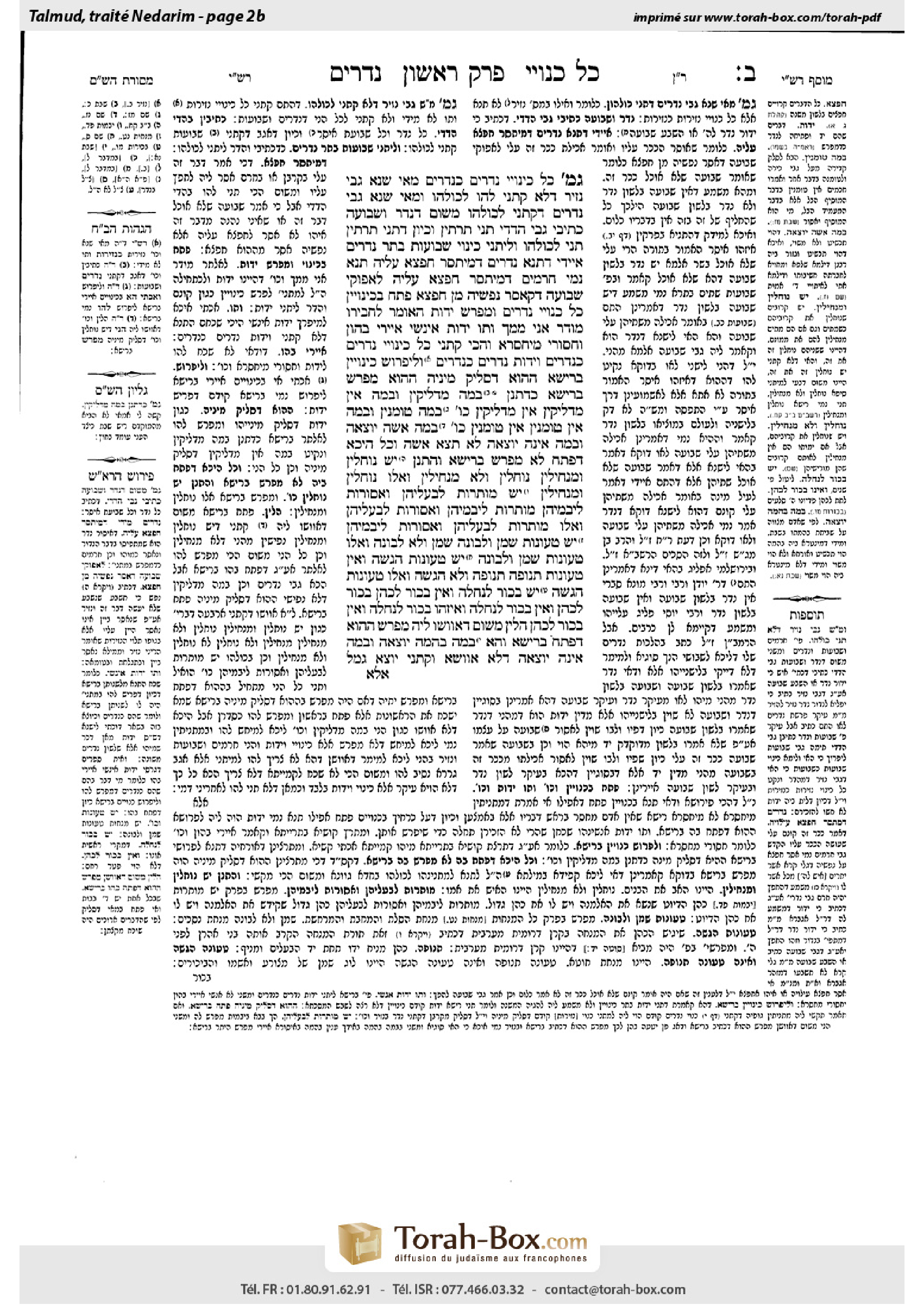
This page of Nedarim includes the Aramaic text, an English translation and an AI-generated French translation, alongside the scan above.
נדרים ב׳ ב · Aramaic and Hebrew text
גְּמָ׳ ״כָּל כִּינּוּיֵי נְדָרִים כִּנְדָרִים״, מַאי שְׁנָא גַּבֵּי נָזִיר דְּלָא קָתָנֵי לְהוּ לְכוּלְּהוּ, וּמַאי שְׁנָא גַּבֵּי נְדָרִים דְּקָתָנֵי לְכוּלְּהוּ?
מִשּׁוּם דְּנֶדֶר וּשְׁבוּעָה כְּתִיבִי גַּבֵּי הֲדָדֵי תָּנֵי תַּרְתֵּין, וְכֵיוָן דְּתָנֵי תַּרְתֵּין — תָּנֵי לְכוּלְּהוּ.
וְלִיתְנֵי כִּינּוּיֵי שְׁבוּעוֹת בָּתַר נְדָרִים! אַיְּידֵי דִּתְנָא נְדָרִים דְּמִיתְּסַר חֶפְצָא עֲלֵיהּ, תְּנָא נָמֵי חֲרָמִים, דְּמִיתְּסַר חֶפְצָא עֲלֵיהּ. לְאַפּוֹקֵי שְׁבוּעָה, דְּקָאָסַר נַפְשֵׁיהּ מִן חֶפְצָא.
פְּתַח בְּכִינּוּיִין ״כָּל כִּנּוּיַי נְדָרִים״, וּמְפָרֵשׁ יָדוֹת: הָאוֹמֵר לַחֲבֵירוֹ ״מוּדָּר אֲנִי מִמָּךְ״! וְתוּ: יָדוֹת אִינְּשִׁי?!
אַיְירִי בְּהוֹן, וְחַסּוֹרֵי מִיחַסְּרָא, וְהָכִי קָתָנֵי: כָּל כִּינּוּיֵי נְדָרִים כִּנְדָרִים, וִידוֹת נְדָרִים כִּנְדָרִים.
וְלִיפְרוֹשׁ כִּינּוּיִין בְּרֵישָׁא!
הָהוּא דְּסָלֵיק מִינֵּיהּ, הָהוּא מְפָרֵשׁ בְּרֵישָׁא. כְּדִתְנַן: בַּמֶּה מַדְלִיקִין וּבַמָּה אֵין מַדְלִיקִין? אֵין מַדְלִיקִין כּוּ׳.
בַּמֶּה טוֹמְנִין וּבַמָּה אֵין טוֹמְנִין? אֵין טוֹמְנִין כּוּ׳. בַּמָּה אִשָּׁה יוֹצְאָה וּבַמָּה אֵינָהּ יוֹצְאָה? לֹא תֵּצֵא אִשָּׁה.
וְכׇל הֵיכָא דְּפָתַח לָא מְפָרֵשׁ בְּרֵישָׁא? וְהָתְנַן: יֵשׁ נוֹחֲלִין וּמַנְחִילִין, נוֹחֲלִין וְלֹא מַנְחִילִין. וְאֵלּוּ נוֹחֲלִין וּמַנְחִילִין.
יֵשׁ מוּתָּרוֹת לְבַעֲלֵיהֶן וַאֲסוּרוֹת לְיִבְמֵיהֶן, מוּתָּרוֹת לְיִבְמֵיהֶן וַאֲסוּרוֹת לְבַעֲלֵיהֶן. וְאֵלּוּ מוּתָּרוֹת לְבַעֲלֵיהֶן וַאֲסוּרוֹת לְיִבְמֵיהֶן.
יֵשׁ טְעוּנוֹת שֶׁמֶן וּלְבוֹנָה, שֶׁמֶן וְלֹא לְבוֹנָה. וְאֵלּוּ טְעוּנוֹת שֶׁמֶן וּלְבוֹנָה. יֵשׁ טְעוּנוֹת הַגָּשָׁה וְאֵין טְעוּנוֹת תְּנוּפָה, תְּנוּפָה וְלֹא הַגָּשָׁה. וְאֵלּוּ טְעוּנוֹת הַגָּשָׁה.
יֵשׁ בְּכוֹר לְנַחֲלָה וְאֵין בְּכוֹר לְכֹהֵן, בְּכוֹר לְכֹהֵן וְאֵין בְּכוֹר לְנַחֲלָה. וְאֵיזֶהוּ בְּכוֹר לְנַחֲלָה וְאֵין בְּכוֹר לְכֹהֵן!
הָלֵין, מִשּׁוּם דְּאָוְושׁוּ לֵיהּ, מְפָרֵשׁ הָהוּא דְּפָתַח בְּרֵישָׁא.
וְהָא בַּמֶּה בְּהֵמָה יוֹצְאָה וּבַמָּה אֵינָהּ יוֹצְאָה דְּלָא אָוְושָׁא, וְקָתָנֵי: יוֹצֵא גָּמָל!
Nedarim 2b · English translation
GEMARA: It was taught in the mishna that all substitutes for the language of vows are like vows, substitutes for the language of dedications are like dedications, substitutes for the language of oaths are like oaths, and substitutes for the language of nazirite vows are like nazirite vows. The Gemara asks: What is different with regard to the first mishna of tractate Nazir that it does not teach all of them, i.e., all of the cases listed above besides nazirite vows, and what is different with regard to the first mishna of tractate Nedarim that it teaches all of them and not merely the case of vows, which is the subject directly relevant to this tractate?
The Gemara answers that due to the fact that vows and oaths are written next to each other in the Torah in the verse: “When a man takes a vow to the Lord, or swears an oath” (Numbers 30:3), the mishna teaches these two cases, i.e., substitutes for the language of vows and oaths. And since it taught two of the cases, it taught all of them.
The Gemara asks: If so, let the mishna teach the halakha with regard to substitutes for the language of oaths immediately after the case of substitutes for the language of vows. The Gemara answers: Since it taught the case of vows, whereby an object becomes forbidden to one, it taught also the case of dedications, whereby an object becomes forbidden to one. This is to the exclusion of an oath, whereby one prohibits himself from making use of an object. In the case of an oath, unlike a vow or a dedication, one prohibits himself from performing a particular action rather than declaring an object to be forbidden.
§ The Gemara asks a question with regard to the style of the mishna: The mishna began with the case of substitutes when it stated: All substitutes for the language of vows are like vows, and it then immediately explains the halakha with regard to intimations of vows, as the next line addresses a case of one who says to his fellow: I am avowed from you. And furthermore, did the tanna forget to mention intimations of vows? Why doesn’t the mishna state that intimations of vows are considered vows before it gives examples of intimations?
The Gemara answers: The mishna is dealing with them, i.e., intimations of vows, and the text of the mishna is incomplete and is teaching the following: All substitutes for the language of vows are like vows, and intimations of vows are like vows. The mishna then continues by giving examples of intimations of vows.
The Gemara asks: Let the mishna explain the case of substitutes for the language of vows first, i.e., before it gives examples of intimations, just as the basic halakha of substitutes for the language of vows was mentioned first. In fact, it is not until later (10a) that the mishna provides examples of substitutes for the language of vows.
The Gemara answers: The general style of the Mishna is that the subject with which it concludes is the one that it explains first, as in that which we learned in a mishna (Shabbat 20b): With what may one light the Shabbat lamp and with what may one not light it? One may not light with cedar bast, etc. The mishna provides examples of items one may not use to light the Shabbat lamp, which was the concluding phrase of the mishna’s introductory question, rather than beginning with examples of what one may use to light the Shabbat lamp.
Similarly, another mishna (Shabbat 47b) states: In what may one insulate a pot of cooked food on Shabbat eve, and in what may one not insulate it? One may not insulate it, etc. A third example of this style is in the following mishna (Shabbat 57a): With what items may a woman go out into the public domain on Shabbat and with what items may she not go out? A woman may not go out with strings of wool and other adornments that she may take off and carry.
The Gemara challenges this explanation: And is it true that wherever it begins, i.e., whichever topic the mishna mentions first, it does not explain first? But didn’t we learn in a mishna (Bava Batra 108a): There are some relatives who inherit and bequeath, e.g., a father and a son, who inherit property from each other, and there are those who inherit but do not bequeath, e.g., a son and his mother; and these are the ones who inherit and bequeath, etc. This mishna provides examples of the opening line of the introductory statement before providing examples of the concluding line of the introductory statement.
Similarly, another mishna (Yevamot 84a) states: There are some women who are permitted to their husbands and forbidden to their yevamin, i.e., their husband’s brothers if their husbands die childless. These cases include one where the yavam is the High Priest, who is prohibited from marrying a widow. There are other women who are permitted to their yevamin if their husbands die childless but forbidden to their husbands, e.g., if a High Priest betrothed a widow and his brother is a common priest. The mishna immediately provides the details of the first principle: And these are the women who are permitted to their husbands and forbidden to their yevamin.
Similarly, another mishna (Menaḥot 59a) states with regard to meal-offerings: There are some meal-offerings that require oil and frankincense and some that require oil but not frankincense. The mishna continues: And these are the ones that require oil and frankincense. Yet another mishna (Menaḥot 60a) states: There are meal-offerings that require bringing near, a ritual where the priests were required to carry the offering in their hands and bring it near the altar, and they do not require waving; other meal-offerings require waving but not bringing near. And these are the meal-offerings that require bringing near.
Another mishna (Bekhorot 46a) states: There are some who are considered a firstborn with regard to receiving a double portion of inheritance, as they are the firstborn of their fathers, and they are not considered a firstborn with regard to a priest, i.e., with regard to the mitzva of redemption of the firstborn, which applies only to a woman’s firstborn son. There are others who are considered a firstborn with regard to a priest and are not considered a firstborn with regard to inheritance. And who is considered a firstborn with regard to inheritance who is not a firstborn with regard to a priest? In each of these five cases, the mishna first explains the opening portion of its introductory statement and only then explains the second part of its introductory statement.
The Gemara explains: In these cases, because there are many [avshu] categories, the mishna explains the statement with which it began first. However, when there are only two categories, the mishna first provides detail for the latter part of its opening statement.
The Gemara asks: Didn’t the mishna (Shabbat 51b) state: With what may an animal go out into the public domain on Shabbat and with what may it not go out? This is a case that does not have many categories, and yet the mishna teaches: A camel may go out on Shabbat with an afsar, etc., which clarifies the opening portion of the mishna’s introductory statement.
Nedarim 2b · Traduction française (IA)
GUEMARA : La Michna enseigne que tous les substituts aux termes des vœux valent comme des vœux, les substituts aux termes des consécrations comme des consécrations, les substituts aux termes des serments comme des serments, et les substituts aux termes des vœux de naziréat comme des vœux de naziréat. La Guemara demande : Pourquoi la première Michna du traité Nazir n’enseigne-t-elle pas tous ces cas, c’est-à-dire tous ceux qui sont énumérés ci-dessus, à l’exception des vœux de naziréat, tandis que la première Michna du traité Nedarim les enseigne tous, au lieu de ne traiter que des vœux, qui sont directement le sujet de ce traité ?
La Guemara répond : Puisque les vœux et les serments sont mentionnés côte à côte dans la Torah, dans le verset : « Lorsqu’un homme fait un vœu à l’Éternel ou prête serment » (Nombres 30,3), la Michna enseigne ces deux cas, c’est-à-dire les substituts aux termes des vœux et des serments. Et puisqu’elle a enseigné deux de ces cas, elle les a tous enseignés.
La Guemara demande : Dans ce cas, que la Michna enseigne la halakha concernant les substituts aux termes des serments immédiatement après ceux des vœux. La Guemara répond : Puisqu’elle a enseigné le cas des vœux, par lesquels un objet devient interdit à une personne, elle a également enseigné celui des consécrations, par lesquelles un objet devient interdit à une personne. Cela exclut le serment, par lequel une personne s’interdit d’utiliser un objet. Dans le cas d’un serment, contrairement à celui d’un vœu ou d’une consécration, on s’interdit d’accomplir une action particulière, au lieu de déclarer un objet interdit.
§ La Guemara pose une question sur la formulation de la Michna : celle-ci commence par les substituts, en disant : « Tous les substituts aux termes des vœux valent comme des vœux », puis traite immédiatement de la halakha concernant les allusions aux vœux, puisque la ligne suivante évoque le cas où quelqu’un dit à son prochain : « Je suis voué à toi. » En outre, le tanna a-t-il oublié de mentionner les allusions aux vœux ? Pourquoi la Michna ne dit-elle pas que les allusions aux vœux sont considérées comme des vœux avant d’en donner des exemples ?
La Guemara répond : La Michna traite de ces cas, c’est-à-dire des allusions aux vœux, mais son texte est incomplet. Elle enseigne ce qui suit : Tous les substituts aux termes des vœux valent comme des vœux, et les allusions aux vœux valent comme des vœux. La Michna poursuit ensuite en donnant des exemples d’allusions aux vœux.
La Guemara demande : Que la Michna explique d’abord le cas des substituts aux termes des vœux, c’est-à-dire avant de donner des exemples d’allusions, tout comme la halakha générale concernant les substituts aux termes des vœux a été mentionnée en premier. En fait, la Michna ne donne des exemples de substituts aux termes des vœux que plus loin (10a).
La Guemara répond : En général, la Michna explique d’abord le sujet par lequel elle conclut, comme dans cette Michna (Chabbat 20b) : « Avec quoi peut-on allumer la lampe de Chabbat, et avec quoi ne peut-on pas l’allumer ? » On ne peut pas l’allumer avec de l’écorce de cèdre, etc. La Michna donne des exemples de matières qu’on ne peut pas utiliser pour allumer la lampe de Chabbat, sujet qui figurait dans la dernière partie de sa question introductive, au lieu de commencer par des exemples de matières qu’on peut utiliser pour l’allumer.
De même, une autre Michna (Chabbat 47b) enseigne : « Avec quoi peut-on isoler une marmite contenant un plat cuit, à la veille de Chabbat, et avec quoi ne peut-on pas l’isoler ? » On ne peut pas l’isoler, etc. Un troisième exemple de ce type se trouve dans la Michna suivante (Chabbat 57a) : « Avec quels objets une femme peut-elle sortir dans le domaine public pendant Chabbat, et avec quels objets ne peut-elle pas sortir ? » Une femme ne peut pas sortir avec des fils de laine ni avec d’autres ornements qu’elle pourrait retirer et transporter.
La Guemara conteste cette explication : Est-il vrai que, quel que soit le sujet par lequel la Michna commence, c’est-à-dire le premier sujet qu’elle mentionne, elle ne l’explique pas en premier ? N’avons-nous pas appris dans une Michna (Bava Batra 108a) : « Certains proches héritent les uns des autres, par exemple un père et un fils, qui héritent l’un de l’autre ; d’autres héritent, mais ne transmettent pas d’héritage, par exemple un fils et sa mère ; et voici ceux qui héritent les uns des autres », etc. Cette Michna donne des exemples de la première partie de son énoncé introductif avant de donner des exemples de la dernière partie.
De même, une autre Michna (Yevamot 84a) enseigne : « Certaines femmes sont permises à leurs maris et interdites à leurs yevamim », c’est-à-dire aux frères de leurs maris si ceux-ci meurent sans enfant. Ces cas comprennent celui où le yavam est le grand prêtre, qui ne peut pas épouser une veuve. « D’autres femmes sont permises à leurs yevamim si leurs maris meurent sans enfant, mais interdites à leurs maris », par exemple si un grand prêtre a contracté les eroussin avec une veuve et que son frère est un prêtre ordinaire. La Michna détaille immédiatement le premier principe : « Et voici les femmes qui sont permises à leurs maris et interdites à leurs yevamim. »
De même, une autre Michna (Menaḥot 59a) enseigne, au sujet des offrandes végétales : « Certaines offrandes végétales requièrent de l’huile et de l’encens, et certaines requièrent de l’huile mais pas d’encens. » La Michna poursuit : « Et voici celles qui requièrent de l’huile et de l’encens. » Une autre Michna encore (Menaḥot 60a) enseigne : « Certaines offrandes végétales doivent faire l’objet de la présentation, rite au cours duquel les prêtres devaient porter l’offrande dans leurs mains et l’approcher de l’autel, mais ne requièrent pas de balancement ; d’autres offrandes végétales requièrent le balancement, mais pas la présentation. Et voici les offrandes végétales qui requièrent la présentation. »
Une autre Michna (Bekhorot 46a) enseigne : « Certains sont considérés comme premiers-nés pour recevoir une double part d’héritage, puisqu’ils sont les premiers-nés de leur père, mais ne sont pas considérés comme premiers-nés à l’égard du prêtre », c’est-à-dire pour la mitsva du rachat du premier-né, qui ne s’applique qu’au premier fils d’une femme. « D’autres sont considérés comme premiers-nés à l’égard du prêtre, mais ne sont pas considérés comme premiers-nés pour l’héritage. Et qui est considéré comme premier-né pour l’héritage sans l’être à l’égard du prêtre ? » Dans chacun de ces cinq cas, la Michna explique d’abord la première partie de son énoncé introductif, puis la seconde partie seulement.
La Guemara explique : Dans ces cas, parce qu’il y a de nombreuses catégories [avshu], la Michna explique d’abord l’énoncé par lequel elle commence. En revanche, lorsqu’il n’y a que deux catégories, la Michna détaille d’abord la dernière partie de son énoncé introductif.
La Guemara demande : La Michna (Chabbat 51b) n’a-t-elle pas dit : « Avec quoi un animal peut-il sortir dans le domaine public pendant Chabbat, et avec quoi ne peut-il pas sortir ? » Ce cas ne comporte pas de nombreuses catégories, et pourtant la Michna enseigne : « Un chameau peut sortir pendant Chabbat avec un afsar », etc., ce qui précise la première partie de son énoncé introductif.
Traduction française générée par IA à partir de l’édition anglaise de Sefaria. Vérifie toujours un passage avec le texte source.
Text from Sefaria: William Davidson Edition - Vocalized Aramaic (CC BY NC); William Davidson Edition - English (CC BY NC).