Nedarim 3a: Talmud study for Daf Yomi
Daf Yomi is the daily study of one Talmud folio. Explore 37 tractates with scans, Hebrew text, Sefaria English and AI-generated French translations where annotated.
Passage selection and English or AI-generated French translation are available where the scan has annotations. Daf Study is independent of Torah-Box and Sefaria.
Browse Nedarim · נדרים · All tractatesNedarim 3a text and translations
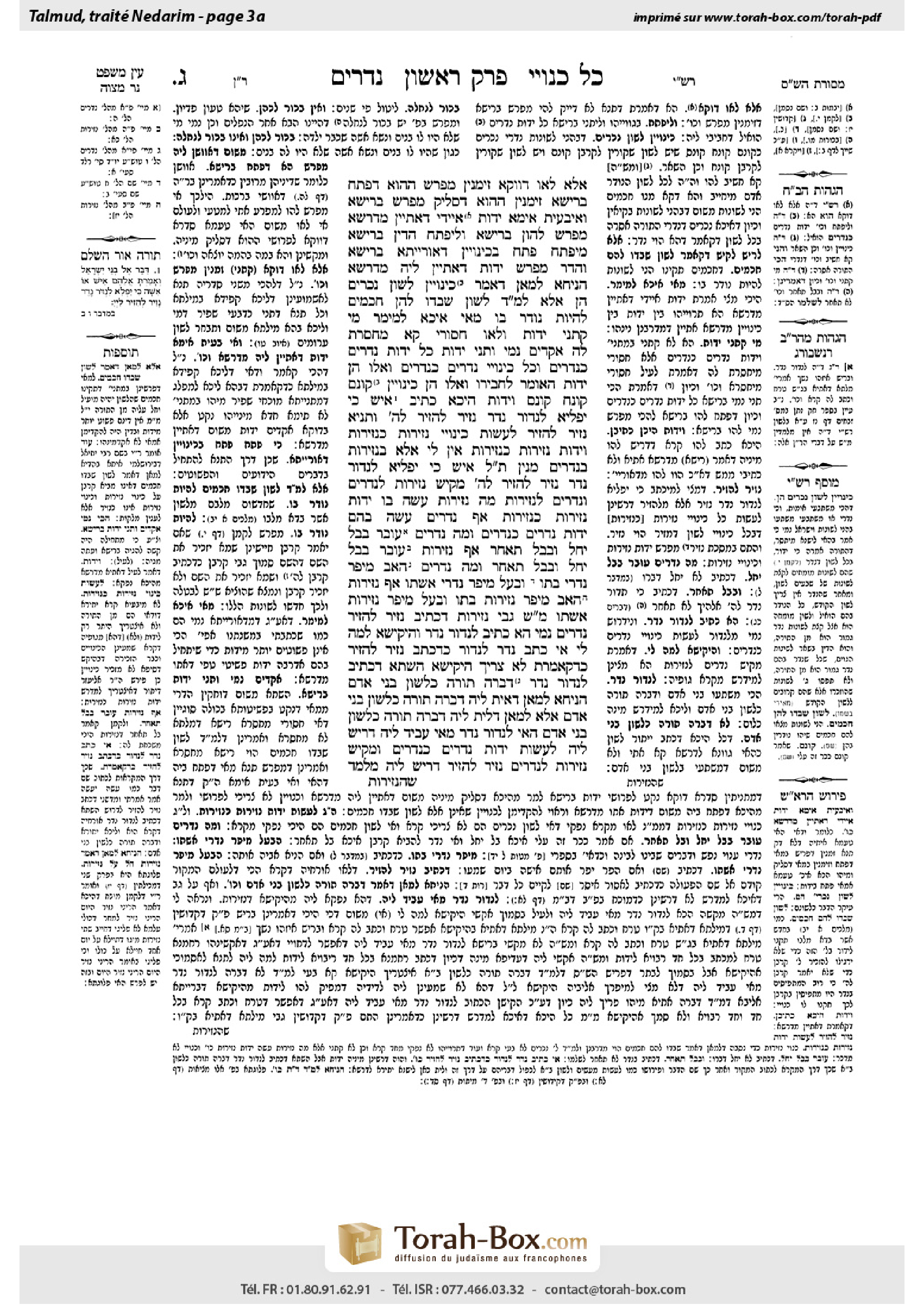
This page of Nedarim includes the Aramaic text, an English translation and an AI-generated French translation, alongside the scan above.
נדרים ג׳ א · Aramaic and Hebrew text
אֶלָּא לָאו דַּוְוקָא: זִימְנִין מְפָרֵשׁ הָהוּא דִּפְתַח בְּרֵישָׁא, זִימְנִין הָהוּא דְּסָלֵיק מְפָרֵשׁ בְּרֵישָׁא. וְאִיבָּעֵית אֵימָא: יָדוֹת אַיְּידֵי דְּאָתְיָין מִדְּרָשָׁא, מְפָרֵשׁ לְהוֹן בְּרֵישָׁא.
וְלִיפְתַּח הָדֵין בְּרֵישָׁא! מִיפְתָּח פָּתַח בְּכִינּוּיִין דְּאוֹרָיְיתָא בְּרֵישָׁא, וַהֲדַר מְפָרֵשׁ יָדוֹת דְּאָתְיָין לֵיהּ מִדְּרָשָׁא.
הָנִיחָא לְמַאן דְּאָמַר כִּינּוּיִין לְשׁוֹן נָכְרִים הֵן. אֶלָּא לְמַאן דְּאָמַר לָשׁוֹן שֶׁבָּדוּ לָהֶן חֲכָמִים לִהְיוֹת נוֹדֵר בּוֹ, מַאי אִיכָּא לְמֵימַר?
מִי קָתָנֵי יָדוֹת? וְלָאו חַסּוֹרֵי קָא מְחַסְּרַתְּ לַהּ? אַקְדֵּים נָמֵי וּתְנִי יָדוֹת: כָּל יְדוֹת נְדָרִים כִּנְדָרִים, וְכׇל כִּינּוּיֵי נְדָרִים כִּנְדָרִים, וְאֵלּוּ הֵן יָדוֹת: הָאוֹמֵר לַחֲבֵירוֹ, וְאֵלּוּ הֵן כִּינּוּיִין: קֻוֽנָּם, קוּנָּח, קוּנָּס.
וְיָדוֹת הֵיכָא כְּתִיב? ״אִישׁ כִּי יַפְלִא לִנְדֹּר נֶדֶר נָזִיר לְהַזִּיר לַה׳״, וְתַנְיָא: ״נָזִיר לְהַזִּיר״ — לַעֲשׂוֹת כִּינּוּיֵי נְזִירוּת כִּנְזִירוּת, וִידוֹת נְזִירוּת כִּנְזִירוּת.
אֵין לִי אֶלָּא בִּנְזִירוּת, בִּנְדָרִים מִנַּיִן? תַּלְמוּד לוֹמַר: ״אִישׁ כִּי יַפְלִא לִנְדֹּר נֶדֶר נָזִיר לְהַזִּיר לַה׳״, מַקִּישׁ נְזִירוּת לִנְדָרִים וּנְדָרִים לִנְזִירוּת; מָה נְזִירוּת עָשָׂה בּוֹ יְדוֹת נְזִירוּת כִּנְזִירוּת — אַף נְדָרִים עָשָׂה בָּהֶם יְדוֹת נְדָרִים כִּנְדָרִים.
וּמָה נְדָרִים עוֹבֵר בְּ״בַל יַחֵל״. וּבְ״בַל תְּאַחֵר״ — אַף נְזִירוּת עוֹבֵר בְּ״בַל יַחֵל״ וּבְ״בַל תְּאַחֵר״. וּמָה נְדָרִים הָאָב מֵיפֵר נִדְרֵי בִתּוֹ וּבַעַל מֵיפֵר נִדְרֵי אִשְׁתּוֹ — אַף נְזִירוּת הָאָב מֵיפֵר נְזִירוּת בִּתּוֹ וּבַעַל מֵיפֵר נְזִירוּת אִשְׁתּוֹ.
מַאי שְׁנָא גַּבֵּי נְזִירוּת דִּכְתִיב ״נָזִיר לְהַזִּיר״, נְדָרִים נָמֵי הָא כְּתִיב ״לִנְדֹּר נֶדֶר״, וְהֶיקֵּישָׁא לְמָה לִי?
אִי כְּתַב ״נֶדֶר לִנְדֹּר״ כְּדִכְתַב ״נָזִיר לְהַזִּיר״ — כִּדְקָאָמְרַתְּ, לָא צָרִיךְ הֶיקֵּישָׁא. הַשְׁתָּא דִּכְתִיב ״לִנְדֹּר נֶדֶר״, דִּבְּרָה תוֹרָה כִלְשׁוֹן בְּנֵי אָדָם.
הָנִיחָא לְמַאן דְּאִית לֵיהּ דִּבְּרָה תּוֹרָה כִּלְשׁוֹן בְּנֵי אָדָם, אֶלָּא לְמַאן דְּלֵית לֵיהּ דִּבְּרָה תּוֹרָה כִּלְשׁוֹן בְּנֵי אָדָם, הַאי ״לִנְדֹּר נֶדֶר״ מַאי עָבֵיד לֵיהּ? דָּרֵישׁ לֵיהּ: לַעֲשׂוֹת יְדוֹת נְדָרִים כִּנְדָרִים, וּמַקִּישׁ נְזִירוּת לִנְדָרִים. ״נָזִיר לְהַזִּיר״ דָּרֵישׁ לֵיהּ: מְלַמֵּד
Nedarim 3a · English translation
Rather, the Mishna is not particular with regard to this matter, and there is no consistent pattern. Sometimes it explains first that subject with which it began, and sometimes it explains first that subject with which the introductory line in the mishna finished. And if you wish, say an alternate explanation of the order of the mishna here: With regard to intimations, since they are derived from the exposition of verses and are not explicitly mentioned in the Torah, the tanna cherishes them and explains them first.
The Gemara asks: If so, let him begin the mishna with that, i.e., intimations, first. The Gemara answers: The tanna begins with substitutes for the language of vows, which are written in the Torah, in the first clause, and then explains intimations, which are derived from the exposition of verses.
The Gemara asks: This works out well according to the one who said that substitutes for the language of vows are terms for vows in a foreign language. Consequently, they may be considered to have been written in the Torah, as vows are certainly valid regardless of the language in which they are expressed. However, according to the one who says that these substitute terms are simply language that the Sages invented for one to use in taking a vow so as to minimize using God’s name in expressing a vow, what can be said? These include novelties just as intimations do.
The Gemara responds: Does the mishna explicitly teach the halakha of intimations of vows? Do you not consider it incomplete, missing the phrase that mentions intimations? Once you are inserting this phrase into the mishna, you can also have it precede the clause about substitutes for the language of vows and teach the halakha of intimations at the beginning, so that the mishna reads as follows: All intimations of vows are like vows, and all substitutes for the language of vows are like vows. And these are intimations: One who says to his fellow: I am avowed from you, etc. And these are substitutes for the language of vows: Konam, konaḥ, konas.
§ Apropos the discussion of intimations of vows, the Gemara asks: And where are intimations of vows written, i.e., from where in the Torah is the halakha of intimations of vows derived? The Gemara explains that it is from the verse: “When a man or a woman shall clearly utter a vow, the vow of a nazirite [nazir], to consecrate [lehazir] himself to the Lord” (Numbers 6:2). And it was taught in a baraita that the doubled term “nazir lehazir” serves to render substitutes for the language of nazirite vows like nazirite vows, and intimations of nazirite vows like nazirite vows.
I have derived only intimations of nazirite vows; from where do I derive intimations of general vows? The verse states: “When a man or woman shall clearly utter a vow, the vow of a nazirite, to consecrate himself to the Lord.” This verse juxtaposes nazirite vows to other vows and other vows to nazirite vows: Just as with regard to nazirite vows, the verse rendered intimations of nazirite vows like nazirite vows, so too, with regard to vows, it rendered intimations of vows like vows.
And just as with regard to vows, one who breaks his vow transgresses the prohibition: He shall not profane (see Numbers 30:3), and if he does not fulfill his vow in time, he transgresses the prohibition: You shall not delay (see Deuteronomy 23:22), so too, with regard to nazirite vows, he transgresses the prohibition: He shall not profane, and the prohibition: You shall not delay. And furthermore, just as with regard to vows, a father may nullify the vows of his daughter and a husband may nullify the vows of his wife, as written explicitly in the passage concerning vows (Numbers, chapter 30), so too, with regard to nazirite vows, a father may nullify the nazirite vows of his daughter and a husband may nullify the nazirite vows of his wife.
The Gemara questions this explanation: What is different with regard to nazirite vows, with regard to which it is written “nazir lehazir,” using the doubled term, when with regard to all vows as well it is written: “To utter a vow [lindor neder],” also using a doubled term? Why do I need the juxtaposition of all other vows to nazirite vows in order to derive that intimations of vows are like vows, when this can be derived from the doubled term with regard to general vows?
The Gemara answers: If the Torah had written: A vow to utter [neder lindor], as it wrote with regard to a nazirite: “The vow of a nazirite, to consecrate himself [nazir lehazir],” it would be as you said, and there would be no need for the juxtaposition. Now that it is written: “To utter a vow [lindor neder],” it is possible to say that the Torah spoke in the language of men, and nothing can be derived from the phrase lindor neder, which is simply a common manner of speech.
The Gemara asks: This works out well according to the one who holds that the Torah spoke in the language of men, but according to the one who does not hold that the Torah spoke in the language of men, any doubled term comes to teach something. What does he do with this phrase: “To utter a vow [lindor neder]”? The Gemara answers: He expounds it to render intimations of vows like vows themselves. And the verse juxtaposes nazirite vows to other vows to teach that intimations of vows are like vows with regard to nazirite vows, and to teach the other halakhot mentioned above. With regard to the phrase: “The vow of a nazirite, to consecrate himself [nazir lehazir],” he expounds: This teaches
Nedarim 3a · Traduction française (IA)
La Michna, plutôt, n’est pas rigoureuse sur ce point et ne suit pas d’ordre constant. Parfois, elle explique d’abord le sujet qu’elle a commencé à traiter, et parfois celui qui clôt la phrase introductive de la Michna. Et si tu préfères, voici une autre explication de l’ordre de la Michna ici : s’agissant des allusions, puisqu’elles sont déduites de l’interprétation des versets et ne sont pas mentionnées explicitement dans la Torah, le tanna leur accorde une importance particulière et les explique en premier.
La Guemara demande : Si c’est ainsi, qu’il commence la Michna par cela, c’est-à-dire par les allusions. La Guemara répond : Dans la première partie, le tanna commence par les substituts des termes de vœu, qui sont écrits dans la Torah, puis explique les allusions, qui sont déduites de l’interprétation des versets.
La Guemara demande : Cela se comprend selon celui qui dit que les substituts des termes de vœu sont des termes désignant des vœux dans une langue étrangère. On peut donc considérer qu’ils sont écrits dans la Torah, puisque les vœux sont assurément valides quelle que soit la langue dans laquelle ils sont exprimés. Toutefois, selon celui qui dit que ces termes de substitution sont simplement des expressions inventées par les Sages pour qu’on les emploie en faisant un vœu, afin de réduire l’usage du nom de Dieu dans l’expression d’un vœu, que peut-on dire ? Ces termes, eux aussi, sont des nouveautés, tout comme les allusions.
La Guemara répond : La Michna enseigne-t-elle explicitement la halakha des allusions aux vœux ? Ne considères-tu pas qu’elle est lacunaire, puisqu’il manque la formule qui mentionne les allusions ? Puisque tu insères cette formule dans la Michna, tu peux aussi la placer avant la partie consacrée aux substituts des termes de vœu et enseigner la halakha des allusions au début, de sorte que la Michna se lise ainsi : « Toutes les allusions aux vœux sont comme des vœux, et tous les substituts des termes de vœu sont comme des vœux. » Et voici des allusions : celui qui dit à son prochain : « Je suis interdit à toi », etc. Et voici des substituts des termes de vœu : konam, konaḥ, konas.
§ À propos de la discussion sur les allusions aux vœux, la Guemara demande : Et où les allusions aux vœux sont-elles écrites, c’est-à-dire de quel passage de la Torah déduit-on la halakha des allusions aux vœux ? La Guemara explique qu’elle est tirée du verset : « Lorsqu’un homme ou une femme prononcera clairement un vœu, le vœu de nazir [nazir], pour se consacrer [lehazir] à l’Éternel » (Nombres 6,2). Et il a été enseigné dans une baraïta que l’expression redoublée « nazir lehazir » sert à assimiler les substituts des termes des vœux de naziréat aux vœux de naziréat, et les allusions aux vœux de naziréat aux vœux de naziréat.
Je n’ai déduit que les allusions aux vœux de naziréat ; d’où déduis-je les allusions aux vœux ordinaires ? Le verset dit : « Lorsqu’un homme ou une femme prononcera clairement un vœu, le vœu de naziréat, pour se consacrer à l’Éternel. » Ce verset met en parallèle les vœux de naziréat et les autres vœux, et les autres vœux et les vœux de naziréat : de même que, pour les vœux de naziréat, le verset a assimilé les allusions aux vœux de naziréat aux vœux de naziréat, de même, pour les vœux, il a assimilé les allusions aux vœux aux vœux.
De même que, pour les vœux, celui qui viole son vœu transgresse l’interdit « Il ne profanera pas » (voir Nombres 30,3), et que, s’il n’accomplit pas son vœu à temps, il transgresse l’interdit « Tu ne tarderas pas » (voir Deutéronome 23,22), de même, pour les vœux de naziréat, il transgresse les interdits « Il ne profanera pas » et « Tu ne tarderas pas ». En outre, de même que, pour les vœux, un père peut annuler les vœux de sa fille et un mari ceux de sa femme, comme cela est écrit explicitement dans le passage relatif aux vœux (Nombres, chapitre 30), de même, pour les vœux de naziréat, un père peut annuler les vœux de naziréat de sa fille et un mari ceux de naziréat de sa femme.
La Guemara conteste cette explication : En quoi les vœux de naziréat diffèrent-ils, puisque l’expression redoublée « nazir lehazir » y figure, alors que, pour tous les vœux également, il est écrit « prononcer un vœu [lindor neder] », expression elle aussi redoublée ? Pourquoi ai-je besoin du rapprochement entre tous les autres vœux et les vœux de naziréat pour déduire que les allusions aux vœux sont comme des vœux, alors que cela peut être déduit de l’expression redoublée concernant les vœux ordinaires ?
La Guemara répond : Si la Torah avait écrit « un vœu à prononcer [neder lindor] », comme elle l’a écrit à propos du naziréat : « le vœu de naziréat, pour se consacrer [nazir lehazir] », ce serait comme tu l’as dit, et le rapprochement ne serait pas nécessaire. Mais puisqu’elle écrit « prononcer un vœu [lindor neder] », on peut dire que la Torah s’exprime selon le langage des hommes, et qu’on ne peut rien déduire de l’expression lindor neder, qui relève simplement d’une manière courante de parler.
La Guemara demande : Cela se comprend selon celui qui soutient que la Torah s’exprime selon le langage des hommes ; mais selon celui qui ne soutient pas que la Torah s’exprime selon le langage des hommes, toute expression redoublée vient enseigner quelque chose. Que fait-il de cette expression : « prononcer un vœu [lindor neder] » ? La Guemara répond : Il l’interprète comme enseignant que les allusions aux vœux sont comme les vœux eux-mêmes. Le verset rapproche les vœux de naziréat des autres vœux pour enseigner que les allusions aux vœux sont comme des vœux en ce qui concerne les vœux de naziréat, et pour enseigner les autres halakhot mentionnées plus haut. Quant à l’expression « le vœu de naziréat, pour se consacrer [nazir lehazir] », il l’interprète ainsi : cela enseigne
Traduction française générée par IA à partir de l’édition anglaise de Sefaria. Vérifie toujours un passage avec le texte source.
Text from Sefaria: William Davidson Edition - Vocalized Aramaic (CC BY NC); William Davidson Edition - English (CC BY NC).