Nedarim 3b: Talmud study for Daf Yomi
Daf Yomi is the daily study of one Talmud folio. Explore 37 tractates with scans, Hebrew text, Sefaria English and AI-generated French translations where annotated.
Passage selection and English or AI-generated French translation are available where the scan has annotations. Daf Study is independent of Torah-Box and Sefaria.
Browse Nedarim · נדרים · All tractatesNedarim 3b text and translations
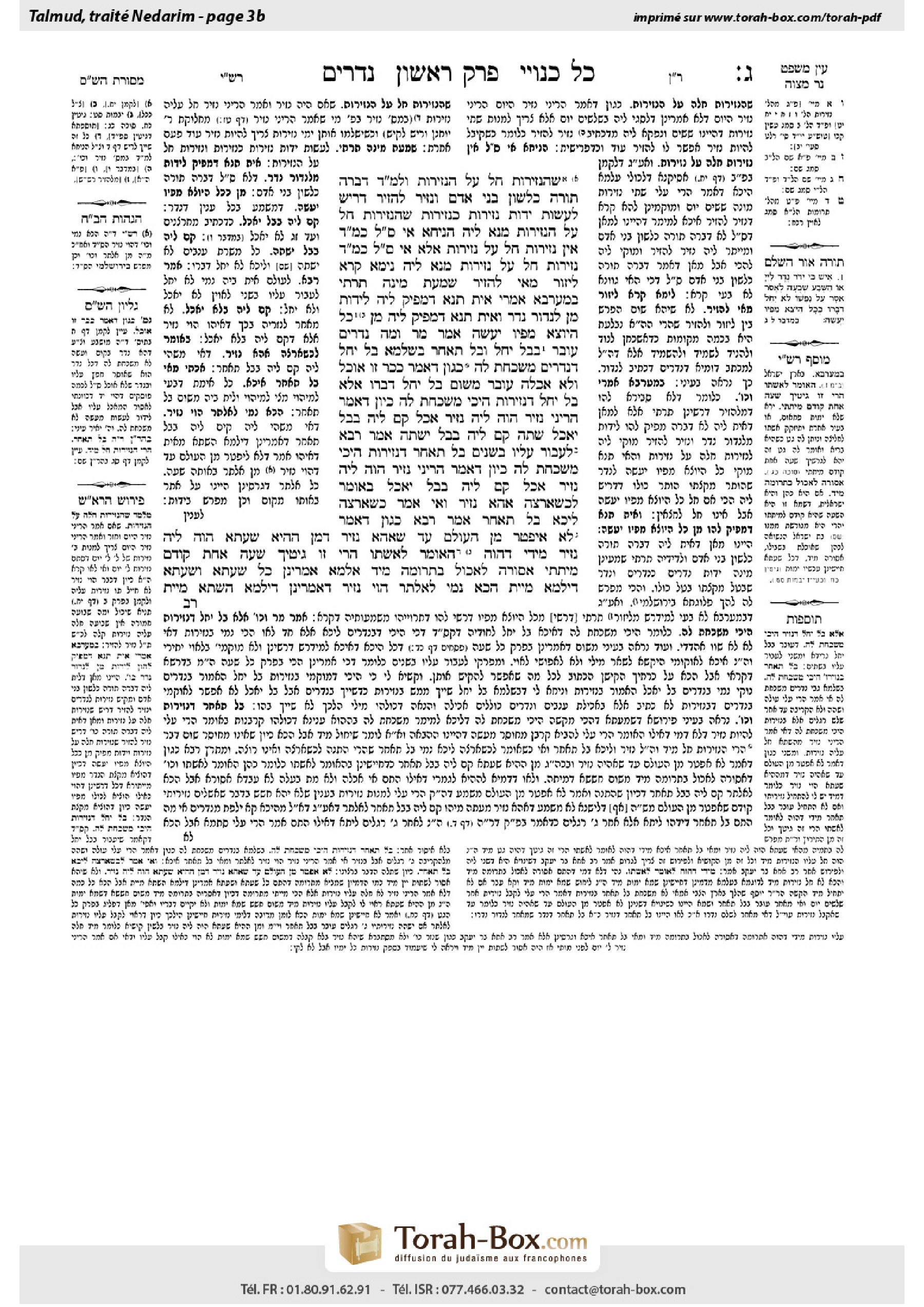
This page of Nedarim includes the Aramaic text, an English translation and an AI-generated French translation, alongside the scan above.
נדרים ג׳ ב · Aramaic and Hebrew text
שֶׁהַנְּזִירוּת חָל עַל הַנְּזִירוּת.
וּלְמַאן דְּאָמַר דִּבְּרָה תּוֹרָה כִּלְשׁוֹן בְּנֵי אָדָם, וְ״נָזִיר לְהַזִּיר״ דָּרֵישׁ לַעֲשׂוֹת יְדוֹת נְזִירוּת כִּנְזִירוּת, שֶׁהַנְּזִירוּת חָל עַל הַנְּזִירוּת מְנָא לֵיהּ? הָנִיחָא אִי סְבִירָא לֵיהּ כְּמַאן דְּאָמַר אֵין נְזִירוּת חָל עַל נְזִירוּת. אֶלָּא אִי סְבִירָא לֵיהּ כְּמַאן דְּאָמַר נְזִירוּת חָל עַל נְזִירוּת, מְנָא לֵיהּ?
נֵימָא קְרָא ״לִיזּוֹר״, מַאי ״לְהַזִּיר״ שָׁמְעַתְּ מִינַּהּ תַּרְתֵּי.
בְּמַעְרְבָא אָמְרִי: אִית תַּנָּא דְּמַפֵּיק לֵיהּ לְיָדוֹת מִן ״לִנְדֹּר נֶדֶר״, וְאִית תַּנָּא דְּמַפֵּיק לֵיהּ, מִן ״כְּכׇל הַיֹּצֵא מִפִּיו יַעֲשֶׂה״.
אָמַר מָר: וּמָה נְדָרִים עוֹבֵר בְּ״בַל יַחֵל״, וּ״בַל תְּאַחֵר״. בִּשְׁלָמָא ״בַּל יַחֵל״ דִּנְדָרִים מַשְׁכַּחַתְּ לַהּ, כְּגוֹן דְּאָמַר כִּכָּר זוֹ אוֹכַל וְלֹא אֲכָלָהּ — עוֹבֵר מִשּׁוּם ״בַּל יַחֵל דְּבָרוֹ״.
אֶלָּא ״בַּל יַחֵל״ דִּנְזִירוּת הֵיכִי מַשְׁכַּחַתְּ לַהּ? כֵּיוָן דְּאָמַר ״הֲרֵינִי נָזִיר״ הָוֵה לֵיהּ נָזִיר. אֲכַל — קָם לֵיהּ בְּ״בַל יֹאכַל״. שְׁתָה — קָם לֵיהּ בְּ״בַל יִשְׁתֶּה״. אָמַר רָבָא: לַעֲבוֹר עָלָיו בִּשְׁנַיִם.
״בַּל תְּאַחֵר״ דִּנְזִירוּת הֵיכִי מַשְׁכַּחַתְּ לַהּ? כֵּיוָן דְּאָמַר ״הֲרֵינִי נָזִיר״ הָוֵי לֵיהּ נָזִיר. אֲכַל — קָם לֵיהּ בְּ״בַל יֹאכַל״? בְּאוֹמֵר ״לִכְשֶׁאֶרְצֶה אֱהֵא נָזִיר״. וְאִי אָמַר ״כְּשֶׁאֶרְצֶה״ לֵיכָּא ״בַּל תְּאַחֵר״!
אָמַר רָבָא: כְּגוֹן דְּאָמַר ״לֹא אִיפָּטֵר מִן הָעוֹלָם עַד שֶׁאֱהֵא נָזִיר״, דְּמִן הָהִיא שַׁעְתָּא הָוֵה לֵיהּ נָזִיר. מִידֵּי דְּהָוֵה הָאוֹמֵר לְאִשְׁתּוֹ ״הֲרֵי זוֹ גִּיטֵּיךְ שָׁעָה אַחַת קוֹדֶם מִיתָתִי״ — אֲסוּרָה לֶאֱכוֹל בִּתְרוּמָה מִיָּד. אַלְמָא אָמְרִינַן כֹּל שַׁעְתָּא וְשַׁעְתָּא דִּילְמָא מָיֵית. הָכָא נָמֵי, לְאַלְתַּר הָוֵי נָזִיר. דְּאָמְרִינַן: דִּילְמָא הַשְׁתָּא מָיֵית.
Nedarim 3b · English translation
that a term of naziriteship takes effect upon a previously accepted term of naziriteship. Consequently, if one became a nazirite and then again declared: I am hereby a nazirite, then when his term of naziriteship is completed he must observe a second term of naziriteship.
The Gemara asks: And according to the one who says that the Torah spoke in the language of men and therefore nothing can be derived from the phrase “to utter a vow [lindor neder],” and he expounds the phrase “the vow of a nazirite to consecrate himself [nazir lehazir]” to render intimations of nazirite vows like nazirite vows, from where does he derive that a term of naziriteship takes effect upon a previously accepted term of naziriteship? This works out well if he holds in accordance with the one who says that a term of naziriteship does not take effect upon a previously accepted term of naziriteship; however, if he holds in accordance with the one who says that a term of naziriteship takes effect upon a previously accepted term of naziriteship, from where does he derive this halakha?
The Gemara answers: Let the verse say: To consecrate himself [lizor]. What is the reason the verse expressed this same idea with the word lehazir? Learn two halakhot from this: That intimations of nazirite vows are considered nazirite vows, and that a term of naziriteship takes effect upon a previously accepted term of naziriteship.
The Gemara adds: In the West, Eretz Yisrael, they say: There is a tanna who derives intimations of vows from the phrase “to utter a vow [lindor neder],” as he holds that the Torah did not speak in the language of men. And conversely, there is a tanna who holds that the Torah spoke in the language of men, and therefore derives this halakha of intimations from the verse: “He shall do according to all that proceeds out of his mouth” (Numbers 30:3). The inclusive formulation of this verse comes to include intimations of vows.
§ The Master said in the baraita cited earlier: Just as with regard to vows, one who breaks his vow transgresses the prohibition: He shall not profane, and one who does not fulfill his vow in time transgresses the prohibition: You shall not delay, so too, the same is true with regard to nazirite vows. The Gemara asks: Granted, you can find a case where one transgresses the prohibition: He shall not profane, in the case of vows. For example, where one said: I will eat this loaf, and he does not eat it, he violates the prohibition: He shall not profane his word.
However, with regard to transgressing the prohibition: He shall not profane, in the case of nazirite vows, how can you find these circumstances? Once he said: I am hereby a nazirite, he is a nazirite as of that moment. If he then ate grapes, he is liable for violating the prohibition: He shall not eat (see Numbers 6:4), and if he drank wine, he is liable for violating the prohibition: He shall not drink (see Numbers 6:3). When would he ever become liable for violating the prohibition against profanation? Rava said: The prohibition against profanation serves to render him liable for violating two prohibitions. Consequently, if he eats grapes or drinks wine, he transgresses the relevant prohibition in addition to the prohibition against profanation.
The Gemara further asks: With regard to violating the prohibition: You shall not delay, in the case of nazirite vows, how can you find these circumstances? Once he said: I am hereby a nazirite, he is a nazirite as of that moment. If he then ate grapes, he is liable for violating the prohibition: He shall not eat. When would he ever become liable for violating the prohibition against delaying? The Gemara answers: It is when he specifically says: I will become a nazirite when I wish, in which case he does not become a nazirite immediately. The Gemara asks: But if he said: When I wish, there is no prohibition of: You shall not delay, as there is no particular time by which he must become a nazirite.
Rava said: It is, for example, when he said: I will not depart the world until I become a nazirite, as he is a nazirite from that time because he does not know when he will depart this world. This is just as it is in the case of a man who says to his wife: This is your bill of divorce that will take effect one hour before my death. If he is a priest and she is the daughter of a non-priest, she is prohibited from partaking of teruma immediately. Apparently, we say every moment that perhaps he is now dead and she is therefore already divorced. Here, too, with regard to naziriteship, he is a nazirite immediately, as we say that perhaps he is now about to die.
Nedarim 3b · Traduction française (IA)
qu’un vœu de naziréat prend effet alors qu’un vœu de naziréat a déjà été accepté. Par conséquent, si quelqu’un est devenu naziréen, puis a de nouveau déclaré : « Je suis désormais naziréen », à la fin de son premier vœu de naziréat, il doit observer un second vœu de naziréat.
La Guemara demande : Selon celui qui affirme que la Torah s’exprime dans le langage des hommes, si bien qu’on ne peut rien déduire de l’expression « prononcer un vœu [lindor neder] », et qui interprète l’expression « le vœu d’un naziréen, pour se consacrer comme naziréen [nazir lehazir] » comme enseignant que les formulations implicites des vœux de naziréat sont assimilées à des vœux de naziréat, de quelle source déduit-il qu’un vœu de naziréat prend effet alors qu’un vœu de naziréat a déjà été accepté ? Cela s’explique s’il suit l’opinion de celui qui affirme qu’un vœu de naziréat ne prend pas effet alors qu’un vœu de naziréat a déjà été accepté. Mais s’il suit l’opinion de celui qui affirme qu’un vœu de naziréat prend effet alors qu’un vœu de naziréat a déjà été accepté, de quelle source déduit-il cette halakha ?
La Guemara répond : Que le verset dise : « Pour se consacrer » [lizor]. Pourquoi exprime-t-il cette même idée par le mot lehazir ? Il faut en déduire deux halakhot : les formulations implicites des vœux de naziréat sont considérées comme des vœux de naziréat, et un vœu de naziréat prend effet alors qu’un vœu de naziréat a déjà été accepté.
La Guemara ajoute : En Occident, en Eretz Israël, on dit : Il existe un tanna qui déduit les formulations implicites des vœux de l’expression « prononcer un vœu [lindor neder] », car il considère que la Torah ne s’exprime pas dans le langage des hommes. À l’inverse, il existe un tanna qui considère que la Torah s’exprime dans le langage des hommes et qui déduit donc cette halakha concernant les formulations implicites du verset : « Il agira conformément à tout ce qui est sorti de sa bouche » (Nombres 30,3). La formulation inclusive de ce verset vient inclure les formulations implicites des vœux.
§ Le Maître a enseigné dans la baraïta citée précédemment : De même que, pour les vœux, celui qui profane son vœu transgresse l’interdit « Il ne profanera pas », et celui qui ne s’acquitte pas de son vœu à temps transgresse l’interdit « Tu ne tarderas pas », il en va de même pour les vœux de naziréat. La Guemara demande : Il est clair que, dans le cas des vœux, on peut trouver une situation où l’on transgresse l’interdit « Il ne profanera pas ». Par exemple, quelqu’un dit : « Je mangerai cette miche », mais ne la mange pas ; il transgresse alors l’interdit de profaner sa parole.
Cependant, dans le cas des vœux de naziréat, comment peut-on transgresser l’interdit « Il ne profanera pas » ? Dès qu’il a dit : « Je suis désormais naziréen », il est naziréen. S’il mange ensuite des raisins, il est passible pour avoir transgressé l’interdit « Il n’en mangera pas » (voir Nombres 6,4) ; s’il boit du vin, il est passible pour avoir transgressé l’interdit « Il ne boira pas » (voir Nombres 6,3). Dans quel cas serait-il donc passible pour avoir transgressé l’interdit de profanation ? Rava a dit : L’interdit de profanation le rend passible de deux interdits. Par conséquent, s’il mange des raisins ou boit du vin, il transgresse l’interdit correspondant, en plus de l’interdit de profanation.
La Guemara demande encore : Dans le cas des vœux de naziréat, comment peut-on transgresser l’interdit « Tu ne tarderas pas » ? Dès qu’il a dit : « Je suis désormais naziréen », il l’est. S’il mange ensuite des raisins, il est passible pour avoir transgressé l’interdit « Il n’en mangera pas ». Dans quel cas serait-il donc passible pour avoir transgressé l’interdit de retard ? La Guemara répond : C’est lorsqu’il dit expressément : « Je deviendrai naziréen quand je le voudrai », auquel cas il ne le devient pas immédiatement. La Guemara demande : Mais s’il dit « quand je le voudrai », il n’y a pas d’interdit « Tu ne tarderas pas », puisqu’aucun délai précis ne l’oblige à devenir naziréen.
Rava a dit : C’est, par exemple, lorsqu’il dit : « Je ne quitterai pas ce monde avant de devenir naziréen », car il l’est à partir de cet instant, puisqu’il ne sait pas quand il quittera ce monde. C’est comparable au cas d’un homme qui dit à sa femme : « Voici ton acte de divorce, qui prendra effet une heure avant ma mort. » S’il est prêtre et qu’elle est la fille d’un non-prêtre, elle ne peut plus consommer de terouma dès cet instant. Il apparaît ainsi qu’à chaque instant, nous considérons qu’il est peut-être déjà mort et qu’elle est donc déjà divorcée. De même ici, concernant le naziréat, il est naziréen immédiatement, car nous considérons qu’il est peut-être sur le point de mourir.
Traduction française générée par IA à partir de l’édition anglaise de Sefaria. Vérifie toujours un passage avec le texte source.
Text from Sefaria: William Davidson Edition - Vocalized Aramaic (CC BY NC); William Davidson Edition - English (CC BY NC).