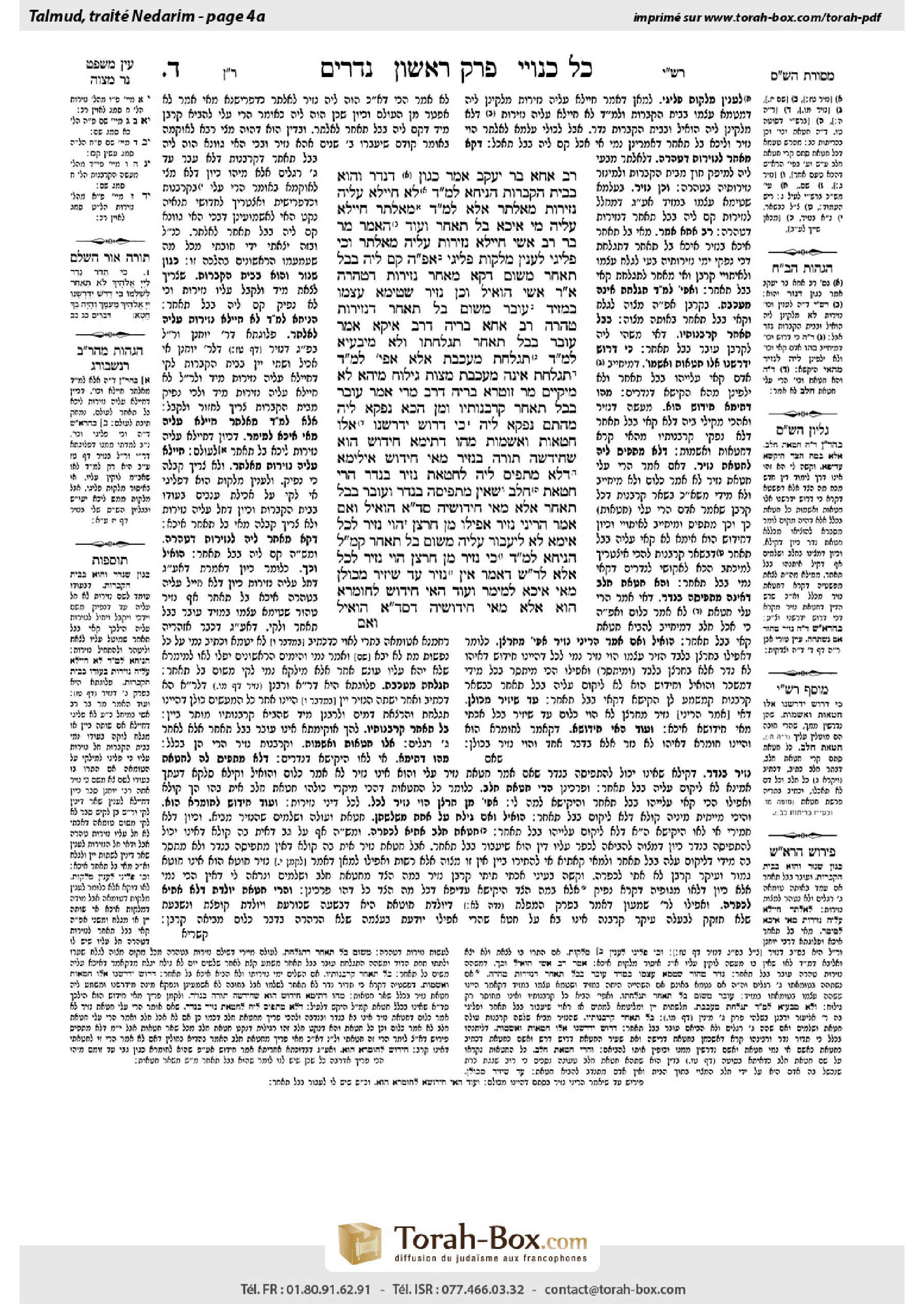
Nedarim 4a: Talmud study for Daf Yomi
Daf Yomi is the daily study of one Talmud folio. Explore 37 tractates with scans, Hebrew text, Sefaria English and AI-generated French translations where annotated.
Passage selection and English or AI-generated French translation are available where the scan has annotations. Daf Study is independent of Torah-Box and Sefaria.
Browse Nedarim · נדרים · All tractatesNedarim 4a text and translations
This page of Nedarim includes the Aramaic text, an English translation and an AI-generated French translation, alongside the scan above.
נדרים ד׳ א · Aramaic and Hebrew text
רַב אַחָא בַּר יַעֲקֹב אָמַר: כְּגוֹן דִּנְדַר וְהוּא בְּבֵית הַקְּבָרוֹת.
הָנִיחָא לְמַאן דְּאָמַר לָא חָיְילָא עֲלֵיהּ נְזִירוּת מֵאַלְתַּר. אֶלָּא לְמַאן דְּאָמַר מֵאַלְתַּר חָיְילָא עֲלֵיהּ, מִי אִיכָּא ״בַּל תְּאַחֵר״? וְעוֹד: הָאָמַר מָר בַּר רַב אָשֵׁי: חָיְילָא נְזִירוּת עֲלֵיהּ מֵאַלְתַּר, וְכִי פְּלִיגִי — לְעִנְיַן מַלְקוֹת פְּלִיגִי!
אֲפִילּוּ הָכִי קָם לֵיהּ בְּ״בַל תְּאַחֵר״, מִשּׁוּם דְּקָא מְאַחַר נְזִירוּת דְּטָהֳרָה. אָמַר רַב אָשֵׁי: הוֹאִיל וְכֵן, נָזִיר שֶׁטִּימֵּא עַצְמוֹ בְּמֵזִיד — עוֹבֵר מִשּׁוּם ״בַּל תְּאַחֵר״ דִּנְזִירוּת טָהֳרָה.
רַב אַחָא בְּרֵיהּ דְּרַב אִיקָא אָמַר: עוֹבֵר בְּ״בַל תְּאַחֵר״ תִּגְלַחְתּוֹ.
וְלָא מִיבַּעְיָא לְמַאן דְּאָמַר תִּגְלַחַת מְעַכֶּבֶת, אֶלָּא אֲפִילּוּ לְמַאן דְּאָמַר תִּגְלַחַת אֵינָהּ מְעַכֶּבֶת, מִצְוַת גִּילּוּחַ מִיהָא לָא מְיקַיֵּים.
מָר זוּטְרָא בְּרֵיהּ דְּרַב מָרִי אָמַר: עוֹבֵר בְּ״בַל תְּאַחֵר״ קָרְבְּנוֹתָיו.
וּמִן הָכָא נָפְקָא לֵיהּ? מֵהָתָם נָפְקָא לֵיהּ: ״כִּי דָרֹשׁ יִדְרְשֶׁנּוּ״ — אֵלּוּ חַטָּאֹת וַאֲשָׁמוֹת!
מַהוּ דְּתֵימָא: חִידּוּשׁ הוּא שֶׁחִידְּשָׁה תּוֹרָה בְּנָזִיר.
מַאי חִידּוּשׁ? אִילֵּימָא דְּלָא מַתְפֵּיס לַיהּ לְחַטַּאת נָזִיר בְּנֶדֶר. הֲרֵי חַטַּאת חֵלֶב, שֶׁאֵין מַתְפִּיסָהּ בְּנֶדֶר, וְעוֹבֵר בְּ״בַל תְּאַחֵר״!
אֶלָּא: מַאי חִידּוּשֵׁיהּ — סָלְקָא דַּעְתָּךְ אָמֵינָא: הוֹאִיל וְאִם אָמַר ״הֲרֵינִי נָזִיר״ אֲפִילּוּ מִן חַרְצָן — הָוֵי נָזִיר לַכֹּל, אֵימָא לָא לַיעֲבוֹר עֲלֵיהּ מִשּׁוּם ״בַּל תְּאַחֵר״ — קָא מַשְׁמַע לַן.
הָנִיחָא לְמַאן דְּאָמַר כִּי נָזִיר מִן חַרְצָן הָוֵי נָזִיר לַכֹּל, אֶלָּא לְרַבִּי שִׁמְעוֹן דְּאָמַר אֵין נָזִיר עַד שֶׁיַּזִּיר מִכּוּלָּן — מַאי אִיכָּא לְמֵימַר? וְעוֹד: הַאי חִידּוּשׁ לְחוּמְרָא הוּא!
אֶלָּא: מַאי חִידּוּשֵׁיהּ? דְּסָלְקָא דַּעְתָּךְ אָמֵינָא: הוֹאִיל
Nedarim 4a · English translation
Rav Aḥa bar Ya’akov said: The prohibition against delaying applies to a nazirite in a case where one vowed to become a nazirite while he was in a cemetery. Since it is prohibited for a nazirite to be in a cemetery, his term of naziriteship does not come into effect until he leaves the cemetery and ritually purifies himself. If he delays this process, he prevents the vow from taking effect and thereby transgresses the prohibition against delaying.
The Gemara asks: This works out well according to the one who says that if one takes a vow of naziriteship while in a cemetery the naziriteship does not apply to him immediately. However, according to the one who said that the naziriteship applies to him immediately, is there a violation of the prohibition: You shall not delay? And furthermore, didn’t Mar bar Rav Ashi say that all agree that the naziriteship applies to him immediately and he need not repeat his vow of naziriteship when he leaves, and when they disagree it is only with regard to the matter of flogging, and it’s only about this that they disagree, i.e., whether the nazirite is flogged if he drinks wine or otherwise violates the prohibitions of a nazirite.
The Gemara answers: Even so, he is liable for violating the prohibition: You shall not delay, because by remaining in the cemetery he delays a naziriteship of ritual purity. Although the halakhot of naziriteship take effect upon him immediately, he is still obligated to fulfill a term of naziriteship in a state of ritual purity, and if he delays doing so, he violates the prohibition against delaying. Rav Ashi said: Since this is so, a nazirite who intentionally renders himself ritually impure violates the prohibition: You shall not delay, with regard to a naziriteship of ritual purity, as he thereby prevents himself from completing his naziriteship in a state of ritual purity on time.
Rav Aḥa, son of Rav Ika, stated another explanation of how the prohibition against delaying applies with regard to naziriteship: The nazirite is commanded to shave his hair at the conclusion of his term, and if he causes this shaving to be delayed, he violates the prohibition: You shall not delay, with regard to his shaving.
The Gemara adds: And this explanation is not necessary to say, i.e., it is obvious, according to the one who says that shaving is indispensable for a nazirite and he is subject to all the prohibitions of a nazirite until he shaves, but even according to the one who says that shaving is not indispensable and the halakhot of naziriteship are terminated for him immediately after he brings his offerings, at least it can be said that he does not fulfill the mitzva of shaving until he actually shaves, and therefore if he delays, he violates the prohibition against delaying.
Mar Zutra, son of Rav Mari, stated another explanation of how the prohibition against delaying applies to a nazirite vow: He transgresses the prohibition: You shall not delay, with regard to his offerings. When he completes his term as a nazirite he is obligated to bring certain offerings, and if he delays bringing them, he violates this prohibition.
The Gemara asks: Is this halakha, that the prohibition against delaying applies to a nazirite vow, derived from here, i.e., the juxtaposition of vows and naziriteship? It is derived from there, a different exposition based upon the verse: “When you shall take a vow…you shall not delay to pay it; for the Lord your God will surely require it of you” (Deuteronomy 23:22). Those items included in the phrase “will surely require it” are sin-offerings and guilt-offerings, including the sin-offering and guilt-offering of a nazirite.
The Gemara explains: The derivation based on the juxtaposition of vows and naziriteship is still necessary lest you say that these offerings are a novelty that the Torah innovated with regard to a nazirite and therefore their halakhot cannot be derived from halakhot of other offerings.
The Gemara asks: What is the novelty that the Torah introduced with regard to the nazirite? If we say it is that he cannot accept upon himself the sin-offering of a nazirite through a vow, i.e., if one who is not a nazirite says: I hereby vow to bring the sin-offering of a nazirite, his vow has no validity, this is not a unique halakha with regard to sin-offerings of a nazirite. There is also the case of the sin-offering of forbidden fat, i.e., a typical sin-offering that one brings when he inadvertently violates certain prohibitions, one of which is eating forbidden fat, which one cannot accept through a vow, as only one who has violated the prohibition may bring it; and nevertheless, one still transgresses the prohibition: You shall not delay, if he delays bringing the offering.
Rather, what is its novelty that makes the juxtaposition between vows and naziriteship necessary? It might enter your mind to say that since if he said: I am hereby a nazirite, even if he accepted upon himself only one of the prohibitions of a nazirite, e.g., the requirement to abstain from grape seeds, he is nevertheless a nazirite with regard to all aspects of naziriteship, therefore say that he does not transgress the prohibition: You shall not delay. Since this halakha is a novelty, perhaps the principles of vows do not apply. The verse therefore teaches us through the juxtaposition of vows and naziriteship that the prohibition against delaying applies even in this case.
The Gemara asks: This works out well according to the one who said that when one vows to be a nazirite from grape seeds he is a nazirite in all respects. However, according to the opinion of Rabbi Shimon, who said that he is not a nazirite unless he explicitly vows to be a nazirite in all respects, what is there to say? And furthermore, this novelty is stringent in that it renders the individual a nazirite even if he did not explicitly accept all of the halakhot of naziriteship. How could this novelty indicate that the prohibition against delaying does not apply in this case, which is a leniency, so that the juxtaposition would be necessary?
Rather, what is its novelty that makes the juxtaposition between vows and naziriteship necessary? It might enter your mind to say that since
Nedarim 4a · Traduction française (IA)
Rav Aḥa bar Ya’akov a dit : L’interdiction de différer s’applique au nazir dans le cas où il a fait vœu de devenir nazir alors qu’il se trouvait dans un cimetière. Puisqu’il est interdit à un nazir de se trouver dans un cimetière, son naziréat ne prend effet qu’après qu’il a quitté le cimetière et s’est purifié rituellement. S’il retarde cette démarche, il empêche son vœu de prendre effet et transgresse ainsi l’interdiction de différer.
La Guemara demande : Cela s’explique bien selon celui qui dit que, si quelqu’un fait vœu de naziréat alors qu’il se trouve dans un cimetière, le naziréat ne prend pas immédiatement effet à son égard. Mais selon celui qui dit que le naziréat prend immédiatement effet à son égard, y a-t-il une transgression de l’interdiction : « Tu ne différeras pas » ? En outre, Mar bar Rav Ashi n’a-t-il pas dit que tous sont d’accord pour dire que le naziréat prend immédiatement effet à son égard et qu’il n’a pas besoin de répéter son vœu de naziréat lorsqu’il sort du cimetière ? Leur désaccord ne porte que sur la question des coups de fouet, c’est-à-dire sur le point de savoir si le nazir reçoit des coups de fouet s’il boit du vin ou enfreint d’une autre manière les interdictions propres au nazir.
La Guemara répond : Malgré tout, il est passible pour avoir transgressé l’interdiction : « Tu ne différeras pas », car, en restant dans le cimetière, il retarde un naziréat en état de pureté rituelle. Bien que les halakhot du naziréat prennent immédiatement effet à son égard, il reste tenu d’accomplir une période de naziréat en état de pureté rituelle ; s’il retarde cela, il transgresse l’interdiction de différer. Rav Ashi a dit : Puisqu’il en est ainsi, un nazir qui se rend intentionnellement impur transgresse l’interdiction : « Tu ne différeras pas », concernant un naziréat en état de pureté rituelle, car il s’empêche ainsi d’achever à temps son naziréat en état de pureté rituelle.
Rav Aḥa, fils de Rav Ika, a proposé une autre explication de la manière dont l’interdiction de différer s’applique au naziréat : le nazir a l’obligation de se raser les cheveux à la fin de sa période de naziréat, et s’il retarde ce rasage, il transgresse l’interdiction : « Tu ne différeras pas », concernant son rasage.
La Guemara ajoute : Il n’est pas nécessaire de présenter cette explication, c’est-à-dire qu’elle est évidente, selon celui qui dit que le rasage est indispensable pour le nazir et qu’il reste soumis à toutes les interdictions du naziréat jusqu’à ce qu’il se rase. Mais même selon celui qui dit que le rasage n’est pas indispensable et que les halakhot du naziréat cessent de s’appliquer à son égard immédiatement après qu’il a apporté ses offrandes, on peut au moins dire qu’il n’accomplit pas la mitsva du rasage tant qu’il ne s’est pas effectivement rasé ; par conséquent, s’il retarde le rasage, il transgresse l’interdiction de différer.
Mar Zutra, fils de Rav Mari, a proposé une autre explication de la manière dont l’interdiction de différer s’applique à un vœu de naziréat : il transgresse l’interdiction : « Tu ne différeras pas », concernant ses offrandes. Lorsqu’il achève sa période de naziréat, il est tenu d’apporter certaines offrandes ; s’il retarde leur apport, il transgresse cette interdiction.
La Guemara demande : Cette halakha, selon laquelle l’interdiction de différer s’applique à un vœu de naziréat, est-elle déduite d’ici, c’est-à-dire du rapprochement entre les vœux et le naziréat ? Elle est déduite d’un autre passage, à partir du verset : « Lorsque tu feras un vœu… tu ne différeras pas de l’acquitter ; car l’Éternel, ton Dieu, te le réclamera certainement » (Deutéronome 23, 22). Les offrandes incluses dans l’expression « te le réclamera certainement » sont les sacrifices expiatoires et les sacrifices de culpabilité, y compris le sacrifice expiatoire et le sacrifice de culpabilité du nazir.
La Guemara explique : La déduction fondée sur le rapprochement entre les vœux et le naziréat reste nécessaire, de peur que l’on dise que ces offrandes constituent une innovation de la Torah propre au nazir et que, par conséquent, leurs halakhot ne peuvent être déduites des halakhot relatives aux autres offrandes.
La Guemara demande : Quelle est l’innovation introduite par la Torah concernant le nazir ? Si l’on dit que l’on ne peut pas s’imposer par un vœu le sacrifice expiatoire d’un nazir — c’est-à-dire que si quelqu’un qui n’est pas nazir dit : « Je fais vœu d’apporter le sacrifice expiatoire d’un nazir », son vœu n’a aucune validité —, ce n’est pas une halakha particulière aux sacrifices expiatoires du nazir. Il existe aussi le cas du sacrifice expiatoire pour avoir consommé de la graisse interdite, c’est-à-dire un sacrifice expiatoire ordinaire que l’on apporte lorsqu’on enfreint involontairement certaines interdictions, dont celle de consommer de la graisse interdite. On ne peut pas non plus s’imposer de l’apporter par un vœu, car seul celui qui a enfreint l’interdiction peut l’apporter ; néanmoins, celui qui retarde l’apport de cette offrande transgresse l’interdiction : « Tu ne différeras pas ».
Mais alors, quelle est l’innovation qui rend nécessaire le rapprochement entre les vœux et le naziréat ? On pourrait penser que, puisque, s’il dit : « Je suis nazir », même s’il ne s’impose qu’une seule des interdictions propres au nazir, par exemple l’obligation de s’abstenir de pépins de raisin, il est néanmoins nazir à tous égards, il ne transgresse pas l’interdiction : « Tu ne différeras pas ». Puisqu’il s’agit d’une innovation, peut-être les principes des vœux ne s’appliquent-ils pas. Le verset nous enseigne donc, par le rapprochement entre les vœux et le naziréat, que l’interdiction de différer s’applique même dans ce cas.
La Guemara demande : Cela s’explique bien selon celui qui dit que, lorsqu’on fait vœu de devenir nazir en s’abstenant de pépins de raisin, on est nazir à tous égards. Mais que peut-on dire selon l’opinion de Rabbi Shimon, qui dit qu’on n’est nazir que si l’on fait explicitement vœu de l’être à tous égards ? En outre, cette innovation est une rigueur, puisqu’elle rend la personne nazir même si elle n’a pas explicitement accepté toutes les halakhot du naziréat. Comment cette innovation pourrait-elle indiquer que l’interdiction de différer ne s’applique pas dans ce cas — ce qui serait une indulgence — au point de rendre nécessaire le rapprochement ?
Mais alors, quelle est l’innovation qui rend nécessaire le rapprochement entre les vœux et le naziréat ? On pourrait penser que, puisque
Traduction française générée par IA à partir de l’édition anglaise de Sefaria. Vérifie toujours un passage avec le texte source.
Text from Sefaria: William Davidson Edition - Vocalized Aramaic (CC BY NC); William Davidson Edition - English (CC BY NC).