Nedarim 4b: Talmud study for Daf Yomi
Daf Yomi is the daily study of one Talmud folio. Explore 37 tractates with scans, Hebrew text, Sefaria English and AI-generated French translations where annotated.
Passage selection and English or AI-generated French translation are available where the scan has annotations. Daf Study is independent of Torah-Box and Sefaria.
Browse Nedarim · נדרים · All tractatesNedarim 4b text and translations
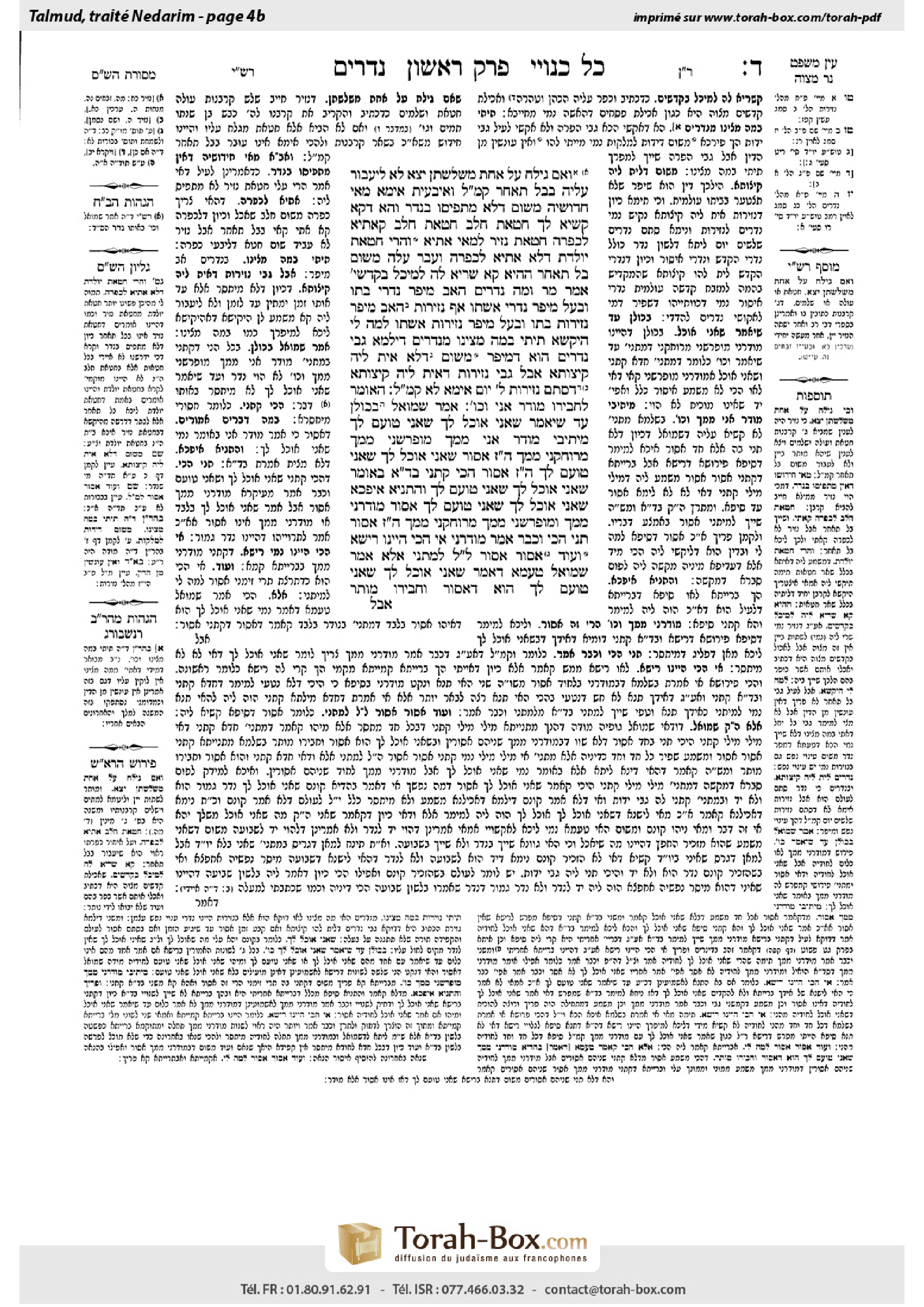
This page of Nedarim includes the Aramaic text, an English translation and an AI-generated French translation, alongside the scan above.
נדרים ד׳ ב · Aramaic and Hebrew text
וְאִם גִּילַּח עַל אַחַת מִשְּׁלׇשְׁתָּן — יָצָא, לָא לַיעֲבוֹר עֲלֵיהּ בְּ״בַל תְּאַחֵר״, קָא מַשְׁמַע לַן.
וְאִיבָּעֵית אֵימָא: מַאי חִדּוּשֵׁיהּ — מִשּׁוּם דְּלֹא מַתְפִּיסוֹ בְּנֶדֶר. וְהָא דְּקָא קַשְׁיָא לָךְ חַטַּאת חֵלֶב — חַטַּאת חֵלֶב קָאָתְיָא לְכַפָּרָה. חַטַּאת נָזִיר לְמַאי אָתְיָא?
וַהֲרֵי חַטַּאת יוֹלֶדֶת דְּלָא אָתְיָא לְכַפָּרָה, וְעָבַר עֲלַהּ מִשּׁוּם ״בַּל תְּאַחֵר״! הָהִיא — קָא שָׁרְיָא לַהּ לְמֵיכַל בְּקָדָשִׁים.
אָמַר מָר: וּמָה נְדָרִים, הָאָב מֵיפֵר נִדְרֵי בִתּוֹ וּבַעַל מֵיפֵר נִדְרֵי אִשְׁתּוֹ — אַף נְזִירוּת, הָאָב מֵיפֵר נְזִירוּת בִּתּוֹ וּבַעַל מֵיפֵר נְזִירוּת אִשְׁתּוֹ. לְמָה לִי הֶיקֵּשָׁא? תֵּיתֵי בְּ״מָה מָצִינוּ״ מִנְּדָרִים!
דִּילְמָא גַּבֵּי נְדָרִים הוּא דְּמֵיפַר, מִשּׁוּם דְּלָא אִית לֵיהּ קִיצּוּתָא. אֲבָל גַּבֵּי נְזִירוּת דְּאִית לֵיהּ קִיצּוּתָא, דִּסְתַם נְזִירוּת שְׁלֹשִׁים יוֹם, אֵימָא לָא — קָא מַשְׁמַע לַן.
הָאוֹמֵר לַחֲבֵירוֹ מוּדָּר אֲנִי וְכוּ׳. אָמַר שְׁמוּאֵל: בְּכוּלָּן עַד שֶׁיֹּאמַר, ״שֶׁאֲנִי אוֹכֵל לָךְ״, ״שֶׁאֲנִי טוֹעֵם לָךְ״.
מֵיתִיבִי: ״מוּדָּר אֲנִי מִמָּךְ״ ״מוּפְרְשַׁנִי מִמָּךְ״ ״מְרוּחָקֵנִי מִמָּךְ״ — הֲרֵי זֶה אָסוּר. ״שֶׁאֲנִי אוֹכֵל לָךְ״ ״שֶׁאֲנִי טוֹעֵם לָךְ״ — הֲרֵי זֶה אָסוּר! הָכִי קָתָנֵי: בַּמֶּה דְּבָרִים אֲמוּרִים — בְּאוֹמֵר: ״שֶׁאֲנִי אוֹכֵל לָךְ״ ״שֶׁאֲנִי טוֹעֵם לָךְ״.
וְהָתַנְיָא אִיפְּכָא: ״שֶׁאֲנִי אוֹכֵל לָךְ״, ״שֶׁאֲנִי טוֹעֵם לָךְ״ — אָסוּר, ״מוּדְּרַנִי מִמָּךְ״ וּ״מוּפְרְשַׁנִי מִמָּךְ״ ״מְרוּחֲקַנִי מִמָּךְ״ — הֲרֵי זֶה אָסוּר! תָּנֵי הָכִי: ״וּכְבָר אָמַר מוּדְּרַנִי״.
אִי הָכִי, הַיְינוּ רֵישָׁא! וְעוֹד: ״אָסוּר״ ״אָסוּר״ לְמָה לֵיהּ לְמִתְנֵי?
אֶלָּא, אָמַר שְׁמוּאֵל: טַעְמָא דְּאָמַר ״שֶׁאֲנִי אוֹכֵל לָךְ״ ״שֶׁאֲנִי טוֹעֵם לָךְ״, הוּא דְּאָסוּר וַחֲבֵירוֹ מוּתָּר.
Nedarim 4b · English translation
if he shaves upon bringing one of the three offerings that a nazirite must bring when completing his term as a nazirite, i.e., a burnt-offering, a sin-offering, and a peace-offering, he has fulfilled his obligation to shave and the restrictions of a nazirite are lifted, he therefore does not violate the prohibition: You shall not delay, for delaying the other offerings. Consequently, it teaches us that the prohibition against delaying applies to these offerings.
And if you wish say: What is the novelty of the nazirite? The halakha of naziriteship is considered a novelty because the offerings of a nazirite cannot be accepted through a vow. And that which poses a difficulty for you based on the fact that one cannot accept upon himself a sin-offering of forbidden fat through a vow either, and nevertheless the prohibition against delaying applies, can be resolved. A sin-offering of forbidden fat comes for the purpose of atonement, and therefore if one delays bringing it he violates the prohibition against delaying. However, for what does the sin-offering of a nazirite come? Since it does not come to atone for a sin, one might have thought that the prohibition against delaying does not apply.
The Gemara asks: But there is the precedent of the sin-offering of a woman who gave birth, which also does not come for the purpose of atonement, and yet if she does not bring the offering on time she still transgresses due to the prohibition: You shall not delay. The Gemara answers: That sin-offering of a woman who gave birth permits the woman to eat consecrated food. Although it does not come to effect atonement, it does come to permit a matter. On the other hand, the sin-offering of a nazirite does not permit anything, and therefore the fact that one cannot accept upon himself an obligation to bring this offering is a novelty. Consequently, it was necessary for there to be a separate source to indicate that one is liable for violating the prohibition against delaying in the case of this offering.
§ The Master said in the baraita cited above: Just as with regard to vows, a father may nullify the vows of his daughter and a husband may nullify the vows of his wife, so too, with regard to nazirite vows, a father may nullify the nazirite vows of his daughter and a husband may nullify the nazirite vows of his wife. The Gemara asks: Why do I need the juxtaposition in the verse to teach us this halakha? Let this halakha come through the method of analogy known as: What do we find, from the halakha with regard to vows. In other words, the halakha in the case of regular vows should serve as a legal precedent that can be applied to nazirite vows even without a biblical juxtaposition.
The Gemara responds: If not for the juxtaposition, one might have said that perhaps it is only with regard to vows that he may nullify her statements because there is no time limit with regard to vows, but with regard to naziriteship, which has a time limit, as unspecified naziriteship is for thirty days, one might say no, he may not nullify her vows. Therefore, it teaches us through juxtaposition that he may nevertheless nullify her vows.
§ It is taught in the mishna with regard to one who says to his fellow: I am avowed from you, or another intimation of a vow, that the vow takes effect. Shmuel said: In all these cases, the vow does not take effect until he says: I am avowed from you with regard to that which I eat of yours, or: That which I taste of yours. Without this addition, the statement: I am avowed from you, is not considered even an intimation of a vow.
The Gemara raises an objection based on the following baraita: If one says: I am avowed from you, or: I am separated from you, or: I am distanced from you, he is prohibited from benefiting from that individual. If he says: That which I eat of yours, or: That which I taste of yours, he is prohibited from eating or tasting that individual’s food. This indicates that the phrases mentioned in the first clause of the baraita take effect as vows even if he does not add the phrases mentioned in the latter clause. The Gemara answers: This is what the baraita is teaching: In what case is this statement said i.e., if one says: I am avowed from you, or the like, the vow takes effect? It is in a case of one who says: That which I eat of yours, or: That which I taste of yours.
The Gemara asks: But isn’t it taught in a baraita in the opposite order? If one says: That which I eat of yours, or: That which I taste of yours, he is prohibited from eating or tasting that individual’s food, i.e., the vow takes effect. If he says: I am avowed from you, or: I am separated from you, or: I am distanced from you, he is likewise prohibited. In this case, the baraita cannot be interpreted as explained above, and it appears that if one said: I am avowed from you, the vow takes effect even if he did not say: I am avowed from you with regard to that which I taste of yours. The Gemara answers: Teach the baraita as follows: The vow takes effect in the cases mentioned in the first clause when he already said: I am avowed.
The Gemara asks: If so, this is the same as the first baraita cited above. And furthermore, if the vow takes effect only if he combined the statements mentioned in the first and latter clauses of the baraita, why does the baraita teach that he is prohibited in the first clause of the baraita and then repeat that he is prohibited in the second clause of the baraita? The repetition of this ruling indicates that these are two separate cases.
Rather, Shmuel actually said as follows: The reason is that he said: I am avowed from you with regard to that which I eat of yours, or with regard to that which I taste of yours; it is for this reason that he is prohibited from benefiting from his fellow, and his fellow is permitted to benefit from him, as this formulation indicates that he is applying his vow only to himself.
Nedarim 4b · Traduction française (IA)
S’il se rase après avoir apporté l’une des trois offrandes qu’un nazir doit apporter à la fin de son naziréat — un holocauste, un sacrifice expiatoire et un sacrifice de paix —, il s’est acquitté de son obligation de se raser et les restrictions du naziréat sont levées. Il ne transgresse donc pas l’interdiction « Tu ne tarderas pas » en retardant l’apport des autres offrandes. Cela nous enseigne par conséquent que l’interdiction de tarder s’applique à ces offrandes.
Et si tu veux, dis plutôt : Quelle est la nouveauté concernant le nazir ? La halakha du naziréat est considérée comme une nouveauté, car on ne peut pas contracter par un vœu l’obligation d’apporter les offrandes d’un nazir. Quant à la difficulté que l’on pourrait soulever — on ne peut pas non plus contracter par un vœu l’obligation d’apporter un sacrifice expiatoire pour consommation de graisse interdite, et pourtant l’interdiction de tarder s’applique —, on peut la résoudre ainsi : un sacrifice expiatoire pour consommation de graisse interdite est apporté afin d’obtenir l’expiation ; si l’on tarde à l’apporter, on transgresse donc l’interdiction de tarder. Mais, dans quel but le sacrifice expiatoire d’un nazir est-il apporté ? Puisqu’il ne sert pas à expier une faute, on aurait pu penser que l’interdiction de tarder ne s’applique pas.
La Guemara demande : Mais il y a l’exemple du sacrifice expiatoire d’une femme qui a accouché, qui n’est pas non plus apporté afin d’obtenir l’expiation ; pourtant, si elle n’apporte pas l’offrande à temps, elle transgresse tout de même l’interdiction « Tu ne tarderas pas ». La Guemara répond : Le sacrifice expiatoire d’une femme qui a accouché lui permet de consommer des aliments consacrés. Bien qu’il ne serve pas à obtenir l’expiation, il permet néanmoins quelque chose. En revanche, le sacrifice expiatoire d’un nazir ne permet rien ; le fait qu’on ne puisse pas contracter l’obligation d’apporter cette offrande constitue donc une nouveauté. Il fallait par conséquent une source distincte pour enseigner que l’on est passible pour avoir transgressé l’interdiction de tarder dans le cas de cette offrande.
§ Le Maître a dit dans la baraïta citée plus haut : De même que, pour les vœux, un père peut annuler les vœux de sa fille et un mari ceux de son épouse, de même, pour les vœux de naziréat, un père peut annuler ceux de sa fille et un mari ceux de son épouse. La Guemara demande : Pourquoi faut-il le rapprochement dans le verset pour nous enseigner cette halakha ? Ne pourrait-elle pas découler de l’analogie connue sous le nom de « ce que nous trouvons », à partir de la halakha relative aux vœux ? Autrement dit, la halakha concernant les vœux ordinaires devrait servir de précédent juridique, applicable aux vœux de naziréat même sans rapprochement biblique.
La Guemara répond : Sans ce rapprochement, on aurait pu dire que, peut-être, il ne peut annuler ses paroles que dans le cas des vœux, car ceux-ci n’ont pas de durée déterminée ; mais, pour le naziréat, qui a une durée déterminée — le naziréat sans autre précision dure trente jours —, on aurait pu dire que non, il ne peut pas annuler ses vœux. Le rapprochement nous enseigne donc qu’il peut néanmoins les annuler.
§ La Michna enseigne au sujet de celui qui dit à son prochain : « Je suis interdit de toi », ou emploie une autre formule implicite de vœu, que le vœu prend effet. Chmouel a dit : Dans tous ces cas, le vœu ne prend effet que s’il dit : « Je suis interdit de toi en ce qui concerne ce que je mange de toi », ou : « Ce que je goûte de toi ». Sans cet ajout, la déclaration « Je suis interdit de toi » n’est même pas considérée comme une formule implicite de vœu.
La Guemara soulève une objection à partir de la baraïta suivante : Si quelqu’un dit : « Je suis interdit de toi », « Je suis séparé de toi » ou « Je suis éloigné de toi », il lui est interdit de tirer profit de cette personne. S’il dit : « Ce que je mange de toi » ou « Ce que je goûte de toi », il lui est interdit de manger ou de goûter la nourriture de cette personne. Cela indique que les formules mentionnées dans la première partie de la baraïta prennent effet comme des vœux même sans qu’il ajoute les expressions mentionnées dans la seconde partie. La Guemara répond : Voici ce qu’enseigne la baraïta : dans quel cas le vœu prend-il effet lorsqu’on dit « Je suis interdit de toi », ou quelque chose de semblable ? C’est lorsque la personne dit : « Ce que je mange de toi » ou « Ce que je goûte de toi ».
La Guemara demande : Mais une baraïta n’est-elle pas enseignée dans l’ordre inverse ? Si quelqu’un dit : « Ce que je mange de toi » ou « Ce que je goûte de toi », il lui est interdit de manger ou de goûter la nourriture de cette personne, c’est-à-dire que le vœu prend effet. S’il dit : « Je suis interdit de toi », « Je suis séparé de toi » ou « Je suis éloigné de toi », cela lui est également interdit. Dans ce cas, on ne peut pas interpréter la baraïta comme expliqué précédemment ; il semble que si quelqu’un dit « Je suis interdit de toi », le vœu prend effet même s’il n’a pas dit : « Je suis interdit de toi en ce qui concerne ce que je goûte de toi ». La Guemara répond : Enseigne la baraïta ainsi : le vœu prend effet dans les cas mentionnés dans la première partie lorsqu’il a déjà dit : « Je suis interdit ».
La Guemara demande : Si c’est ainsi, cette baraïta est identique à la première baraïta citée plus haut. En outre, si le vœu ne prend effet que lorsqu’il a combiné les déclarations mentionnées dans la première et la seconde partie de la baraïta, pourquoi celle-ci enseigne-t-elle dans sa première partie qu’il lui est interdit, puis répète-t-elle dans sa seconde partie qu’il lui est interdit ? La répétition de cette règle indique qu’il s’agit de deux cas distincts.
Mais en réalité, Chmouel a dit ceci : Il est interdit de tirer profit de son prochain parce qu’il a dit : « Je suis interdit de toi en ce qui concerne ce que je mange de toi » ou « ce que je goûte de toi », tandis que son prochain a le droit de tirer profit de lui, car cette formulation indique qu’il ne s’impose le vœu qu’à lui-même.
Traduction française générée par IA à partir de l’édition anglaise de Sefaria. Vérifie toujours un passage avec le texte source.
Text from Sefaria: William Davidson Edition - Vocalized Aramaic (CC BY NC); William Davidson Edition - English (CC BY NC).