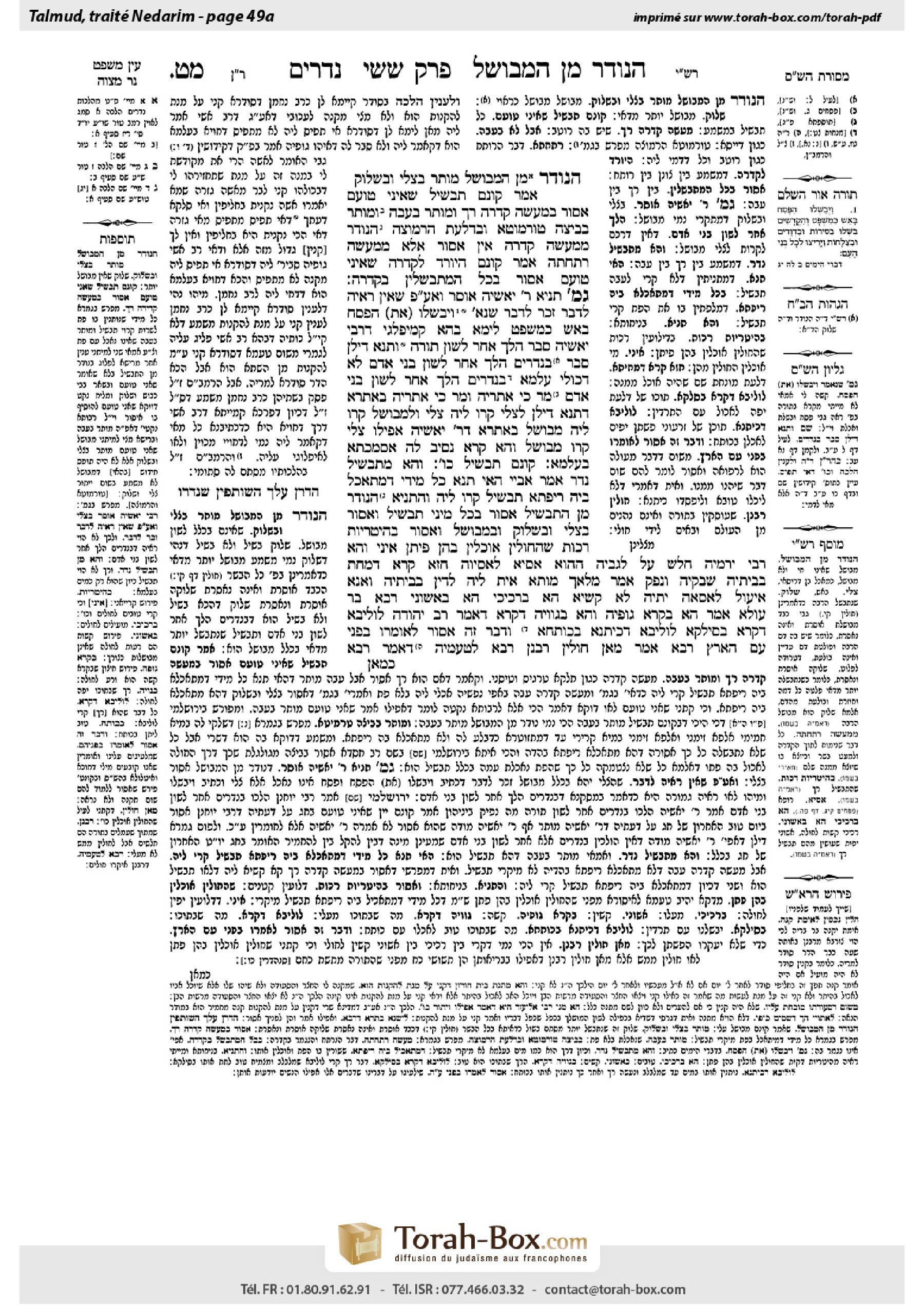
Nedarim 49a: Talmud study for Daf Yomi
Daf Yomi is the daily study of one Talmud folio. Explore 37 tractates with scans, Hebrew text, Sefaria English and AI-generated French translations where annotated.
Passage selection and English or AI-generated French translation are available where the scan has annotations. Daf Study is independent of Torah-Box and Sefaria.
Browse Nedarim · נדרים · All tractatesNedarim 49a text and translations
This page of Nedarim includes the Aramaic text, an English translation and an AI-generated French translation, alongside the scan above.
נדרים מ״ט א · Aramaic and Hebrew text
הַנּוֹדֵר מִן הַמְבוּשָּׁל — מוּתָּר בְּצָלִי וּבְשָׁלוּק. אָמַר: ״קֻוֽנָּם תַּבְשִׁיל שֶׁאֵינִי טוֹעֵם״ — אָסוּר בְּמַעֲשֵׂה קְדֵרָה רַךְ, וּמוּתָּר בְּעָבֶה, וּמוּתָּר בְּבֵיצָה טוֹרְמוֹטָא וּבַדַּלַּעַת הָרְמוּצָה. הַנּוֹדֵר מִמַּעֲשֵׂה קְדֵרָה — אֵין אָסוּר אֶלָּא מִמַּעֲשֵׂה רְתַחְתָּה, אָמַר: ״קֻוֽנָּם הַיּוֹרֵד לִקְדֵרָה שֶׁאֵינִי טוֹעֵם — אָסוּר בְּכׇל הַמִּתְבַּשְּׁלִין בִּקְדֵרָה.
גְּמָ׳ תַּנְיָא: רַבִּי יֹאשִׁיָּה אוֹסֵר, וְאַף עַל פִּי שֶׁאֵין רְאָיָה לְדָבָר — זֵכֶר לַדָּבָר, שֶׁנֶּאֱמַר: ״וַיְבַשְּׁלוּ אֶת הַפֶּסַח בָּאֵשׁ כַּמִּשְׁפָּט״.
לֵימָא בְּהָא קָמִיפַּלְגִי, דְּרַבִּי יֹאשִׁיָּה סָבַר: הַלֵּךְ אַחַר לְשׁוֹן תּוֹרָה, וְתַנָּא דִילַן סָבַר: בִּנְדָרִים הַלֵּךְ אַחַר לְשׁוֹן בְּנֵי אָדָם?
לָא, דְּכוּלֵּי עָלְמָא בִּנְדָרִים הַלֵּךְ אַחַר לְשׁוֹן בְּנֵי אָדָם, מָר כִּי אַתְרֵיהּ וּמָר כִּי אַתְרֵיהּ. בְּאַתְרָא דְּתַנָּא דִילַן — לְצָלִי קָרוּ לֵיהּ צָלִי, וְלִמְבוּשָּׁל קָרוּ לֵיהּ מְבוּשָּׁל. בְּאַתְרָא דְּרַבִּי יֹאשִׁיָּה — אֲפִילּוּ צָלִי קָרוּ מְבוּשָּׁל.
וְהָא קְרָא נָסֵיב לַהּ! אַסְמַכְתָּא בְּעָלְמָא.
קֻוֽנָּם תַּבְשִׁיל כּוּ׳. וְהָא מִתַּבְשִׁיל נְדַר!
אָמַר אַבָּיֵי: הַאי תַּנָּא כֹּל מִידֵּי דְּמִתְאֲכֵל בֵּיהּ רִיפְתָּא — תַּבְשִׁיל קָרוּ לֵיהּ. וְהָתַנְיָא: הַנּוֹדֵר מִן הַתַּבְשִׁיל — אָסוּר בְּכׇל מִינֵי תַּבְשִׁיל, וְאָסוּר בְּצָלִי וּבְשָׁלוּק וּבִמְבוּשָּׁל, וְאָסוּר בְּהִיטְרִיּוֹת רַכּוֹת שֶׁהַחוֹלִין אוֹכְלִין בָּהֶן פִּיתָּן.
אִינִי?! וְהָא רַבִּי יִרְמְיָה חֲלַשׁ, עַל לְגַבֵּיהּ הָהוּא אָסְיָא לְאַסּוֹיֵהּ, חֲזָא קַרָא דְּמַחֵת בְּבֵיתֵיהּ, שַׁבְקֵיהּ וּנְפַק. אֲמַר: מַלְאַךְ מוֹתָא אִית לֵיהּ לְדֵין בְּבֵיתֵיהּ, וַאֲנָא אֵיעוּל לְאַסָּאָה יָתֵיהּ?!
לָא קַשְׁיָא: הָא — בְּרַכִּיכֵי, הָא — בְּאַשּׁוּנֵי. רָבָא בַּר עוּלָּא אָמַר: הָא — בְּקַרָא גּוּפֵיהּ, וְהָא — בְּגַוֵּויהּ דִּקְרָא. דְּאָמַר רַב יְהוּדָה: לוּלִיבָּא דְקַרָא בְּסִילְקָא, לוּלִיבָּא דְכִיתָּנָא בְּכוּתָּחָא. וְדָבָר זֶה אָסוּר לְאוֹמְרוֹ בִּפְנֵי עַם הָאָרֶץ.
רָבָא אָמַר: מַאן חוֹלִין — רַבָּנַן. רָבָא לְטַעְמֵיהּ, דְּאָמַר רָבָא:
Nedarim 49a · English translation
MISHNA: In the case of one who vows that cooked foods are forbidden to him, he is permitted to eat roasted and boiled foods, as they are not defined as cooked. If one said: Cooked food is konam for me, and for that reason I will not taste it, he is prohibited from tasting a loose cooked food but is permitted to taste a thick one, which people do not generally refer to as a cooked food. And he is likewise permitted to eat a turemuta egg and the remutza gourd, as they are not considered cooked foods either. In the case of one who vows that food cooked in a dish is forbidden to him, he is prohibited from deriving benefit only from food that is cooked by boiling it in a dish. However, if one said: That which enters into a dish is konam for me, and for that reason I will not taste it, he is prohibited from tasting anything cooked in a dish.
GEMARA: It is taught in a baraita: In the case of one who vowed that cooked foods are forbidden to him, Rabbi Yoshiya maintains that he is prohibited from eating roasted foods. And although there is no biblical proof of the matter, there is an allusion to the matter, as it is stated: “And they cooked the Paschal offering with fire according to the ordinance” (II Chronicles 35:13). Since the Paschal offering must be roasted, it is evident that roasting can also be referred to as cooking.
The Gemara suggests: Let us say that they disagree with regard to this following principle, that Rabbi Yoshiya holds that one should follow the language of the Torah, and our tanna holds that with regard to vows one should follow the language of people.
The Gemara refutes this suggestion: No, it is possible that everyone agrees that with regard to vows one should follow the language of people. Rather, this Sage stated his opinion in accordance with the language of his locale, and this Sage stated his opinion in accordance with the language of his locale. In the locale of our tanna, roasted food is called roasted and cooked food is called cooked, and in the locale of Rabbi Yoshiya even roasted food is called cooked.
The Gemara raises a difficulty: But doesn’t Rabbi Yoshiya cite a verse as proof for his opinion, which shows that his opinion is not based on the vernacular? The Gemara answers: The verse is cited as a mere support for his opinion, as implied by his statement that the verse is only an allusion, not a full proof.
It is stated in the mishna that one who said: A cooked food is konam for me and for that reason I will not taste it, he is prohibited from tasting a loose cooked food but is permitted to taste a thick one. The Gemara asks: Why is he permitted to eat it? But didn’t he vow that a cooked food, which includes one that is thick, is forbidden to him?
Abaye said: This tanna maintains that anything with which bread is eaten is called a cooked food, whereas a thick dish is eaten without bread. And it is taught likewise in a baraita: One who vows that a cooked food is forbidden to him is prohibited from eating all types of cooked foods, and he is therefore prohibited from eating roasted, boiled, and cooked foods. And he is also prohibited from eating soft gourds [hiteriyyot], with which the sick eat their bread. This indicates that a cooked food is one eaten with bread.
The Gemara asks: Is that so, that the sick eat gourds? But Rabbi Yirmeya fell ill, and a certain doctor came to him to heal him. He saw a gourd that was placed in his house, and he left Rabbi Yirmeya and exited the house and said: This person has an angel of death, a gourd, in his house, and I will enter to heal him? This incident teaches that gourds are detrimental for the sick.
The Gemara responds: This is not difficult. This baraita is referring to soft gourds, which are beneficial to the sick, and this incident is referring to hard ones, which are detrimental. Rava bar Ulla said a different answer: This incident is referring to the gourd itself, which is detrimental, and this baraita is referring to the innards [luliva] of the gourd, as Rav Yehuda said: The innards of the gourd are best eaten with chard; the innards of flax seeds are best eaten with kuteḥa, a dip made from bread crumbs and sour milk. And one may not say this matter in the presence of an ignoramus, so that ignoramuses do not uproot flax for consumption of its seeds.
Rava said a different response: Who are the sick mentioned in the baraita, for whom a gourd is beneficial? They are the Sages, who are weakened by their toil in the study of Torah and their abstention from worldly pleasures, although they are not actually sick. Therefore, there is no contradiction. Gourds are harmful for people who are actually sick. The Gemara comments: Rava conforms to his standard line of reasoning, as Rava said:
Nedarim 49a · Traduction française (IA)
MICHNA : Celui qui fait le vœu que les aliments cuits lui soient interdits peut manger des aliments rôtis et bouillis, car ceux-ci ne sont pas considérés comme cuits. Si quelqu’un dit : « Un aliment cuit m’est konam, et pour cette raison je n’y goûterai pas », il lui est interdit de goûter un mets liquide, mais il peut goûter un mets épais, que l’on ne désigne généralement pas comme un aliment cuit. Il peut également manger un œuf turemuta et une courge remutza, car ceux-ci ne sont pas non plus considérés comme des aliments cuits. Celui qui fait le vœu que les aliments cuits dans un récipient lui soient interdits ne peut tirer profit que des aliments cuits par ébullition dans un récipient. En revanche, si quelqu’un dit : « Ce qui entre dans un récipient m’est konam, et pour cette raison je n’y goûterai pas », il lui est interdit de goûter quoi que ce soit qui ait été cuit dans un récipient.
GUEMARA : Il est enseigné dans une baraïta : Celui qui fait le vœu que les aliments cuits lui soient interdits ne peut, selon Rabbi Yoshiya, manger des aliments rôtis. Bien qu’il n’y ait pas de preuve scripturaire à ce sujet, il existe une allusion à cette idée, comme il est dit : « Ils firent cuire l’offrande pascale au feu, conformément à la règle » (II Chroniques 35, 13). Puisque l’offrande pascale doit être rôtie, il apparaît que le rôtissage peut lui aussi être désigné par le terme « cuisson ».
La Guemara suggère : Dirons-nous qu’ils sont en désaccord sur le principe suivant : Rabbi Yoshiya considère qu’il faut suivre le langage de la Torah, tandis que notre tanna considère que, pour les vœux, il faut suivre le langage des gens ?
La Guemara réfute cette suggestion : Non, il est possible que tous reconnaissent que, pour les vœux, il faut suivre le langage des gens. Mais chacun de ces Sages a exprimé son opinion conformément au langage de sa région. Dans la région de notre tanna, les aliments rôtis sont appelés « rôtis » et les aliments cuits, « cuits », tandis que dans la région de Rabbi Yoshiya, même les aliments rôtis sont appelés « cuits ».
La Guemara soulève une difficulté : Mais Rabbi Yoshiya ne cite-t-il pas un verset à l’appui de son opinion, ce qui montre que celle-ci ne repose pas sur le langage courant ? La Guemara répond : Le verset n’est cité qu’à titre d’appui à son opinion, comme le laisse entendre sa déclaration selon laquelle il ne constitue qu’une allusion et non une preuve formelle.
La Michna enseigne que celui qui dit : « Un aliment cuit m’est konam, et pour cette raison je n’y goûterai pas », ne peut goûter un mets liquide, mais peut goûter un mets épais. La Guemara demande : Pourquoi lui est-il permis d’en manger ? N’a-t-il pas fait le vœu qu’un aliment cuit, ce qui inclut un mets épais, lui soit interdit ?
Abayé a dit : Selon ce tanna, tout ce avec quoi on mange du pain est appelé un aliment cuit, tandis qu’un mets épais se mange sans pain. On enseigne également dans une baraïta : Celui qui fait le vœu qu’un aliment cuit lui soit interdit ne peut manger aucune sorte d’aliment cuit ; il lui est donc interdit de manger des aliments rôtis, bouillis et cuits. Il lui est également interdit de manger des courges tendres [hiteriyyot], avec lesquelles les malades mangent leur pain. Cela indique qu’un aliment cuit est un aliment que l’on mange avec du pain.
La Guemara demande : Les malades mangent-ils vraiment des courges ? Rabbi Yirmeya tomba malade, et un médecin vint le soigner. Celui-ci vit une courge dans sa maison, quitta Rabbi Yirmeya, sortit de la maison et dit : « Cet homme a chez lui un ange de la mort, une courge, et moi, je vais entrer pour le soigner ? » Cet épisode enseigne que les courges sont nocives pour les malades.
La Guemara répond : Il n’y a pas de difficulté. Cette baraïta parle de courges tendres, bénéfiques aux malades, tandis que cet épisode parle de courges dures, qui leur sont nocives. Rava bar Ulla donne une autre réponse : cet épisode parle de la courge elle-même, qui est nocive, tandis que la baraïta parle de l’intérieur [luliva] de la courge. En effet, Rav Yehouda a dit : l’intérieur de la courge se mange de préférence avec de la blette ; l’intérieur des graines de lin se mange de préférence avec du kuteḥa, une sauce faite de miettes de pain et de lait aigre. Et il ne faut pas enseigner cela en présence d’un ignorant, de peur que les ignorants ne déracinent du lin pour en consommer les graines.
Rava donne une autre réponse : qui sont les malades mentionnés dans la baraïta, pour lesquels la courge est bénéfique ? Ce sont les Sages, affaiblis par leur labeur dans l’étude de la Torah et leur renoncement aux plaisirs de ce monde, bien qu’ils ne soient pas réellement malades. Il n’y a donc pas de contradiction : les courges sont nocives pour les personnes réellement malades. La Guemara remarque : Rava est fidèle à sa ligne de raisonnement habituelle, car Rava a dit :
Traduction française générée par IA à partir de l’édition anglaise de Sefaria. Vérifie toujours un passage avec le texte source.
Text from Sefaria: William Davidson Edition - Vocalized Aramaic (CC BY NC); William Davidson Edition - English (CC BY NC).