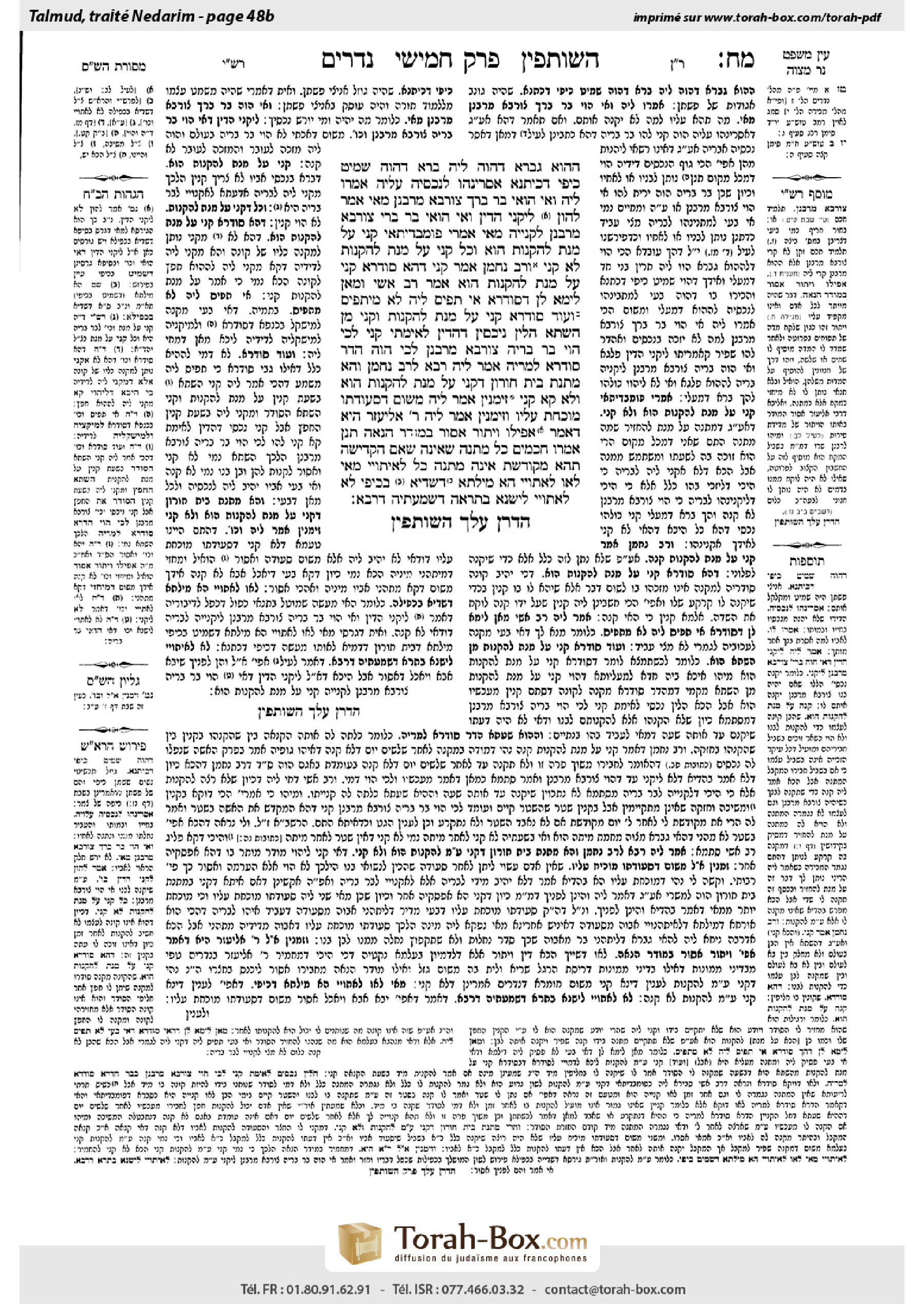
Nedarim 48b: Talmud study for Daf Yomi
Daf Yomi is the daily study of one Talmud folio. Explore 37 tractates with scans, Hebrew text, Sefaria English and AI-generated French translations where annotated.
Passage selection and English or AI-generated French translation are available where the scan has annotations. Daf Study is independent of Torah-Box and Sefaria.
Browse Nedarim · נדרים · All tractatesNedarim 48b text and translations
This page of Nedarim includes the Aramaic text, an English translation and an AI-generated French translation, alongside the scan above.
נדרים מ״ח ב · Aramaic and Hebrew text
הָהוּא גַּבְרָא דַּהֲוָה לֵיהּ בְּרָא דַּהֲוָה שָׁמֵיט כִּיפֵּי דְכִיתָּנָא. אַסְרִינְהוּ לְנִכְסֵיהּ עֲלֵיהּ. אָמְרוּ לֵיהּ: וְאִי הֲוַאי בַּר בְּרָךְ צוּרְבָּא מֵרַבָּנַן, מַאי? אֲמַר לְהוֹן: לִיקְנֵי הָדֵין, וְאִי הֲוַאי בַּר בְּרִי צוּרְבָּא מֵרַבָּנַן, לִקְנְיֵיהּ. מַאי?
אָמְרִי פּוּמְבְּדִיתָאֵי: ״קְנִי עַל מְנָת לְהַקְנוֹת״ הוּא, וְכׇל ״קְנִי עַל מְנָת לְהַקְנוֹת״ — לָא קָנֵי.
וְרַב נַחְמָן אָמַר: קָנֵי, דְּהָא סוּדָרָא ״קָנֵי עַל מְנָת לְהַקְנוֹת״ הוּא.
אָמַר רַב אָשֵׁי: וּמַאן לֵימָא לַן דְּסוּדָרָא אִי תָּפֵיס לֵיהּ לָא מִיתְּפִיס? וְעוֹד: ״סוּדָרָא קָנֵי עַל מְנָת לְהַקְנוֹת וְקָנֵי מִן הַשְׁתָּא״. הָלֵין נִיכְסִין דְּהָדֵין לְאִימַתִּי קָנֵי — לְכִי הָוֵי בַּר בְּרֵיהּ צוּרְבָּא מֵרַבָּנַן, לְכִי הֲוָה — הָדַר סוּדָרָא לְמָרֵיהּ!
אֲמַר לֵיהּ רָבָא לְרַב נַחְמָן: וְהָא מַתְּנַת בֵּית חוֹרוֹן ״דִּקְנִי עַל מְנָת לְהַקְנוֹת״ הוּא, וְלָא קָא קָנֵי!
זִימְנִין אֲמַר לֵיהּ: מִשּׁוּם דִּסְעוּדָתוֹ מוֹכַחַת עָלָיו, וְזִימְנִין אֲמַר לֵיהּ רַבִּי אֱלִיעֶזֶר הִיא, דְּאָמַר: אֲפִילּוּ וִיתּוּר אָסוּר בְּמוּדָּר הֲנָאָה.
תְּנַן, אָמְרוּ חֲכָמִים: כׇּל מַתָּנָה שֶׁאֵינָהּ שֶׁאִם הִקְדִּישָׁהּ תְּהֵא מְקוּדֶּשֶׁת — אֵינָהּ מַתָּנָה. ״כׇּל״ לְאֵיתוֹיֵי מַאי? לָאו לְאֵתוֹיֵי הָא מִילְּתָא דְּשַׁדְיָא בְּכִיפֵּי? לָא, לְאֵתוֹיֵי לִישָּׁנָא בָּתְרָאָה דִּשְׁמַעְתֵּיהּ דְּרָבָא.
הַדְרָן עֲלָךְ הַשּׁוּתָּפִין
Nedarim 48b · English translation
There was a certain man who had a son who seized in theft sheaves [keifei] of flax, and the father took a vow prohibiting his son from deriving any benefit from his possessions. They said to the father: And if the son of your son would become a Torah scholar, and you would want him to be able to inherit your possessions, what would you do? He said to them: Let this son of mine acquire the possessions, and only if the son of my son becomes a Torah scholar then let him, my grandson, acquire them from my son. They asked: What is the ruling?
The Sages of Pumbedita say: This is just as if he stated: Acquire the property on the condition that you transfer it to your son. In such a case he has not given anything to the recipient, but has merely made him a conduit to transfer the item to someone else. And in any case where one says: Acquire this item on the condition that you transfer ownership, the recipient does not acquire the item, and the statement has no effect.
But Rav Naḥman said: He does acquire, as an acquisition by means of a cloth is a case of an act of acquisition performed only in order to transfer ownership. In such a case, one gives another a cloth in order to confer ownership of some other item, but the cloth itself does not assume new ownership. Still, this is an effective means of acquisition. So too, the property of the grandfather may be effectively conferred upon the grandson through the son, without the son acquiring it himself.
Rav Ashi said: And who will say to us concerning the cloth that if the recipient of the cloth would seize it with the intention of keeping it that it would not be an effective seizure? While the cloth is technically transferred, the recipient does not usually exercise his right to it. And furthermore, an acquisition by means of a cloth is a case where the giver is saying: Acquire only in order to transfer ownership, but acquire from now. However, with regard to these possessions of this one who took the vow, when does the son acquire? Only when his son’s son becomes a Torah scholar. And when he becomes a Torah scholar, the cloth has already been returned to its owner, i.e., the act of acquisition had taken place long before the grandson became a Torah scholar. The initial transfer therefore has no effect.
Rava said to Rav Naḥman: But the gift of Beit Ḥoron discussed in the mishna is an example of an acquisition performed only in order to transfer ownership, and there he did not acquire it at all.
The Gemara recounts: Sometimes when Rav Naḥman was asked this question he said to him: That is because his wedding meal proves about him that he did not truly intend to give the items to the recipient, and not because such an acquisition is invalid per se. And sometimes he said to him that in that case they followed the stringent opinion of Rabbi Eliezer, who said: Even negligible benefits ordinarily waived are forbidden to one prohibited by a vow from deriving benefit from another. So too, Rabbi Eliezer holds that one cannot rely on an act of acquisition performed merely in order to transfer ownership to a third party.
§ We learned in the mishna (48a): The Sages therefore said: Any gift that is not so absolute so that, if the recipient were to consecrate the gift it would be consecrated, is not a gift. The Gemara asks: What is added by the word: Any? Is it not adding this matter of one who seized sheaves of flax, and to say that the gift of the father has no effect? The Gemara responds: No, the intent is to add the latter version of the aforementioned statement of Rava, that a gift given as a means of circumventing a vow has no effect, even when the giver mentions the nature of the gift only casually and does not stipulate it as a formal condition.
Nedarim 48b · Traduction française (IA)
Il y avait un homme dont le fils avait volé des gerbes [keifei] de lin, et le père fit le vœu d’interdire à son fils de tirer le moindre profit de ses biens. On dit au père : « Et si le fils de ton fils devenait un érudit en Torah et que tu souhaitais qu’il puisse hériter de tes biens, que ferais-tu ? » Il leur répondit : « Que mon fils acquière ces biens, et que, si le fils de mon fils devient un érudit en Torah, il les acquière de mon fils. » On demanda : quelle est la halakha ?
Les Sages de Poumbedita disent : c’est comme s’il avait dit : « Acquiers le bien à condition de le transférer à ton fils. » Dans un tel cas, il n’a rien donné au destinataire, mais en a simplement fait un intermédiaire chargé de transférer l’objet à quelqu’un d’autre. Or, chaque fois qu’une personne dit : « Acquiers cet objet à condition d’en transférer la propriété », le destinataire n’acquiert pas l’objet et cette déclaration est sans effet.
Mais Rav Naḥman a dit : il l’acquiert, car l’acquisition au moyen d’un tissu est un cas où l’acte d’acquisition est accompli uniquement pour transférer la propriété. Dans un tel cas, on remet à une autre personne un tissu afin de lui transférer la propriété d’un autre objet, mais le tissu lui-même ne change pas de propriétaire. Pourtant, il s’agit bien d’un mode d’acquisition valide. De même, les biens du grand-père peuvent être valablement transmis au petit-fils par l’intermédiaire du fils, sans que celui-ci les acquière lui-même.
Rav Ashi a dit : « Et qui nous dira que, dans le cas du tissu, si son destinataire s’en emparait avec l’intention de le garder, cette prise ne serait pas valable ? » Bien que le tissu soit techniquement transféré, le destinataire n’exerce généralement pas son droit sur celui-ci. En outre, l’acquisition au moyen d’un tissu est un cas où le donateur dit : « Acquiers-le uniquement pour en transférer la propriété, mais acquiers-le dès maintenant. » Or, s’agissant des biens de l’homme qui a fait le vœu, à quel moment le fils les acquiert-il ? Seulement lorsque le fils de son fils devient un érudit en Torah. Mais lorsqu’il le devient, le tissu a déjà été rendu à son propriétaire, c’est-à-dire que l’acte d’acquisition a eu lieu bien avant que le petit-fils ne devienne un érudit en Torah. Le transfert initial est donc sans effet.
Rava dit à Rav Naḥman : « Mais le don de Beit Ḥoron évoqué dans la Michna est un exemple d’acquisition accomplie uniquement pour transférer la propriété, et, dans ce cas, le destinataire ne l’a pas acquis du tout. »
La Guemara rapporte que, parfois, lorsque Rav Naḥman était interrogé à ce sujet, il lui répondait : « C’est parce que le festin de noces prouve que le donateur n’avait pas réellement l’intention de donner les objets au destinataire, et non parce qu’une telle acquisition est invalide en soi. » D’autres fois, il lui répondait que, dans ce cas, on avait suivi l’opinion rigoureuse de Rabbi Eliezer, qui disait : « Même les avantages négligeables auxquels on renonce habituellement sont interdits à celui qu’un vœu empêche de tirer profit d’autrui. » De même, Rabbi Eliezer estime qu’on ne peut pas s’appuyer sur un acte d’acquisition accompli simplement pour transférer la propriété à un tiers.
§ Nous avons appris dans la Michna (48a) : « Les Sages ont donc dit : tout don qui n’est pas absolument inconditionnel, au point que, si le destinataire le consacrait, il serait consacré, n’est pas un don. » La Guemara demande : qu’ajoute le mot « tout » ? N’ajoute-t-il pas le cas de celui qui s’est emparé de gerbes de lin, pour enseigner que le don du père est sans effet ? La Guemara répond : non ; il vise à ajouter la seconde version de la déclaration de Rava mentionnée précédemment : un don fait afin de contourner un vœu est sans effet, même si le donateur ne mentionne la nature du don qu’incidemment et ne la stipule pas comme une condition formelle.
Traduction française générée par IA à partir de l’édition anglaise de Sefaria. Vérifie toujours un passage avec le texte source.
Text from Sefaria: William Davidson Edition - Vocalized Aramaic (CC BY NC); William Davidson Edition - English (CC BY NC).