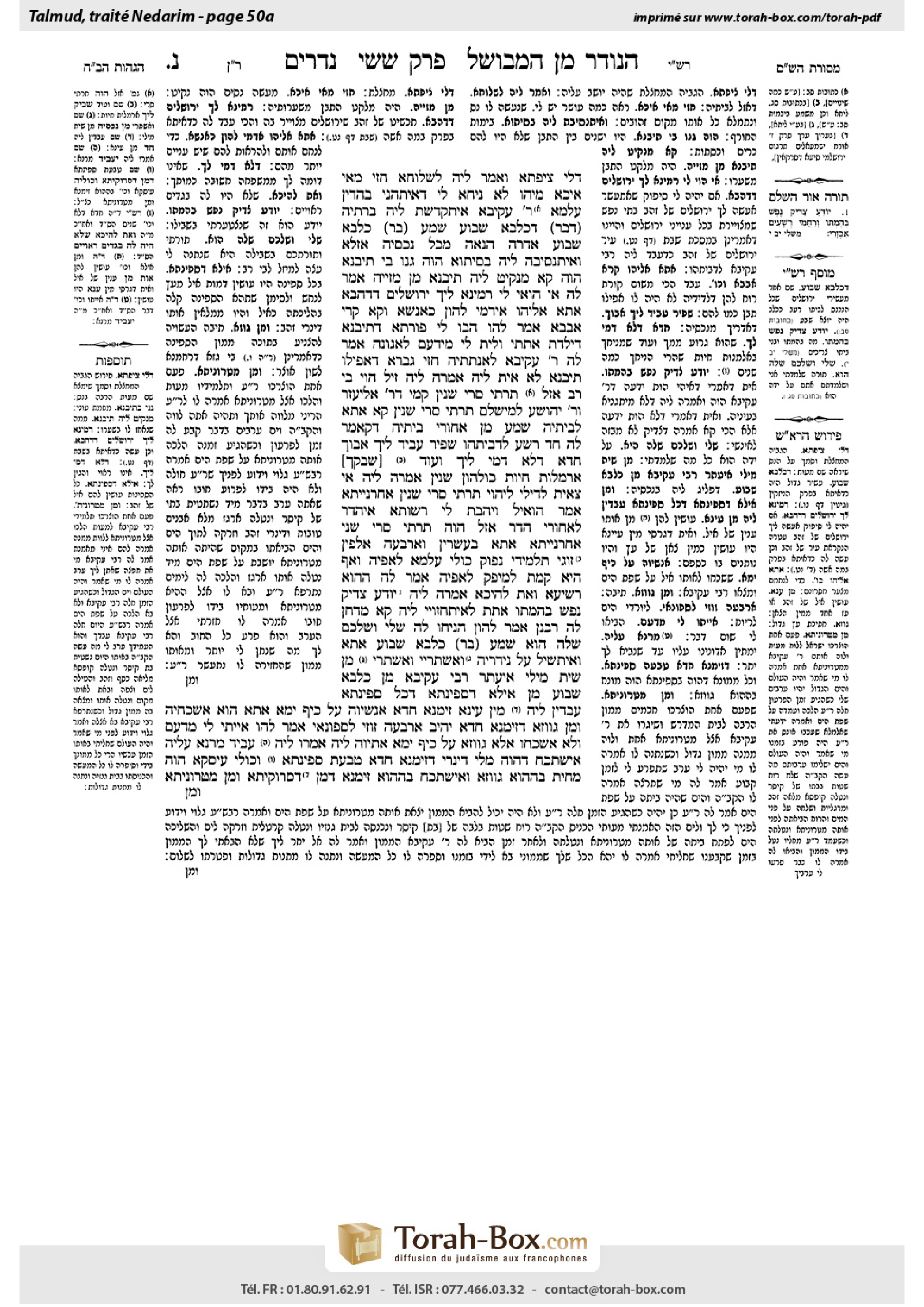
Nedarim 50a: Talmud study for Daf Yomi
Daf Yomi is the daily study of one Talmud folio. Explore 37 tractates with scans, Hebrew text, Sefaria English and AI-generated French translations where annotated.
Passage selection and English or AI-generated French translation are available where the scan has annotations. Daf Study is independent of Torah-Box and Sefaria.
Browse Nedarim · נדרים · All tractatesNedarim 50a text and translations
This page of Nedarim includes the Aramaic text, an English translation and an AI-generated French translation, alongside the scan above.
נדרים נ׳ א · Aramaic and Hebrew text
דַּלִּי צִיפְּתָא וַאֲמַר לֵיהּ לִשְׁלוּחָא: חֲזִי מַאי אִיכָּא. מִיהוּ, לָא נִיחָא לִי דְּאִיתְהֲנֵי בְּהָדֵין עָלְמָא.
רַבִּי עֲקִיבָא אִיתְקַדַּשַׁת לֵיהּ בְּרַתֵּיה (דְּבַר) דְּכַלְבָּא שָׂבוּעַ. שְׁמַע (בַּר) כַּלְבָּא שָׂבוּעַ, אַדְּרַהּ הֲנָאָה מִכׇּל נִכְסֵיהּ. אֲזַלָא וְאִיתְנְסִיבָה לֵיהּ.
בְּסִיתְוָא הֲוָה גָּנוּ בֵּי תִיבְנָא, הֲוָה קָא מְנַקֵּיט לַיהּ תִּיבְנָא מִן מַזְּיַיהּ. אֲמַר לַהּ: אִי הֲוַאי לִי, רָמֵינָא לִיךְ יְרוּשָׁלַיִם דְּדַהֲבָא. אֲתָא אֵלִיָּהוּ אִידְּמִי לְהוֹן כֶּאֱנָשָׁא וְקָא קָרֵי אַבָּבָא. אֲמַר לְהוּ: הַבוּ לִי פּוּרְתָּא דְתִיבְנָא דִּילֵדַת אִתְּתִי, וְלֵית לִי מִידַּעַם לְאַגְנוֹיַהּ. אֲמַר לַהּ רַבִּי עֲקִיבָא לְאִנְתְּתֵיהּ: חֲזִי גַּבְרָא דַּאֲפִילּוּ תִּיבְנָא לָא אִית לֵיהּ.
אֲמַרָה לֵיהּ: זִיל הֱוֵי בֵּי רַב. אֲזַל תַּרְתֵּי סְרֵי שְׁנִין קַמֵּי דְּרַבִּי אֱלִיעֶזֶר וְרַבִּי יְהוֹשֻׁעַ. לְמִישְׁלַם תַּרְתֵּי סְרֵי שְׁנִין קָא אֲתָא לְבֵיתֵיהּ, שְׁמַע מִן אֲחוֹרֵי בֵּיתֵיהּ דְּקָאָמַר לַהּ חַד רָשָׁע לִדְבֵיתְהוּ: שַׁפִּיר עָבֵיד לִיךְ אֲבוּךְ חֲדָא דְּלָא דָּמֵי לִיךְ. וְעוֹד: [שַׁבְקִךְ] אַרְמְלוּת חַיּוּת כּוּלְּהוֹן שְׁנִין. אֲמַרָה לֵיהּ: אִי צָאֵית לְדִילִי — לֶיהֱוֵי תַּרְתֵּי סְרֵי שְׁנִין אַחְרָנְיָיתָא. אָמַר: הוֹאִיל וִיהַבַת לִי רְשׁוּתָא, אֶיהְדַּר לַאֲחוֹרַי. הֲדַר אֲזַל הֲוָה תַּרְתֵּי סְרֵי שְׁנֵי אַחְרָנְיָיתָא.
אֲתָא בְּעֶשְׂרִין וְאַרְבְּעָה אַלְפִין זוּגֵי תַלְמִידֵי. נְפוּק כּוּלֵּי עָלְמָא לְאַפֵּיהּ, וְאַף הִיא קָמַת לְמִיפַּק לְאַפֵּיהּ. אֲמַר לַהּ הַהוּא רַשִּׁיעָא: וְאַתְּ לְהֵיכָא? אֲמַרָה לֵיהּ: ״יוֹדֵעַ צַדִּיק נֶפֶשׁ בְּהֶמְתּוֹ״. אֲתָת לְאִיתְחֲזוֹיֵי לֵיהּ, קָא מְדַחִן לַהּ רַבָּנַן. אֲמַר לְהוֹן: הַנִּיחוּ לָהּ, שֶׁלִּי וְשֶׁלָּכֶם שֶׁלָּהּ הוּא. שְׁמַע (בַּר) כַּלְבָּא שָׂבוּעַ, אֲתָא וְאִיתְּשִׁיל עַל נִידְרֵיהּ וְאִשְׁתְּרַיי, וְאִשְׁתְּרִי.
מִן שֵׁית מִילֵּי אִיעַתַּר רַבִּי עֲקִיבָא: מִן כַּלְבָּא שָׂבוּעַ, מִן אַיָּלָא דִסְפִינְתָּא. דְּכֹל סְפִינָתָא עָבְדִין לֵיהּ מִין עָינָא. זִימְנָא חֲדָא אַנְשְׁיוּהּ עַל כֵּיף יַמָּא אֲתָא הוּא, אַשְׁכְּחֵיהּ.
וּמִן גְּווֹזָא, דְּזִימְנָא חֲדָא יְהֵיב אַרְבָּעָה זוּזֵי לְסָפוֹנָאֵי, אֲמַר לְהוּ: אַיְיתֵי לִי מִדַּעַם, וְלָא אַשְׁכַּחוּ אֶלָּא גְּווֹזָא עַל כֵּיף יַמָּא. אַתְיוּהּ לֵיהּ. אֲמַרוּ לֵיהּ: עֲבֵיד מָרַנָא עֲלֵיהּ, אִישְׁתְּכַח דַּהֲוָה מְלֵי דִּינָרֵי. דְּזִימְנָא חֲדָא טְבַעַת סְפִינְתָּא, וְכוּלֵּי עִיסְקָא הֲוָה מַחֵית בְּהָהוּא גְּווֹזָא, וְאִישְׁתְּכַח בְּהָהוּא זִימְנָא.
דְּמִן דִּסְרוּקִיתָא, וּמִן מַטְרוֹנִיתָא,
Nedarim 50a · English translation
He lifted the mat [tzifeta] upon which he was sitting and said to the messenger: See what there is here. The place was miraculously filled with gold dinars. This demonstrated that Rabbi Yehuda could have had plenty of money if he had so desired. He explained: However, it is not amenable to me to derive benefit in this world.
§ In connection to the above incident concerning the poverty of scholars and their potential to become wealthy through remarkable circumstances, the Gemara relates an incident: Rabbi Akiva became betrothed to the daughter of bar Kalba Savua. When bar Kalba Savua heard about their betrothal, he took a vow prohibiting her from eating all of his property. Despite this, she went ahead and married Rabbi Akiva.
In the winter they would sleep in a storehouse of straw, and Rabbi Akiva would gather strands of straw from her hair. He said to her: If I had the means I would place on your head a Jerusalem of Gold, a type of crown. Elijah the prophet came and appeared to them as a regular person and started calling and knocking on the door. He said to them: Give me a bit of straw, as my wife gave birth and I do not have anything on which to lay her. Rabbi Akiva said to his wife: See this man, who does not even have straw. We should be happy with our lot, as we at least have straw to sleep on.
She said to him: Go and be a student of Torah. He went and studied Torah for twelve years before Rabbi Eliezer and Rabbi Yehoshua. At the completion of the twelve years, he was coming home when he heard from behind his house that one wicked person was saying to his wife: Your father behaved well toward you. He was right to disinherit you. One reason is that your husband is not similar to you, i.e., he is not suitable for you. And furthermore, he has left you in widowhood in his lifetime all these years. She said to him: If he listens to me, he should be there for another twelve years. Rabbi Akiva said: Since she has given me permission through this statement, I will go back and study more. He turned back and went to the study hall, and he was there for another twelve years.
Eventually he came back accompanied by 24,000 pairs of students. Everyone went out to greet him, as he was by then a renowned teacher, and she too arose to go out to greet him. That wicked person said to her: And to where are you going? As she was excessively poor, she was not dressed in a grand manner, as fit for the wife of one so esteemed. She said to him: “A righteous man regards the life of his beast” (Proverbs 12:10); he knows that I am in this state as a result of my dedication to him. She came to present herself before Rabbi Akiva, but the Sages tried to fend her off, as they were unaware of her identity. He said to them: Leave her. Both my Torah knowledge and yours are hers. When bar Kalba Savua heard that the famous man was his son-in-law, he came before halakhic authorities and requested the dissolution of his vow, and it was dissolved.
The Gemara adds: Rabbi Akiva became wealthy from six things. First, from the money he received from Kalba Savua after his vow was dissolved. Second, he gained money from the ram of a ship [eila disfineta], as craftsmen would fashion a sculpture of a type of sheep for every ship, which would be placed on its bow, and which would be used to conceal money. On one occasion, the sailors forgot this ram on the seashore, and Rabbi Akiva came and found it with the money stored inside.
And third, he became wealthy from a log [gavza] of wood, as on one occasion he gave four dinars to sailors and said to them: Bring me something worthwhile. And they found only a log of wood on the seashore. They brought it to him and said to him: May our master wait with this until we bring a more worthy item. He found that the log was full of dinars, as on one occasion a ship sunk and all the merchandise, i.e., the money, owned by the people on the ship was placed in that log, and it was found on that occasion by the sailors.
Rabbi Akiva became wealthy from a convoy of Ishmaelites [Serukita]. And he became wealthy from a certain lady. Rabbi Akiva borrowed money from a lady and said that God would be his guarantor. When it came time to return the loan, the king’s daughter became insane and threw a purse of jewelry into the sea, which was found by that lady. She told Rabbi Akiva that his guarantor had paid his debt and she allowed him to keep the loan.
Nedarim 50a · Traduction française (IA)
Il souleva la natte [tzifeta] sur laquelle il était assis et dit au messager : « Regarde ce qu’il y a ici. » L’endroit se remplit miraculeusement de dinars d’or. Cela démontra que Rabbi Yehouda aurait pu avoir beaucoup d’argent s’il l’avait voulu. Il expliqua : « Cependant, je ne souhaite pas tirer profit de ce monde. »
§ À propos de l’incident évoqué plus haut concernant la pauvreté des érudits et leur capacité à s’enrichir dans des circonstances extraordinaires, la Guemara rapporte un autre incident : Rabbi Akiva se fiança à la fille de bar Kalba Savua. Lorsque celui-ci apprit leurs fiançailles, il prononça un vœu lui interdisant de jouir de l’ensemble de ses biens. Malgré cela, elle épousa Rabbi Akiva.
En hiver, ils dormaient dans un entrepôt de paille, et Rabbi Akiva retirait des brins de paille des cheveux de sa femme. Il lui dit : « Si j’en avais les moyens, je poserais sur ta tête une Jérusalem d’or », une sorte de couronne. Le prophète Élie vint et leur apparut sous l’aspect d’un homme ordinaire ; il se mit à appeler et à frapper à la porte. Il leur dit : « Donnez-moi un peu de paille, car ma femme vient d’accoucher et je n’ai rien sur quoi l’allonger. » Rabbi Akiva dit à sa femme : « Regarde cet homme, qui n’a même pas de paille. Nous devrions nous contenter de notre sort, puisque nous avons au moins de la paille pour dormir. »
Elle lui dit : « Va étudier la Torah. » Il partit étudier la Torah pendant douze ans auprès de Rabbi Eliezer et de Rabbi Yehoshua. Au terme de ces douze années, il rentrait chez lui lorsqu’il entendit, derrière sa maison, un homme méchant dire à sa femme : « Ton père a bien agi envers toi. Il avait raison de te déshériter. D’une part, ton mari n’est pas ton égal, c’est-à-dire qu’il n’est pas fait pour toi. De plus, il t’a laissée veuve de son vivant pendant toutes ces années. » Elle lui répondit : « S’il m’écoute, qu’il reste encore douze ans là-bas. » Rabbi Akiva se dit : « Puisqu’elle m’a donné la permission par ces paroles, je vais repartir étudier davantage. » Il retourna à la maison d’étude et y resta encore douze ans.
Finalement, il revint accompagné de 24 000 paires d’élèves. Tout le monde sortit à sa rencontre, car il était désormais un maître renommé, et elle aussi se leva pour aller à sa rencontre. Cet homme méchant lui dit : « Où vas-tu donc ? » Comme elle était extrêmement pauvre, elle n’était pas vêtue avec élégance, comme il convenait à la femme d’un homme aussi estimé. Elle lui répondit : « Le juste prend soin de la vie de sa bête » (Proverbes 12,10) ; il sait que je suis dans cet état en raison de mon dévouement envers lui. Elle vint se présenter devant Rabbi Akiva, mais les Sages essayèrent de l’écarter, car ils ne savaient pas qui elle était. Il leur dit : « Laissez-la. Ma connaissance de la Torah et la vôtre lui appartiennent. » Lorsque bar Kalba Savua apprit que cet homme célèbre était son gendre, il se présenta devant des autorités halakhiques et demanda la dissolution de son vœu, qui fut prononcée.
La Guemara ajoute : Rabbi Akiva s’enrichit grâce à six choses. Premièrement, grâce à l’argent qu’il reçut de Kalba Savua après la dissolution de son vœu. Deuxièmement, il s’enrichit grâce au bélier d’un navire [eila disfineta] : les artisans façonnaient pour chaque navire une sculpture représentant une sorte de mouton, placée à la proue et servant à cacher de l’argent. Un jour, les marins oublièrent ce bélier sur le rivage, et Rabbi Akiva le trouva avec l’argent qui y était dissimulé.
Troisièmement, il s’enrichit grâce à une bûche [gavza]. Un jour, il donna quatre dinars à des marins et leur dit : « Rapportez-moi quelque chose qui en vaille la peine. » Ils ne trouvèrent qu’une bûche sur le rivage. Ils la lui apportèrent et lui dirent : « Que notre maître la garde en attendant que nous trouvions un objet plus digne. » Il découvrit que la bûche était pleine de dinars : un navire avait fait naufrage, et toutes les marchandises — c’est-à-dire l’argent — appartenant aux personnes qui se trouvaient à bord avaient été placées dans cette bûche, que les marins avaient trouvée à cette occasion.
Rabbi Akiva s’enrichit grâce à une caravane d’Ismaélites [Serukita]. Il s’enrichit également grâce à une certaine dame. Rabbi Akiva lui emprunta de l’argent et lui dit que Dieu serait son garant. Au moment de rembourser le prêt, la fille du roi devint folle et jeta à la mer une bourse de bijoux, que cette dame trouva. Elle dit à Rabbi Akiva que son garant avait remboursé sa dette et lui permit de garder l’argent emprunté.
Traduction française générée par IA à partir de l’édition anglaise de Sefaria. Vérifie toujours un passage avec le texte source.
Text from Sefaria: William Davidson Edition - Vocalized Aramaic (CC BY NC); William Davidson Edition - English (CC BY NC).