Nedarim 50b: Talmud study for Daf Yomi
Daf Yomi is the daily study of one Talmud folio. Explore 37 tractates with scans, Hebrew text, Sefaria English and AI-generated French translations where annotated.
Passage selection and English or AI-generated French translation are available where the scan has annotations. Daf Study is independent of Torah-Box and Sefaria.
Browse Nedarim · נדרים · All tractatesNedarim 50b text and translations
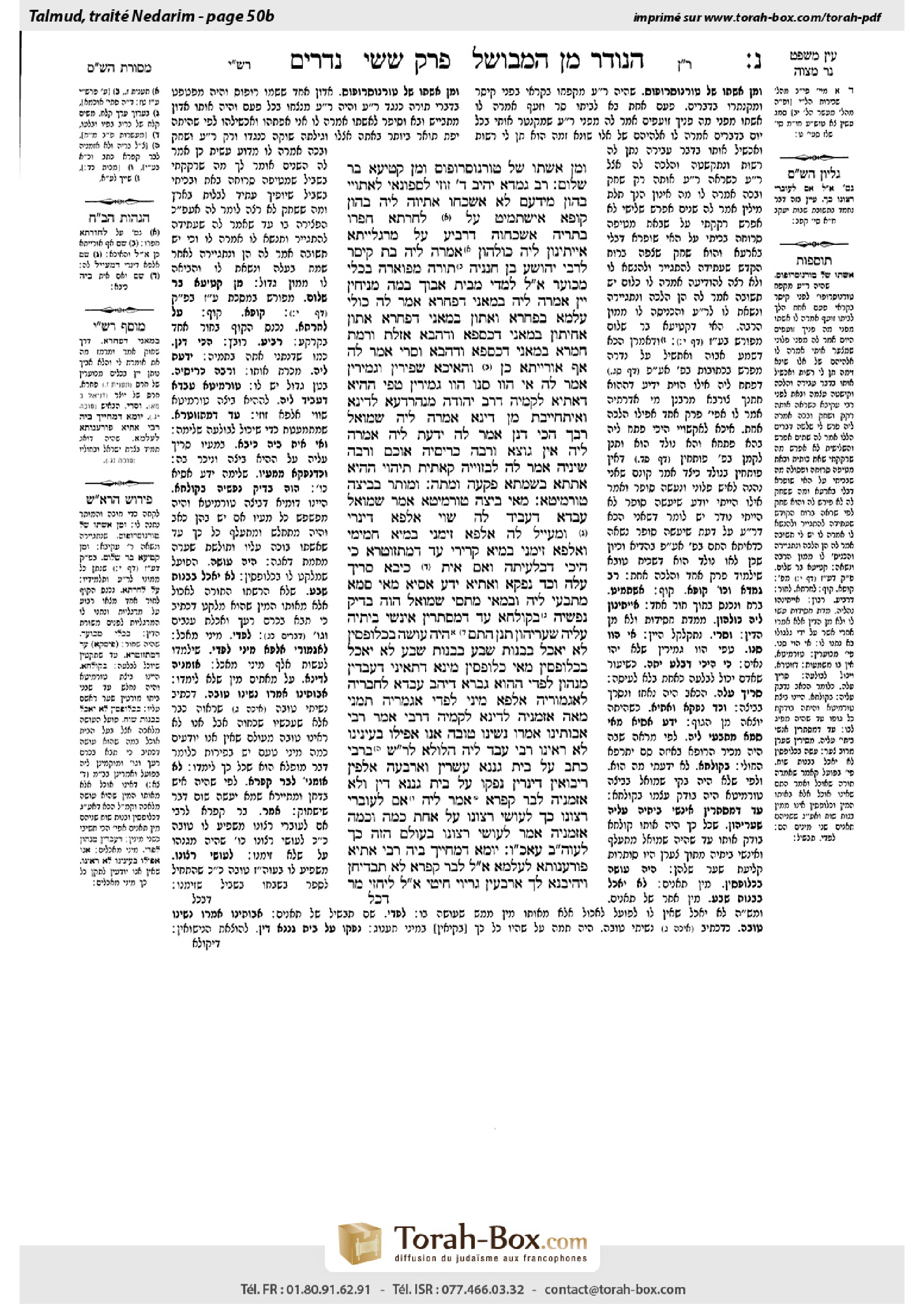
This page of Nedarim includes the Aramaic text, an English translation and an AI-generated French translation, alongside the scan above.
נדרים נ׳ ב · Aramaic and Hebrew text
וּמִן אִשְׁתּוֹ שֶׁל טוֹרָנוּסְרוּפוּס, וּמִן קְטִיעָא בַּר שָׁלוֹם.
רַב גַּמָּדָא יְהֵיב אַרְבָּעָה זוּזִי לְסָפוֹנָאֵי לְאֵתוֹיֵי בְּהוֹן מִידַּעַם. לָא אַשְׁכַּחוּ, אַתְיוּהּ לֵיהּ בְּהוֹן קוֹפָא. אִישְׁתְּמִיט עַל לְחָרְתָא, חֲפַרוּ בָּתְרֵיהּ, אַשְׁכְּחוּהּ דִּרְבִיעַ עַל מַרְגָּלְיָיתָא, אַיְּיתִינּוּן לֵיהּ כּוּלְּהוֹן.
אֲמַרָה לֵיהּ בַּת קֵיסָר לְרַבִּי יְהוֹשֻׁעַ בֶּן חֲנַנְיָה: תּוֹרָה מְפוֹאָרָה, בִּכְלִי מְכוֹעָר. אֲמַר לַהּ: לִמְדִי מִבֵּית אֲבוּךְ, בַּמֶּה מַנִּיחִין יַיִן? אֲמַרָה לֵיהּ: בְּמָאנֵי דְפַחְרָא. אֲמַר לַהּ: כּוּלֵּי עָלְמָא בְּפַחְרָא, וְאַתּוּן בְּמָאנֵי דְפַחְרָא?! אַתּוּן אַחִיתוּן בְּמָאנֵי דְּכַסְפָּא וְדַהֲבָא!
אֲזַלַת וּרְמָת חַמְרָא בְּמָאנֵי דְּכַסְפָּא וְדַהֲבָא, וּסְרִי. אֲמַר לַהּ: אַף אוֹרָיְיתָא כֵּן. וְהָאִיכָּא שַׁפִּירִין וּגְמִירִין! אֲמַר לַהּ: אִי הֲווֹ סְנוּ, הֲווֹ גְּמִירִין טְפֵי.
הָהִיא דְּאָתְיָא לְקַמֵּיהּ דְּרַב יְהוּדָה מִנְּהַרְדְּעָא לְדִינָא וְאִיתְחַיַּיבַת מִן דִּינָא. אֲמַרָה לֵיהּ: שְׁמוּאֵל רַבָּךְ הָכִי דָּנַן?! אֲמַר לַהּ: יָדְעַתְּ לֵיהּ? אֲמַרָה לֵיהּ: אִין, גּוּצָּא וְרַבָּה כְּרֵיסֵיהּ אוּכָּם וְרַבָּה שִׁינֵּיהּ. אֲמַר לַהּ: לְבַזּוֹיֵיהּ קָאָתֵית? תֶּיהְוֵי הַהִיא אִתְּתָא בְּשַׁמְתָּא. פְּקַעָה וּמִתָה.
וּמוּתָּר בְּבֵיצָה טוֹרְמִיטָא. מַאי בֵּיצָה טוֹרְמִיטָא? אָמַר שְׁמוּאֵל: עַבְדָּא דְּעָבֵיד לַהּ שָׁוֵי אַלְפָּא דִּינָרֵי, וּמְעַיֵּיל לַהּ אַלְפָּא זִימְנֵי בְּמַיָּא חַמִּימֵי וְאַלְפָּא זִימְנֵי בְּמַיָּא קָרִירֵי עַד דְּמִתְזוּטְרָא כִּי הֵיכִי דְּבָלַע יָתַהּ, וְאִם אִית כֵּיבָא — סָרֵיךְ עֲלַהּ, וְכַד נָפְקָא וְאָתְיָא, יָדַע אָסְיָא מַאי סַמָּא מִתְבְּעֵי לֵיהּ וּבְמַאי מִתַּסִּי.
שְׁמוּאֵל הֲוָה בָּדֵיק נַפְשֵׁיהּ בְּקוּלְחָא, עַד דִּמְסַתְּרִין אִינָשֵׁי בֵּיתֵיהּ עֲלֵיהּ שַׂעְרֵיהוֹן.
תְּנַן הָתָם: הָיָה עוֹשֶׂה בִּכְלוּפְסִין — לֹא יֹאכַל בִּבְנוֹת שֶׁבַע. בִּבְנוֹת שֶׁבַע — לֹא יֹאכַל בִּכְלוּפְסִין. מַאי כְּלוּפְסִין? מִינָא דִתְאֵינֵי דְּעָבְדִין מִנְּהוֹן לַפְדֵי.
הָהוּא גַּבְרָא דִּיהַב עַבְדָּא לְחַבְרֵיהּ לְאַגְמוֹרֵיהּ אַלְפָּא מִינֵי לַפְדֵי, אַגְמְרֵיהּ תַּמְנֵי מְאָה. אַזְמְנֵיהּ לְדִינָא לְקַמֵּיהּ דְּרַבִּי. אָמַר רַבִּי: אֲבוֹתֵינוּ אָמְרוּ ״נָשִׁינוּ טוֹבָה״, אָנוּ אֲפִילּוּ בְּעֵינֵינוּ לֹא רָאִינוּ.
רַבִּי עֲבַד לֵיהּ הִלּוּלָא לְרַבִּי שִׁמְעוֹן בְּרַבִּי, כְּתַב עַל בֵּית גְּנָנָא: עֶשְׂרִין וְאַרְבְּעָה אַלְפִין רִיבּוֹאִין דִּינָרִין נְפַקוּ עַל בֵּית גְּנָנָא דֵּין, וְלָא אַזְמְנֵיהּ לְבַר קַפָּרָא. אֲמַר לֵיהּ: אִם לְעוֹבְרֵי רְצוֹנוֹ כָּךְ — לְעוֹשֵׂי רְצוֹנוֹ עַל אַחַת כַּמָּה וְכַמָּה. אַזְמְנֵיהּ, אֲמַר: לְעוֹשֵׂי רְצוֹנוֹ בָּעוֹלָם הַזֶּה כָּךְ — לָעוֹלָם הַבָּא עַל אַחַת כַּמָּה וְכַמָּה.
יוֹמָא דִּמְחַיֵּיךְ בֵּיהּ רַבִּי, אָתְיָא פּוּרְעָנוּתָא לְעָלְמָא. אֲמַר לֵיהּ לְבַר קַפָּרָא: לָא תְּבַדְּיחַן וְיָהֵיבְנָא לָךְ אַרְבְּעִין גְּרִיוֵי חִיטֵּי. אֲמַר לֵיהּ: לִיחְזֵי מָר
Nedarim 50b · English translation
And Rabbi Akiva also grew wealthy from the wife of Turnus Rufus, who converted and gave him her money, and from Ketia bar Shalom, a Roman minister who bequeathed his fortune to him.
§ The Gemara relates a similar incident: Rav Gamda gave four dinars to sailors to bring him something from overseas in exchange for them. However, they did not find anything of worth, so they bought him a monkey with the coins and brought it to him. The monkey escaped and entered a hole. When they dug after it to retrieve it, they found it crouching over pearls, and they brought all of the pearls to Rav Gamda.
The daughter of the emperor said to Rabbi Yehoshua ben Ḥananya: You are the epitome of magnificent Torah, but it is stored in an ugly vessel, as Rabbi Yehoshua ben Ḥananya was an unattractive man. He said to her: You may learn the answer to your statement from your father’s house. In what container do you place wine? She said to him: In earthenware vessels. He said to her: Is it conceivable that everyone stores their wine in earthenware vessels, and you also store it in earthenware vessels? Is there no distinction between the emperor and ordinary people? You should place your wine in vessels of silver and gold.
She went and placed the wine in vessels of silver and gold, and it spoiled. Rabbi Yehoshua said to her: The same is also true of the Torah. It spoils if it is contained in a handsome person. She asked him: But are there not people who are both good looking and learned in Torah? He said to her: If they were ugly they would be even more learned.
A certain woman came before Rav Yehuda of the city of Neharde’a for judgment, and she was found guilty in the judgment of her case. She said to him: Would Shmuel your teacher have judged me in this manner? He said to her: Did you know him? She said to him: Yes. He was short and potbellied. He was dark and his teeth were large. He said to her: Did you come here to disparage him by describing him in this manner? Let that woman be in a state of excommunication. After he excommunicated her, her belly split open and she died, as a punishment for having disparaged a Torah scholar.
§ The mishna teaches that if one said: Cooked food is konam for me, and for that reason I will not taste it, he is prohibited from tasting a loose cooked food but is permitted to taste a thick one, and he is likewise permitted to eat a turemita egg. The Gemara asks: What is a turemita egg? Shmuel said: A slave who knows how to prepare it is worth a thousand dinars. And this is how one prepares it: He inserts it into hot water a thousand times and in cold water a thousand times, until it shrinks enough so that it can be swallowed whole. And if there is a lesion in one’s intestines, part of the lesion adheres to the egg, and when the egg emerges the doctor knows what medicine the patient requires and with what he can be healed. It is therefore an important dish for medicinal purposes.
The Gemara relates: Shmuel would examine himself with a stalk that he would swallow for this purpose. This would weaken his body and cause him to look faint to such an extent that the members of his household would tear their hairs out for him in grief, as they would think he was dying.
Besides vows, there are other areas of halakha where there is a distinction between different varieties of the same food. We learned in a mishna there (Ma’asrot 2:8): A hired worker who was working with keloppasin, a type of fig, may not partake of benot sheva, a different species of fig, during his work. A worker may partake only of the fruit that he is handling at the time (see Deuteronomy 23:25–26). Similarly, if he was working with benot sheva he may not partake of keloppasin. The Gemara asks: What are keloppasin? The Gemara answers: A type of fig from which compote [lifdei] is made.
The Gemara relates: There was a certain man who gave a slave to his friend so that the friend would teach him how to prepare a thousand varieties of compote from figs. However, he taught him only eight hundred. He therefore brought his friend for judgment before Rabbi Yehuda HaNasi. Rabbi Yehuda HaNasi said: Our forefathers said: We have forgotten prosperity (see Lamentations 3:17). They forgot the opulence they enjoyed in better times, but they at least experienced it. By contrast, we have not even seen it with our eyes. Rabbi Yehuda HaNasi had not imagined that so many types of compote could be prepared from figs.
§ The Gemara relates: Rabbi Yehuda HaNasi made a wedding for Rabbi Shimon, son of Rabbi Yehuda HaNasi. Someone wrote on the canopy: 24,000 myriad dinars were expended on this canopy, and nevertheless Rabbi Yehuda HaNasi did not invite bar Kappara to the wedding. The insulted bar Kappara said to Rabbi Yehuda HaNasi: If to those who transgress God’s will, i.e., you who act improperly, their reward is such, as Rabbi Yehuda HaNasi was very wealthy, all the more so those who perform His will are to be rewarded. Upon hearing his reaction, Rabbi Yehuda HaNasi invited him. Bar Kappara then said: If to those who perform His will their reward is such in this world, all the more so will they be rewarded in the World-to-Come.
The Gemara relates additional incidents that occurred between the two scholars. On a day when Rabbi Yehuda HaNasi would laugh, calamity would befall the world, as Rabbi Yehuda HaNasi’s sufferings would atone for the sins of the Jewish people. He therefore said to bar Kappara: Do not cause me to laugh, and I will give you forty se’a of wheat in return. Bar Kappara said to him: The Master will see
Nedarim 50b · Traduction française (IA)
Rabbi Akiva s’enrichit également grâce à l’épouse de Turnus Rufus, qui se convertit et lui donna son argent, ainsi que grâce à Ketia bar Shalom, un dignitaire romain qui lui légua sa fortune.
§ La Guemara rapporte un récit similaire : Rav Gamda donna quatre dinars à des marins pour qu’ils lui rapportent quelque chose d’outre-mer. Mais ils ne trouvèrent rien qui ait de la valeur ; ils achetèrent donc un singe avec les pièces et le lui rapportèrent. Le singe s’échappa et entra dans un trou. En creusant pour le récupérer, ils le trouvèrent accroupi sur des perles et rapportèrent toutes les perles à Rav Gamda.
La fille de l’empereur dit à Rabbi Yehoshua ben Ḥananya : « Tu es l’incarnation même d’une Torah splendide, mais celle-ci est conservée dans un récipient laid », car Rabbi Yehoshua ben Ḥananya était un homme peu séduisant. Il lui dit : « Tu peux trouver la réponse à ta remarque dans la maison de ton père. Dans quel récipient mets-tu le vin ? » Elle lui répondit : « Dans des récipients en terre cuite. » Il lui dit : « Est-il concevable que tout le monde conserve son vin dans des récipients en terre cuite, et que toi aussi tu le conserves dans des récipients en terre cuite ? N’y a-t-il donc aucune différence entre l’empereur et les gens ordinaires ? Tu devrais mettre ton vin dans des récipients en argent et en or. »
Elle alla placer le vin dans des récipients en argent et en or, et il se gâta. Rabbi Yehoshua lui dit : « Il en va de même pour la Torah : elle se gâte lorsqu’elle est contenue dans une belle personne. » Elle lui demanda : « Mais n’y a-t-il pas des gens qui sont à la fois beaux et versés dans la Torah ? » Il lui répondit : « S’ils étaient laids, ils seraient encore plus versés dans la Torah. »
Une femme se présenta devant Rav Yehuda, de la ville de Neharde’a, pour un jugement, et fut reconnue coupable dans cette affaire. Elle lui dit : « Shmuel, ton maître, m’aurait-il jugée ainsi ? » Il lui demanda : « Le connaissais-tu ? » Elle répondit : « Oui. Il était petit et ventru. Il avait le teint sombre et de grandes dents. » Il lui dit : « Es-tu venue ici pour le dénigrer en le décrivant ainsi ? Que cette femme soit excommuniée. » Après qu’il l’eut excommuniée, son ventre se fendit et elle mourut, punie pour avoir dénigré un sage de la Torah.
§ La Michna enseigne que si quelqu’un dit : « Le plat cuisiné m’est konam », et que, pour cette raison, il ne le goûtera pas, il lui est interdit de goûter un plat cuisiné liquide, mais il lui est permis d’en goûter un épais ; il lui est également permis de manger un œuf turemita. La Guemara demande : Qu’est-ce qu’un œuf turemita ? Shmuel dit : « Un esclave qui sait le préparer vaut mille dinars. » Voici comment on le prépare : on le plonge mille fois dans de l’eau chaude et mille fois dans de l’eau froide, jusqu’à ce qu’il rétrécisse suffisamment pour pouvoir être avalé tout entier. S’il y a une lésion dans les intestins d’une personne, une partie de la lésion adhère à l’œuf. Lorsque celui-ci ressort, le médecin sait quel remède le malade requiert et comment le guérir. C’est donc un mets important à des fins médicinales.
La Guemara rapporte : Shmuel s’examinait à l’aide d’une tige qu’il avalait à cette fin. Cela affaiblissait son corps et lui donnait un air si épuisé que les membres de sa maisonnée s’arrachaient les cheveux de chagrin, pensant qu’il était en train de mourir.
Outre les vœux, d’autres domaines de la halakha distinguent différentes variétés d’un même aliment. Nous avons appris dans une Michna, là-bas (Ma’asrot 2:8) : Un ouvrier salarié qui travaille avec des keloppasin, une sorte de figue, ne peut pas manger de benot sheva, une autre espèce de figue, pendant son travail. Un ouvrier ne peut manger que du fruit qu’il manipule à ce moment-là (voir Deutéronome 23:25–26). De même, s’il travaille avec des benot sheva, il ne peut pas manger de keloppasin. La Guemara demande : Que sont les keloppasin ? La Guemara répond : Une sorte de figue dont on fait de la compote [lifdei].
La Guemara rapporte : Un homme donna un esclave à son ami afin que celui-ci lui apprenne à préparer mille variétés de compote à partir de figues. Cependant, il ne lui en enseigna que huit cents. L’homme fit donc comparaître son ami devant Rabbi Yehuda HaNasi. Rabbi Yehuda HaNasi dit : « Nos ancêtres disaient : “Nous avons oublié la prospérité” » (voir Lamentations 3:17). Ils avaient oublié l’opulence dont ils jouissaient en des temps meilleurs, mais ils l’avaient au moins connue. Nous, en revanche, nous ne l’avons même pas vue de nos yeux. Rabbi Yehuda HaNasi n’avait pas imaginé qu’on pouvait préparer autant de sortes de compote à partir de figues.
§ La Guemara rapporte : Rabbi Yehuda HaNasi organisa le mariage de Rabbi Shimon, son fils. Quelqu’un écrivit sur le dais nuptial : « Vingt-quatre mille myriades de dinars ont été dépensés pour ce dais. » Pourtant, Rabbi Yehuda HaNasi n’invita pas bar Kappara au mariage. Offensé, bar Kappara dit à Rabbi Yehuda HaNasi : « Si ceux qui transgressent la volonté de Dieu, c’est-à-dire vous qui agissez de manière inconvenante, reçoivent une telle récompense — car Rabbi Yehuda HaNasi était très riche —, à plus forte raison ceux qui accomplissent Sa volonté seront-ils récompensés. » En entendant sa réaction, Rabbi Yehuda HaNasi l’invita. Bar Kappara dit alors : « Si ceux qui accomplissent Sa volonté reçoivent une telle récompense dans ce monde, à plus forte raison seront-ils récompensés dans le Monde futur. »
La Guemara rapporte d’autres incidents survenus entre les deux sages. Les jours où Rabbi Yehuda HaNasi riait, un malheur s’abattait sur le monde, car les souffrances de Rabbi Yehuda HaNasi expiaient les péchés du peuple juif. Il dit donc à bar Kappara : « Ne me fais pas rire, et je te donnerai en échange quarante séa de blé. » Bar Kappara lui dit : « Le Maître verra
Traduction française générée par IA à partir de l’édition anglaise de Sefaria. Vérifie toujours un passage avec le texte source.
Text from Sefaria: William Davidson Edition - Vocalized Aramaic (CC BY NC); William Davidson Edition - English (CC BY NC).