Nedarim 51a: Talmud study for Daf Yomi
Daf Yomi is the daily study of one Talmud folio. Explore 37 tractates with scans, Hebrew text, Sefaria English and AI-generated French translations where annotated.
Passage selection and English or AI-generated French translation are available where the scan has annotations. Daf Study is independent of Torah-Box and Sefaria.
Browse Nedarim · נדרים · All tractatesNedarim 51a text and translations
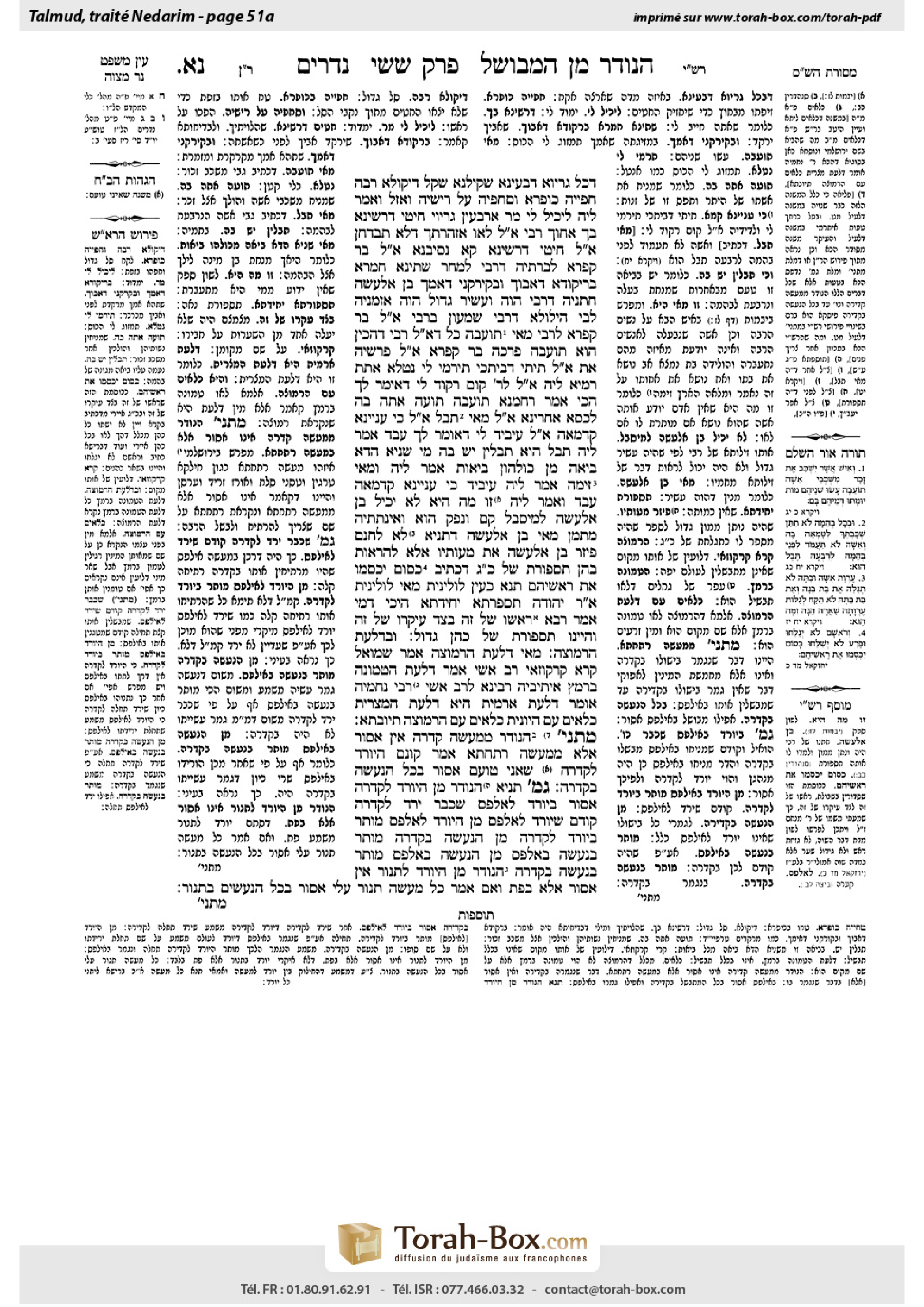
This page of Nedarim includes the Aramaic text, an English translation and an AI-generated French translation, alongside the scan above.
נדרים נ״א א · Aramaic and Hebrew text
דְּכֹל גְּרִיוָא דְּבָעֵינָא שָׁקֵילְנָא. שְׁקַל דִּיקּוּלָא רַבָּה, חַפְיֵיהּ כּוּפְרָא וְסַחְפֵיהּ עַל רֵישֵׁיהּ, וַאֲזַל וַאֲמַר לֵיהּ: לֵיכִיל לִי מָר אַרְבְּעִין גְּרִיוֵי חִיטֵּי דְּרָשֵׁינָא בָּךְ. אַחוּךְ רַבִּי. אֲמַר לֵיהּ: לָאו אַזְהַרְתָּךָ דְּלָא תְּבַדְּחַן? אֲמַר לֵיהּ: חִיטֵּי דְּרָשֵׁינָא קָא נָסֵיבְנָא.
אֲמַר לַהּ בַּר קַפָּרָא לְבַרְתֵּיהּ דְּרַבִּי: לִמְחַר שָׁתֵינָא חַמְרָא בְּרִיקּוּדָא דַּאֲבוּךְ וּבְקִירְקָנֵי דְאִמִּךְ. בֶּן אֶלְעָשָׂה חַתְנֵיהּ דְּרַבִּי הֲוָה, וְעָשִׁיר גָּדוֹל הֲוָה. אַזְמְנֵיהּ לְבֵי הִילּוּלָא דְּרַבִּי שִׁמְעוֹן בְּרַבִּי.
אֲמַר לֵיהּ בַּר קַפָּרָא לְרַבִּי: מַאי ״תּוֹעֵבָה״? כֹּל דַּאֲמַר לֵיהּ רַבִּי דְּהָכֵין הוּא ״תּוֹעֵבָה״, פַּרְכַהּ בַּר קַפָּרָא. אֲמַר לֵיהּ: פָּרְשֵׁיהּ אַתְּ. אֲמַר לֵיהּ: תֵּיתֵי דְּבֵיתְכִי תִּירְמֵי לִי נַטְלָא. אֲתָת רָמְיָא לֵיהּ. אֲמַר לֵיהּ לְרַבִּי: קוּם רְקוֹד לִי, דְּאֵימַר לָךְ: הָכִי אָמַר רַחֲמָנָא: ״תּוֹעֵבָה״ — תּוֹעֶה אַתָּה בָּהּ.
לְכָסָא אַחֲרִינָא אֲמַר לֵיהּ: מַאי ״תֶּבֶל״? אֲמַר לֵיהּ כִּי עִנְיָינָא קַדְמָאָה. אֲמַר לֵיהּ: עִיבֵיד לִי דְּאוֹמַר לָךְ. עֲבַד. אֲמַר לֵיהּ: ״תֶּבֶל הוּא״ — תַּבְלִין יֵשׁ בָּהּ. מִי שָׁנְיָא הָדָא בִּיאָה מִן כּוּלְּהוֹן בִּיאוֹת?
אֲמַר לֵיהּ: וּמַאי ״זִימָּה״? אֲמַר לֵיהּ: עִיבֵיד כִּי עִנְיָינָא קַדְמָאָה. עֲבַד וַאֲמַר לֵיהּ: זוֹ מָה הִיא. לָא יְכֵיל בֶּן אֶלְעָשָׂה לְמִיסְבַּל, קָם וּנְפַק הוּא וְאִינְתְּתֵיהּ מִתַּמָּן.
מַאי בֶּן אֶלְעָשָׂה? דְּתַנְיָא: לֹא לְחִנָּם פִּיזֵּר בֶּן אֶלְעָשָׂה אֶת מְעוֹתָיו, אֶלָּא לְהַרְאוֹת בָּהֶן תִּסְפּוֹרֶת שֶׁל כֹּהֵן גָּדוֹל.
דִּכְתִיב: ״כָּסוֹם יִכְסְמוּ אֶת רָאשֵׁיהֶם״. תָּנָא: כְּעֵין לוּלְיָנִית. מַאי ״לוּלְיָנִית״? אָמַר רַב יְהוּדָה: תִּסְפֻּרְתָּא יְחִידְתָּא. הֵיכִי דָּמֵי? אָמַר רָבָא: רֹאשׁוֹ שֶׁל זֶה בְּצַד עִיקָּרוֹ שֶׁל זֶה. וְהַיְינוּ תִּסְפּוֹרֶת שֶׁל כֹּהֵן גָּדוֹל.
וּבַדַּלַּעַת הָרְמוּצָה. מַאי ״דַּלַּעַת הָרְמוּצָה״? אָמַר שְׁמוּאֵל: קַרָּא קַרְקוּזַאי. רַב אָשֵׁי אָמַר: דַּלַּעַת הַטְּמוּנָה בְּרֶמֶץ.
אֵיתִיבֵיהּ רָבִינָא לְרַב אָשֵׁי, רַבִּי נְחֶמְיָה אוֹמֵר: דַּלַּעַת אֲרַמִּית הִיא דַּלַּעַת הַמִּצְרִית, כִּלְאַיִם עִם הַיְּוָנִית, כִּלְאַיִם עִם הָרְמוּצָה. תְּיוּבְתָּא.
מַתְנִי׳ הַנּוֹדֵר מִמַּעֲשֵׂה קְדֵרָה — אֵין אָסוּר אֶלָּא מִמַּעֲשֵׂה רְתַחְתָּא. אָמַר ״קֻוֽנָּם הַיּוֹרֵד לִקְדֵרָה שֶׁאֲנִי טוֹעֵם״ — אָסוּר בְּכׇל הַנַּעֲשֶׂה בִּקְדֵרָה.
גְּמָ׳ תַּנְיָא: הַנּוֹדֵר מִן הַיּוֹרֵד לִקְדֵרָה — אָסוּר בַּיּוֹרֵד לְאִלְפָּס, שֶׁכְּבָר יָרַד לִקְדֵרָה קוֹדֶם שֶׁיּוֹרַד לְאִלְפָּס. מִן הַיּוֹרֵד לְאִלְפָּס — מוּתָּר בְּיוֹרֵד לִקְדֵרָה. מִן הַנַּעֲשֶׂה בִּקְדֵרָה — מוּתָּר בְּנַעֲשֶׂה בְּאִלְפָּס. מִן הַנַּעֲשֶׂה בְּאִלְפָּס — מוּתָּר בְּנַעֲשֶׂה בִּקְדֵרָה.
הַנּוֹדֵר מִן הַיּוֹרֵד לְתַנּוּר — אֵין אָסוּר אֶלָּא בְּפַת. וְאִם אָמַר: ״כׇּל מַעֲשֵׂה תַנּוּר עָלַי״ — אָסוּר בְּכׇל הַנַּעֲשִׂים בְּתַנּוּר.
Nedarim 51a · English translation
that any se’a I wish I will take. He took a large palm basket, smeared it with tar, and overturned it upon his head, and went, and said to Rabbi Yehuda HaNasi: Let the Master measure for me the forty se’a of wheat that I am owed by you. Rabbi Yehuda HaNasi laughed at this and said to him: Did I not warn you not to make me laugh? He said to him: What I am taking from you is simply the wheat that I am owed by you.
The Gemara relates another story. Bar Kappara said to the daughter of Rabbi Yehuda HaNasi, whose husband’s name was ben Elasa: Tomorrow I will drink wine at your father’s dancing and your mother’s singing [kirekanei]. Ben Elasa was the son-in-law of Rabbi Yehuda HaNasi and was a very wealthy man. Rabbi Yehuda HaNasi invited him to the wedding of Rabbi Shimon, son of Rabbi Yehuda HaNasi.
Bar Kappara said to Rabbi Yehuda HaNasi at the wedding: What is the meaning of the word to’eva, abomination, used by the Torah to describe homosexual intercourse (see Leviticus 18:22)? Whatever it was that Rabbi Yehuda HaNasi said to bar Kappara in explanation, claiming that this is the meaning of to’eva, bar Kappara refuted it by proving otherwise. Rabbi Yehuda HaNasi said to him: You explain it. Bar Kappara said to him: Let your wife come and pour me a goblet of wine. She came and poured him wine. Bar Kappara then said to Rabbi Yehuda HaNasi: Arise and dance for me, so that I will tell you the meaning of the word: This is what the Merciful One is saying in the Torah in the word to’eva: You are straying after it [to’e ata bah], i.e., after an atypical mate.
When they came to drink another cup, bar Kappara said to him: What is the meaning of the word tevel, perversion, as in the verse: “Neither shall any woman stand before a beast, to lie down thereto; it is perversion [tevel]” (Leviticus 18:23)? Rabbi Yehuda HaNasi said various explanations to him, as he did the previous time, which were all refuted again by bar Kappara. Bar Kappara then said to him: Perform for me as you did before, so that I will tell you. Rabbi Yehuda HaNasi did so. Bar Kappara then said to him that the phrase: “It is tevel” means: Does it have any spice [tevalin yesh bah]? Is this act of sexual intercourse with an animal different than all other acts of sexual intercourse, which would cause one to engage in such a repulsive action?
Rabbi Yehuda HaNasi said to bar Kappara: And what is the meaning of the word zimma, lewdness, as in the verse: “They are near kinswomen; it is lewdness [zimma]” (Leviticus 18:17), stated with regard to a man who engages in sexual intercourse with a woman and her daughter? He said to him: Perform for me as you did the previous time. Rabbi Yehuda HaNasi did so, and bar Kappara said to him that zimma means: What is she [zo ma hi]? This man would be confused about how to refer to his wives; his wife is also his other wife’s mother or daughter. Ben Elasa could not tolerate Rabbi Yehuda HaNasi’s humiliation, so he and his wife arose and left the wedding.
In what other context is ben Elasa mentioned? He is mentioned in a baraita, as it is taught: Ben Elasa did not dispense his money on his special haircut for naught. Rather, he spent it to show others what the haircut of a High Priest looked like.
As it is written with regard to the priests: “They shall poll their heads” (Ezekiel 44:20), and it is taught in a baraita: This haircut is like a luleyanit. The Gemara asks: What is a luleyanit? Rav Yehuda said: It is a unique haircut. The Gemara asks: What is this haircut like? Rava said: The edge of this hank of hair is by the roots of that hank of hair. The hair is cut in the form of hanks that do not overlap. And this is the haircut of a High Priest, for which ben Elasa paid a large sum.
§ It is stated in the mishna that one who said: Cooked food is konam for me, and for that reason I will not taste it, is permitted to taste a turemita egg and the remutza gourd. The Gemara asks: What is the remutza gourd? Shmuel said: A type of gourd that grows in Karkuza [kara karkuzai], which does not cook well. Rav Ashi said: A gourd that is insulated in embers [remetz].
Ravina raised an objection to the definition given by Rav Ashi from a baraita: The halakha is that one who plants different types of vegetables in close proximity to each other violates, by rabbinic law, the transgression of diverse kinds (see Kilayim). Concerning which types of gourd are considered to be different types, Rabbi Neḥemya says that an Aramean gourd is identical to the Egyptian gourd, and one is permitted to plant them together. However, there is a prohibition of diverse kinds when it is planted with the Greek gourd, and there is a prohibition of diverse kinds when it is planted with the remutza gourd. This indicates that the remutza gourd is a type of gourd rather than a gourd prepared in a certain manner. This is a conclusive refutation of Rav Ashi’s opinion.
MISHNA: In the case of one who vows that food cooked in a dish is forbidden to him, he is prohibited from eating only food that is cooked by boiling it in a dish, i.e., its main preparation is in a dish. However, if one said: That which enters into a dish is konam for me, and for that reason I will not taste it, he is prohibited from tasting anything cooked in a dish, even if the final stage of the food’s preparation is not in a dish.
GEMARA: It is taught in a baraita: One who vows that that which enters into a dish is forbidden to him is also prohibited from eating that which enters a stewpot, as it has already entered into a dish before it enters into the stewpot. Food would be cooked in a dish and then it would be cooked some more in a stewpot. However, if one vowed that that which enters into the stewpot is forbidden to him, he is permitted to eat from that which enters into a dish, i.e., food that is cooked only in a regular dish. If one vows that that which is cooked in a dish is forbidden to him, he is permitted to eat that which is cooked in a stewpot, as he referred only to foods whose main preparation is in a dish. Similarly, if one vows that that which is cooked in a stewpot is forbidden to him, he is permitted to eat that which is cooked in a dish.
One who vows that that which enters into an oven is forbidden to him is prohibited only from eating bread, as that is the main food that is baked in an oven. But if one said: Anything made in an oven is forbidden to me, he is prohibited from eating anything made in an oven.
Nedarim 51a · Traduction française (IA)
que je prendrai toute se'a que je voudrai. Il prit un grand panier en palmier, l'enduisit de goudron, le renversa sur sa tête, et alla dire à Rabbi Yehuda HaNasi : Que le Maître mesure pour moi les quarante se'a de blé que vous me devez. Rabbi Yehuda HaNasi rit de cela et lui dit : Ne t'avais-je pas averti de ne pas me faire rire ? Il lui répondit : Ce que je prends de vous n'est que le blé que vous me devez.
La Guemara rapporte une autre histoire. Bar Kappara dit à la fille de Rabbi Yehuda HaNasi, dont le mari s'appelait ben Elasa : Demain, je boirai du vin lors de la danse de votre père et du chant de votre mère [kirekanei]. Ben Elasa était le gendre de Rabbi Yehuda HaNasi et un homme très riche. Rabbi Yehuda HaNasi l'avait invité au mariage de Rabbi Shimon, fils de Rabbi Yehuda HaNasi.
Bar Kappara dit à Rabbi Yehuda HaNasi lors du mariage : Quelle est la signification du mot to'eva, abomination, utilisé par la Torah pour décrire les relations homosexuelles (voir Lévitique 18:22) ? Quoi que Rabbi Yehuda HaNasi ait dit à Bar Kappara en explication, affirmant que c'était le sens de to'eva, Bar Kappara le réfuta en prouvant le contraire. Rabbi Yehuda HaNasi lui dit : Explique-le toi-même. Bar Kappara lui dit : Que votre femme vienne et me verse une coupe de vin. Elle vint et lui versa du vin. Bar Kappara dit alors à Rabbi Yehuda HaNasi : Lève-toi et danse pour moi, afin que je te dise la signification du mot : Voici ce que le Tout-Puissant dit dans la Torah par le mot to'eva : Tu t'écartes après cela [to'e ata bah], c'est-à-dire après un partenaire atypique.
Lorsqu'ils vinrent à boire une autre coupe, Bar Kappara lui dit : Quelle est la signification du mot tevel, perversion, comme dans le verset : « Ni aucune femme ne se mettra devant une bête pour s'abattre sur elle ; c'est une perversion [tevel] » (Lévitique 18:23) ? Rabbi Yehuda HaNasi lui donna diverses explications, comme la fois précédente, qui furent toutes à nouveau réfutées par Bar Kappara. Bar Kappara lui dit alors : Fais pour moi comme tu l'as fait auparavant, afin que je te dise. Rabbi Yehuda HaNasi le fit. Bar Kappara lui dit alors que la phrase : « C'est tevel » signifie : A-t-elle quelque épice [tevalin yesh bah] ? Cet acte de rapport sexuel avec un animal est-il différent de tous les autres actes de rapport sexuel, au point de pousser quelqu'un à commettre une action aussi répugnante ?
Rabbi Yehuda HaNasi dit à Bar Kappara : Et quelle est la signification du mot zimma, débauche, comme dans le verset : « Ce sont des parentes proches ; c'est une débauche [zimma] » (Lévitique 18:17), dit à propos d'un homme qui a des relations sexuelles avec une femme et sa fille ? Il lui dit : Fais pour moi comme tu l'as fait la fois précédente. Rabbi Yehuda HaNasi le fit, et Bar Kappara lui dit que zimma signifie : Qu'est-ce qu'elle [zo ma hi] ? Cet homme serait confus sur la manière de désigner ses épouses ; son épouse est aussi la mère ou la fille de son autre épouse. Ben Elasa ne put supporter l'humiliation de Rabbi Yehuda HaNasi, si bien qu'il et sa femme se levèrent et quittèrent le mariage.
Dans quel autre contexte ben Elasa est-il mentionné ? Il est mentionné dans une baraïta, car il est enseigné : Ben Elasa ne dépensa pas son argent pour sa coiffure spéciale pour rien. Plutôt, il le dépensa pour montrer aux autres à quoi ressemblait la coiffure d'un Grand Prêtre.
Comme il est écrit à propos des prêtres : « Ils raseront leur tête » (Ézéchiel 44:20), et il est enseigné dans une baraïta : Cette coupe est comme une luleyanit. La Guemara demande : Qu'est-ce qu'une luleyanit ? Rav Yehuda dit : C'est une coupe unique. La Guemara demande : À quoi ressemble cette coupe ? Rava dit : Le bord de cette mèche de cheveux est au niveau des racines de l'autre mèche. Les cheveux sont coupés en mèches qui ne se chevauchent pas. Et c'est la coupe du Grand Prêtre, pour laquelle ben Elasa a payé une forte somme.
§ Il est dit dans la Michna qu'une personne qui a dit : La nourriture cuite est konam pour moi, et pour cette raison je ne la goûterai pas, est autorisée à goûter un œuf turemita et la courge remutza. La Guemara demande : Qu'est-ce que la courge remutza ? Shmuel dit : Un type de courge qui pousse à Karkuza [kara karkuzai], qui ne cuit pas bien. Rav Ashi dit : Une courge qui est isolée dans des braises [remetz].
Ravina a soulevé une objection à la définition donnée par Rav Ashi à partir d'une baraïta : La halakha est qu'une personne qui plante différents types de légumes à proximité les uns des autres viole, par loi rabbinique, l'interdiction des espèces mêlées (voir Kilayim). Concernant quels types de courge sont considérés comme différents, Rabbi Neḥemya dit qu'une courge araméenne est identique à la courge égyptienne, et qu'il est permis de les planter ensemble. Cependant, il y a une interdiction des espèces mêlées lorsqu'elle est plantée avec la courge grecque, et il y a une interdiction des espèces mêlées lorsqu'elle est plantée avec la courge remutza. Cela indique que la courge remutza est un type de courge plutôt qu'une courge préparée d'une certaine manière. C'est une réfutation concluante de l'opinion de Rav Ashi.
Michna : Dans le cas d'une personne qui jure que la nourriture cuite dans un plat lui est interdite, il lui est interdit de manger uniquement la nourriture qui est cuite en la faisant bouillir dans un plat, c'est-à-dire dont la préparation principale est dans un plat. Cependant, si une personne a dit : Ce qui entre dans un plat est konam pour moi, et pour cette raison je ne le goûterai pas, il lui est interdit de goûter à tout ce qui est cuit dans un plat, même si l'étape finale de la préparation de la nourriture n'est pas dans un plat.
Guemara : Il est enseigné dans une baraïta : Celui qui jure que ce qui entre dans un plat lui est interdit est également interdit de manger ce qui entre dans un chaudron, car cela a déjà entré dans un plat avant d'entrer dans le chaudron. La nourriture est d'abord cuite dans un plat, puis elle est cuite davantage dans un chaudron. Cependant, si l'on a juré que ce qui entre dans un chaudron lui est interdit, il est permis de manger ce qui entre dans un plat, c'est-à-dire la nourriture qui est cuite uniquement dans un plat ordinaire. Si l'on jure que ce qui est cuit dans un plat lui est interdit, il est permis de manger ce qui est cuit dans un chaudron, car il ne s'est référé qu'aux aliments dont la préparation principale se fait dans un plat. De même, si l'on jure que ce qui est cuit dans un chaudron lui est interdit, il est permis de manger ce qui est cuit dans un plat.
Celui qui jure que ce qui entre dans un four lui est interdit est interdit uniquement de manger du pain, car c'est la principale nourriture qui est cuite au four. Mais si l'on a dit : Tout ce qui est fait au four m'est interdit, il est interdit de manger tout ce qui est fait au four.
Traduction française générée par IA à partir de l’édition anglaise de Sefaria. Vérifie toujours un passage avec le texte source.
Text from Sefaria: William Davidson Edition - Vocalized Aramaic (CC BY NC); William Davidson Edition - English (CC BY NC).