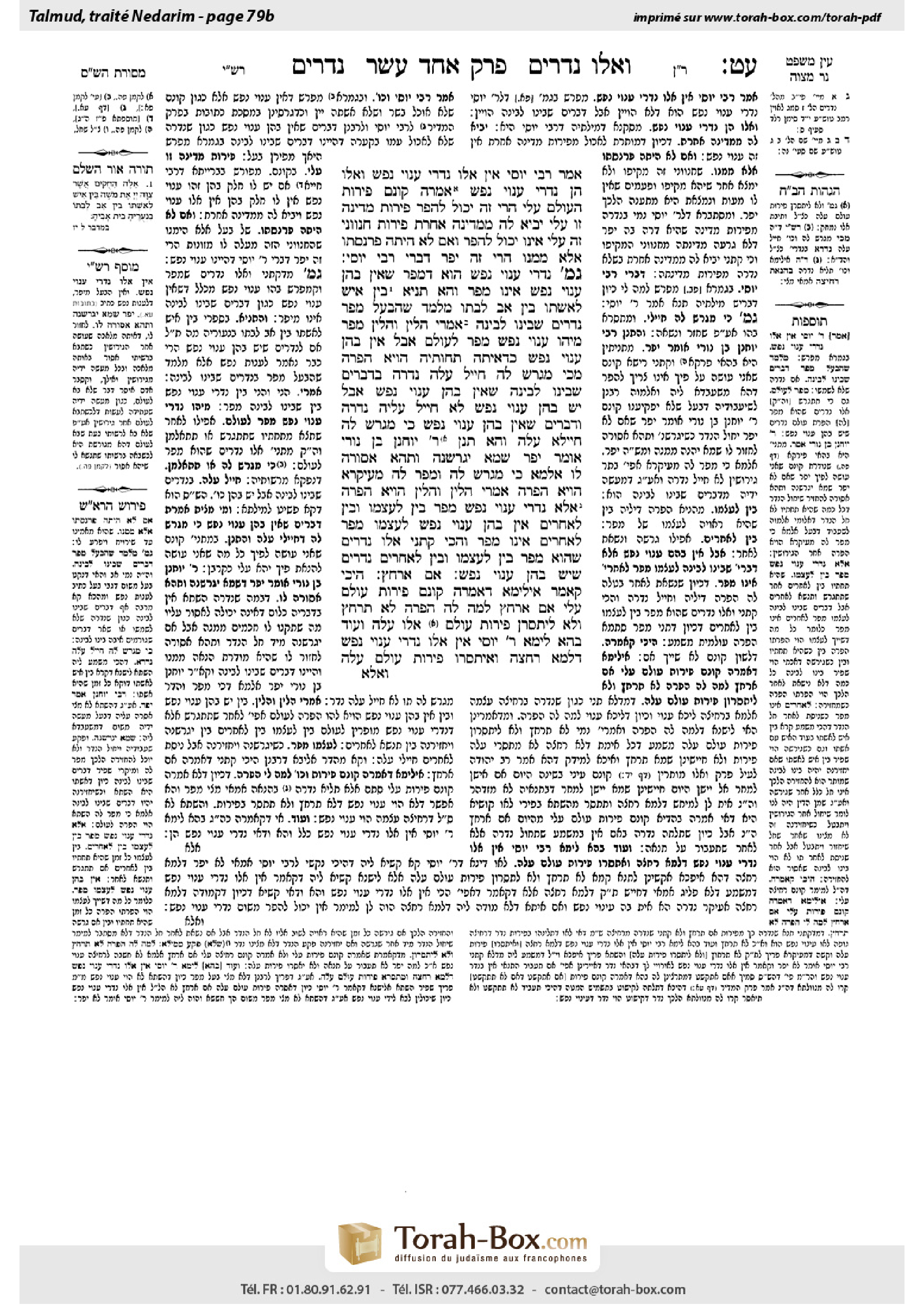
Nedarim 79b: Talmud study for Daf Yomi
Daf Yomi is the daily study of one Talmud folio. Explore 37 tractates with scans, Hebrew text, Sefaria English and AI-generated French translations where annotated.
Passage selection and English or AI-generated French translation are available where the scan has annotations. Daf Study is independent of Torah-Box and Sefaria.
Browse Nedarim · נדרים · All tractatesNedarim 79b text and translations
This page of Nedarim includes the Aramaic text, an English translation and an AI-generated French translation, alongside the scan above.
נדרים ע״ט ב · Aramaic and Hebrew text
אָמַר רַבִּי יוֹסֵי: אֵין אֵלּוּ נִדְרֵי עִנּוּי נֶפֶשׁ. וְאֵלּוּ הֵן נִדְרֵי עִנּוּי נֶפֶשׁ: אָמְרָה ״קֻוֽנָּם פֵּירוֹת הָעוֹלָם עָלַי״ — הֲרֵי זֶה יָכוֹל לְהָפֵר. ״פֵּירוֹת מְדִינָה זוֹ עָלַי״ — יָבִיא לָהּ מִמְּדִינָה אַחֶרֶת. ״פֵּירוֹת חֶנְווֹנִי זֶה עָלַי״ — אֵינוֹ יָכוֹל לְהָפֵר. וְאִם לֹא הָיְתָה פַּרְנָסָתוֹ אֶלָּא מִמֶּנּוּ — הֲרֵי זֶה יָפֵר, דִּבְרֵי רַבִּי יוֹסֵי.
גְּמָ׳ נִדְרֵי עִנּוּי נֶפֶשׁ הוּא דְּמֵפֵר, שֶׁאֵין בָּהֶן עִנּוּי נֶפֶשׁ אֵינוֹ מֵפֵר? וְהָא תַּנְיָא: ״בֵּין אִישׁ לְאִשְׁתּוֹ בֵּין אָב לְבִתּוֹ״ — מְלַמֵּד שֶׁהַבַּעַל מֵפֵר נְדָרִים שֶׁבֵּינוֹ לְבֵינָהּ!
אָמְרִי: הָלֵין וְהָלֵין מֵפֵר, מִיהוּ עִנּוּי נֶפֶשׁ — מֵפֵר לְעוֹלָם. אֲבָל אֵין בָּהֶן עִנּוּי נֶפֶשׁ, כִּדְאִיתַהּ תְּחוֹתֵיהּ — הָוְיָא הֲפָרָה, מִכִּי מְגָרֵשׁ לַהּ — חָיֵיל עֲלַהּ נִדְרַהּ. בִּדְבָרִים שֶׁבֵּינוֹ לְבֵינָהּ שֶׁאֵין בָּהֶן עִנּוּי נֶפֶשׁ. אֲבָל יֵשׁ בָּהֶן עִנּוּי נֶפֶשׁ — לָא חָיֵיל עֲלַיהּ נִדְרַהּ.
וּדְבָרִים שֶׁאֵין בָּהֶן עִנּוּי נֶפֶשׁ, כִּי מְגָרֵשׁ לַהּ חָיְילָא עֲלַהּ? וְהָא תְּנַן, רַבִּי יוֹחָנָן בֶּן נוּרִי אוֹמֵר: יָפֵר, שֶׁמָּא יְגָרְשֶׁנָּה וּתְהֵא אֲסוּרָה לוֹ. אַלְמָא: כִּי מְגָרֵשׁ לַהּ וּמֵפַר לַהּ מֵעִיקָּרָא — הָוְיָא הֲפָרָה!
אָמְרִי: הָלֵין וְהָלֵין הָוְיָא הֲפָרָה. אֶלָּא: נִדְרֵי עִנּוּי נֶפֶשׁ מֵפֵר, בֵּין לְעַצְמוֹ וּבֵין לַאֲחֵרִים. אֵין בָּהֶן עִנּוּי נֶפֶשׁ, לְעַצְמוֹ — מֵפֵר, לַאֲחֵרִים — אֵינוֹ מֵפֵר. וְהָכִי קָתָנֵי: אֵלּוּ נְדָרִים שֶׁהוּא מֵפֵר בֵּין לְעַצְמוֹ וּבֵין לַאֲחֵרִים — נְדָרִים שֶׁיֵּשׁ בָּהֶן עִנּוּי נֶפֶשׁ.
״אִם אֶרְחַץ״, הֵיכִי קָאָמַר? אִילֵּימָא דְּאָמְרָה ״קֻוֽנָּם פֵּירוֹת עוֹלָם עָלַי אִם אֶרְחַץ״ — לְמָה לֵהּ הֲפָרָה? לָא תִּרְחַץ וְלָא לִיתַּסְרָן פֵּירוֹת עוֹלָם אֵלּוּ עֲלַהּ!
וְעוֹד: בְּהָא לֵימָא רַבִּי יוֹסֵי אֵין אֵלּוּ נִדְרֵי עִנּוּי נֶפֶשׁ? דִּלְמָא רָחֲצָה וְאִיתַּסְרוּ פֵּירוֹת עוֹלָם עֲלַהּ.
Nedarim 79b · English translation
Rabbi Yosei said: These are not vows of affliction. Rather, these are vows of affliction: For example, if she said: The produce of the entire world is konam for me as if it were an offering, he can nullify the vow, as it certainly involves affliction. If, however, she said: The produce of this country is konam for me, he cannot nullify the vow, as it does not involve affliction, since he may still bring her produce from another country. Similarly, if she said: The produce of this storekeeper is konam for me, he cannot nullify her vow, as he may still bring her produce from another storekeeper. But if he can obtain his sustenance only from him, that particular storekeeper, he can nullify the vow. This is the statement of Rabbi Yosei.
GEMARA: The Gemara raises a question with regard to the ruling of the mishna: Is it only vows of affliction that he can nullify, whereas vows that do not involve affliction he cannot nullify? But isn’t it taught in a baraita: The verse “These are the statutes that the Lord commanded Moses, between a man and his wife, between a father and his daughter” (Numbers 30:17) teaches that a husband can nullify any of his wife’s vows that adversely affect the relationship between him and her, even if they do not involve affliction?
The Sages say in response: In fact, he can nullify both these and those. There is, however, a difference between them. When he nullifies vows of affliction, he nullifies them forever, i.e., the vows remain nullified even if they subsequently divorce. But when he nullifies vows that do not involve affliction but merely impact upon their relationship, then, while they are married and she is under his authority it is an effective nullification, but when he divorces her, her vow takes effect upon her, i.e., his nullification is no longer effective. As stated, this is referring to vows concerning matters that adversely affect the relationship between him and her, that do not involve affliction. However, if he nullifies a vow that affects their relationship and also involves affliction, her vow does not take effect upon her even after she leaves her husband’s authority.
The Gemara asks: And as for vows concerning matters that do not involve affliction, when a man divorces his wife, do they really take effect upon her? But didn’t we learn in a mishna with regard to a woman who prohibited her handiwork to her husband by way of a vow (85a) that Rabbi Yoḥanan ben Nuri says: Even though the vow is presently invalid, as a woman cannot render forbidden to her husband that to which he is already entitled, he should nevertheless nullify the vow? This is because perhaps he will one day divorce her, at which point the vow will take effect and she will then be forbidden to him, since he will be unable to remarry her lest he come to benefit from her handiwork. Apparently, however, if he divorces her after having nullified her vow from the outset, before their divorce, it is a permanent nullification, and although the vow does not involve affliction it remains nullified after their divorce.
Consequently, the Sages say a different answer: With regard to both these and those, vows of affliction and vows adversely affecting the relationship between them, when the husband nullifies the vow, it is a permanent nullification. Rather, the difference between them is as follows: Vows of affliction he can fully nullify, both with respect to himself and with respect to others, i.e., the vow remains nullified even if he divorces her and she marries another man. Whereas vows that do not involve affliction but still adversely affect the relationship between him and her he can permanently nullify with respect to himself, but he cannot nullify with respect to others; if she marries another man, the vow takes effect. And according to this explanation, this is what the mishna is teaching: These are the vows that he can nullify both for himself and for others: Vows that involve affliction.
§ The mishna teaches that, according to the first tanna, a woman’s vow: If I bathe, falls into the category of vows of affliction, whereas Rabbi Yosei disagrees and says that this is not a vow of affliction. The Gemara asks: As the phrase: If I bathe, is not the main substance of the vow, but rather the woman wishes to prohibit herself from deriving a certain benefit depending on whether or not she bathes, with regard to what case is the mishna speaking? If we say that she said: The produce of the world is konam for me if I bathe, why, according to the first tanna, does she need nullification at all to prevent her affliction? Let her not bathe and this produce of the world will not be forbidden to her.
And furthermore, this explanation is problematic for a different reason: With regard to a vow of this type, would Rabbi Yosei say that these are not vows of affliction? There is certainly room for concern that perhaps she will bathe and the produce of the world will be forbidden to her, a situation that certainly entails deprivation.
Nedarim 79b · Traduction française (IA)
Rabbi Yosei dit : Ce ne sont pas des vœux d’affliction. Voici plutôt des vœux d’affliction : par exemple, si elle dit : « Les produits du monde entier me sont konam, comme une offrande », le mari peut annuler le vœu, car celui-ci entraîne certainement une affliction. En revanche, si elle dit : « Les produits de ce pays me sont konam », il ne peut pas annuler le vœu, car celui-ci n’entraîne pas d’affliction, puisqu’il peut encore lui apporter des produits d’un autre pays. De même, si elle dit : « Les produits de ce commerçant me sont konam », il ne peut pas annuler son vœu, car il peut encore lui apporter des produits d’un autre commerçant. Mais s’il ne peut se procurer sa subsistance qu’auprès de ce commerçant-là, il peut annuler le vœu. Telle est la position de Rabbi Yosei.
GUEMARA : La Guemara soulève une question au sujet de la décision de la Michna : Peut-il annuler uniquement les vœux d’affliction, mais non les vœux qui n’entraînent pas d’affliction ? Pourtant, n’est-il pas enseigné dans une baraïta que le verset « Telles sont les lois que l’Éternel a prescrites à Moïse, entre un homme et sa femme, entre un père et sa fille » (Nombres 30, 17) enseigne qu’un mari peut annuler tous les vœux de sa femme qui portent préjudice à leur relation, même s’ils n’entraînent pas d’affliction ?
Les Sages répondent : En réalité, il peut annuler aussi bien les uns que les autres. Il existe toutefois une différence entre eux. Lorsqu’il annule des vœux d’affliction, il les annule définitivement, c’est-à-dire qu’ils restent annulés même s’ils divorcent par la suite. Mais lorsqu’il annule des vœux qui n’entraînent pas d’affliction et qui ont seulement une incidence sur leur relation, son annulation est valable tant qu’ils sont mariés et qu’elle est sous son autorité ; lorsqu’il divorce d’elle, cependant, son vœu prend effet, c’est-à-dire que l’annulation du mari n’est alors plus valable. Comme indiqué, il s’agit ici de vœux portant sur des sujets qui nuisent à leur relation, mais qui n’entraînent pas d’affliction. En revanche, s’il annule un vœu qui affecte leur relation et entraîne aussi une affliction, le vœu de sa femme ne prend pas effet, même après qu’elle a cessé d’être sous l’autorité de son mari.
La Guemara demande : Mais les vœux portant sur des sujets qui n’entraînent pas d’affliction prennent-ils vraiment effet lorsque le mari divorce de sa femme ? Pourtant, n’avons-nous pas appris dans une Michna, au sujet d’une femme qui, par un vœu, interdit à son mari de tirer profit de son travail (85a), que Rabbi Yoḥanan ben Nouri dit : Même si le vœu est actuellement sans effet, puisqu’une femme ne peut interdire à son mari ce à quoi il a déjà droit, celui-ci doit néanmoins annuler le vœu. En effet, il se peut qu’il divorce un jour d’elle ; le vœu prendra alors effet et elle lui sera interdite, car il ne pourra pas la reprendre pour épouse sans risquer de tirer profit de son travail. Il apparaît donc que s’il divorce d’elle après avoir annulé son vœu dès le départ, avant leur divorce, l’annulation est définitive ; ainsi, bien que le vœu n’entraîne pas d’affliction, il reste annulé après leur divorce.
Les Sages donnent donc une autre réponse : qu’il s’agisse des uns ou des autres, des vœux d’affliction ou de ceux qui nuisent à leur relation, lorsque le mari annule le vœu, cette annulation est définitive. La différence entre eux est plutôt la suivante : il peut annuler pleinement les vœux d’affliction, aussi bien à son égard qu’à l’égard d’autrui, c’est-à-dire que le vœu reste annulé même s’il divorce de sa femme et qu’elle épouse un autre homme. En revanche, pour les vœux qui n’entraînent pas d’affliction mais nuisent néanmoins à leur relation, il peut les annuler définitivement à son égard, mais pas à l’égard d’autrui ; si elle épouse un autre homme, le vœu prend effet. Selon cette explication, voici ce qu’enseigne la Michna : les vœux qu’il peut annuler aussi bien pour lui-même que pour autrui sont les vœux qui entraînent une affliction.
§ La Michna enseigne que, selon le premier tanna, le vœu d’une femme « Si je me baigne » relève des vœux d’affliction, tandis que Rabbi Yosei n’est pas d’accord et dit qu’il ne s’agit pas d’un vœu d’affliction. La Guemara demande : Puisque l’expression « si je me baigne » ne constitue pas l’essentiel du vœu, mais que la femme souhaite plutôt s’interdire un certain bénéfice selon qu’elle se baigne ou non, de quel cas la Michna parle-t-elle ? Si l’on suppose qu’elle a dit : « Les produits du monde me sont konam si je me baigne », pourquoi, selon le premier tanna, aurait-elle besoin d’une annulation pour éviter l’affliction ? Qu’elle ne se baigne pas, et les produits du monde ne lui seront pas interdits.
De plus, cette explication pose problème pour une autre raison : à propos d’un vœu de ce type, Rabbi Yosei dirait-il que ce ne sont pas des vœux d’affliction ? Il y a certainement lieu de craindre qu’elle se baigne et que les produits du monde lui soient alors interdits, une situation qui entraîne assurément une privation.
Traduction française générée par IA à partir de l’édition anglaise de Sefaria. Vérifie toujours un passage avec le texte source.
Text from Sefaria: William Davidson Edition - Vocalized Aramaic (CC BY NC); William Davidson Edition - English (CC BY NC).