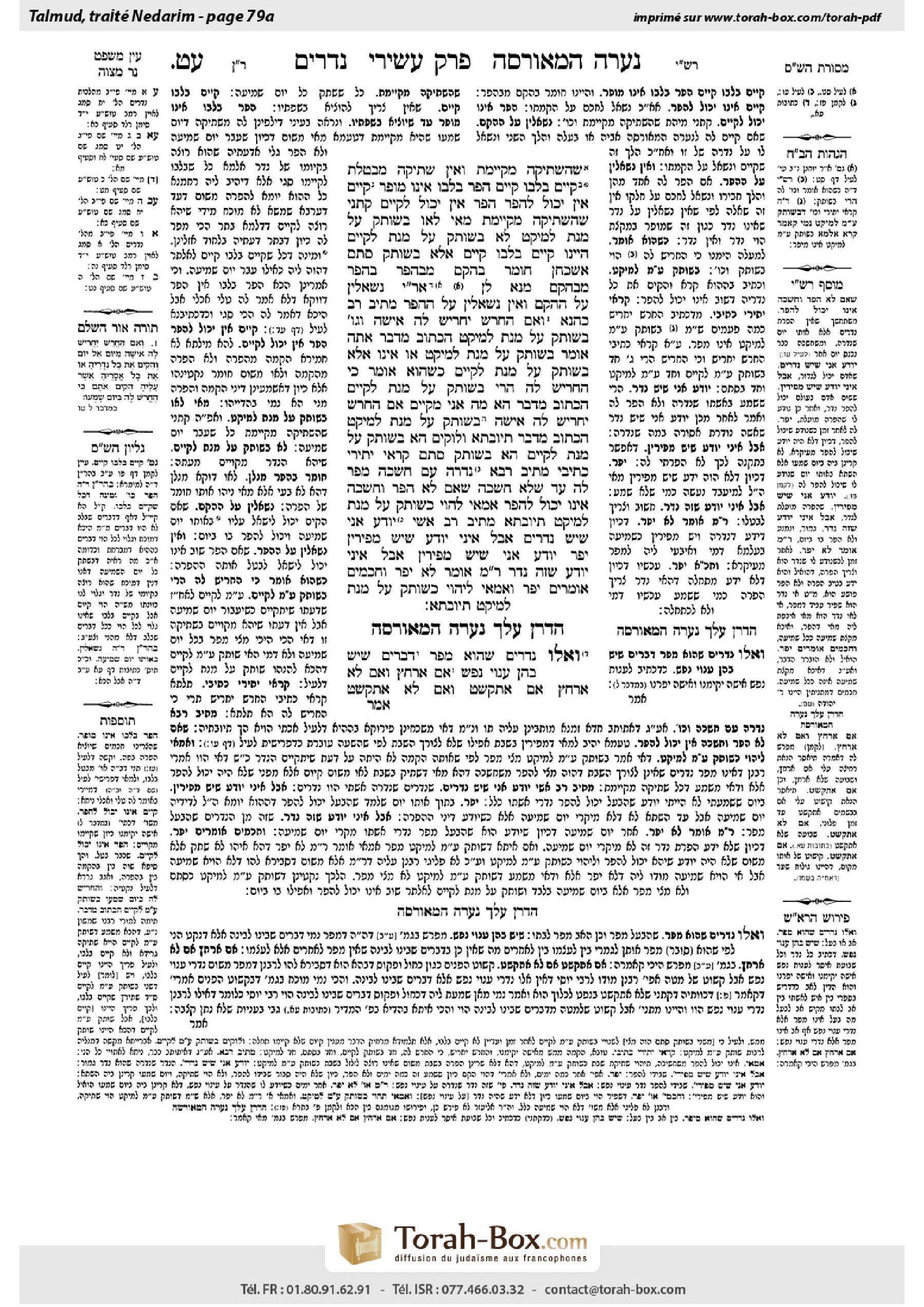
Nedarim 79a: Talmud study for Daf Yomi
Daf Yomi is the daily study of one Talmud folio. Explore 37 tractates with scans, Hebrew text, Sefaria English and AI-generated French translations where annotated.
Passage selection and English or AI-generated French translation are available where the scan has annotations. Daf Study is independent of Torah-Box and Sefaria.
Browse Nedarim · נדרים · All tractatesNedarim 79a text and translations
This page of Nedarim includes the Aramaic text, an English translation and an AI-generated French translation, alongside the scan above.
נדרים ע״ט א · Aramaic and Hebrew text
שֶׁהַשְּׁתִיקָה מְקַיֶּימֶת, וְאֵין שְׁתִיקָה מְבַטֶּלֶת. קִיֵּים בְּלִבּוֹ — קַיָּים, הֵפֵר בְּלִבּוֹ — אֵינוֹ מוּפָר. קִיֵּים — אֵין יָכוֹל לְהָפֵר, הֵפֵר — אֵין יָכוֹל לְקַיֵּים. קָתָנֵי: שֶׁהַשְּׁתִיקָה מְקַיֶּימֶת, מַאי לָאו בְּשׁוֹתֵק עַל מְנָת לְמֵיקַט?
לֹא, בְּשׁוֹתֵק עַל מְנָת לְקַיֵּים. הַיְינוּ: קִיֵּים בְּלִבּוֹ קַיָּים! אֶלָּא בְּשׁוֹתֵק סְתָם.
אַשְׁכְּחַן חוֹמֶר בְּהָקֵם מִבְּהָפֵר, בְּהָפֵר מִבְּהָקֵם מְנָא לַן? אָמַר רַבִּי יוֹחָנָן: נִשְׁאָלִין עַל הֶהָקֵם, וְאֵין נִשְׁאָלִין עַל הֶהָפֵר.
מֵתִיב רַב כָּהֲנָא: ״וְאִם הַחֲרֵשׁ יַחֲרִישׁ לָהּ אִישָׁהּ וְגוֹ׳״, בְּשׁוֹתֵק עַל מְנָת לְמֵיקַט הַכָּתוּב מְדַבַּר. אַתָּה אוֹמֵר בְּשׁוֹתֵק עַל מְנָת לְמֵיקַט, אוֹ אֵינוֹ אֶלָּא בְּשׁוֹתֵק עַל מְנָת לְקַיֵּים?
כְּשֶׁהוּא אוֹמֵר ״כִּי הֶחֱרִשׁ לָהּ״, הֲרֵי בְּשׁוֹתֵק עַל מְנָת לְקַיֵּים הַכָּתוּב מְדַבֵּר, הָא מָה אֲנִי מְקַיֵּים ״אִם הַחֲרֵשׁ יַחֲרִישׁ לָהּ אִישָׁהּ״ — בְּשׁוֹתֵק עַל מְנָת לְמֵיקַט הַכָּתוּב מְדַבֵּר! תְּיוּבְתָּא.
וְלוֹקֵים: הָא — בְּשׁוֹתֵק עַל מְנָת לְקַיֵּים, הָא — בְּשׁוֹתֵק סְתָם! קְרָאֵי יַתִּירִי כְּתִיבִי.
מֵתִיב רָבָא: נָדְרָה עִם חֲשֵׁכָה — מֵפֵר לָהּ עַד שֶׁלֹּא חָשְׁכָה, שֶׁאִם לֹא הֵפֵר וְחָשְׁכָה — אֵינוֹ יָכוֹל לְהָפֵר. אַמַּאי? לֶהֱוֵי כְּשׁוֹתֵק עַל מְנָת לְמֵיקַט! תְּיוּבְתָּא.
מֵתִיב רַב אָשֵׁי: ״יוֹדֵעַ אֲנִי שֶׁיֵּשׁ נְדָרִים, אֲבָל אֵינִי יוֹדֵעַ שֶׁיֵּשׁ מְפִירִין״ — יָפֵר. ״יוֹדֵעַ אֲנִי שֶׁיֵּשׁ מְפִירִין, אֲבָל אֵינִי יוֹדֵעַ שֶׁזֶּה נֶדֶר״, רַבִּי מֵאִיר אוֹמֵר: לֹא יָפֵר, וַחֲכָמִים אוֹמְרִים: יָפֵר.
וְאַמַּאי? לֶיהֱוֵי כְּשׁוֹתֵק עַל מְנָת לְמֵיקַט! תְּיוּבְתָּא.
הָדְרָן עֲלָךְ נַעֲרָה הַמְאוֹרָסָה
וְאֵלּוּ נְדָרִים שֶׁהוּא מֵפֵר: דְּבָרִים שֶׁיֵּשׁ בָּהֶן עִנּוּי נֶפֶשׁ: ״אִם אֶרְחַץ״ וְ״אִם לֹא אֶרְחַץ״, ״אִם אֶתְקַשֵּׁט״ וְ״אִם לֹא אֶתְקַשֵּׁט״.
Nedarim 79a · English translation
that silence ratifies a vow, but silence does not cancel, i.e., nullify, a vow. If the husband ratified a vow in his heart, it is ratified, but if he nullified it in his heart, it is not nullified. The baraita adds: If he ratified a vow he can no longer nullify it; and similarly, if he nullified a vow he can no longer ratify it. In any case, the baraita teaches that silence ratifies a vow. What, is it not referring even to one who is silent in order to annoy his wife?
The Gemara rejects this interpretation: No, it is referring to one who is silent in order to sustain the vow. The Gemara asks: If so, this is the same as: If the husband ratified a vow in his heart, it is ratified. Rather, the phrase in the baraita: Silence ratifies a vow, is referring to a case where the husband is silent without specifying his intent.
Relating to the baraita, the Gemara asks: We found how the halakha is more stringent in ratification of vows than in nullification of vows, but where do we find a case in which the halakha is more stringent in nullification than in ratification? Rabbi Yoḥanan says: One can request from a halakhic authority dissolution of the ratification of a vow his wife took, but one cannot request dissolution of the nullification of a vow.
Rav Kahana raised an objection to the opinion of Rabbi Ḥanina that a husband who is silent about his wife’s vow in order to annoy her can nullify it even several days later. A baraita teaches: “But if her husband altogether hold his peace at her from day to day, then he causes all her vows to be ratified” (Numbers 30:15). The verse is speaking of one who is silent in order to annoy his wife. Do you say that the verse is referring to one who is silent in order to annoy her, or it is referring only to one who is silent in order to ratify the vow?
The baraita continues: When it says, in the continuation of the same verse: “He has ratified them, because he held his peace at her on the day that he heard them” (Numbers 30:15), the verse is speaking of one who is silent in order to ratify the vow. How do I realize the meaning of: “If her husband altogether holds his peace at her”? It must be that the verse is speaking of one who is silent in order to annoy his wife, and that this is also considered an act of ratification. This baraita is a conclusive refutation [teyuveta] of Rabbi Ḥanina’s opinion.
The Gemara asks about this baraita: And let the tanna interpret this part of the verse as referring to one who is silent in order to ratify the vow, and that part of the same verse as referring to one who was silent without specifying his intent, as the Gemara suggests above in explanation of the baraita? The Gemara answers: Superfluous verses are written about silence, leading to the conclusion that whatever the reason for the husband’s silence, the vow is ratified.
Rava raised a further objection to the opinion of Rabbi Ḥanina, from a mishna (76b): If she took a vow on Friday with nightfall approaching, her father or husband can nullify the vow only until nightfall, since, if it became dark and he had not yet nullified her vow, he cannot nullify it anymore. Why should this be so? Let the fact that the husband refrained from nullifying the vow out of respect for Shabbat be regarded like one who is silent in order to annoy his wife, who, according to Rav Huna, can still nullify the vow later. The fact that this is not the case is a conclusive refutation of the opinion of Rabbi Ḥanina.
Rav Ashi also raised an objection to Rabbi Ḥanina’s opinion, from another mishna (87b): If a husband or father said, after failing to nullify a vow on the day he heard it: I know that there are vows, but I do not know that there are those who can nullify vows, i.e., he was unaware that he can nullify a vow, he can nullify it even after the day he heard it. However, if he said: I know there are those who nullify, but I refrained from nullifying the vow because I do not know that this is considered a vow that I could nullify, Rabbi Meir says: He cannot nullify at this point, but the Rabbis say: Even in this case he can nullify the vow when he discovers his error.
Rav Ashi asks rhetorically: But why may he not nullify according to Rabbi Meir’s opinion? Let his silence by mistake be like that of one who is silent in order to annoy, who, according to Rabbi Ḥanina, can nullify the vow at a later stage. This is a conclusive refutation of Rabbi Ḥanina’s opinion.
MISHNA: And these are the vows that he, the husband or father, can nullify: The first category consists of matters that involve affliction for the woman who took the vow. For example, if a woman vowed: If I bathe, or: If I do not bathe; if she vowed: If I adorn myself [etkashet], or: If I do not adorn myself.
Nedarim 79a · Traduction française (IA)
que le silence ratifie un vœu, mais ne l’annule pas, c’est-à-dire ne le révoque pas. Si le mari a ratifié un vœu dans son cœur, il est ratifié ; mais s’il l’a annulé dans son cœur, il n’est pas annulé. La baraïta ajoute : s’il a ratifié un vœu, il ne peut plus l’annuler ; de même, s’il l’a annulé, il ne peut plus le ratifier. Quoi qu’il en soit, la baraïta enseigne que le silence ratifie un vœu. N’est-ce pas là une référence même à celui qui garde le silence pour contrarier sa femme ?
La Guemara rejette cette interprétation : non, il s’agit de celui qui garde le silence afin de maintenir le vœu. La Guemara demande : dans ce cas, cela revient au même que : « Si le mari a ratifié un vœu dans son cœur, il est ratifié. » Il faut donc comprendre que l’expression de la baraïta « le silence ratifie un vœu » désigne le cas où le mari garde le silence sans préciser son intention.
À propos de la baraïta, la Guemara demande : nous avons trouvé en quoi la halakha est plus stricte pour la ratification des vœux que pour leur annulation, mais où trouve-t-on un cas où la halakha est plus stricte pour l’annulation que pour la ratification ? Rabbi Yoḥanan dit : on peut demander à une autorité halakhique la dissolution de la ratification d’un vœu prononcé par son épouse, mais on ne peut pas demander la dissolution de l’annulation d’un vœu.
Rav Kahana soulève une objection contre l’opinion de Rabbi Ḥanina, selon laquelle un mari qui garde le silence au sujet du vœu de son épouse pour la contrarier peut encore l’annuler plusieurs jours plus tard. Une baraïta enseigne : « Mais si son mari se tait complètement à son égard, de jour en jour, il fait ratifier tous ses vœux » (Nombres 30,15). Le verset parle de celui qui garde le silence pour contrarier son épouse. Faut-il dire que le verset se rapporte à celui qui garde le silence pour la contrarier, ou bien se rapporte-t-il uniquement à celui qui garde le silence afin de ratifier le vœu ?
La baraïta poursuit : lorsqu’il est dit, dans la suite du même verset : « Il les a ratifiés, parce qu’il s’est tu à son égard le jour où il les a entendus » (Nombres 30,15), le verset parle de celui qui garde le silence afin de ratifier le vœu. Comment faut-il alors comprendre : « Si son mari se tait complètement à son égard » ? Il faut que le verset parle de celui qui garde le silence pour contrarier son épouse, et que cela soit également considéré comme un acte de ratification. Cette baraïta constitue une réfutation décisive [teyuveta] de l’opinion de Rabbi Ḥanina.
La Guemara interroge au sujet de cette baraïta : pourquoi le tanna n’interprète-t-il pas cette partie du verset comme se rapportant à celui qui garde le silence afin de ratifier le vœu, et l’autre partie du même verset comme se rapportant à celui qui a gardé le silence sans préciser son intention, comme la Guemara le suggère plus haut pour expliquer la baraïta ? La Guemara répond : des versets superflus sont écrits au sujet du silence, ce qui conduit à conclure que, quelle que soit la raison du silence du mari, le vœu est ratifié.
Rava soulève une autre objection contre l’opinion de Rabbi Ḥanina, à partir d’une Michna (76b) : si elle a prononcé un vœu le vendredi, à l’approche de la tombée de la nuit, son père ou son mari ne peut l’annuler que jusqu’à la tombée de la nuit, car, s’il fait nuit et qu’il n’a pas encore annulé son vœu, il ne peut plus l’annuler. Pourquoi en est-il ainsi ? Que le fait que le mari se soit abstenu d’annuler le vœu par respect pour Chabbat soit considéré comme le silence de celui qui garde le silence pour contrarier son épouse, lequel, selon Rav Huna, peut encore annuler le vœu par la suite. Le fait que ce ne soit pas le cas constitue une réfutation décisive de l’opinion de Rabbi Ḥanina.
Rav Ashi soulève lui aussi une objection contre l’opinion de Rabbi Ḥanina, à partir d’une autre Michna (87b) : si un mari ou un père dit, après avoir omis d’annuler un vœu le jour où il l’a entendu : « Je sais qu’il existe des vœux, mais je ne savais pas que certains peuvent annuler les vœux », c’est-à-dire qu’il ignorait qu’il pouvait annuler un vœu, il peut l’annuler même après le jour où il l’a entendu. En revanche, s’il dit : « Je sais qu’il existe des personnes qui annulent les vœux, mais je me suis abstenu d’annuler le vœu parce que je ne savais pas que c’était un vœu que je pouvais annuler », Rabbi Meir dit : il ne peut plus l’annuler à ce stade ; mais les Sages disent : même dans ce cas, il peut annuler le vœu lorsqu’il découvre son erreur.
Rav Ashi pose une question rhétorique : mais pourquoi ne peut-il pas annuler le vœu selon l’opinion de Rabbi Meir ? Que son silence dû à une erreur soit considéré comme celui de quelqu’un qui garde le silence pour contrarier son épouse, et qui, selon Rabbi Ḥanina, peut annuler le vœu ultérieurement. Cela constitue une réfutation décisive de l’opinion de Rabbi Ḥanina.
MICHNA : Et voici les vœux que lui, le mari ou le père, peut annuler : la première catégorie comprend les choses qui causent une affliction à la femme qui a prononcé le vœu. Par exemple, si une femme a fait le vœu : « Si je me baigne », ou : « Si je ne me baigne pas » ; si elle a fait le vœu : « Si je me pare [etkashet] », ou : « Si je ne me pare pas ».
Traduction française générée par IA à partir de l’édition anglaise de Sefaria. Vérifie toujours un passage avec le texte source.
Text from Sefaria: William Davidson Edition - Vocalized Aramaic (CC BY NC); William Davidson Edition - English (CC BY NC).