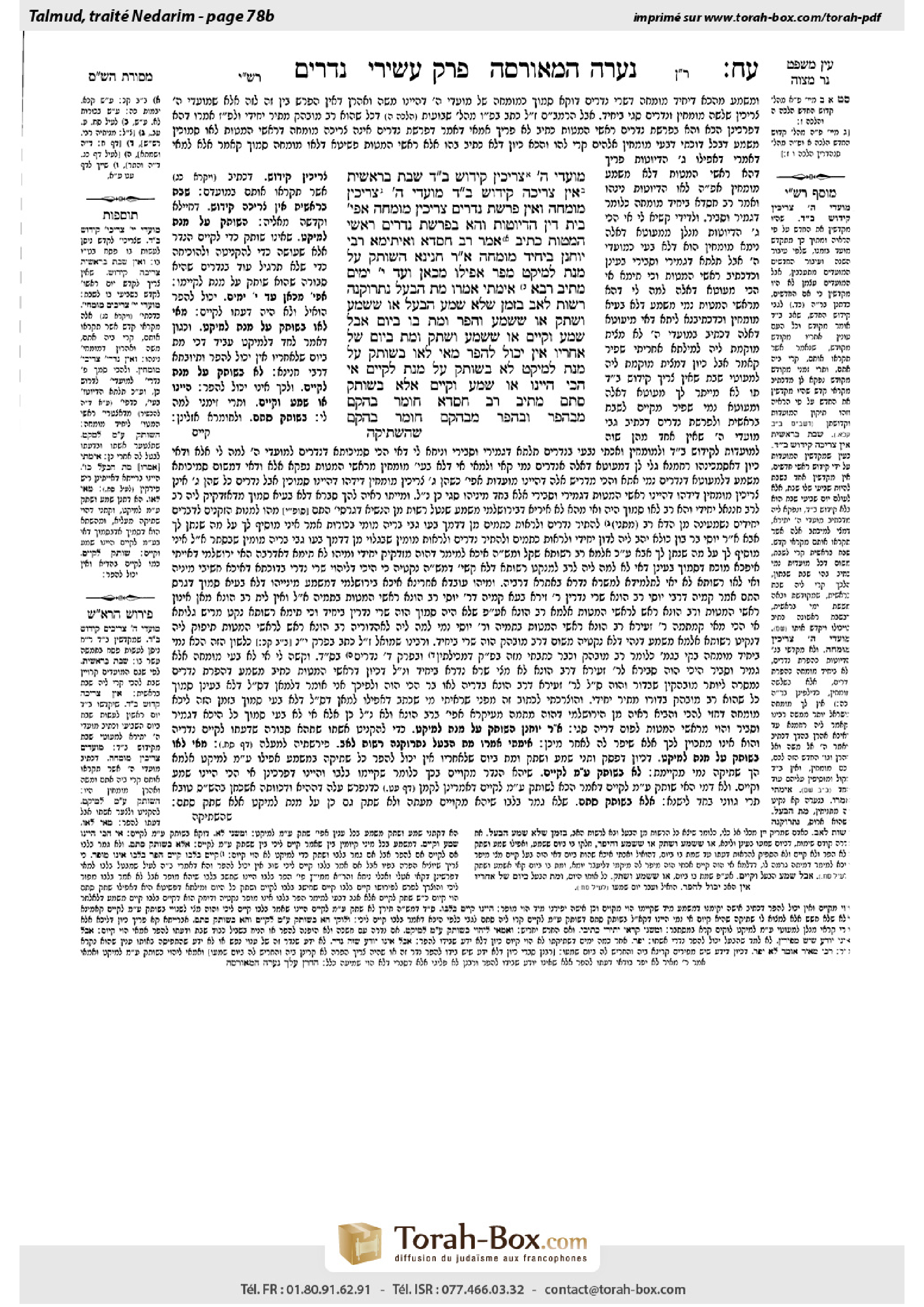
Nedarim 78b: Talmud study for Daf Yomi
Daf Yomi is the daily study of one Talmud folio. Explore 37 tractates with scans, Hebrew text, Sefaria English and AI-generated French translations where annotated.
Passage selection and English or AI-generated French translation are available where the scan has annotations. Daf Study is independent of Torah-Box and Sefaria.
Browse Nedarim · נדרים · All tractatesNedarim 78b text and translations
This page of Nedarim includes the Aramaic text, an English translation and an AI-generated French translation, alongside the scan above.
נדרים ע״ח ב · Aramaic and Hebrew text
מוֹעֲדֵי ה׳ צְרִיכִין קִידּוּשׁ בֵּית דִּין, שַׁבַּת בְּרֵאשִׁית אֵין צְרִיכָה קִידּוּשׁ בֵּית דִּין.
מוֹעֲדֵי ה׳ צְרִיכִין מוּמְחֶה, וְאֵין פָּרָשַׁת נְדָרִים צְרִיכִין מוּמְחֶה, אֲפִילּוּ בֵּית דִּין הֶדְיוֹטוֹת.
וְהָא בְּפָרָשַׁת נְדָרִים ״רָאשֵׁי הַמַּטּוֹת״ כְּתִיב! אָמַר רַב חִסְדָּא וְאִיתֵּימָא רַבִּי יוֹחָנָן: בְּיָחִיד מוּמְחֶה.
אָמַר רַבִּי חֲנִינָא: הַשּׁוֹתֵק עַל מְנָת לְמֵיקַט, מֵפֵר אֲפִילּוּ מִכָּאן וְעַד עֲשָׂרָה יָמִים. מֵתִיב רָבָא: אֵימָתַי אָמְרוּ מֵת הַבַּעַל נִתְרוֹקְנָה רְשׁוּת לָאָב — בִּזְמַן שֶׁלֹּא שָׁמַע הַבַּעַל, אוֹ שֶׁשָּׁמַע וְשָׁתַק, אוֹ שֶׁשָּׁמַע וְהֵפֵר וּמֵת בּוֹ בַּיּוֹם. אֲבָל שָׁמַע וְקִיֵּים, אוֹ שֶׁשָּׁמַע וְשָׁתַק וּמֵת בַּיּוֹם שֶׁל אַחֲרָיו — אֵין יָכוֹל לְהָפֵר.
מַאי לָאו, בְּשׁוֹתֵק עַל מְנָת לְמֵיקַט? לֹא, בְּשׁוֹתֵק עַל מְנָת לְקַיֵּים. אִי הָכִי, הַיְינוּ אוֹ שָׁמַע וְקִיֵּים! אֶלָּא, בְּשׁוֹתֵק סְתָם.
מֵתִיב רַב חִסְדָּא: חוֹמֶר בְּהָקֵם מִבְּהָפֵר, וּבְהָפֵר מִבְּהָקֵם. חוֹמֶר בְּהָקֵם —
Nedarim 78b · English translation
The Festivals of the Lord require sanctification by the court, as the Festival dates are established by the court’s determination of the New Moon, whereas Shabbat, which commemorates Creation, does not require sanctification by the court. Shabbat is sanctified every week independent of any court decision.
As for ben Azzai’s statement, it should be understood as follows: The Festivals of the Lord require an expert, as the start of the month, which is dependent upon the appearance of the new moon, which in turn determines the Festivals, can be established only by a court composed of experts. But the portion on vows does not require an expert, i.e., vows can be dissolved even by a court of laymen. This explanation of the baraita given to Rav Asi bar Natan also serves to explain Beit Shammai’s source for the halakha that three laymen can dissolve vows.
The Gemara raises a difficulty: But in the portion on vows the phrase “the heads of the tribes” (Numbers 30:2) is written. How, then, can it be said that vows can be dissolved by laymen? Rav Ḥisda said, and some say it was Rabbi Yoḥanan: From “the heads of the tribes,” the Sages derive that vows can be dissolved by a single expert by himself, but three laymen also have that ability.
§ Rabbi Ḥanina says: A husband who is silent and does not formally nullify his wife’s vow in order to annoy [lemeikat] her, but intends to nullify it later, can nullify it even from now until ten days later. Rava raised an objection to this from a baraita: When did they say that if the husband of a betrothed young woman dies, the authority to nullify the woman’s vows reverts to the father? The authority reverts to the father when the husband did not hear of her vow, or when he heard and was silent, or when he heard and nullified it and died on the same day. But if he heard and ratified it, or if he heard and was silent and died on the following day, he, the father, cannot nullify the vow.
What, is the phrase: Heard and was silent, not referring even to one who is silent in order to annoy her, and nevertheless nullification is only possible that day, contradicting the opinion of Rabbi Ḥanina? The Gemara answers: No, the baraita is referring to one who is silent in order to sustain the vow. The Gemara asks: If so, this is the same as: Or he heard and ratified, mentioned earlier in the baraita. Rather, the baraita is referring to one who is silent without any specific intent, as opposed to the husband who is silent in order to annoy his wife, whose intent is to nullify the vow.
Rav Ḥisda raised an objection from a different baraita: In some ways the halakha is more stringent in ratification than in nullification, and in other ways it is more stringent in nullification than in ratification. The stringency in ratification of vows is
Nedarim 78b · Traduction française (IA)
Les fêtes de l’Éternel doivent être sanctifiées par le tribunal, car leurs dates sont fixées par le tribunal en fonction de la détermination de la nouvelle lune, tandis que le Chabbat, qui commémore la Création, n’a pas besoin d’être sanctifié par le tribunal. Le Chabbat est sanctifié chaque semaine, indépendamment de toute décision du tribunal.
Quant à la déclaration de ben Azzai, il faut la comprendre ainsi : les fêtes de l’Éternel requièrent un expert, car le début du mois, qui dépend de l’apparition de la nouvelle lune et détermine à son tour les fêtes, ne peut être fixé que par un tribunal composé d’experts. En revanche, le passage relatif aux vœux ne requiert pas d’expert, c’est-à-dire que les vœux peuvent être déliés même par un tribunal composé de non-spécialistes. Cette explication de la baraïta donnée à Rav Asi bar Natan explique également la source sur laquelle s’appuient les membres de Beit Shammaï pour établir la halakha selon laquelle trois non-spécialistes peuvent délier les vœux.
La Guemara soulève une difficulté : mais dans le passage relatif aux vœux figure l’expression « les chefs des tribus » (Nombres 30:2). Comment peut-on alors dire que les vœux peuvent être déliés par des non-spécialistes ? Rav Ḥisda a dit — et certains attribuent ces paroles à Rabbi Yoḥanan : les Sages déduisent de l’expression « les chefs des tribus » que les vœux peuvent être déliés par un seul expert, à lui seul, mais que trois non-spécialistes ont également cette faculté.
§ Rabbi Ḥanina dit : Un mari qui garde le silence et ne prononce pas formellement l’annulation du vœu de sa femme afin de l’agacer [lemeikat], mais qui a l’intention de l’annuler plus tard, peut l’annuler même à partir de maintenant et jusqu’à dix jours plus tard. Rava soulève une objection à partir d’une baraïta : dans quels cas a-t-on dit que, si le mari d’une jeune femme fiancée meurt, le pouvoir d’annuler les vœux de celle-ci revient au père ? Il lui revient lorsque le mari n’a pas entendu parler du vœu, ou lorsqu’il l’a entendu et est resté silencieux, ou lorsqu’il l’a entendu, l’a annulé, puis est mort le même jour. Mais s’il l’a entendu et l’a confirmé, ou s’il l’a entendu, est resté silencieux et est mort le lendemain, le père ne peut pas annuler le vœu.
L’expression « il l’a entendu et est resté silencieux » ne désigne-t-elle pas aussi celui qui garde le silence pour l’agacer, alors que l’annulation n’est pourtant possible que ce jour-là, ce qui contredit l’opinion de Rabbi Ḥanina ? La Guemara répond : Non, la baraïta parle de celui qui garde le silence afin de maintenir le vœu. La Guemara demande : Dans ce cas, cela revient au même que « ou il l’a entendu et l’a confirmé », mentionné précédemment dans la baraïta. La baraïta parle plutôt de celui qui garde le silence sans intention particulière, contrairement au mari qui garde le silence pour agacer sa femme et a l’intention d’annuler le vœu.
Rav Ḥisda soulève une objection à partir d’une autre baraïta : à certains égards, la halakha est plus stricte en matière de confirmation qu’en matière d’annulation, et à d’autres égards, elle est plus stricte en matière d’annulation qu’en matière de confirmation. La rigueur relative à la confirmation des vœux est
Traduction française générée par IA à partir de l’édition anglaise de Sefaria. Vérifie toujours un passage avec le texte source.
Text from Sefaria: William Davidson Edition - Vocalized Aramaic (CC BY NC); William Davidson Edition - English (CC BY NC).