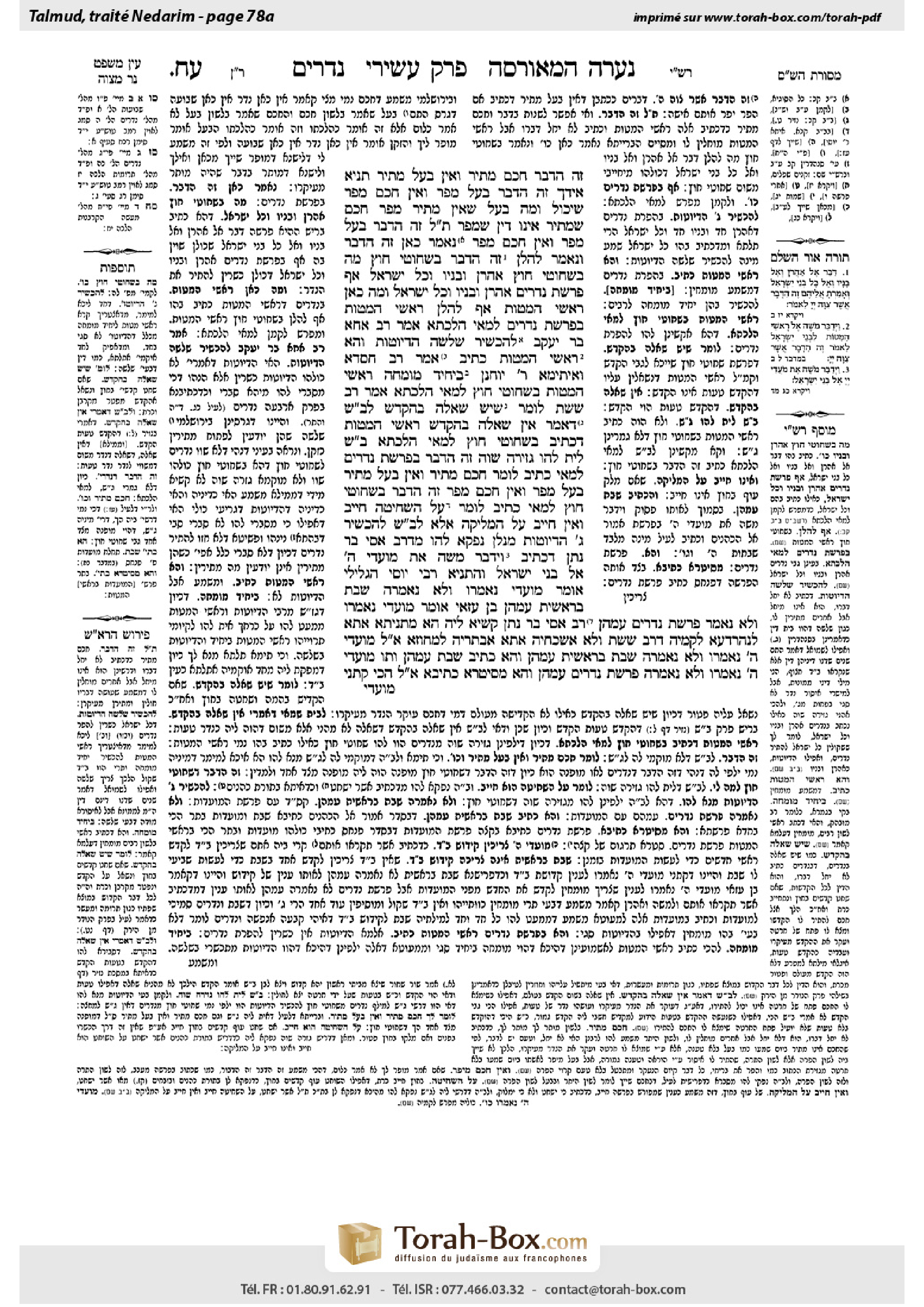
Nedarim 78a: Talmud study for Daf Yomi
Daf Yomi is the daily study of one Talmud folio. Explore 37 tractates with scans, Hebrew text, Sefaria English and AI-generated French translations where annotated.
Passage selection and English or AI-generated French translation are available where the scan has annotations. Daf Study is independent of Torah-Box and Sefaria.
Browse Nedarim · נדרים · All tractatesNedarim 78a text and translations
This page of Nedarim includes the Aramaic text, an English translation and an AI-generated French translation, alongside the scan above.
נדרים ע״ח א · Aramaic and Hebrew text
״זֶה הַדָּבָר״ — חָכָם מַתִּיר, וְאֵין בַּעַל מַתִּיר. תַּנְיָא אִידַּךְ: ״זֶה הַדָּבָר״ — בַּעַל מֵפֵר וְאֵין חָכָם מֵפֵר. שֶׁיָּכוֹל: וּמָה בַּעַל שֶׁאֵין מַתִּיר — מֵפֵר, חָכָם שֶׁמַּתִּיר — אֵינוֹ דִּין שֶׁמֵּפֵר, תַּלְמוּד לוֹמַר: ״זֶה הַדָּבָר״ — בַּעַל מֵפֵר, וְאֵין חָכָם מֵפֵר.
נֶאֱמַר כָּאן ״זֶה הַדָּבָר״, וְנֶאֱמַר לְהַלָּן ״זֶה הַדָּבָר״ בִּשְׁחוּטֵי חוּץ. מָה בִּשְׁחוּטֵי חוּץ — אַהֲרֹן וּבָנָיו וְכׇל יִשְׂרָאֵל, אַף פָּרָשַׁת נְדָרִים — אַהֲרֹן וּבָנָיו וְכׇל יִשְׂרָאֵל. וּמָה כָּאן רָאשֵׁי הַמַּטּוֹת — אַף לְהַלָּן רָאשֵׁי הַמַּטּוֹת.
בְּפָרָשַׁת נְדָרִים לְמַאי הִלְכְתָא? אָמַר רַב אַחָא בַּר יַעֲקֹב: לְהַכְשִׁיר שְׁלֹשָׁה הֶדְיוֹטוֹת. וְהָא ״רָאשֵׁי הַמַּטּוֹת״ כְּתִיב! אָמַר רַב חִסְדָּא וְאִיתֵּימָא רַבִּי יוֹחָנָן: בְּיָחִיד מוּמְחֶה.
רָאשֵׁי הַמַּטּוֹת בִּשְׁחוּטֵי חוּץ לְמַאי הִלְכְתָא? אָמַר רַב שֵׁשֶׁת: לוֹמַר שֶׁיֵּשׁ שְׁאֵלָה בְּהֶקְדֵּשׁ.
לְבֵית שַׁמַּאי דְּאָמַר אֵין שְׁאֵלָה בְּהֶקְדֵּשׁ, ״רָאשֵׁי הַמַּטּוֹת״ דִּכְתִיב בִּשְׁחוּטֵי חוּץ לְמַאי הִלְכְתָא? בֵּית שַׁמַּאי לֵית לְהוּ גְּזֵירָה שָׁוָה.
״זֶה הַדָּבָר״ בְּפָרָשַׁת נְדָרִים לְמַאי כְּתִיב? לוֹמַר: חָכָם מַתִּיר וְאֵין בַּעַל מַתִּיר, בַּעַל מֵפֵר וְאֵין חָכָם מֵפֵר.
״זֶה הַדָּבָר״ בִּשְׁחוּטֵי חוּץ לְמַאי כְּתִיב? לוֹמַר: עַל הַשְּׁחִיטָה חַיָּיב, וְאֵין חַיָּיב עַל הַמְּלִיקָה.
אֶלָּא לְבֵית שַׁמַּאי, לְהַכְשִׁיר שְׁלֹשָׁה הֶדְיוֹטוֹת מְנָלַן? נָפְקָא לְהוּ מִדְּרַב אַסִּי בַּר נָתָן.
דִּכְתִיב: ״וַיְדַבֵּר מֹשֶׁה אֶת מֹעֲדֵי ה׳ אֶל בְּנֵי יִשְׂרָאֵל״, וְהָתַנְיָא, רַבִּי יוֹסֵי הַגְּלִילִי אוֹמֵר: ״מוֹעֲדֵי״ נֶאֶמְרוּ, וְלֹא נֶאֶמְרָה שַׁבַּת בְּרֵאשִׁית עִמָּהֶן. בֶּן עַזַּאי אוֹמֵר: ״מוֹעֲדֵי״ נֶאֶמְרוּ, וְלֹא נֶאֱמַר פָּרָשַׁת נְדָרִים עִמָּהֶן.
רַב אַסִּי בַּר נָתָן קַשְׁיָא לֵיהּ הָא מַתְנִיתָא. אֲתָא לִנְהַרְדְּעָא לְקַמֵּיהּ דְּרַב שֵׁשֶׁת וְלָא אַשְׁכְּחֵיהּ, אֲתָא אַבָּתְרֵיהּ לְמָחוֹזָא. אֲמַר לֵיהּ: מוֹעֲדֵי ה׳ נֶאֶמְרוּ, וְלֹא נֶאֶמְרָה שַׁבַּת בְּרֵאשִׁית עִמָּהֶן?
וְהָא כְּתִיב שַׁבָּת עִמָּהֶן! וְתוּ: מוֹעֲדֵי ה׳ נֶאֶמְרוּ, וְלֹא נֶאֶמְרָה פָּרָשַׁת נְדָרִים עִמָּהֶן? וְהָא מִסִּיטְרָא כְּתִיבָא! אֲמַר לֵיהּ, הָכִי קָתָנֵי:
Nedarim 78a · English translation
“This is the thing” (Numbers 30:2), to teach that the husband nullifies vows and a halakhic authority dissolves vows, but a husband does not dissolve them. It is taught in another baraita: The phrase “this is the thing” teaches that a husband nullifies vows but a halakhic authority does not nullify vows. As, one might have thought: Just as a husband, who cannot dissolve vows, nevertheless nullifies them, so too with regard to a halakhic authority, who can dissolve vows, is it not logical that he should also nullify them? Therefore, the verse states: “This is the thing,” to teach us that a husband nullifies vows, but a halakhic authority does not nullify them.
It is taught in a baraita: It is stated here, with regard to vows: “This is the thing,” and it is stated elsewhere: “Speak to Aaron, and to his sons, and to all the children of Israel, and say to them: This is the thing which the Lord has commanded, saying” (Leviticus 17:2), in the verse introducing the prohibition against slaughtering offerings outside of the Temple courtyard. Just as with regard to offerings slaughtered outside the Temple courtyard, the verse is directed to Aaron and his sons and all of Israel, so too, the portion in the Torah about vows is directed to Aaron and his sons and all of Israel. And just as here, with regard to vows, the verse states: “And Moses spoke to the heads of the tribes of the children of Israel” (Numbers 30:2), so too, there, with regard to offerings slaughtered outside the Temple courtyard, Moses spoke to the heads of the tribes.
The Gemara asks: With regard to the Torah portion on vows, for what halakha is the verbal analogy between it and slaughtering offerings outside the Temple courtyard taught? Rav Aḥa bar Ya’akov says: The verbal analogy is the source to authorize three laymen to dissolve vows. The Gemara raises a difficulty: But isn’t it written: “The heads of the tribes”? Rav Ḥisda said, and some say it was Rabbi Yoḥanan: From the phrase “the heads of the tribes” the Sages derive that vows can also be dissolved by a single expert.
The Gemara then asks the corresponding question about the other passage. The verbal analogy connects “the heads of the tribes” to offerings slaughtered outside of the Temple courtyard. For what halakha is this connection made? Rav Sheshet said: This connection is made in order to say that there is a concept of requesting dissolution of consecration of consecrated property.
The Gemara asks: According to Beit Shammai, who say that there is no possibility of requesting from a halakhic authority to cancel the consecration of consecrated property, the treatment of the verse “the heads of the tribes” as if it were written also about offerings slaughtered outside the Temple courtyard serves to teach what halakha? The Gemara answers: Beit Shammai do not have a tradition of interpreting the verses in accordance with this verbal analogy.
The Gemara asks: Since Beit Shammai do not use this verbal analogy, for what purpose is “this is the thing,” in the portion on vows, written? The Gemara answers: It is written to say that only a halakhic authority dissolves vows, but a husband does not dissolve them; a husband nullifies vows, but a halakhic authority does not nullify them.
According to Beit Shammai, for what purpose is written the phrase “this is the thing,” found in the portion on offerings slaughtered outside of the Temple courtyard? The Gemara answers: It is written to say that one is liable for slaughtering outside, but one is not liable for pinching the neck of a bird-offering outside the Temple courtyard, although that is the way it would be killed if it were a valid offering in the Temple.
The Gemara asks: But according to Beit Shammai, who do not accept the verbal analogy between vows and the prohibition against slaughtering offerings outside of the Temple courtyard, from where do we derive the source to authorize three laymen to dissolve vows? The Gemara answers: Beit Shammai derive it from the explanation given to Rav Asi bar Natan.
This is as it is written: “And Moses declared the Festivals of the Lord to the children of Israel” (Leviticus 23:44). And it is taught in a baraita: Rabbi Yosei HaGelili says: The Festivals are stated, but Shabbat, which commemorates Creation, is not stated with them. Ben Azzai says: The Festivals are stated, but the portion on vows is not stated with them.
The Gemara relates that Rav Asi bar Natan had a difficulty with this baraita. He came to Neharde’a to ask about it before Rav Sheshet, but he did not find him there. He pursued him to Meḥoza and said to him: How can the baraita say that the Festivals of the Lord were stated, but Shabbat, which commemorates Creation, was not stated with them?
But Shabbat is written with them in the portions of the Torah about the Festivals (Leviticus 23:3; Numbers 28:9–10). And furthermore, can it be said that the Festivals of the Lord are stated, but the portion on vows (Numbers, chapter 30) is not stated with them? Isn’t it next to one of the portions in the Torah detailing the halakhot of the Festivals (Numbers, chapters 28–29)? Rav Sheshet said to him: This is what Rabbi Yosei HaGelili’s statement in the baraita is teaching:
Nedarim 78a · Traduction française (IA)
« Voici la chose » (Nombres 30:2) : cela enseigne que le mari annule les vœux et qu’une autorité halakhique les délie, mais qu’un mari ne les délie pas. Il est enseigné dans une autre baraïta : l’expression « voici la chose » enseigne que le mari annule les vœux, mais qu’une autorité halakhique ne les annule pas. On aurait pu penser : de même qu’un mari, qui ne peut pas délier les vœux, peut néanmoins les annuler, de même, concernant une autorité halakhique, qui peut délier les vœux, n’est-il pas logique qu’elle puisse aussi les annuler ? C’est pourquoi le verset dit : « Voici la chose », pour nous enseigner que le mari annule les vœux, mais qu’une autorité halakhique ne les annule pas.
Il est enseigné dans une baraïta : il est écrit ici, à propos des vœux : « Voici la chose », et il est écrit ailleurs : « Parle à Aaron, à ses fils et à tous les enfants d’Israël, et dis-leur : Voici la chose que l’Éternel a ordonnée, en disant » (Lévitique 17:2), dans le verset qui introduit l’interdiction d’abattre des sacrifices hors de la cour du Temple. De même que, concernant les sacrifices abattus hors de la cour du Temple, le verset s’adresse à Aaron, à ses fils et à tout Israël, de même, le passage de la Torah relatif aux vœux s’adresse à Aaron, à ses fils et à tout Israël. Et de même qu’ici, à propos des vœux, le verset dit : « Moïse parla aux chefs des tribus des enfants d’Israël » (Nombres 30:2), de même, là-bas, à propos des sacrifices abattus hors de la cour du Temple, Moïse parla aux chefs des tribus.
La Guemara demande : dans le passage de la Torah relatif aux vœux, pour quelle halakha l’analogie verbale avec l’abattage de sacrifices hors de la cour du Temple est-elle enseignée ? Rav Aḥa bar Ya’akov dit : l’analogie verbale est la source qui autorise trois personnes ordinaires à délier les vœux. La Guemara soulève une difficulté : mais n’est-il pas écrit « les chefs des tribus » ? Rav Ḥisda a dit — certains disent que c’est Rabbi Yoḥanan qui l’a dit — : les Sages déduisent de l’expression « les chefs des tribus » que les vœux peuvent aussi être déliés par un expert unique.
La Guemara pose ensuite la question correspondante au sujet de l’autre passage. L’analogie verbale relie « les chefs des tribus » aux sacrifices abattus hors de la cour du Temple. À quelle halakha cette relation sert-elle ? Rav Sheshet dit : cette relation sert à enseigner qu’il est possible de demander la dissolution de la consécration d’un bien consacré.
La Guemara demande : selon Beit Shammaï, qui disent qu’il est impossible de demander à une autorité halakhique d’annuler la consécration d’un bien consacré, à quelle halakha sert le fait de traiter le verset « les chefs des tribus » comme s’il était également écrit à propos des sacrifices abattus hors de la cour du Temple ? La Guemara répond : Beit Shammaï n’ont pas reçu la tradition d’interpréter les versets selon cette analogie verbale.
La Guemara demande : puisque Beit Shammaï n’utilisent pas cette analogie verbale, dans quel but l’expression « voici la chose » est-elle écrite dans le passage sur les vœux ? La Guemara répond : elle est écrite pour enseigner que seule une autorité halakhique délie les vœux, mais qu’un mari ne les délie pas ; un mari annule les vœux, mais une autorité halakhique ne les annule pas.
Selon Beit Shammaï, dans quel but l’expression « voici la chose », qui figure dans le passage sur les sacrifices abattus hors de la cour du Temple, est-elle écrite ? La Guemara répond : elle est écrite pour enseigner qu’on est passible pour l’abattage effectué à l’extérieur, mais qu’on n’est pas passible pour la mélika d’un oiseau offert en sacrifice effectuée hors de la cour du Temple, bien que ce soit ainsi qu’on le tuerait s’il s’agissait d’un sacrifice valide dans le Temple.
La Guemara demande : mais selon Beit Shammaï, qui n’acceptent pas l’analogie verbale entre les vœux et l’interdiction d’abattre des sacrifices hors de la cour du Temple, d’où tirons-nous la source qui autorise trois personnes ordinaires à délier les vœux ? La Guemara répond : Beit Shammaï la déduisent de l’explication donnée à Rav Asi bar Natan.
C’est comme il est écrit : « Moïse déclara aux enfants d’Israël les fêtes de l’Éternel » (Lévitique 23:44). Et il est enseigné dans une baraïta : Rabbi Yosei HaGelili dit : les fêtes sont mentionnées, mais le Chabbat, qui commémore la Création, n’est pas mentionné avec elles. Ben Azzai dit : les fêtes sont mentionnées, mais le passage sur les vœux ne l’est pas avec elles.
La Guemara rapporte que Rav Asi bar Natan avait une difficulté à propos de cette baraïta. Il se rendit à Neharde’a pour interroger Rav Sheshet à ce sujet, mais ne le trouva pas là. Il le suivit jusqu’à Meḥoza et lui dit : comment la baraïta peut-elle dire que les fêtes de l’Éternel sont mentionnées, mais que le Chabbat, qui commémore la Création, n’est pas mentionné avec elles ?
Pourtant, le Chabbat est mentionné avec elles dans les passages de la Torah consacrés aux fêtes (Lévitique 23:3 ; Nombres 28:9–10). Et en outre, peut-on dire que les fêtes de l’Éternel sont mentionnées, mais que le passage sur les vœux (Nombres, chapitre 30) ne l’est pas avec elles ? N’est-il pas à côté de l’un des passages de la Torah qui détaillent les halakhot des fêtes (Nombres, chapitres 28–29) ? Rav Sheshet lui dit : voici ce que l’énoncé de Rabbi Yosei HaGelili dans la baraïta enseigne :
Traduction française générée par IA à partir de l’édition anglaise de Sefaria. Vérifie toujours un passage avec le texte source.
Text from Sefaria: William Davidson Edition - Vocalized Aramaic (CC BY NC); William Davidson Edition - English (CC BY NC).