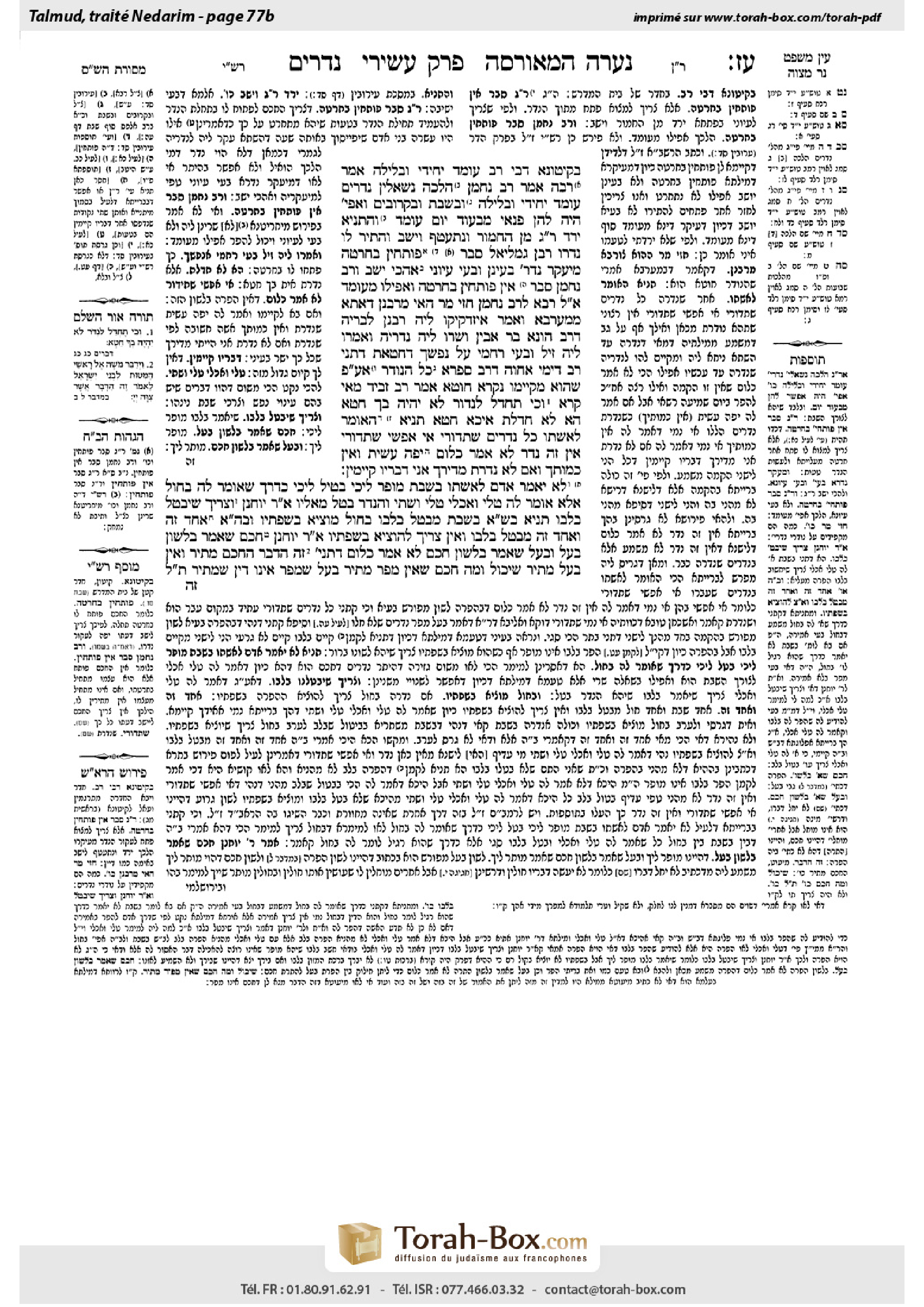
Nedarim 77b: Talmud study for Daf Yomi
Daf Yomi is the daily study of one Talmud folio. Explore 37 tractates with scans, Hebrew text, Sefaria English and AI-generated French translations where annotated.
Passage selection and English or AI-generated French translation are available where the scan has annotations. Daf Study is independent of Torah-Box and Sefaria.
Browse Nedarim · נדרים · All tractatesNedarim 77b text and translations
This page of Nedarim includes the Aramaic text, an English translation and an AI-generated French translation, alongside the scan above.
נדרים ע״ז ב · Aramaic and Hebrew text
בְּקִיטוֹנָא דְבֵי רַב, עוֹמֵד, יְחִידִי, וּבַלַּיְלָה.
אָמַר רַבָּה אָמַר רַב נַחְמָן: הֲלָכָה, נִשְׁאָלִין נְדָרִים עוֹמֵד, יְחִידִי, וּבַלַּיְלָה, וּבַשַּׁבָּת, וּבִקְרוֹבִים, וַאֲפִילּוּ הָיָה לָהֶן פְּנַאי מִבְּעוֹד יוֹם.
עוֹמֵד? וְהָתַנְיָא: יָרַד רַבָּן גַּמְלִיאֵל מִן הַחֲמוֹר וְנִתְעַטֵּף וְיָשַׁב וְהִתִּיר לוֹ נִדְרוֹ. רַבָּן גַּמְלִיאֵל סָבַר: פּוֹתְחִין בַּחֲרָטָה. מִיעְקַר נִדְרָא בָּעִינַן, וּבָעֵי עַיּוֹנֵי, אַהָכִי יָשַׁב. וְרַב נַחְמָן סָבַר: אֵין פּוֹתְחִין בַּחֲרָטָה, וַאֲפִילּוּ מְעוּמָּד.
אֲמַר לֵיהּ רָבָא לְרַב נַחְמָן: חֲזִי מָר הַאי מֵרַבָּנַן דַּאֲתָא מִמַּעְרְבָא וְאָמַר: אִיזְדְּקִיקוּ לֵיהּ רַבָּנַן לִבְרֵיהּ דְּרַב הוּנָא בַּר אָבִין, וּשְׁרוֹ לֵיהּ נִדְרֵיהּ וַאֲמַרוּ לֵיהּ: זִיל וּבְעִי רַחֲמֵי עַל נַפְשָׁךְ דַּחֲטָאת. דְּתָנֵי רַב דִּימִי אֲחוּהּ דְּרַב סָפְרָא: כׇּל הַנּוֹדֵר, אַף עַל פִּי שֶׁהוּא מְקַיְּימוֹ — נִקְרָא חוֹטֵא. אָמַר רַב זְבִיד: מַאי קְרָא — ״וְכִי תֶחְדַּל לִנְדֹּר לֹא יִהְיֶה בְךָ חֵטְא״, הָא לֹא חָדַלְתָּ — אִיכָּא חֵטְא.
תַּנְיָא: הָאוֹמֵר לְאִשְׁתּוֹ ״כׇּל נְדָרִים שֶׁתִּדּוֹרִי, אִי אֶפְשִׁי שֶׁתִּדּוֹרִי״, ״אֵין זֶה נֶדֶר״ — לֹא אָמַר כְּלוּם. ״יָפֶה עָשִׂית״, וְ״אֵין כְּמוֹתֵךְ״, וְ״אִם לֹא נָדַרְתְּ, מַדִּירֵךְ אֲנִי״ — דְּבָרָיו קַיָּימִין.
לֹא יֹאמַר אָדָם לְאִשְׁתּוֹ בְּשַׁבָּת ״מוּפָר לִיכִי״, ״בָּטֵיל לִיכִי״, כְּדֶרֶךְ שֶׁאוֹמֵר לָהּ בַּחוֹל, אֶלָּא אוֹמֵר לָהּ: ״טְלִי וְאִכְלִי״, ״טְלִי וּשְׁתִי״, וְהַנֶּדֶר בָּטֵל מֵאֵלָיו. אָמַר רַבִּי יוֹחָנָן: וְצָרִיךְ שֶׁיְּבַטֵּל בְּלִבּוֹ.
תַּנְיָא, בֵּית שַׁמַּאי אוֹמְרִים: בַּשַּׁבָּת מְבַטֵּל בְּלִבּוֹ, בַּחוֹל מוֹצִיא בִּשְׂפָתָיו. וּבֵית הִלֵּל אוֹמְרִים: אֶחָד זֶה וְאֶחָד זֶה — מְבַטֵּל בְּלִבּוֹ, וְאֵין צָרִיךְ לְהוֹצִיא בִּשְׂפָתָיו.
אָמַר רַבִּי יוֹחָנָן: חָכָם שֶׁאָמַר בִּלְשׁוֹן בַּעַל, וּבַעַל שֶׁאָמַר בִּלְשׁוֹן חָכָם — לָא אָמַר כְּלוּם.
דְּתַנְיָא: ״זֶה הַדָּבָר״ — הֶחָכָם מַתִּיר וְאֵין בַּעַל מַתִּיר. שֶׁיָּכוֹל: וּמָה חָכָם שֶׁאֵין מֵפֵר — מַתִּיר, בַּעַל שֶׁמֵּפֵר — אֵינוֹ דִּין שֶׁמַּתִּיר? תַּלְמוּד לוֹמַר:
Nedarim 77b · English translation
in a side room [kitona] of the study hall, while standing, alone and at night.
Rabba said that Rav Naḥman said: The halakha is that one can request the dissolution of vows even when the halakhic authority is standing or alone, i.e., without a court of three, as long as he is a halakhic authority, and that one can do so at night, on Shabbat, and by relatives, and even when those requesting dissolution on Shabbat had the opportunity to do so while it was still day, i.e., before Shabbat.
The Gemara raises a difficulty with this ruling: Can a judge dissolve a vow while standing? But it is taught in a baraita that Rabban Gamliel alighted from a donkey, and wrapped himself in his shawl in the customary manner of a judge, and sat, and dissolved a man’s vow for him. If one can dissolve a vow while standing, why did he sit? The Gemara explains: Rabban Gamliel holds that one must broach dissolution based on regret. In other words, a halakhic authority does not dissolve vows directly, but must prompt the one who took the vow to concede that he regrets having taken the vow in the first place. We require that the vow be uprooted, and he needed to examine the case; therefore, he sat down. But Rav Naḥman holds that one need not broach dissolution based on regret, and therefore a halakhic authority can dissolve the vow even while standing.
Rava said to Rav Naḥman: Master, see that Sage who came from the West, Eretz Yisrael, and who said: The Sages attended to the dissolution of a vow taken by the son of Rav Huna bar Avin, and they dissolved his vow and said to him: Go and request mercy for yourself, for you have sinned by taking a vow. As Rav Dimi, the brother of Rav Safra teaches: With regard to anyone who takes a vow, even if he fulfills it, he is called a sinner. Rav Zevid said: What verse teaches this? It is: “But if you refrain to vow, it will be no sin in you” (Deuteronomy 23:23). It may be inferred that if you did not refrain from taking vows, there is sin.
§ It is taught in a baraita: One who says to his wife: Any vows which you will vow, I do not want [ee efshi] you to vow, or one who wants to nullify a vow and says: This is not a vow, has not said anything, as this is not a valid formula of nullification. If he says: You have done well, or: There are none like you, or: If you had not taken a vow, I, myself, would have taken a vow to obligate you in this, his statement is substantial, and the vow is ratified.
A man should not say to his wife when nullifying her vows on Shabbat: It is nullified for you, or: It is canceled for you, in the manner that he would say to her on weekdays. Rather, he should say to her, if she took a vow to refrain from food or drink: Take this and eat it, or: Take this and drink it, and the vow is canceled on its own. Rabbi Yoḥanan said: And he must also cancel the vow in his heart; simply telling her to eat or drink is not sufficient.
It is taught in a baraita: Beit Shammai say: On Shabbat he cancels the vow in his heart and on a weekday he articulates the nullification with his lips. And Beit Hillel say: Both in this case and in that case, i.e., whether on Shabbat or a weekday, it is sufficient if he cancels the vow in his heart, and he need not articulate with his lips.
§ Rabbi Yoḥanan said: A halakhic authority who pronounced his dissolution of a vow with language appropriate to a husband, i.e., he said the word nullified instead of dissolved, or a husband who pronounced his nullification of a vow with language appropriate to a halakhic authority, i.e., he said the word dissolved instead of nullified, has not said anything. Each of them has the authority to cancel a vow only in the particular manner allotted to him.
As it is taught in a baraita: The verse “This is the thing which the Lord has commanded” (Numbers 30:2) indicates that the husband’s nullification, which is the topic of the subsequent verses, must be done specifically in this way. The Sages concluded that a halakhic authority dissolves a vow, but a husband does not dissolve it. As, one might have thought: And just as a halakhic authority, who cannot nullify vows, nevertheless dissolves them, so too with regard to a husband, who can nullify vows, is it not logical that he should also dissolve them? Therefore, the verse states:
Nedarim 77b · Traduction française (IA)
dans une pièce latérale [kitona] de la salle d’étude, debout, seul et de nuit.
Rabba dit au nom de Rav Naḥman : La halakha est qu’on peut demander la dissolution des vœux même lorsque l’autorité halakhique est debout ou seule, c’est-à-dire sans tribunal de trois personnes, pourvu qu’il s’agisse d’une autorité halakhique. On peut aussi le faire de nuit, le Chabbat et par l’intermédiaire de proches, même lorsque ceux qui demandent la dissolution le Chabbat auraient pu le faire alors qu’il faisait encore jour, c’est-à-dire avant Chabbat.
La Guemara soulève une difficulté à propos de cette décision : un juge peut-il dissoudre un vœu debout ? Pourtant, il est enseigné dans une baraïta que Rabban Gamliel descendit d’un âne, s’enveloppa dans son châle comme le fait habituellement un juge, s’assit et dissout le vœu d’un homme. Si l’on peut dissoudre un vœu debout, pourquoi s’est-il assis ? La Guemara explique : Rabban Gamliel estime qu’il faut susciter une demande de dissolution fondée sur le regret. Autrement dit, une autorité halakhique ne dissout pas directement les vœux, mais doit amener celui qui a prononcé le vœu à reconnaître qu’il regrette de l’avoir prononcé. Il faut déraciner le vœu, et Rabban Gamliel devait examiner le cas ; c’est pourquoi il s’assit. Rav Naḥman, en revanche, estime qu’il n’est pas nécessaire de susciter une demande de dissolution fondée sur le regret ; une autorité halakhique peut donc dissoudre le vœu même debout.
Rava dit à Rav Naḥman : Maître, considère ce Sage venu de l’Ouest, c’est-à-dire de la Terre d’Israël, qui a dit : Les Sages se sont occupés de la dissolution du vœu prononcé par le fils de Rav Huna bar Avin ; ils ont dissous son vœu et lui ont dit : « Va demander miséricorde pour toi-même, car tu as péché en prononçant un vœu. » Rav Dimi, le frère de Rav Safra, enseigne en effet : Quiconque prononce un vœu, même s’il l’accomplit, est appelé pécheur. Rav Zevid dit : Quel verset l’enseigne ? Le voici : « Mais si tu t’abstiens de faire un vœu, il n’y aura pas de péché en toi » (Deutéronome 23:23). On peut en déduire que si tu ne t’abstiens pas de prononcer des vœux, il y a péché.
§ Il est enseigné dans une baraïta : Celui qui dit à sa femme : « Je ne veux pas [ee efshi] que tu prononces les vœux que tu prononceras », ou celui qui veut annuler un vœu et dit : « Ceci n’est pas un vœu », n’a rien dit, car ce n’est pas une formule d’annulation valable. S’il dit : « Tu as bien fait », ou : « Il n’y a personne comme toi », ou : « Si tu n’avais pas prononcé de vœu, moi-même j’aurais prononcé un vœu pour t’obliger à cela », ses paroles ont un effet et le vœu est confirmé.
Un homme ne doit pas dire à sa femme, lorsqu’il annule ses vœux le Chabbat : « C’est annulé pour toi » ou « C’est révoqué pour toi », comme il le lui dirait en semaine. Il doit plutôt lui dire, si elle a fait vœu de s’abstenir de manger ou de boire : « Prends ceci et mange » ou « Prends ceci et bois » ; le vœu est alors annulé de lui-même. Rabbi Yoḥanan dit : Il doit aussi annuler le vœu dans son cœur ; le simple fait de lui dire de manger ou de boire ne suffit pas.
Il est enseigné dans une baraïta : Beit Shammaï disent : Le Chabbat, il annule le vœu dans son cœur, tandis qu’en semaine, il exprime l’annulation par ses lèvres. Beit Hillel disent : Dans les deux cas, c’est-à-dire le Chabbat comme en semaine, il suffit qu’il annule le vœu dans son cœur et il n’a pas besoin de l’exprimer par ses lèvres.
§ Rabbi Yoḥanan dit : Une autorité halakhique qui prononce la dissolution d’un vœu en employant les termes propres à un mari, c’est-à-dire qui dit « annuler » au lieu de « dissoudre », ou un mari qui prononce l’annulation d’un vœu en employant les termes propres à une autorité halakhique, c’est-à-dire qui dit « dissoudre » au lieu d’« annuler », n’a rien dit. Chacun d’eux ne peut annuler un vœu que de la manière qui lui est propre.
Comme il est enseigné dans une baraïta : Le verset « Voici la chose que l’Éternel a ordonnée » (Nombres 30:2) indique que l’annulation par le mari, dont parlent les versets suivants, doit se faire précisément de cette manière. Les Sages en ont conclu qu’une autorité halakhique dissout un vœu, mais qu’un mari ne le dissout pas. En effet, on aurait pu penser : de même qu’une autorité halakhique, qui ne peut pas annuler les vœux, peut néanmoins les dissoudre, de même, à propos d’un mari, qui peut annuler les vœux, n’est-il pas logique qu’il puisse aussi les dissoudre ? C’est pourquoi le verset dit :
Traduction française générée par IA à partir de l’édition anglaise de Sefaria. Vérifie toujours un passage avec le texte source.
Text from Sefaria: William Davidson Edition - Vocalized Aramaic (CC BY NC); William Davidson Edition - English (CC BY NC).