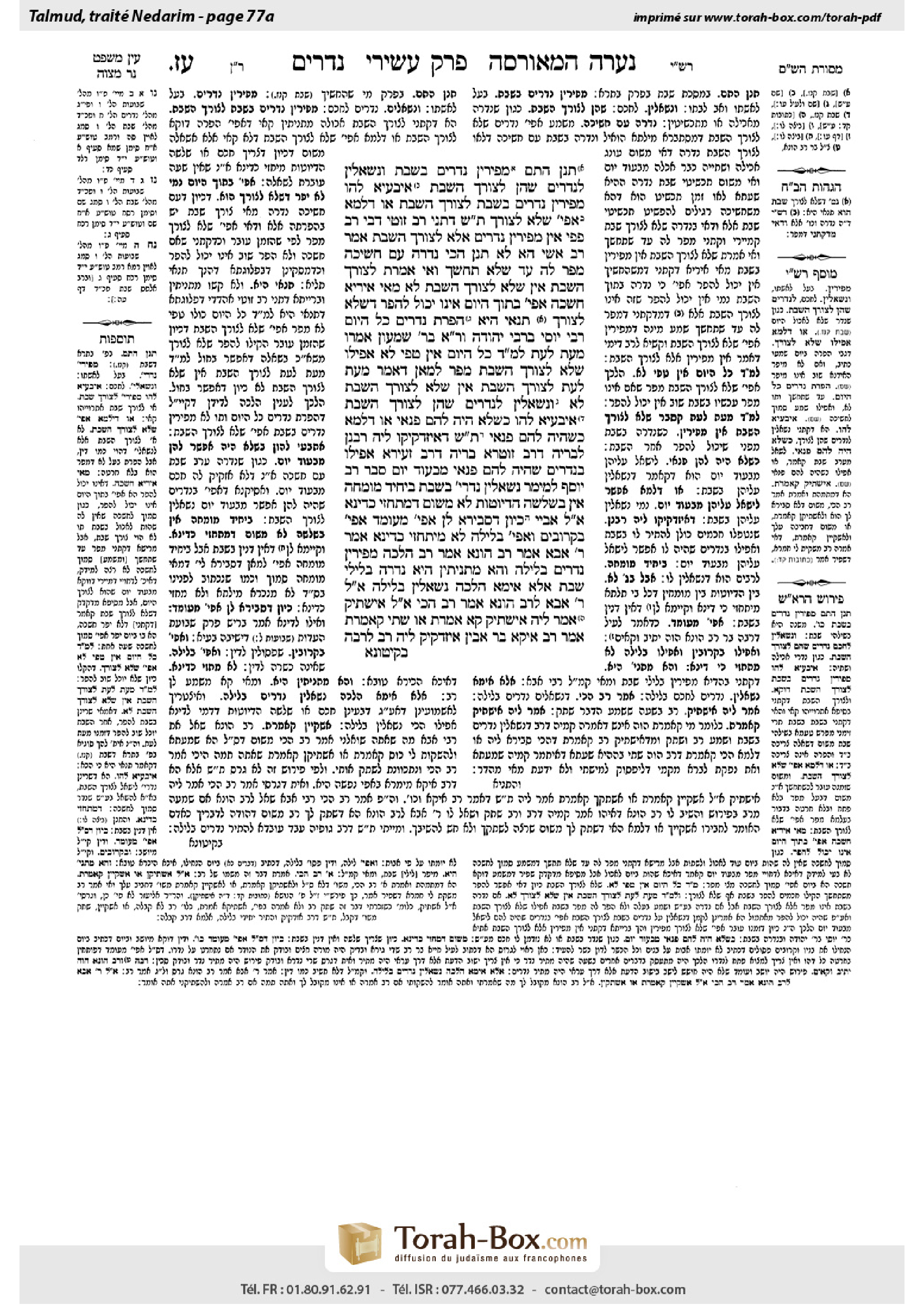
Nedarim 77a: Talmud study for Daf Yomi
Daf Yomi is the daily study of one Talmud folio. Explore 37 tractates with scans, Hebrew text, Sefaria English and AI-generated French translations where annotated.
Passage selection and English or AI-generated French translation are available where the scan has annotations. Daf Study is independent of Torah-Box and Sefaria.
Browse Nedarim · נדרים · All tractatesNedarim 77a text and translations
This page of Nedarim includes the Aramaic text, an English translation and an AI-generated French translation, alongside the scan above.
נדרים ע״ז א · Aramaic and Hebrew text
תְּנַן הָתָם: מְפִירִין נְדָרִים בְּשַׁבָּת, וְנִשְׁאָלִין לִנְדָרִים שֶׁהֵן לְצוֹרֶךְ הַשַּׁבָּת. אִיבַּעְיָא לְהוּ: מְפִירִין נְדָרִים בְּשַׁבָּת לְצוֹרֶךְ הַשַּׁבָּת, אוֹ דִלְמָא אֲפִילּוּ שֶׁלֹּא לְצוֹרֶךְ?
תָּא שְׁמַע, דְּתָנֵי רַב זוּטֵי דְּבֵי רַב פַּפֵּי: אֵין מְפִירִין נְדָרִים אֶלָּא לְצוֹרֶךְ הַשַּׁבָּת. אָמַר רַב אָשֵׁי, הָא לָא תְּנַן הָכִי: נָדְרָה עִם חֲשֵׁיכָה — מֵפֵר לָהּ עַד שֶׁלֹּא תֶּחְשַׁךְ. וְאִי אָמְרַתְּ לְצוֹרֶךְ הַשַּׁבָּת — אִין, שֶׁלֹּא לְצוֹרֶךְ הַשַּׁבָּת — לָא, מַאי אִירְיָא חָשְׁכָה? אֲפִילּוּ בְּתוֹךְ הַיּוֹם אֵינוֹ יָכוֹל לְהָפֵר דְּשֶׁלֹּא לְצוֹרֶךְ!
תַּנָּאֵי הִיא: הֲפָרַת נְדָרִים כׇּל הַיּוֹם, רַבִּי יוֹסֵי בְּרַבִּי יְהוּדָה וְרַבִּי אֶלְעָזָר בְּרַבִּי שִׁמְעוֹן אָמְרוּ: מֵעֵת לְעֵת.
לְמַאן דְּאָמַר כׇּל הַיּוֹם אִין, טְפֵי לָא — אֲפִילּוּ שֶׁלֹּא לְצוֹרֶךְ הַשַּׁבָּת מֵפֵר. לְמַאן דְּאָמַר מֵעֵת לְעֵת, לְצוֹרֶךְ הַשַּׁבָּת — אִין, שֶׁלֹּא לְצוֹרֶךְ הַשַּׁבָּת — לָא.
וְנִשְׁאָלִין לִנְדָרִים שֶׁהֵן לְצוֹרֶךְ הַשַּׁבָּת. אִיבַּעְיָא לְהוּ: כְּשֶׁלֹּא הָיָה לָהֶם פְּנַאי, אוֹ דִלְמָא כְּשֶׁהָיָה לָהֶם פְּנַאי? תָּא שְׁמַע, דְּאִיזְדְּקִיקוּ לֵיהּ רַבָּנַן לִבְרֵיהּ דְּרַב זוּטְרָא בְּרֵיהּ דְּרַב זְעֵירָא אֲפִילּוּ בִּנְדָרִים שֶׁהָיָה לָהֶם פְּנַאי מִבְּעוֹד יוֹם.
סָבַר רַב יוֹסֵף לְמֵימַר: נִשְׁאָלִין נְדָרִים בְּשַׁבָּת, בְּיָחִיד מוּמְחֶה — אִין, בִּשְׁלֹשָׁה הֶדְיוֹטוֹת — לָא, מִשּׁוּם דְּמִתְחֲזֵי כְּדִינָא.
אֲמַר לֵיהּ אַבָּיֵי: כֵּיוָן דִּסְבִירָא לַן אֲפִילּוּ מְעוּמָּד, אֲפִילּוּ בִּקְרוֹבִים, וַאֲפִילּוּ בַּלַּיְלָה — לָא מִתְחֲזֵי כְּדִינָא.
אָמַר רַבִּי אַבָּא אָמַר רַב הוּנָא אָמַר רַב: הֲלָכָה, מְפִירִין נְדָרִים בַּלַּיְלָה. וְהָא מַתְנִיתִין הִיא: נָדְרָה בְּלֵילֵי שַׁבָּת! אֶלָּא אֵימָא: הֲלָכָה, נִשְׁאָלִין בַּלַּיְלָה.
אֲמַר לֵיהּ רַבִּי אַבָּא לְרַב הוּנָא: אֲמַר רַב הָכִי? אֲמַר לֵיהּ: אִישְׁתִּיק. אֲמַר לֵיהּ: אִישְׁתִּיק קָא אָמְרַתְּ, אוֹ שָׁתֵי קָאָמְרַתְּ?
אָמַר רַב אִיקָא בַּר אָבִין: אִיזְדְּקִיק לֵיהּ רַב לְרַבָּה
Nedarim 77a · English translation
§ We learned in a mishna elsewhere (Shabbat 157a): A father or husband may nullify his daughter’s or his wife’s vows on Shabbat and one may request from a halakhic authority to dissolve vows that are for the purpose of Shabbat. A dilemma was raised before the Sages: May one nullify vows on Shabbat only when they are for the purpose of Shabbat, or may one perhaps nullify vows on Shabbat even when they are not for the purpose of Shabbat?
Come and hear the baraita that Rav Zuti from the school of Rav Pappi taught: Vows may be nullified on Shabbat only for the purpose of Shabbat. Rav Ashi said: We did not learn that way in the mishna here. The mishna teaches: If she took a vow with nightfall approaching, her father or husband can nullify the vow for her only until nightfall. And if you say that with regard to nullification of vows that are for the purpose of Shabbat, yes, he may nullify those vows, but nullifications that are not for the purpose of Shabbat, no, he may not, why does the tanna specify nightfall? After all, even during the day he may not nullify that which is not for the purpose of Shabbat.
The Gemara rejects this conclusion: Nullification on Shabbat is subject to a dispute between tanna’im: Nullification of vows can be performed all day on the day that the vow was heard. And Rabbi Yosei, son of Rabbi Yehuda, and Rabbi Elazar, son of Rabbi Shimon, said: A vow can be nullified for a twenty-four-hour period from the time it was heard.
According to the one who says all day, yes, one can nullify vows all day, but not more than that; he may nullify on Shabbat even when it is not for the purpose of Shabbat, since otherwise, he could not nullify a vow taken on Shabbat at all. According to the one who says that one can nullify her vows for a twenty-four-hour period, that which is for the purpose of Shabbat, yes, he may nullify, but that which is not necessary for Shabbat, he may not nullify, as he can do so after Shabbat.
§ The mishna from tractate Shabbat teaches: And one may request from a halakhic authority to dissolve vows that are for the purpose of Shabbat. A dilemma was raised before the Sages: Is this specifically when those who took the vows did not have the opportunity to request dissolution of the vows before Shabbat, or perhaps it is the case even when they did have the opportunity? The Gemara responds: Come and hear: It happened that the Sages attended to the dissolution of the vows of the son of Rav Zutra, son of Rav Zeira, on Shabbat, even for vows that they had the opportunity to dissolve while it was still day, before Shabbat had begun.
Rav Yosef thought to say: With regard to requesting that a halakhic authority dissolve vows on Shabbat, yes, requesting of a single expert is permitted on Shabbat, but requesting of three laymen is not permitted on Shabbat, because it looks like a court judgment, which may not be performed on Shabbat.
Abaye said to him: Since we hold that vows may be dissolved even while the halakhic authority is standing, and even by relatives, and even at night, it does not look like a judgment. Since it is not regarded as an act of a court, vows may be dissolved on Shabbat even by three laymen.
Rabbi Abba said that Rav Huna said that Rav said: The halakha is that one can nullify vows at night. The Gemara asks: But this is already stated in the mishna: If a woman took a vow on Shabbat evening, her father or husband can nullify the vow on Shabbat evening; why would Rav Huna need to state his halakha? Rather, say that Rav’s ruling was as follows: The halakha is that one can request that a halakhic authority dissolve a vow at night.
Rabbi Abba said to Rav Huna: Did Rav say that? Rav Huna said to him: Rav was silent [ishtik] when this ruling was stated in his presence. Rabbi Abba said to him: Did you say: He was silent [ishtik], indicating that he accepted this ruling, or did you say: He was drinking [shatei], and was therefore preoccupied, so that his silence did not necessarily indicate agreement?
In order to clarify Rav’s opinion on the issue, the Gemara cites Rav Ika bar Avin who said: Rav attended to the dissolution of a vow made by Rabba,
Nedarim 77a · Traduction française (IA)
§ Nous avons appris dans une Michna d’un autre traité (Chabbat 157a) : Un père ou un mari peut annuler les vœux de sa fille ou de son épouse pendant Chabbat, et l’on peut demander à une autorité halakhique de délier les vœux qui concernent Chabbat. Les Sages ont soulevé une question : Peut-on annuler des vœux pendant Chabbat uniquement lorsqu’ils concernent Chabbat, ou peut-on peut-être les annuler même lorsqu’ils ne concernent pas Chabbat ?
Viens et entends ce qu’enseigne la baraïta rapportée par Rav Zouti, de l’école de Rav Pappi : On ne peut annuler des vœux pendant Chabbat que lorsqu’ils concernent Chabbat. Rav Ashi dit : Nous ne l’avons pas appris ainsi dans la Michna ici. La Michna enseigne : Si elle a prononcé un vœu à l’approche de la nuit, son père ou son mari ne peut l’annuler pour elle que jusqu’à la nuit. Or, si tu dis que les vœux qui concernent Chabbat peuvent être annulés, mais que ceux qui ne le concernent pas ne peuvent pas l’être, pourquoi le tanna précise-t-il « jusqu’à la nuit » ? Après tout, même pendant la journée, il ne peut pas annuler un vœu qui ne concerne pas Chabbat.
La Guemara rejette cette conclusion : l’annulation des vœux pendant Chabbat fait l’objet d’un désaccord entre des tannaïm. Selon un avis, les vœux peuvent être annulés toute la journée où le vœu a été entendu. Rabbi Yosei, fils de Rabbi Yehuda, et Rabbi Elazar, fils de Rabbi Shimon, disent : Un vœu peut être annulé pendant les vingt-quatre heures qui suivent le moment où il a été entendu.
Selon celui qui dit « toute la journée », on peut effectivement annuler les vœux pendant toute cette journée, mais pas au-delà ; il peut donc les annuler pendant Chabbat même s’ils ne concernent pas Chabbat, car autrement, il ne pourrait pas du tout annuler un vœu prononcé pendant Chabbat. Selon celui qui dit que l’on peut annuler ses vœux pendant les vingt-quatre heures qui suivent leur audition, il peut annuler ceux qui concernent Chabbat, mais pas ceux qui ne sont pas nécessaires pour Chabbat, puisqu’il peut les annuler après Chabbat.
§ La Michna du traité Chabbat enseigne : Et l’on peut demander à une autorité halakhique de délier les vœux qui concernent Chabbat. Les Sages ont soulevé une question : Cela s’applique-t-il uniquement lorsque ceux qui ont prononcé les vœux n’ont pas eu la possibilité d’en demander la dissolution avant Chabbat, ou bien même lorsqu’ils en ont eu la possibilité ? La Guemara répond : Viens et entends : Il est arrivé que les Sages s’occupent, pendant Chabbat, de délier les vœux du fils de Rav Zutra, fils de Rav Zeira, y compris des vœux qu’ils avaient eu la possibilité de délier alors qu’il faisait encore jour, avant le début de Chabbat.
Rav Yosef pensa dire : Pour ce qui est de demander à une autorité halakhique de délier des vœux pendant Chabbat, il est permis de s’adresser à un expert unique, mais pas à trois laïcs, car cela ressemble à un jugement de tribunal, qui ne peut pas avoir lieu pendant Chabbat.
Abaye lui dit : Puisque nous considérons que les vœux peuvent être déliés alors même que l’autorité halakhique est debout, même par des proches et même la nuit, cela ne ressemble pas à un jugement. Puisqu’il ne s’agit pas d’un acte judiciaire, des vœux peuvent être déliés pendant Chabbat même par trois laïcs.
Rabbi Abba dit au nom de Rav Huna, au nom de Rav : La halakha est que l’on peut annuler des vœux la nuit. La Guemara demande : Mais cela est déjà énoncé dans la Michna : Si une femme a prononcé un vœu le soir de Chabbat, son père ou son mari peut annuler le vœu ce soir-là. Pourquoi Rav Huna aurait-il besoin d’énoncer cette halakha ? Il faut plutôt dire que la décision de Rav était la suivante : La halakha est que l’on peut demander à une autorité halakhique de délier un vœu la nuit.
Rabbi Abba dit à Rav Huna : Rav a-t-il dit cela ? Rav Huna lui répondit : Rav est resté silencieux [ishtik] lorsque cette décision a été énoncée en sa présence. Rabbi Abba lui demanda : As-tu dit qu’il était resté silencieux [ishtik], ce qui indique qu’il acceptait cette décision, ou as-tu dit qu’il buvait [shatei] et était donc préoccupé, de sorte que son silence n’indiquait pas nécessairement son accord ?
Afin de clarifier l’opinion de Rav sur la question, la Guemara cite Rav Ika bar Avin, qui dit : Rav s’occupa de délier un vœu prononcé par Rabba,
Traduction française générée par IA à partir de l’édition anglaise de Sefaria. Vérifie toujours un passage avec le texte source.
Text from Sefaria: William Davidson Edition - Vocalized Aramaic (CC BY NC); William Davidson Edition - English (CC BY NC).