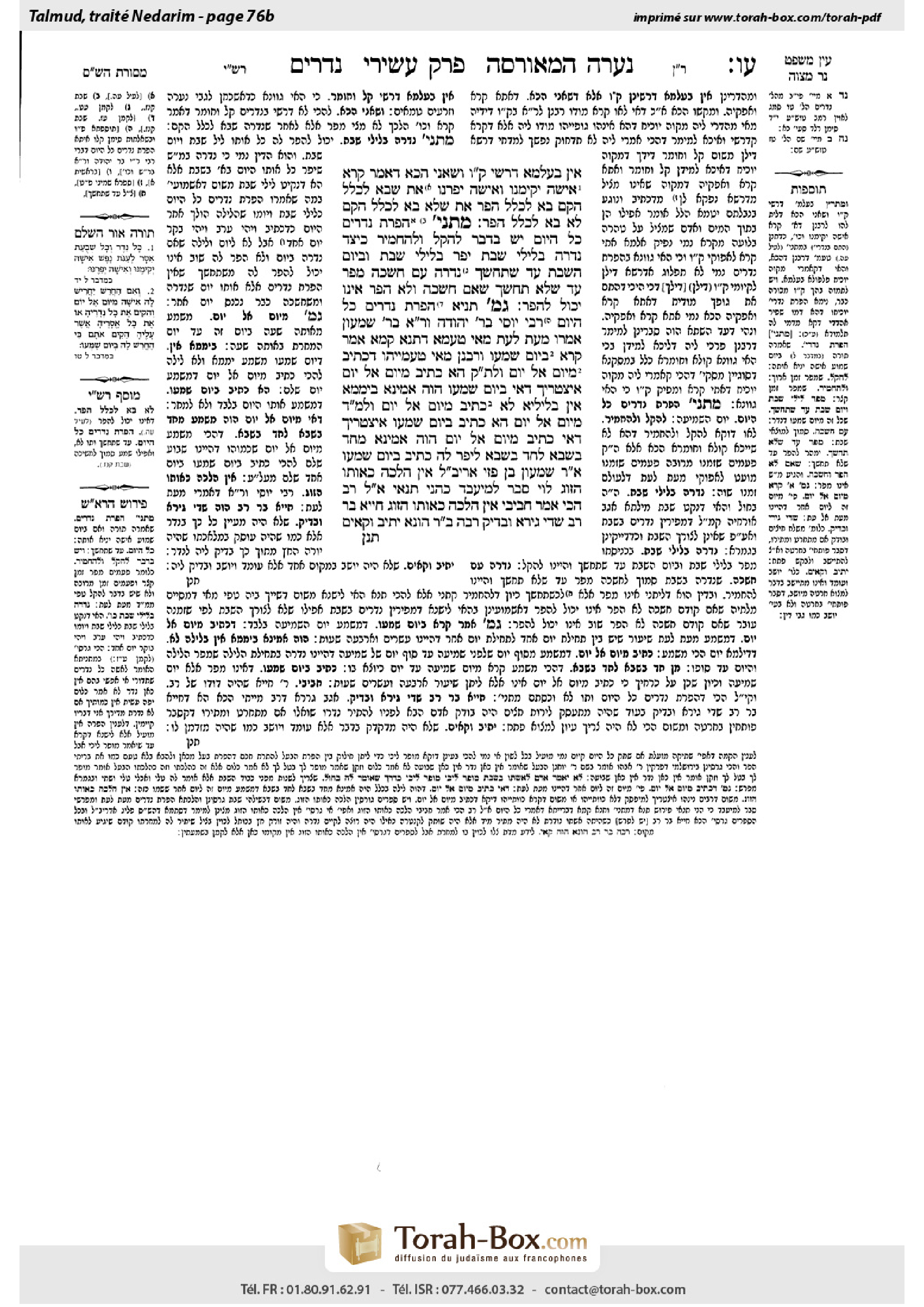
Nedarim 76b: Talmud study for Daf Yomi
Daf Yomi is the daily study of one Talmud folio. Explore 37 tractates with scans, Hebrew text, Sefaria English and AI-generated French translations where annotated.
Passage selection and English or AI-generated French translation are available where the scan has annotations. Daf Study is independent of Torah-Box and Sefaria.
Browse Nedarim · נדרים · All tractatesNedarim 76b text and translations
This page of Nedarim includes the Aramaic text, an English translation and an AI-generated French translation, alongside the scan above.
נדרים ע״ו ב · Aramaic and Hebrew text
אִין, בְּעָלְמָא דָּרְשִׁי קַל וָחוֹמֶר, וְשָׁאנֵי הָכָא דְּאָמַר קְרָא ״אִישָׁהּ יְקִימֶנּוּ וְאִישָׁהּ יְפֵרֶנּוּ״. אֶת שֶׁבָּא לִכְלַל הָקֵם — בָּא לִכְלַל הָפֵר, אֶת שֶׁלֹּא בָּא לִכְלַל הָקֵם — לֹא בָּא לִכְלַל הָפֵר.
מַתְנִי׳ הֲפָרַת נְדָרִים כׇּל הַיּוֹם. יֵשׁ בַּדָּבָר לְהָקֵל וּלְהַחֲמִיר
כֵּיצַד? נָדְרָה בְּלֵילֵי שַׁבָּת — יָפֵר בְּלֵילֵי שַׁבָּת וּבְיוֹם הַשַּׁבָּת עַד שֶׁתֶּחְשַׁךְ. נָדְרָה עִם חֲשֵׁכָה — מֵפֵר עַד שֶׁלֹּא תֶּחְשַׁךְ, שֶׁאִם חָשְׁכָה וְלֹא הֵפֵר — אֵינוֹ יָכוֹל לְהָפֵר,
גְּמָ׳ תַּנְיָא: הֲפָרַת נְדָרִים כׇּל הַיּוֹם. רַבִּי יוֹסֵי בְּרַבִּי יְהוּדָה וְרַבִּי אֶלְעָזָר בְּרַבִּי שִׁמְעוֹן אָמְרוּ: מֵעֵת לְעֵת. מַאי טַעְמָא דְּתַנָּא קַמָּא, אָמַר קְרָא: ״בְּיוֹם שׇׁמְעוֹ״.
וְרַבָּנַן מַאי טַעְמַיְיהוּ — דִּכְתִיב: ״מִיּוֹם אֶל יוֹם״.
וּלְתַנָּא קַמָּא, הָא כְּתִיב ״מִיּוֹם אֶל יוֹם״! אִיצְטְרִיךְ. דְּאִי ״בְּיוֹם שׇׁמְעוֹ״, הֲוָה אָמֵינָא בִּימָמָא — אִין, בְּלֵילְיָא — לָא, כְּתִיב ״מִיּוֹם אֶל יוֹם״.
וּלְמַאן דְּאָמַר ״מִיּוֹם אֶל יוֹם״, הָא כְּתִיב ״בְּיוֹם שׇׁמְעוֹ״! אִיצְטְרִיךְ, דְּאִי כְּתִיב ״מִיּוֹם אֶל יוֹם״, הֲוָה אָמֵינָא מֵחַד בְּשַׁבָּא לְחַד בְּשַׁבָּא לֵיפַר לָהּ, כְּתִיב ״בְּיוֹם שׇׁמְעוֹ״.
אָמַר רַבִּי שִׁמְעוֹן בֶּן פַּזִּי אָמַר רַבִּי יְהוֹשֻׁעַ בֶּן לֵוִי: אֵין הֲלָכָה כְּאוֹתוֹ הַזּוּג. לֵוִי סָבַר לְמִיעְבַּד כְּהָנֵי תַּנָּאֵי. אֲמַר לֵיהּ רַב, הָכִי אָמַר חֲבִיבִי: אֵין הֲלָכָה כְּאוֹתוֹ הַזּוּג.
חִיָּיא בַּר רַב שָׁדֵי גִּירָא וּבָדֵיק. רַבָּה בַּר רַב הוּנָא יָתֵיב וְקָאֵים.
Nedarim 76b · English translation
The Gemara answers: Yes, generally they do teach halakhot based upon an a fortiori inference of this type, but here it is different, as the verse states: “Her husband may ratify it, or her husband may nullify it” (Numbers 30:14). The Rabbis interpret this to mean: That which has become eligible for ratification, i.e., a vow that she has already taken, has become eligible for nullification. However, that which has not become eligible for ratification, i.e., a vow she has not yet taken, has not become eligible for nullification.
MISHNA: The nullification of vows can be performed all day on the day on which the vow was heard. There is in this matter both a leniency, extending the nullification period, and a stricture, curtailing that period.
How so? If a woman took a vow on Shabbat evening, her father or husband can nullify the vow on Shabbat evening, and on Shabbat day until dark. This is an example of extending the nullification period. However, if she took a vow with nightfall approaching, her father or husband can nullify the vow only until nightfall, since, if it became dark and he had not yet nullified her vow, he cannot nullify it anymore. This is an example of a curtailed nullification period.
GEMARA: It is taught in a baraita: The nullification of vows can be performed all day on the day on which the vow was heard. Rabbi Yosei, son of Rabbi Yehuda, and Rabbi Elazar, son of Rabbi Shimon, said: A vow can be nullified for a twenty-four-hour period from the time it was heard. The Gemara asks: What is the reason for the opinion of the first tanna? The Gemara answers: Since the verse states: “But if her husband make them null and void on the day that he hears them” (Numbers 30:13), he derives that the husband can nullify his wife’s vow only until the end of the day on which he hears the vow.
The Gemara asks: And with regard to the Rabbis, Rabbi Yosei, son of Rabbi Yehuda, and Rabbi Eliezer, son of Rabbi Shimon, what is their reason? The Gemara answers: It is written: “From day to day” (Numbers 30:15), which indicates that a vow can be nullified from a particular hour on one day until the same hour on the following day.
The Gemara asks: And according to the first tanna, isn’t it written: “From day to day”? The Gemara answers: That verse is necessary, as if it had said only “on the day that he hears them,” I would say that during the day, yes, he can nullify vows, but at night he is not able to. Therefore, it is written: “From day to day,” to teach that nullification can be performed even between one day and the next, i.e., night.
The Gemara asks: And according to the one who said that “from day to day” indicates a twenty-four-hour period for nullification, isn’t it written: “On the day that he hears them?” The Gemara explains here, too: That verse was necessary, as if it had written only “from day to day,” I would say that he can nullify a vow for her until the same day in the following week, i.e., he can nullify her vow during the entire period from one Sunday to the next Sunday. Therefore, it is written: “On the day that he hears them” to teach that nullification is limited to a period of a single day of twenty-four hours.
Rabbi Shimon ben Pazi said that Rabbi Yehoshua ben Levi said: The halakha is not in accordance with that pair [zug], Rabbi Yosei, son of Rabbi Yehuda, and Rabbi Eliezer, son of Rabbi Shimon, who hold that one has an entire twenty-four-hour period to nullify vows. Rather, one can nullify only on that day, as stated in the mishna. The Gemara relates: Levi thought to act in accordance with the opinion of those two tanna’im. Rav said to him: So said my uncle [ḥavivi], Rabbi Ḥiyya: The halakha is not in accordance with that pair.
The Gemara relates that when a case of dissolving a vow was brought before Ḥiyya bar Rav, he would shoot an arrow [gira] and examine the vow at the same time. In other words, he would not examine the case in great depth, but would immediately dissolve it. Similarly, Rabba bar Rav Huna would sit to review the vow and stand immediately, without conducting a comprehensive examination.
Nedarim 76b · Traduction française (IA)
La Guemara répond : Oui, en général, on enseigne bien des halakhot fondées sur une déduction a fortiori de ce type. Mais ici, le cas est différent, car le verset dit : « Son mari peut ratifier son vœu, ou son mari peut l’annuler » (Nombres 30,14). Les Sages interprètent cela ainsi : ce qui est devenu susceptible d’être ratifié, c’est-à-dire un vœu qu’elle a déjà prononcé, est devenu susceptible d’être annulé. En revanche, ce qui n’est pas devenu susceptible d’être ratifié, c’est-à-dire un vœu qu’elle n’a pas encore prononcé, n’est pas devenu susceptible d’être annulé.
Michna : L’annulation des vœux peut avoir lieu toute la journée où le vœu a été entendu. À cet égard, il y a à la fois une facilité, qui prolonge la période d’annulation, et une rigueur, qui la raccourcit.
Comment cela ? Si une femme prononce un vœu le vendredi soir, son père ou son mari peut l’annuler le vendredi soir et pendant la journée du Chabbat, jusqu’à la tombée de la nuit. C’est un exemple de prolongation de la période d’annulation. En revanche, si elle prononce un vœu à l’approche de la tombée de la nuit, son père ou son mari ne peut l’annuler que jusqu’à la tombée de la nuit ; en effet, une fois la nuit tombée, s’il n’a pas encore annulé son vœu, il ne peut plus le faire. C’est un exemple de raccourcissement de la période d’annulation.
Guemara : Il est enseigné dans une baraïta : L’annulation des vœux peut avoir lieu toute la journée où le vœu a été entendu. Rabbi Yosei, fils de Rabbi Yehuda, et Rabbi Elazar, fils de Rabbi Shimon, ont dit : Un vœu peut être annulé pendant les vingt-quatre heures qui suivent le moment où il a été entendu. La Guemara demande : Quelle est la raison de l’opinion du premier tanna ? La Guemara répond : Puisque le verset dit : « Mais si son mari les annule le jour où il les entend » (Nombres 30,13), il en déduit que le mari ne peut annuler le vœu de sa femme que jusqu’à la fin du jour où il l’entend.
La Guemara demande : Et quelle est la raison des Sages, de Rabbi Yosei, fils de Rabbi Yehuda, et de Rabbi Eliezer, fils de Rabbi Shimon ? La Guemara répond : Il est écrit : « D’un jour à l’autre » (Nombres 30,15), ce qui indique qu’un vœu peut être annulé à partir d’une heure donnée un jour donné jusqu’à la même heure le lendemain.
La Guemara demande : Et selon le premier tanna, n’est-il pas écrit : « D’un jour à l’autre » ? La Guemara répond : Ce verset est nécessaire, car si le texte avait dit seulement « le jour où il les entend », j’aurais dit qu’il peut annuler les vœux pendant la journée, mais pas la nuit. C’est pourquoi il est écrit : « D’un jour à l’autre », pour enseigner que l’annulation peut aussi avoir lieu entre un jour et le suivant, c’est-à-dire pendant la nuit.
La Guemara demande : Et selon celui qui dit que « d’un jour à l’autre » désigne une période d’annulation de vingt-quatre heures, n’est-il pas écrit : « Le jour où il les entend » ? La Guemara explique ici aussi : Ce verset était nécessaire, car si le texte avait écrit seulement « d’un jour à l’autre », j’aurais dit qu’il peut annuler son vœu pour elle jusqu’au même jour de la semaine suivante, c’est-à-dire pendant toute la période allant d’un dimanche au dimanche suivant. C’est pourquoi il est écrit : « Le jour où il les entend », pour enseigner que l’annulation est limitée à une période de vingt-quatre heures.
Rabbi Shimon ben Pazi a dit au nom de Rabbi Yehoshua ben Levi : La halakha n’est pas conforme à cette paire [zug], Rabbi Yosei, fils de Rabbi Yehuda, et Rabbi Eliezer, fils de Rabbi Shimon, qui soutiennent qu’on dispose de vingt-quatre heures entières pour annuler les vœux. On ne peut annuler un vœu que ce jour-là, comme l’enseigne la Michna. La Guemara rapporte : Levi avait l’intention d’agir conformément à l’opinion de ces deux tannaïm. Rav lui dit : Mon oncle [ḥavivi], Rabbi Ḥiyya, a dit : La halakha n’est pas conforme à cette paire.
La Guemara rapporte que lorsqu’un cas de dissolution d’un vœu était présenté à Ḥiyya bar Rav, il tirait une flèche [gira] et examinait le vœu en même temps. Autrement dit, il n’examinait pas le cas en profondeur, mais dissolvait immédiatement le vœu. De même, Rabba bar Rav Huna s’asseyait pour examiner le vœu, puis se levait aussitôt, sans procéder à un examen approfondi.
Traduction française générée par IA à partir de l’édition anglaise de Sefaria. Vérifie toujours un passage avec le texte source.
Text from Sefaria: William Davidson Edition - Vocalized Aramaic (CC BY NC); William Davidson Edition - English (CC BY NC).