Nedarim 76a: Talmud study for Daf Yomi
Daf Yomi is the daily study of one Talmud folio. Explore 37 tractates with scans, Hebrew text, Sefaria English and AI-generated French translations where annotated.
Passage selection and English or AI-generated French translation are available where the scan has annotations. Daf Study is independent of Torah-Box and Sefaria.
Browse Nedarim · נדרים · All tractatesNedarim 76a text and translations
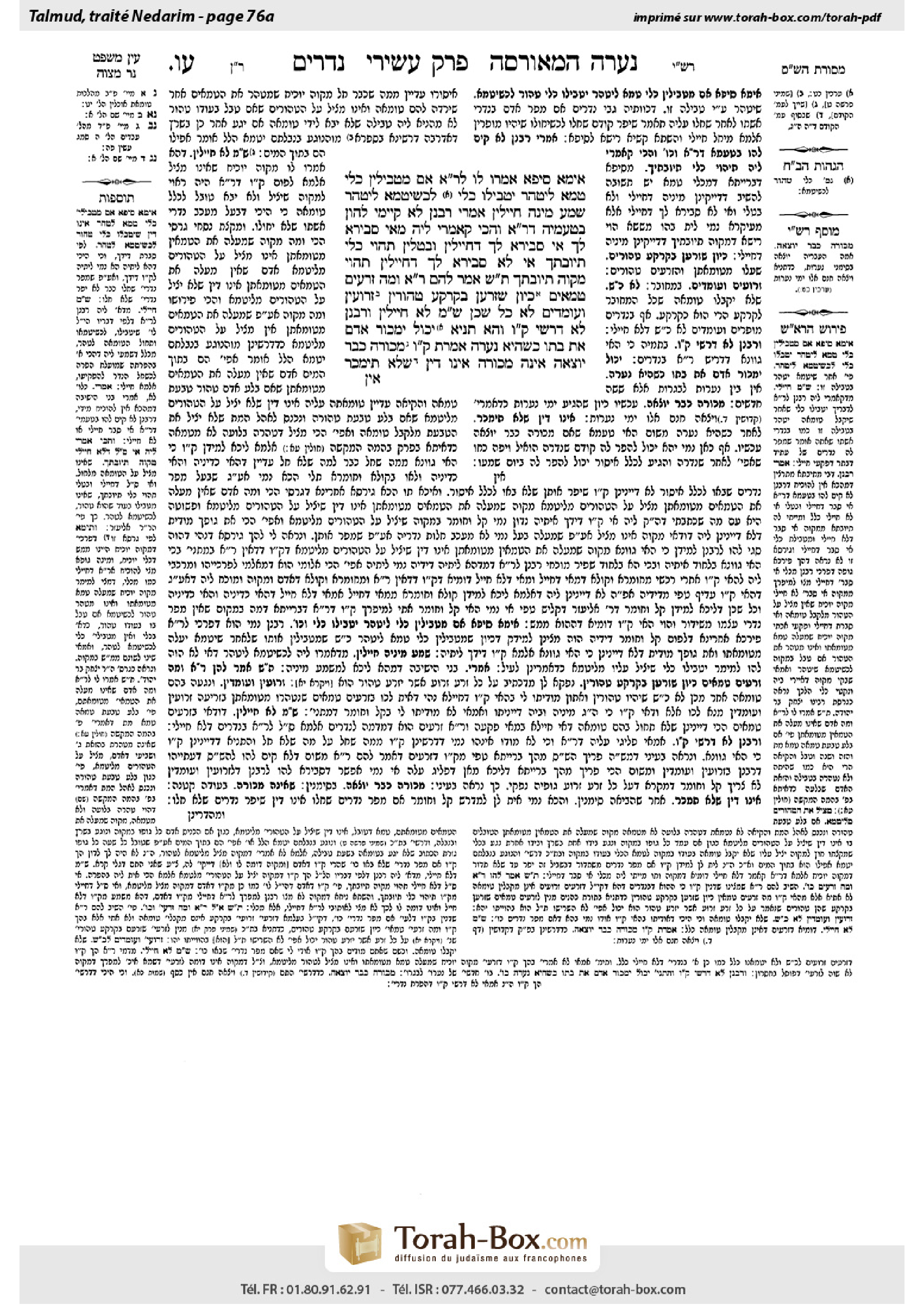
This page of Nedarim includes the Aramaic text, an English translation and an AI-generated French translation, alongside the scan above.
נדרים ע״ו א · Aramaic and Hebrew text
אֵימָא סֵיפָא, אָמְרוּ לוֹ לְרַבִּי אֱלִיעֶזֶר: אִם מַטְבִּילִין כְּלִי טָמֵא לִיטָּהֵר, יַטְבִּילוּ כְּלִי לִכְשֶׁיִּטְמָא לִיטָּהֵר? שְׁמַע מִינַּהּ חָיְילִין.
אָמְרִי: רַבָּנַן לָא קָיְימִי לְהוֹן בְּטַעְמֵיהּ דְּרַבִּי אֱלִיעֶזֶר, וְהָכִי קָאָמְרִי לֵיהּ: מַאי סְבִירָא לָךְ? אִי סְבִירָא לָךְ דְּחָיְילִין וּבָטְלִין — תִּהְוֵי כְּלִי תְּיוּבְתָּךְ, אִי לָא סְבִירָא לָךְ דְּחָיְילִין — תִּהְוֵי מִקְוֶה תְּיוּבְתָּךְ.
תָּא שְׁמַע, אָמַר לָהֶם רַבִּי אֱלִיעֶזֶר: וּמָה זְרָעִים טְמֵאִים, כֵּיוָן שֶׁזְּרָעָן בְּקַרְקַע טְהוֹרִין, זְרוּעִין וְעוֹמְדִים — לֹא כׇּל שֶׁכֵּן? שְׁמַע מִינַּהּ לָא חָיְילִין.
וְרַבָּנַן לָא דָּרְשִׁי קַל וָחוֹמֶר? וְהָא תַּנְיָא: יָכוֹל יִמְכּוֹר אָדָם אֶת בִּתּוֹ כְּשֶׁהִיא נַעֲרָה? אָמְרַתְּ קַל וָחוֹמֶר: מְכוּרָה כְּבָר — יוֹצְאָה, אֵינָהּ מְכוּרָה — אֵינוֹ דִּין שֶׁלֹּא תִּימָּכֵר?
Nedarim 76a · English translation
The Gemara rejects this conclusion and refers back to the baraita. Say the latter clause of that baraita: They said to Rabbi Eliezer: If one immerses an impure vessel to purify it, shall one immerse a vessel in advance so that when it will become impure it will then be purified? Learn from this clause of the baraita that according to Rabbi Eliezer, vows nullified preemptively take effect momentarily and are then immediately nullified. The Rabbis’ objection is that according to Rabbi Eliezer, prior immersion should purify an item that momentarily became impure.
The Gemara rejects this conclusion: One could say that the Rabbis could not determine the reasoning of Rabbi Eliezer, and this is what they said to him: What do you hold? If you hold that preemptively nullified vows take effect momentarily and are then nullified, then the example of a vessel will be your refutation, i.e., will serve to refute your opinion. If you do not hold that they take effect, but rather that they do not take effect at all, then the example of a ritual bath will be your refutation.
Come and hear: Rabbi Eliezer said to them: And just as ritually impure seeds, once one has sown them in the ground, become pure, then with regard to those which are already sown and then come into contact with impurity, should they not all the more so be pure? Similarly, vows that have been preemptively nullified should be nullified, since a husband can nullify vows after they have been taken. Learn from this baraita that according to Rabbi Eliezer preemptively nullified vows do not take effect at all, just as seeds that were already sown do not become impure at all.
The Gemara comments: And the Rabbis, do they not teach halakhot based upon an a fortiori inference of this sort? But isn’t it taught in a baraita: Can a person sell his daughter as a maidservant when she is a young woman? You can say an a fortiori inference to show that he cannot: A maidservant who was already sold goes free upon becoming a young woman; with regard to one who has not been sold, is it not logical that she cannot be sold once she already is a young woman? This baraita shows that the Rabbis do utilize similar a fortiori inferences.
Nedarim 76a · Traduction française (IA)
La Guemara rejette cette conclusion et revient à la baraïta. Citons la dernière clause de cette baraïta : Ils dirent à Rabbi Eliezer : « Si l’on immerge un récipient impur pour le purifier, immergera-t-on un récipient à l’avance afin que, lorsqu’il deviendra impur, il soit alors purifié ? » On apprend de cette clause de la baraïta que, selon Rabbi Eliezer, les vœux annulés par anticipation prennent effet momentanément, puis sont aussitôt annulés. L’objection des Sages est que, selon Rabbi Eliezer, une immersion effectuée à l’avance devrait purifier un objet devenu impur momentanément.
La Guemara rejette cette conclusion : on pourrait dire que les Sages n’avaient pas compris le raisonnement de Rabbi Eliezer, et que voici ce qu’ils lui dirent : « Quelle est ta position ? Si tu estimes que les vœux annulés par anticipation prennent effet momentanément, puis sont annulés, alors l’exemple du récipient réfutera ta position. Si tu estimes qu’ils ne prennent pas effet, mais qu’ils ne prennent pas effet du tout, alors l’exemple du bain rituel réfutera ta position. »
Viens et entends : Rabbi Eliezer leur dit : « De même que des graines rituellement impures deviennent pures une fois semées en terre, celles qui sont déjà semées et entrent ensuite en contact avec l’impureté ne devraient-elles pas, à plus forte raison, être pures ? De même, les vœux annulés par anticipation devraient être annulés, puisque le mari peut annuler les vœux après qu’ils ont été prononcés. » On apprend de cette baraïta que, selon Rabbi Eliezer, les vœux annulés par anticipation ne prennent pas effet du tout, tout comme les graines déjà semées ne deviennent pas impures du tout.
La Guemara fait remarquer : Les Sages n’enseignent-ils pas des halakhot sur la base d’un raisonnement a fortiori de ce genre ? N’est-il pas enseigné dans une baraïta : « Un homme peut-il vendre sa fille comme servante alors qu’elle est une jeune fille ? » On peut démontrer par un raisonnement a fortiori qu’il ne le peut pas : une servante déjà vendue est libérée lorsqu’elle devient une jeune fille ; quant à celle qui n’a pas été vendue, n’est-il pas logique qu’elle ne puisse pas être vendue dès lors qu’elle est déjà une jeune fille ? Cette baraïta montre que les Sages recourent bien à des raisonnements a fortiori similaires.
Traduction française générée par IA à partir de l’édition anglaise de Sefaria. Vérifie toujours un passage avec le texte source.
Text from Sefaria: William Davidson Edition - Vocalized Aramaic (CC BY NC); William Davidson Edition - English (CC BY NC).