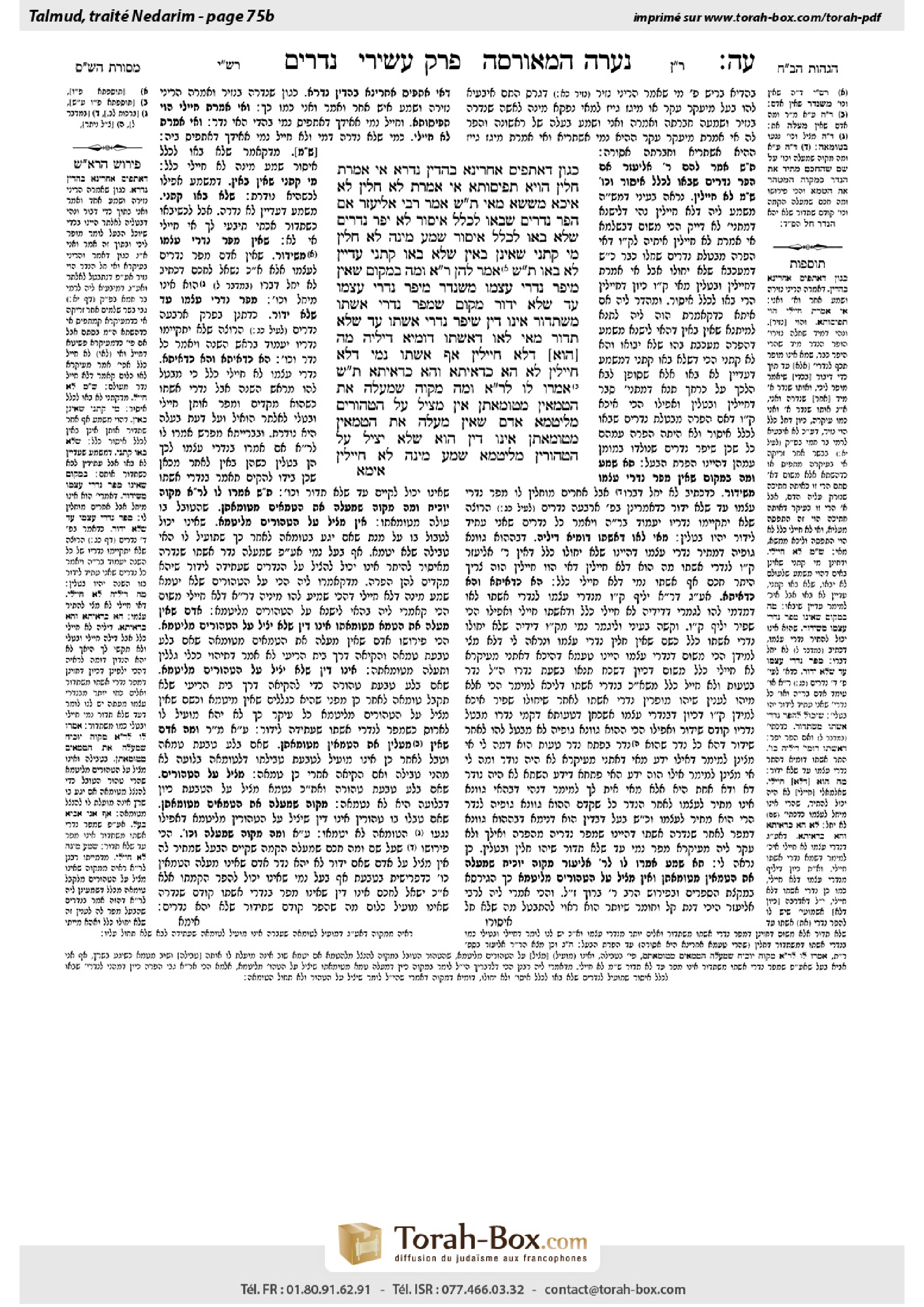
Nedarim 75b: Talmud study for Daf Yomi
Daf Yomi is the daily study of one Talmud folio. Explore 37 tractates with scans, Hebrew text, Sefaria English and AI-generated French translations where annotated.
Passage selection and English or AI-generated French translation are available where the scan has annotations. Daf Study is independent of Torah-Box and Sefaria.
Browse Nedarim · נדרים · All tractatesNedarim 75b text and translations
This page of Nedarim includes the Aramaic text, an English translation and an AI-generated French translation, alongside the scan above.
נדרים ע״ה ב · Aramaic and Hebrew text
כְּגוֹן דְּאַתְפֵּיס אַחֲרִינָא בְּהָדֵין נִדְרָא. אִי אָמְרַתְּ חָלִין — הָוְיָא תְּפִיסוּתָא. אִי אָמְרַתְּ לָא חָלִין — לָא אִיכָּא מְשָׁשָׁא.
מַאי? תָּא שְׁמַע, אָמַר רַבִּי אֱלִיעֶזֶר: אִם הֵפֵר נְדָרִים שֶׁבָּאוּ לִכְלַל אִיסּוּר, לֹא יָפֵר נְדָרִים שֶׁלֹּא בָּאוּ לִכְלַל אִיסּוּר? שְׁמַע מִינַּהּ לָא חָלִין!
מִי קָתָנֵי ״שֶׁאֵינָן בָּאִין״? ״שֶׁלֹּא בָּאוּ״ קָתָנֵי, עֲדַיִין לֹא בָּאוּ.
תָּא שְׁמַע, אָמַר לָהֶן רַבִּי אֱלִיעֶזֶר: וּמָה בִּמְקוֹם שֶׁאֵין מֵיפֵר נִדְרֵי עַצְמוֹ מִשֶּׁנָּדַר, מֵיפֵר נִדְרֵי עַצְמוֹ עַד שֶׁלֹּא יָדוּר. מְקוֹם שֶׁמֵּפֵר נִדְרֵי אִשְׁתּוֹ מִשֶּׁתִּדּוֹר, אֵינוֹ דִּין שֶׁיָּפֵר נִדְרֵי אִשְׁתּוֹ עַד שֶׁלֹּא תִּדּוֹר?
מַאי לָאו, דְּאִשְׁתּוֹ דּוּמְיָא דִּילֵיהּ, מָה [הוּא] דְּלָא חָיְילִין — אַף אִשְׁתּוֹ נָמֵי דְּלָא חָיְילִין? לָא, הָא כִּדְאִיתָא וְהָא כִּדְאִיתָא.
תָּא שְׁמַע, אָמְרוּ לוֹ לְרַבִּי אֱלִיעֶזֶר: וּמָה מִקְוֶה שֶׁמַּעֲלֶה אֶת הַטְּמֵאִין מִטּוּמְאָתָן — אֵין מַצִּיל עַל הַטְּהוֹרִים מִלִּיטָּמֵא, אָדָם שֶׁאֵין מַעֲלֶה אֶת הַטְּמֵאִין מִטּוּמְאָתָן — אֵינוֹ דִּין הוּא שֶׁלֹּא יַצִּיל עַל הַטְּהוֹרִין מִלִּיטָּמֵא?
שְׁמַע מִינַּהּ לָא חָיְילִין!
Nedarim 75b · English translation
The Gemara answers: There is a difference in a case where another person associated his own vow with this vow. If someone else heard her vow and declared his vow to be like hers, the status of his vow depends on this question. If you say that such vows take effect, then the association of the other person’s vow takes effect. If you say that such vows do not take effect at all, then the vow of the other person has no substance, as the vow with which he associated it never existed.
What, then, is Rabbi Eliezer’s opinion? Come and hear the mishna: Rabbi Eliezer said: If one can nullify vows that have reached the status of a prohibition, shall he not nullify vows that have not reached the status of a prohibition? Learn from it that such vows do not take effect at all, as they are described as not having reached the status of a prohibition.
The Gemara rejects this conclusion: Does the mishna teach using the words: That do not reach the status of a prohibition? It teaches: That have not reached the status of a prohibition, which could mean that they have not yet reached the status of a prohibition, but they may take effect, momentarily, when she actually takes the vow.
Come and hear a baraita from the Tosefta (Nedarim 6:5): Rabbi Eliezer said to them: And just as in a situation where he cannot nullify his own vows once he has vowed, he can nullify his own vows before he vows by stipulating beforehand that the vows he takes should not take effect, all the more so in a situation where he can nullify his wife’s vows even after she vows, is it not logical that he should be able to nullify his wife’s vows before she vows?
The Gemara explains the proof: What, is it not referring to where his wife’s vows are similar to his own in that just as his vows, which were nullified in advance, do not take effect at all, so too the vows of his wife do not take effect at all when nullified in advance? The Gemara rejects this: No, this case of his nullifying his own vows prior to taking them is as it is, and that case of his nullifying her vows prior to her taking them is as it is; the similarity between the two cases is sufficient for an a fortiori inference, but they are not similar in all respects.
Come and hear a baraita: They said to Rabbi Eliezer: Your a fortiori inference is flawed, as can be seen from this example: And just as with regard to a ritual bath, which elevates the impure from their ritual impurity when they immerse in it but does not save the pure from becoming impure if they come into contact with impurity after immersion, so too, with regard to a person, who does not elevate the impure from their impurity, e.g., when a person swallows a ritually impure object and then immerses in a ritual bath, the object remains impure, is it not logical that he should not save pure items from becoming impure? When one who has swallowed a ritually pure object comes into contact with impurity, the object he has swallowed should also become impure. This is not the case, as a swallowed object does not become impure when the person who swallowed it does. Therefore the a fortiori argument is flawed, and one cannot derive from the ability to change a status, like the husband’s ability to nullify his wife’s vows or the ability of the ritual bath to render something ritually pure, that the source of the change can also prevent a change of status or preserve that status.
However, learn from this baraita that, according to Rabbi Eliezer, vows nullified by the husband from the outset do not take effect at all, as the Rabbis’ objection presumes that according to Rabbi Eliezer, the vows do not take effect at all. Their argument is based on the analogy between preemptive nullification and preemptive prevention of impurity. Preemptive prevention of impurity is understood to be saving an item from ever becoming impure and analogously, preemptive nullification is understood to be preventing a vow from ever taking effect.
Nedarim 75b · Traduction française (IA)
La Guemara répond : Il y a une différence dans le cas où une autre personne a associé son propre vœu à celui-ci. Si quelqu’un a entendu son vœu et a déclaré que son propre vœu serait comme le sien, le statut de son vœu dépend de cette question. Si l’on considère que de tels vœux prennent effet, alors le vœu de l’autre personne, associé au sien, prend effet. Mais si l’on considère que de tels vœux ne prennent pas effet du tout, alors le vœu de l’autre personne est sans substance, puisque le vœu auquel il l’a associé n’a jamais existé.
Quelle est donc l’opinion de Rabbi Eliezer ? Viens et écoute la Michna : Rabbi Eliezer a dit : « Si l’on peut annuler des vœux qui ont atteint le statut d’interdiction, ne peut-on pas, à plus forte raison, annuler ceux qui ne l’ont pas atteint ? » Apprends-en que de tels vœux ne prennent pas effet du tout, puisqu’ils sont décrits comme n’ayant pas atteint le statut d’interdiction.
La Guemara rejette cette conclusion : La Michna dit-elle : « qui n’atteignent pas le statut d’interdiction » ? Elle dit : « qui n’ont pas atteint le statut d’interdiction », ce qui pourrait signifier qu’ils ne l’ont pas encore atteint, mais qu’ils peuvent prendre effet, ne serait-ce qu’un instant, au moment où elle prononce effectivement son vœu.
Viens et écoute une baraïta de la Tosefta (Nedarim 6:5) : Rabbi Eliezer leur dit : « De même que, lorsqu’il ne peut pas annuler ses propres vœux après les avoir prononcés, il peut les annuler avant de les prononcer en stipulant à l’avance que les vœux qu’il prononcera ne prendront pas effet, à plus forte raison, lorsqu’il peut annuler les vœux de sa femme même après qu’elle les a prononcés, est-il logique qu’il puisse les annuler avant qu’elle ne les prononce ? »
La Guemara explique la preuve : Ne s’agit-il pas du cas où les vœux de sa femme sont semblables aux siens, en ce que, de même que ses propres vœux, annulés à l’avance, ne prennent pas effet du tout, les vœux de sa femme, annulés à l’avance, ne prennent pas effet non plus ? La Guemara rejette cette interprétation : Non, le cas où il annule ses propres vœux avant de les prononcer est un cas en soi, et celui où il annule les vœux de sa femme avant qu’elle ne les prononce en est un autre. La similitude entre les deux cas suffit à établir une déduction a fortiori, mais ils ne sont pas semblables à tous égards.
Viens et écoute une baraïta : Ils dirent à Rabbi Eliezer : « Ta déduction a fortiori est erronée, comme le montre l’exemple suivant : De même qu’un bain rituel fait sortir les personnes impures de leur état d’impureté rituelle lorsqu’elles s’y immergent, mais ne préserve pas les personnes pures de l’impureté si elles entrent en contact avec elle après l’immersion, de même, à plus forte raison, une personne ne devrait-elle pas préserver les objets purs de l’impureté, puisque cette personne ne fait pas sortir les personnes impures de leur état d’impureté. Par exemple, lorsqu’une personne avale un objet rituellement impur puis s’immerge dans un bain rituel, l’objet reste impur. Lorsqu’une personne qui a avalé un objet rituellement pur entre en contact avec l’impureté, l’objet qu’elle a avalé devrait donc lui aussi devenir impur. Or, ce n’est pas le cas : un objet avalé ne devient pas impur lorsque la personne qui l’a avalé devient impure. La déduction a fortiori est donc erronée : on ne peut pas conclure de la capacité à modifier un statut — comme celle du mari à annuler les vœux de sa femme ou celle du bain rituel à rendre un objet rituellement pur — que la source du changement peut aussi empêcher un changement de statut ou préserver ce statut. »
Cependant, apprends de cette baraïta que, selon Rabbi Eliezer, les vœux annulés par le mari dès le départ ne prennent pas effet du tout, car l’objection des Rabbins présuppose que, selon Rabbi Eliezer, les vœux ne prennent pas effet du tout. Leur argument repose sur l’analogie entre l’annulation par avance et la prévention de l’impureté par avance. Cette prévention consiste à préserver un objet afin qu’il ne devienne jamais impur ; par analogie, l’annulation par avance consiste à empêcher un vœu de prendre effet.
Traduction française générée par IA à partir de l’édition anglaise de Sefaria. Vérifie toujours un passage avec le texte source.
Text from Sefaria: William Davidson Edition - Vocalized Aramaic (CC BY NC); William Davidson Edition - English (CC BY NC).