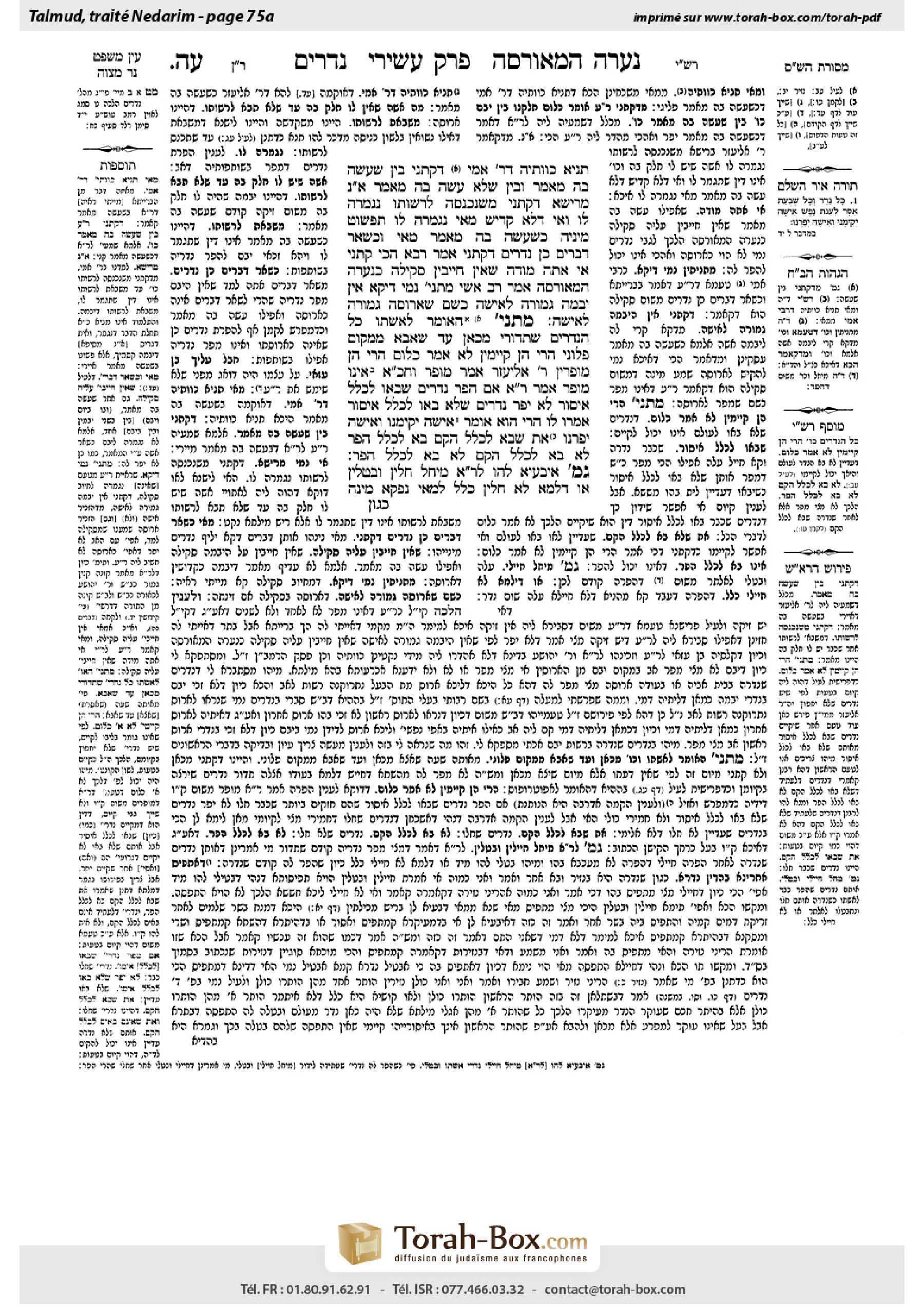
Nedarim 75a: Talmud study for Daf Yomi
Daf Yomi is the daily study of one Talmud folio. Explore 37 tractates with scans, Hebrew text, Sefaria English and AI-generated French translations where annotated.
Passage selection and English or AI-generated French translation are available where the scan has annotations. Daf Study is independent of Torah-Box and Sefaria.
Browse Nedarim · נדרים · All tractatesNedarim 75a text and translations
This page of Nedarim includes the Aramaic text, an English translation and an AI-generated French translation, alongside the scan above.
נדרים ע״ה א · Aramaic and Hebrew text
תַּנְיָא כְּווֹתֵיהּ דְּרַבִּי אַמֵּי? דְּקָתָנֵי: בֵּין שֶׁעָשָׂה בָּהּ מַאֲמָר וּבֵין שֶׁלֹּא עָשָׂה בָּהּ מַאֲמָר.
אִי נָמֵי מֵרֵישָׁא דְּקָתָנֵי: מִשֶּׁנִּכְנְסָה לִרְשׁוּתוֹ נִגְמְרָה לוֹ. וְאִי דְּלָא קַדֵּישׁ, מַאי ״נִגְמְרָה לוֹ״? תִּפְשׁוֹט מִינֵּיהּ כְּשֶׁעָשָׂה בָּהּ מַאֲמָר.
מַאי ״וְכִשְׁאָר דְּבָרִים כֵּן נְדָרִים״ דְּקָתָנֵי? אָמַר רָבָא, הָכִי קָתָנֵי: אִי אַתָּה מוֹדֶה שֶׁאֵין חַיָּיבִין סְקִילָה, כְּנַעֲרָה הַמְאוֹרָסָה?
אָמַר רַב אָשֵׁי, מַתְנִיתִין נָמֵי דַּיְקָא: אֵין יְבָמָה גְּמוּרָה לְאִישָׁהּ כְּשֵׁם שֶׁאֲרוּסָה גְּמוּרָה לְאִישָׁהּ.
מַתְנִי׳ הָאוֹמֵר לְאִשְׁתּוֹ ״כׇּל הַנְּדָרִים שֶׁתִּדּוֹרִי מִכָּאן עַד שֶׁאָבֹא מִמָּקוֹם פְּלוֹנִי הֲרֵי הֵן קַיָּימִין״ — לֹא אָמַר כְּלוּם. ״הֲרֵי הֵן מוּפָרִין״ — רַבִּי אֱלִיעֶזֶר אֹמֵר: מוּפָר, וַחֲכָמִים אוֹמְרִים: אֵינוֹ מוּפָר. אָמַר רַבִּי אֱלִיעֶזֶר: אִם הֵפֵר נְדָרִים שֶׁבָּאוּ לִכְלַל אִיסּוּר — לֹא יָפֵר נְדָרִים שֶׁלֹּא בָּאוּ לִכְלַל אִיסּוּר?!
אָמְרוּ לוֹ: הֲרֵי הוּא אוֹמֵר ״אִישָׁהּ יְקִימֶנּוּ וְאִישָׁהּ יְפֵרֶנּוּ״. אֶת שֶׁבָּא לִכְלַל הָקֵם — בָּא לִכְלַל הָפֵר, לֹא בָּא לִכְלַל הָקֵם — לֹא בָּא לִכְלַל הָפֵר.
גְּמָ׳ אִיבַּעְיָא לְהוּ: לְרַבִּי אֱלִיעֶזֶר מֵיחָל חָלִין וּבָטְלִין, אוֹ דִלְמָא לָא חָלִין כְּלָל? לְמַאי נָפְקָא מִינַּהּ,
Nedarim 75a · English translation
is it taught in the baraita in accordance with the opinion of Rabbi Ami? The Gemara explains that support for Rabbi Ami’s opinion is found in that which is taught in the baraita, as Rabbi Akiva mentions the following distinction: Whether he performed levirate betrothal or whether he did not perform levirate betrothal. This indicates that Rabbi Eliezer’s statement is referring to a yevama with whom he performed levirate betrothal.
Alternatively, support can be derived from the first clause of the baraita, which teaches: Once she enters his jurisdiction, she is fully under his authority. If the baraita is referring to a situation where he did not betroth her in levirate betrothal, in what sense is she fully under his authority? Deduce from it that the situation is one in which he has performed levirate betrothal.
The Gemara then asks with regard to the baraita itself. What is the meaning of the phrase: And just as in other matters there is no such distinction, so too with regard to vows, that Rabbi Akiva teaches in the baraita? Rava said: This is what Rabbi Akiva is teaching: Do you not concede that one is not liable to be punished with stoning for adulterous relations with a yevama as he would be if she were a betrothed young woman? The status of the relationship is inferior to proper marriage, as one who engages in sexual intercourse with a yevama does not incur the death penalty. Accordingly, the authority of the yavam with regard to vows is also inferior.
Rav Ashi said: The mishna (74a) is also precisely formulated to indicate this, as it teaches: A yevama is not her husband’s full-fledged wife in the same manner that a betrothed woman is her husband’s full-fledged wife.
MISHNA: One who says to his wife: All vows that you will vow from now until I arrive from such and such a place are hereby ratified, has not said anything, i.e., the vows are not ratified. However, if he states that all vows that she will take until then are hereby nullified, Rabbi Eliezer said: They are nullified, while the Rabbis say: They are not nullified. Rabbi Eliezer said in explanation: If one can nullify vows that have reached the status of a prohibition, i.e., that have already taken effect, shall he not be able to nullify vows that have not reached the status of a prohibition?
The Rabbis said to him in response: The verse states: “Every vow, and every binding oath to afflict the soul, her husband may ratify it, or her husband may nullify it” (Numbers 30:14). This teaches: That which has reached the status of eligibility for ratification, i.e., a vow that she has already taken, has reached the status of eligibility for nullification. However, a vow that has not reached the status of eligibility for ratification has not reached the status of eligibility for nullification either, and it cannot be nullified.
GEMARA: A dilemma was raised before the Sages: According to Rabbi Eliezer, do the vows that the husband nullifies in advance take effect momentarily and are then canceled immediately after? Or perhaps they do not take effect at all. The Gemara inquires: In what case is there a difference between these possibilities?
Nedarim 75a · Traduction française (IA)
Est-ce enseigné dans la baraïta conformément à l’opinion de Rabbi Ami ? La Guemara explique que la baraïta apporte un appui à l’opinion de Rabbi Ami, car Rabbi Akiva y établit la distinction suivante : qu’il ait procédé aux fiançailles léviratiques ou qu’il n’y ait pas procédé. Cela indique que la déclaration de Rabbi Eliezer concerne une yevama avec laquelle il a procédé aux fiançailles léviratiques.
On peut également trouver un appui dans la première partie de la baraïta, qui enseigne : « Dès qu’elle entre sous son autorité, elle est entièrement sous son autorité. » Si la baraïta traite d’une situation où il ne l’a pas fiancée par des fiançailles léviratiques, en quel sens est-elle entièrement sous son autorité ? Déduis-en qu’il s’agit d’une situation où il a procédé aux fiançailles léviratiques.
La Guemara interroge ensuite la baraïta elle-même. Que signifie la formule que Rabbi Akiva enseigne dans la baraïta : « Et de même que, dans les autres domaines, il n’existe pas une telle distinction, de même en ce qui concerne les vœux » ? Rava dit : Voici ce que Rabbi Akiva enseigne : « Ne reconnaissez-vous pas que l’on n’encourt pas la peine de lapidation pour avoir eu des relations adultères avec une yevama, comme on l’encourrait si elle était une jeune fille fiancée ? » Le statut de cette relation est inférieur à celui d’un mariage à part entière, car celui qui a des relations sexuelles avec une yevama n’encourt pas la peine de mort. Par conséquent, l’autorité du yavam en matière de vœux est elle aussi moindre.
Rav Ashi dit : La Michna (74a) est elle aussi formulée avec précision pour indiquer cela, puisqu’elle enseigne : « Une yevama n’est pas l’épouse de son mari à part entière, comme l’est une femme fiancée pour son mari. »
Michna : Celui qui dit à sa femme : « Tous les vœux que tu prononceras à partir de maintenant et jusqu’à mon retour de tel ou tel endroit sont dès à présent ratifiés », n’a rien dit, c’est-à-dire que les vœux ne sont pas ratifiés. En revanche, s’il déclare que tous les vœux qu’elle prononcera jusque-là sont dès à présent annulés, Rabbi Eliezer dit : « Ils sont annulés », tandis que les Sages disent : « Ils ne sont pas annulés. » Rabbi Eliezer explique : « Si l’on peut annuler des vœux qui ont atteint le statut d’interdiction, c’est-à-dire qui ont déjà pris effet, ne devrait-on pas pouvoir annuler des vœux qui n’ont pas encore atteint le statut d’interdiction ? »
Les Sages lui répondirent : Le verset dit : « Tout vœu et tout serment contraignant à s’imposer une souffrance, son mari peut le ratifier ou son mari peut l’annuler » (Nombres 30:14). Cela enseigne que ce qui a atteint le statut permettant la ratification, c’est-à-dire un vœu qu’elle a déjà prononcé, a également atteint le statut permettant l’annulation. En revanche, un vœu qui n’a pas atteint le statut permettant la ratification n’a pas non plus atteint le statut permettant l’annulation et ne peut donc pas être annulé.
Guemara : Les Sages posèrent la question suivante : Selon Rabbi Eliezer, les vœux que le mari annule à l’avance prennent-ils effet momentanément, puis sont-ils annulés aussitôt après ? Ou bien ne prennent-ils pas effet du tout ? La Guemara demande : Dans quel cas y a-t-il une différence entre ces deux possibilités ?
Traduction française générée par IA à partir de l’édition anglaise de Sefaria. Vérifie toujours un passage avec le texte source.
Text from Sefaria: William Davidson Edition - Vocalized Aramaic (CC BY NC); William Davidson Edition - English (CC BY NC).