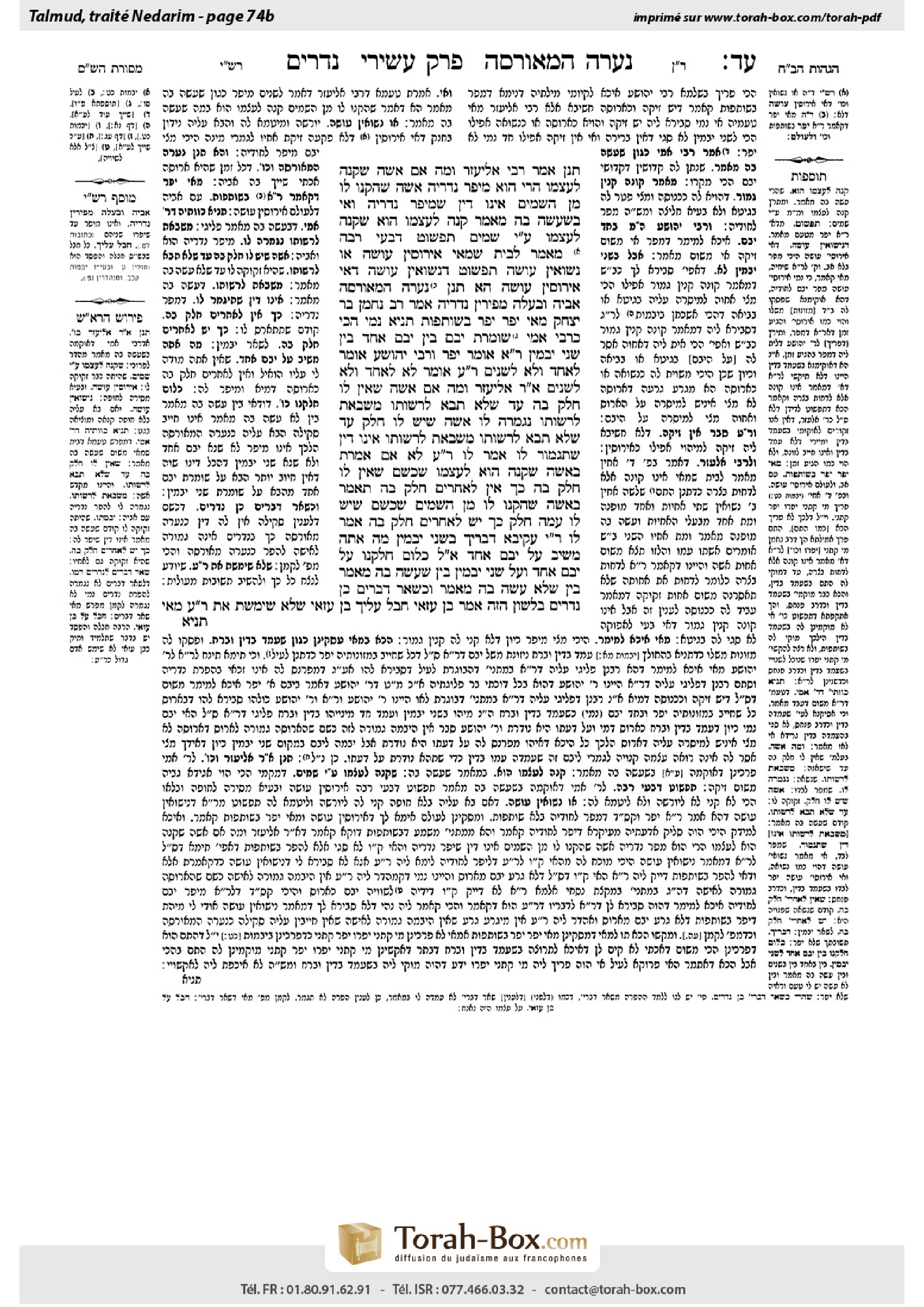
Nedarim 74b: Talmud study for Daf Yomi
Daf Yomi is the daily study of one Talmud folio. Explore 37 tractates with scans, Hebrew text, Sefaria English and AI-generated French translations where annotated.
Passage selection and English or AI-generated French translation are available where the scan has annotations. Daf Study is independent of Torah-Box and Sefaria.
Browse Nedarim · נדרים · All tractatesNedarim 74b text and translations
This page of Nedarim includes the Aramaic text, an English translation and an AI-generated French translation, alongside the scan above.
נדרים ע״ד ב · Aramaic and Hebrew text
תְּנַן אָמַר רַבִּי אֱלִיעֶזֶר: וּמָה אִם אִשָּׁה שֶׁקָּנָה לְעַצְמוֹ — הֲרֵי הוּא מֵיפֵר נְדָרֶיהָ, אִשָּׁה שֶׁהִקְנוּ לוֹ מִן הַשָּׁמַיִם — אֵינוֹ דִין שֶׁמֵּיפֵר נְדָרֶיהָ? וְאִי בְּשֶׁעָשָׂה בָּהּ מַאֲמָר, קָנָה לְעַצְמוֹ הוּא! שֶׁקָּנָה לְעַצְמוֹ עַל יְדֵי שָׁמַיִם.
תִּפְשׁוֹט דְּבָעֵי רַבָּה: מַאֲמָר לְבֵית שַׁמַּאי, אֵירוּסִין עוֹשֶׂה אוֹ נִשּׂוּאִין עוֹשֶׂה? תִּפְשׁוֹט דְּנִשּׂוּאִין עוֹשֶׂה. דְּאִי אֵירוּסִין עוֹשֶׂה — הָא תְּנַן: נַעֲרָה הַמְאוֹרָסָה, אָבִיהָ וּבַעְלָהּ מְפִירִין נְדָרֶיהָ.
אָמַר רַב נַחְמָן בַּר יִצְחָק: מַאי ״יָפֵר״ — יָפֵר בְּשׁוּתָּפוּת.
תַּנְיָא נָמֵי הָכִי כְּרַבִּי אַמֵּי: שׁוֹמֶרֶת יָבָם, בֵּין יָבָם אֶחָד בֵּין שְׁנֵי יְבָמִין, רַבִּי אֱלִיעֶזֶר אוֹמֵר: יָפֵר, וְרַבִּי יְהוֹשֻׁעַ אוֹמֵר: לְאֶחָד וְלֹא לִשְׁנַיִם. רַבִּי עֲקִיבָא אוֹמֵר: לֹא לְאֶחָד וְלֹא לִשְׁנַיִם.
אָמַר רַבִּי אֱלִיעֶזֶר: וּמָה אִם אִשָּׁה שֶׁאֵין לוֹ חֵלֶק בָּהּ עַד שֶׁלֹּא תָּבֹא לִרְשׁוּתוֹ, מִשֶּׁבָּאת לִרְשׁוּתוֹ — נִגְמְרָה לוֹ. אִשָּׁה, שֶׁיֵּשׁ לוֹ חֵלֶק עַד שֶׁלֹּא תָּבֹא לִרְשׁוּתוֹ, מִשֶּׁבָּאת לִרְשׁוּתוֹ — אֵינוֹ דִּין שֶׁתִּגְמוֹר לוֹ?
אָמַר לוֹ רַבִּי עֲקִיבָא: לֹא, אִם אָמַרְתָּ בְּאִשָּׁה שֶׁקָּנָה הוּא לְעַצְמוֹ, שֶׁכְּשֵׁם שֶׁאֵין לוֹ חֵלֶק בָּהּ, כָּךְ אֵין לַאֲחֵרִים חֵלֶק בָּהּ. תֹּאמַר בְּאִשָּׁה שֶׁהִקְנוּ לוֹ מִן הַשָּׁמַיִם, שֶׁכְּשֵׁם שֶׁיֵּשׁ לוֹ עִמָּהּ חֵלֶק — כָּךְ יֵשׁ לַאֲחֵרִים חֵלֶק בָּהּ!
אָמַר לוֹ רַבִּי יְהוֹשֻׁעַ: עֲקִיבָא, דְּבָרֶיךָ — בִּשְׁנֵי יְבָמִין, מָה אַתָּה מֵשִׁיב עַל יָבָם אֶחָד? אָמַר לוֹ: כְּלוּם חִלַּקְנוּ עַל יָבָם אֶחָד וְעַל שְׁנֵי יְבָמִין בֵּין שֶׁעָשָׂה בָּהּ מַאֲמָר בֵּין שֶׁלֹּא עָשָׂה בָּהּ מַאֲמָר? וְכִשְׁאָר דְּבָרִים כֵּן נְדָרִים.
בַּלָּשׁוֹן הַזֶּה אָמַר בֶּן עַזַּאי: חֲבָל עָלֶיךָ בֶּן עַזַּאי שֶׁלֹּא שִׁימַּשְׁתָּ אֶת רַבִּי עֲקִיבָא.
מַאי
Nedarim 74b · English translation
The Gemara raises a difficulty with Rabbi Ami’s explanation of Rabbi Eliezer’s opinion: We learned in the mishna that Rabbi Eliezer said: Just as with regard to a woman he acquired for himself through betrothal, he nullifies her vows, so too with regard to a woman acquired for him from Heaven, i.e., the yevama, isn’t it logical that he should be able to nullify her vows? Now if Rabbi Ami’s interpretation is correct, and the mishna is referring to a case where a yavam performed levirate betrothal, then it is actually a case where he acquired a woman for himself by performing levirate betrothal. The Gemara answers: Nevertheless, it is a case where he acquired for himself a woman who was imposed upon him by means of Heaven.
The Gemara raises another difficulty with Rabbi Ami’s interpretation, in that if it is correct, you can resolve the dilemma that Rabba raised: Does levirate betrothal, according to Beit Shammai, merely effect betrothal, or does it effect full-fledged marriage? According to Rabbi Eliezer, you can resolve the dilemma by proving that it effects marriage. The proof is as follows: Because if levirate betrothal effects only betrothal, why does the mishna mention only the yavam with regard to nullification of vows? Didn’t we learn in a mishna (Nedarim 66b) that with regard to a betrothed young woman, her father and her husband together nullify her vows? If levirate betrothal renders her betrothed to the yavam, the father should also be mentioned as a partner in the nullification.
Rav Naḥman bar Yitzḥak said: This does not resolve the dilemma, as what could be the meaning of nullify in the mishna? It could mean that he nullifies vows in partnership with the father.
The Gemara comments: It is also taught in a baraita that Rabbi Eliezer is addressing a case where levirate betrothal has been performed, in accordance with the opinion of Rabbi Ami: With regard to a widow awaiting her yavam, whether she is waiting for one yavam, if her late husband had only one brother, or for two or more yevamin, Rabbi Eliezer says: The yavam can nullify her vows, and Rabbi Yehoshua says: He can nullify her vows only in a case where she is waiting for one yavam, but not if she is waiting for two. Rabbi Akiva says: Nullification is not possible at all, not if she is waiting for one, and not if she is waiting for two or more.
The baraita continues: Rabbi Eliezer said to his disputants: And just as if one accepts that a man cannot nullify the vows of a woman in whom he has no share until she enters into his jurisdiction through betrothal, yet once she enters into his jurisdiction, she is fully under his authority for the nullification of her vows, so too with regard to a woman in whom he has a share before she enters his jurisdiction, i.e., his yevama, once she enters his jurisdiction, is it not logical that she be fully under his authority for the nullification of her vows?
The baraita continues: Rabbi Akiva said to him: No, your a fortiori inference is refutable. If you spoke of a man having authority over the vows of a woman he acquired for himself through betrothal, that would be different: Just as he has no share in her before betrothal, so too others have no share in her. Will you say the same with regard to a woman who is acquired for him from Heaven, i.e., his yevama, for whom, just as he has a share in her, so do others, i.e., his brothers, also have a share in her, as they also are yevamin?
The baraita continues: Rabbi Yehoshua said to him: Akiva, your statement fits a situation with two yevamin, but what do you answer for the case of one yavam? Rabbi Akiva replied to him: Did we distinguish between one yavam and two yevamin, regardless of whether he performed levirate betrothal or whether he did not perform levirate betrothal? And just as in other matters there is no such distinction, so too with regard to vows.
The baraita adds a comment: Ben Azzai stated his response to hearing this discussion in this language: Woe [ḥaval] to you, ben Azzai, that you did not serve Rabbi Akiva properly.
Since this baraita was cited in support of Rabbi Ami’s interpretation, the Gemara asks: In what way
Nedarim 74b · Traduction française (IA)
La Guemara soulève une difficulté concernant l’explication que Rabbi Ami donne de l’opinion de Rabbi Eliezer : nous avons appris dans la Michna que Rabbi Eliezer a dit : « De même qu’en ce qui concerne une femme qu’il a acquise pour lui-même par les kidouchin, il peut annuler ses vœux, de même, en ce qui concerne une femme qui lui a été attribuée par le Ciel, c’est-à-dire la yevama, n’est-il pas logique qu’il puisse annuler ses vœux ? » Or, si l’interprétation de Rabbi Ami est juste et que la Michna parle d’un cas où le yavam a accompli les kidouchin léviratiques, il s’agit en réalité d’un cas où il a acquis une femme pour lui-même en accomplissant ces kidouchin. La Guemara répond : malgré tout, il s’agit d’une femme qu’il a acquise pour lui-même, mais qui lui a été imposée par le Ciel.
La Guemara soulève une autre difficulté concernant l’interprétation de Rabbi Ami : si elle est juste, on peut alors résoudre la question soulevée par Rabba : selon Beit Chammaï, les kidouchin léviratiques produisent-ils seulement des fiançailles, ou un mariage à part entière ? Selon Rabbi Eliezer, on peut résoudre la question en démontrant qu’ils produisent un mariage. Voici la preuve : si les kidouchin léviratiques ne produisent que des fiançailles, pourquoi la Michna ne mentionne-t-elle que le yavam à propos de l’annulation des vœux ? N’avons-nous pas appris dans une Michna (Nedarim 66b) qu’en ce qui concerne une jeune fille fiancée, son père et son mari annulent ensemble ses vœux ? Si les kidouchin léviratiques la rendent fiancée au yavam, son père devrait lui aussi être mentionné comme participant à l’annulation.
Rav Naḥman bar Yitzḥak a dit : Cela ne résout pas la question, car que peut signifier « annuler » dans la Michna ? Cela peut vouloir dire qu’il annule les vœux conjointement avec le père.
La Guemara fait remarquer qu’une baraïta enseigne également que Rabbi Eliezer parle d’un cas où les kidouchin léviratiques ont été accomplis, conformément à l’opinion de Rabbi Ami : au sujet d’une veuve qui attend son yavam, qu’elle en attende un seul — si son défunt mari n’avait qu’un frère — ou deux yevamin ou davantage, Rabbi Eliezer dit : « Le yavam peut annuler ses vœux. » Rabbi Yehoshua dit : « Il ne peut annuler ses vœux que si elle attend un seul yavam, mais pas si elle en attend deux. » Rabbi Akiva dit : « L’annulation n’est pas possible du tout, qu’elle attende un seul yavam ou deux yevamin ou davantage. »
La baraïta poursuit : Rabbi Eliezer dit à ses contradicteurs : « De même que, si l’on admet qu’un homme ne peut pas annuler les vœux d’une femme sur laquelle il n’a aucun droit tant qu’elle n’est pas entrée dans son domaine par les kidouchin, dès lors qu’elle y entre, elle relève entièrement de son autorité pour l’annulation de ses vœux, de même, en ce qui concerne une femme sur laquelle il a un droit avant qu’elle n’entre dans son domaine, c’est-à-dire sa yevama, une fois qu’elle y entre, n’est-il pas logique qu’elle relève entièrement de son autorité pour l’annulation de ses vœux ? »
La baraïta poursuit : Rabbi Akiva lui dit : « Non, ton raisonnement a fortiori peut être réfuté. Ce que tu dis d’un homme qui exerce son autorité sur les vœux d’une femme qu’il a acquise pour lui-même par les kidouchin est différent : de même qu’il n’a aucun droit sur elle avant les kidouchin, les autres n’ont eux non plus aucun droit sur elle. En diras-tu autant d’une femme qui lui a été attribuée par le Ciel, c’est-à-dire sa yevama, pour laquelle, de même qu’il a un droit, d’autres — à savoir ses frères — ont également un droit, puisqu’eux aussi sont des yevamin ? »
La baraïta poursuit : Rabbi Yehoshua lui dit : « Akiva, ton argument convient à une situation où il y a deux yevamin, mais que réponds-tu au cas où il n’y en a qu’un ? » Rabbi Akiva lui répondit : « Avons-nous établi une distinction entre un yavam unique et deux yevamin, selon qu’il a accompli ou non les kidouchin léviratiques ? Et de même qu’il n’y a pas de distinction de ce genre dans les autres domaines, il n’y en a pas non plus en matière de vœux. »
La baraïta ajoute une remarque : Ben Azzai exprima ainsi sa réaction en entendant cette discussion : « Malheur [ḥaval] à toi, Ben Azzai, de ne pas avoir servi Rabbi Akiva comme il convenait. »
Puisque cette baraïta a été citée à l’appui de l’interprétation de Rabbi Ami, la Guemara demande : « En quoi »
Traduction française générée par IA à partir de l’édition anglaise de Sefaria. Vérifie toujours un passage avec le texte source.
Text from Sefaria: William Davidson Edition - Vocalized Aramaic (CC BY NC); William Davidson Edition - English (CC BY NC).