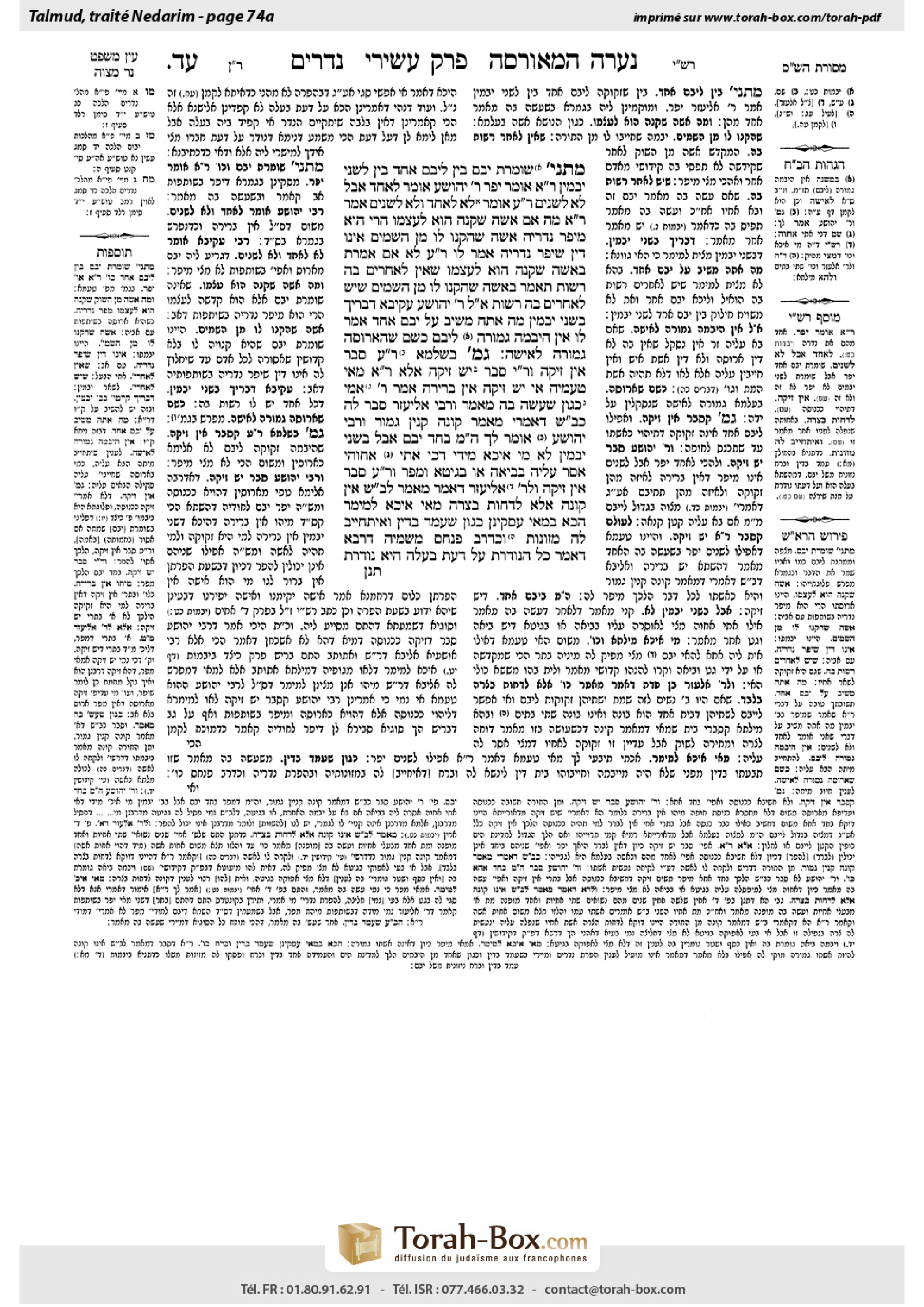
Nedarim 74a: Talmud study for Daf Yomi
Daf Yomi is the daily study of one Talmud folio. Explore 37 tractates with scans, Hebrew text, Sefaria English and AI-generated French translations where annotated.
Passage selection and English or AI-generated French translation are available where the scan has annotations. Daf Study is independent of Torah-Box and Sefaria.
Browse Nedarim · נדרים · All tractatesNedarim 74a text and translations
This page of Nedarim includes the Aramaic text, an English translation and an AI-generated French translation, alongside the scan above.
נדרים ע״ד א · Aramaic and Hebrew text
מַתְנִי׳ שׁוֹמֶרֶת יָבָם, בֵּין לְיָבָם אֶחָד, בֵּין לִשְׁנֵי יְבָמִין. רַבִּי אֱלִיעֶזֶר אוֹמֵר: יָפֵר. רַבִּי יְהוֹשֻׁעַ אוֹמֵר: לְאֶחָד, אֲבָל לֹא לִשְׁנַיִם. רַבִּי עֲקִיבָא אוֹמֵר: לֹא לְאֶחָד וְלֹא לִשְׁנַיִם.
אָמַר רַבִּי אֱלִיעֶזֶר: מָה אִם אִשָּׁה שֶׁקָּנָה הוּא לְעַצְמוֹ — הֲרֵי הוּא מֵיפֵר נְדָרֶיהָ, אִשָּׁה שֶׁהִקְנוּ לוֹ מִן הַשָּׁמַיִם — אֵינוֹ דִּין שֶׁיָּפֵר נְדָרֶיהָ?
אָמַר לוֹ רַבִּי עֲקִיבָא: לֹא, אִם אָמַרְתָּ בְּאִשָּׁה שֶׁקָּנָה הוּא לְעַצְמוֹ — שֶׁאֵין לַאֲחֵרִים בָּהּ רְשׁוּת, תֹּאמַר בְּאִשָּׁה שֶׁהִקְנוּ לוֹ מִן הַשָּׁמַיִם, שֶׁיֵּשׁ לַאֲחֵרִים בָּהּ רְשׁוּת?!
אָמַר לוֹ רַבִּי יְהוֹשֻׁעַ: עֲקִיבָא, דְּבָרֶיךָ בִּשְׁנֵי יְבָמִין, מָה אַתָּה מֵשִׁיב עַל יָבָם אֶחָד? אָמַר לוֹ: אֵין הַיְּבָמָה גְּמוּרָה לַיָּבָם כְּשֵׁם שֶׁהָאֲרוּסָה גְּמוּרָה לְאִישָׁהּ.
גְּמָ׳ בִּשְׁלָמָא רַבִּי עֲקִיבָא סָבַר אֵין זִיקָה, וְרַבִּי יְהוֹשֻׁעַ סָבַר יֵשׁ זִיקָה. אֶלָּא רַבִּי אֱלִיעֶזֶר, מַאי טַעְמֵיהּ? אִי יֵשׁ זִיקָה, אֵין בְּרֵירָה.
אָמַר רַבִּי אַמֵּי: כְּגוֹן שֶׁעָשָׂה בָּהּ מַאֲמָר. וְרַבִּי אֱלִיעֶזֶר סָבַר לַהּ כְּבֵית שַׁמַּאי, דְּאָמְרִי: מַאֲמָר קוֹנֶה קִנְיָן גָּמוּר.
וְרַבִּי יְהוֹשֻׁעַ אוֹמֵר לְךָ: הָנֵי מִילֵּי בְּחַד יָבָם, אֲבָל בִּשְׁנֵי יְבָמִין — לָא. מִי אִיכָּא מִידֵּי דְּכִי אָתֵי אֲחוּהִי אָסַר עֲלֵיהּ בְּבִיאָה, אוֹ בְּגִיטָּא וּמֵפֵר? וְרַבִּי עֲקִיבָא סָבַר: אֵין זִיקָה.
וּלְרַבִּי (אֱלִיעֶזֶר) [אֶלְעָזָר], דְּאָמַר: מַאֲמָר לְבֵית שַׁמַּאי אֵין קוֹנֶה אֶלָּא לִדְחוֹת בַּצָּרָה. מַאי אִיכָּא לְמֵימַר?
הָכָא בְּמַאי עָסְקִינַן — כְּגוֹן שֶׁעָמַד בַּדִּין, וְאִיתְחַיֵּיב לָהּ מְזוֹנוֹת, וְכִדְרַב פִּנְחָס מִשְּׁמֵיהּ דְּרָבָא: דְּאָמַר כׇּל הַנּוֹדֶרֶת — עַל דַּעַת בַּעְלָהּ הִיא נוֹדֶרֶת.
Nedarim 74a · English translation
MISHNA: With regard to a widow waiting for her yavam to perform levirate marriage, whether she is waiting for one yavam, if her late husband had only one brother, or whether she is waiting for two or more yevamin, if he had several brothers, Rabbi Eliezer says: A yavam can nullify her vows. Rabbi Yehoshua says: If she is waiting for one yavam, he can nullify her vows, but not if she is waiting for two. Rabbi Akiva says: A yavam cannot nullify her vows, regardless of whether she is waiting for one yavam or for two or more.
The mishna then elaborates: Rabbi Eliezer said: Just as with regard to a woman he acquired for himself through betrothal, he nullifies her vows, so too with regard to a woman acquired for him from Heaven, i.e., the yevama, isn’t it logical that he should be able to nullify her vows?
Rabbi Akiva said to him: No, if you say that a husband can nullify the vows of a woman he acquired for himself, over whom others have no authority, shall you also say that this is the case with regard to a woman acquired for him from Heaven, over whom others have authority? If there are two yevamin, each yavam has equal authority with regard to her vows.
Rabbi Yehoshua said to him: Akiva, your statement applies in a situation with two yevamin, but how do you reply to Rabbi Eliezer in the case of one yavam? Rabbi Akiva said to him: A yevama is not the full-fledged wife of the yavam in the way that a betrothed woman is her husband’s full-fledged wife, and the yavam is not empowered to nullify vows at all.
GEMARA: The latter two opinions in the mishna make sense: Rabbi Akiva holds that the levirate bond is not substantial. Since the obligation of levirate marriage does not create a marriage-like bond between the yavam and the yevama, a yavam cannot nullify the vows of the yevama. And Rabbi Yehoshua holds that the levirate bond is substantial, so that if there is only one yavam, the yevama is considered his wife, allowing him to nullify her vows. However, with regard to Rabbi Eliezer, what is his reason? Even if he holds that the levirate bond is substantial, there is, nevertheless, no retroactive designation. Since it has not yet been established which of them will be her husband, how can either of them nullify her vows?
Rav Ami said: It is a case where one yavam has already performed levirate betrothal with her. According to Beit Hillel, levirate betrothal does not have the full force of a regular betrothal, but Rabbi Eliezer holds like Beit Shammai, who say: Levirate betrothal effects a full-fledged acquisition just like a regular betrothal.
But Rabbi Yehoshua would say to you, Rabbi Eliezer, in response: That statement, that levirate betrothal effects a full-fledged acquisition, applies only to a case with one yavam, but with two yevamin it is not so. The Gemara explains why it cannot be a full-fledged acquisition where there is more than one yavam: Is there anything like this sort of betrothal that when his brother comes, he can render the betrothed woman forbidden to the one who performed levirate betrothal by engaging in sexual intercourse with the yevama, thereby performing levirate marriage, or by giving her a bill of divorce, thereby disqualifying her from levirate marriage, and nevertheless the betrothed can still nullify her vows? Since this betrothal can in essence be nullified, it cannot be viewed as betrothal with regard to nullification of vows. Rabbi Ami completes his analysis: And Rabbi Akiva holds that the levirate bond is not substantial at all, and there is no marital bond between a yevama and her yavam until the levirate marriage is consummated.
The Gemara challenges Rabbi Ami’s interpretation of the dispute: And according to the amora Rabbi Elazar, who said that levirate betrothal, according to Beit Shammai, does not effect a full-fledged acquisition except in that it removes a rival wife from being considered substantially bound to the yavam while she is a yevama, what can be said? Only the relatives of the betrothed yevama are then forbidden to the yavam.
The Gemara answers: Here we are dealing with a case where the yavam stood in court in judgment after the woman demanded that he marry her and he was obligated by the court to provide her sustenance. And this is in accordance with that which Rav Pineḥas stated in the name of Rava, who said: Any woman who vows, that which she vows is contingent upon her husband’s consent. Since under these circumstances the yavam must provide for the yevama he betrothed, he is authorized to nullify her vows.
Nedarim 74a · Traduction française (IA)
MICHNA : Au sujet d’une veuve qui attend que son yavam contracte avec elle un mariage léviratique, qu’elle attende un seul yavam — si son défunt mari n’avait qu’un frère — ou deux yevamin ou davantage — s’il avait plusieurs frères —, Rabbi Eliezer dit : Un yavam peut annuler ses vœux. Rabbi Yehoshua dit : S’il n’y a qu’un seul yavam, il peut annuler ses vœux, mais pas s’il y en a deux. Rabbi Akiva dit : Un yavam ne peut pas annuler ses vœux, qu’elle attende un seul yavam ou deux ou davantage.
La Michna développe ensuite : Rabbi Eliezer dit : De même qu’un homme annule les vœux d’une femme qu’il a acquise pour lui-même par les kiddouchin, de même, pour une femme qui lui a été attribuée par le Ciel, c’est-à-dire la yevama, n’est-il pas logique qu’il puisse annuler ses vœux ?
Rabbi Akiva lui dit : Non. Si tu dis qu’un mari peut annuler les vœux d’une femme qu’il a acquise pour lui-même, sur laquelle nul autre n’a d’autorité, diras-tu aussi qu’il en va de même pour une femme qui lui a été attribuée par le Ciel, sur laquelle d’autres ont autorité ? S’il y a deux yevamin, chacun a la même autorité sur ses vœux.
Rabbi Yehoshua lui dit : Akiva, ton argument vaut lorsqu’il y a deux yevamin, mais que réponds-tu à Rabbi Eliezer dans le cas d’un seul yavam ? Rabbi Akiva lui dit : Une yevama n’est pas l’épouse à part entière du yavam, contrairement à une femme fiancée, qui est l’épouse à part entière de son mari ; le yavam n’est pas habilité à annuler les vœux.
GUEMARA : Les deux dernières opinions de la Michna se comprennent : Rabbi Akiva considère que le lien léviratique n’a pas de consistance. Puisque l’obligation du mariage léviratique ne crée pas entre le yavam et la yevama un lien comparable au mariage, le yavam ne peut pas annuler les vœux de la yevama. Rabbi Yehoshua, lui, considère que le lien léviratique a de la consistance ; s’il n’y a qu’un seul yavam, la yevama est donc considérée comme son épouse, ce qui lui permet d’annuler ses vœux. Mais quelle est la raison de Rabbi Eliezer ? Même s’il considère que le lien léviratique a de la consistance, il n’y a pourtant pas de désignation rétroactive. Puisqu’on n’a pas encore déterminé lequel d’entre eux sera son mari, comment l’un ou l’autre peut-il annuler ses vœux ?
Rav Ami dit : Il s’agit d’un cas où un yavam a déjà contracté avec elle des kiddouchin léviratiques. Selon Beit Hillel, les kiddouchin léviratiques n’ont pas toute la force de kiddouchin ordinaires, mais Rabbi Eliezer suit Beit Shammaï, qui dit que les kiddouchin léviratiques réalisent une acquisition à part entière, comme des kiddouchin ordinaires.
Mais Rabbi Yehoshua répondrait à Rabbi Eliezer : Cette affirmation, selon laquelle les kiddouchin léviratiques réalisent une acquisition à part entière, ne vaut que lorsqu’il y a un seul yavam ; lorsqu’il y en a deux, il n’en va pas ainsi. La Guemara explique pourquoi il ne peut s’agir d’une acquisition à part entière lorsqu’il y a plusieurs yevamin : existe-t-il des kiddouchin de ce genre, tels que, lorsque son frère survient, celui-ci peut rendre la femme fiancée interdite à l’homme qui a contracté avec elle des kiddouchin léviratiques, soit en ayant des rapports sexuels avec la yevama et en accomplissant ainsi le mariage léviratique, soit en lui donnant un acte de divorce, ce qui la rend inapte au mariage léviratique, et pourtant l’homme qui l’a fiancée peut encore annuler ses vœux ? Puisque ces kiddouchin peuvent, en substance, être remis en cause, ils ne peuvent être considérés comme des kiddouchin aux fins de l’annulation des vœux. Rav Ami achève son analyse : Rabbi Akiva considère que le lien léviratique n’a absolument aucune consistance et qu’aucun lien conjugal n’unit une yevama à son yavam avant que le mariage léviratique ne soit consommé.
La Guemara conteste l’interprétation du désaccord proposée par Rav Ami : Et selon l’amora Rabbi Elazar, qui a dit que, selon Beit Shammaï, les kiddouchin léviratiques ne réalisent pas une acquisition à part entière, si ce n’est en ce qu’ils soustraient une épouse rivale au statut de femme substantiellement liée au yavam tant qu’elle est une yevama, que peut-on dire ? Seuls les proches de la yevama fiancée sont alors interdits au yavam.
La Guemara répond : Il s’agit ici d’un cas où le yavam a comparu devant le tribunal, après que la femme lui a demandé de l’épouser, et où le tribunal l’a obligé à pourvoir à sa subsistance. Cela correspond à ce que Rav Pineḥas a déclaré au nom de Rava : Tout vœu prononcé par une femme est subordonné à l’assentiment de son mari. Dans ces circonstances, puisque le yavam doit subvenir aux besoins de la yevama avec laquelle il a contracté des kiddouchin, il est habilité à annuler ses vœux.
Traduction française générée par IA à partir de l’édition anglaise de Sefaria. Vérifie toujours un passage avec le texte source.
Text from Sefaria: William Davidson Edition - Vocalized Aramaic (CC BY NC); William Davidson Edition - English (CC BY NC).