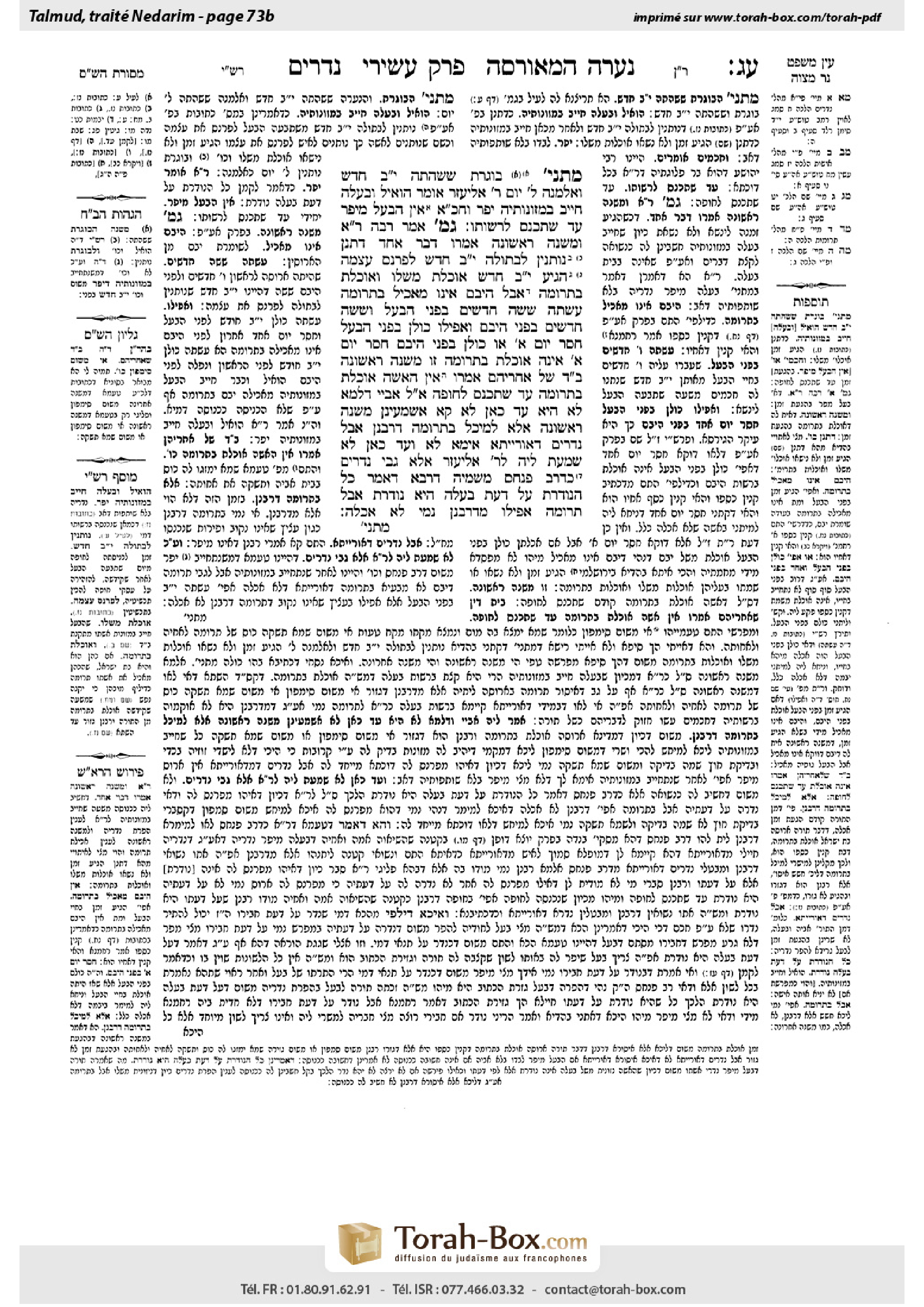
Nedarim 73b: Talmud study for Daf Yomi
Daf Yomi is the daily study of one Talmud folio. Explore 37 tractates with scans, Hebrew text, Sefaria English and AI-generated French translations where annotated.
Passage selection and English or AI-generated French translation are available where the scan has annotations. Daf Study is independent of Torah-Box and Sefaria.
Browse Nedarim · נדרים · All tractatesNedarim 73b text and translations
This page of Nedarim includes the Aramaic text, an English translation and an AI-generated French translation, alongside the scan above.
נדרים ע״ג ב · Aramaic and Hebrew text
מַתְנִי׳ בּוֹגֶרֶת שֶׁשָּׁהֲתָה שְׁנֵים עָשָׂר חֹדֶשׁ, וְאַלְמָנָה שְׁלֹשִׁים יוֹם, רַבִּי אֱלִיעֶזֶר אוֹמֵר: הוֹאִיל וּבַעְלָהּ חַיָּיב בִּמְזוֹנוֹתֶיהָ — יָפֵר. וַחֲכָמִים אוֹמְרִים: אֵין הַבַּעַל מֵיפֵר עַד שֶׁתִּכָּנֵס לִרְשׁוּתוֹ.
גְּמָ׳ אָמַר רַבָּה: רַבִּי אֱלִיעֶזֶר וּמִשְׁנָה רִאשׁוֹנָה אָמְרוּ דָּבָר אֶחָד. דִּתְנַן: נוֹתְנִין לַבְּתוּלָה שְׁנֵים עָשָׂר חֹדֶשׁ לְפַרְנֵס עַצְמָהּ. הִגִּיעַ שְׁנֵים עָשָׂר חֹדֶשׁ — אוֹכֶלֶת מִשֶּׁלּוֹ, וְאוֹכֶלֶת בִּתְרוּמָה. אֲבָל הַיָּבָם אֵינוֹ מַאֲכִיל בִּתְרוּמָה.
עָשְׂתָה שִׁשָּׁה חֳדָשִׁים בִּפְנֵי הַבַּעַל, וְשִׁשָּׁה חֳדָשִׁים בִּפְנֵי הַיָּבָם, וַאֲפִילּוּ כּוּלָּן בִּפְנֵי הַבַּעַל חָסֵר יוֹם אֶחָד, אוֹ כּוּלָּן בִּפְנֵי הַיָּבָם חָסֵר יוֹם אֶחָד — אֵינָהּ אוֹכֶלֶת בִּתְרוּמָה. זוֹ מִשְׁנָה רִאשׁוֹנָה. בֵּית דִּין שֶׁל אַחֲרֵיהֶם אָמְרוּ: אֵין הָאִשָּׁה אוֹכֶלֶת בִּתְרוּמָה עַד שֶׁתִּכָּנֵס לַחוּפָּה.
אֲמַר לֵיהּ אַבָּיֵי, דִּלְמָא לָא הִיא: עַד כָּאן לָא קָא אַשְׁמְעִינַן מִשְׁנָה רִאשׁוֹנָה אֶלָּא לְמֵיכַל בִּתְרוּמָה דְּרַבָּנַן. אֲבָל נְדָרִים דְּאוֹרָיְיתָא — אֵימָא לָא.
וְעַד כָּאן לָא שָׁמְעַתְּ לֵיהּ לְרַבִּי אֱלִיעֶזֶר אֶלָּא גַּבֵּי נְדָרִים, כִּדְרַב פִּנְחָס מִשְּׁמֵיהּ דְּרָבָא דְּאָמַר כׇּל הַנּוֹדֶרֶת עַל דַּעַת בַּעְלָהּ הִיא נוֹדֶרֶת. אֲבָל תְּרוּמָה — אֲפִילּוּ מִדְּרַבָּנַן נָמֵי לָא אָכְלָה.
Nedarim 73b · English translation
MISHNA: With regard to a grown woman who waited twelve months after her betrothal and the time arrived for her betrothed to marry her, or a widow who waited thirty days and the time arrived for her betrothed to marry her, Rabbi Eliezer says: Since her husband is already obligated to provide for her sustenance, as he is obligated to have married her by then, he can nullify her vows by himself, as if he were fully married to her. But the Rabbis say: The husband does not nullify her vows on his own until she enters his jurisdiction.
GEMARA: Rabba says: Rabbi Eliezer and the initial version of the mishna said the same thing, as we learned in a mishna (Ketubot 57a): A virgin is given twelve months from the time of her betrothal to prepare herself, i.e., to prepare her trousseau. If the end of the twelve-month period arrived, even if he has not married her, she partakes of his food, i.e., he is obligated to provide for her. And if she was betrothed to a priest, she partakes of teruma like a priest’s wife. However, a man, i.e., a priest, whose married brother died childless [yavam], does not enable the woman awaiting levirate marriage to him to partake of teruma until they are actually married.
If the woman completed six months of awaiting marriage under the aegis of the husband, and he died, and then she completed six months under the aegis of the yavam; or even if she completed all of those months under the aegis of the husband, less one day; or all of them under the aegis of the yavam less one day, she may not partake of teruma. This is the initial version of the mishna. However, a court that convened after them, in a later generation, said: The woman may not partake of teruma until she enters the marriage canopy, thereby finalizing the marriage. Rabbi Eliezer’s opinion that her husband can nullify her vows after the completion of the period allotted after the betrothal follows the initial version, which requires the husband to support her from that point forward.
Abaye said to him: Perhaps it is not so. The initial version of the mishna teaches us only about the permissibility of her partaking of teruma whose status is by rabbinic law, but with regard to vows, whose prohibitions have the force of Torah law, say that her betrothed cannot nullify them.
And perhaps you did not hear Rabbi Eliezer state his opinion that a betrothed woman is regarded as married only with regard to vows. Perhaps Rabbi Eliezer holds like that which Rav Pineḥas said in the name of Rava, who said: Any woman who takes a vow, takes a vow contingent upon the consent of her husband, since he provides her sustenance. Perhaps Rabbi Eliezer grants her betrothed authority over her vows only because she vows with his consent in mind, since he is now obligated to provide for her. But with regard to teruma, Rabbi Eliezer might hold that even if it is teruma by rabbinic law, she may not partake of it.
Nedarim 73b · Traduction française (IA)
MICHNA : À propos d’une femme adulte qui a attendu douze mois après ses fiançailles, lorsque vient le moment où son fiancé doit l’épouser, ou d’une veuve qui a attendu trente jours, lorsque vient le moment où son fiancé doit l’épouser, Rabbi Eliezer dit : Puisque son mari est déjà tenu de subvenir à ses besoins, car il aurait dû l’épouser à ce moment-là, il peut annuler ses vœux seul, comme s’il était pleinement marié avec elle. Mais les Sages disent : Le mari ne peut pas annuler ses vœux seul tant qu’elle n’est pas entrée sous son autorité.
GUEMARA : Rabba dit : Rabbi Eliezer et la première version de la Michna expriment la même opinion, comme nous l’avons appris dans une Michna (Ketoubot 57a) : Une vierge dispose de douze mois à compter de ses fiançailles pour se préparer, c’est-à-dire pour préparer son trousseau. Si les douze mois sont écoulés, même s’il ne l’a pas épousée, elle bénéficie de sa nourriture, c’est-à-dire qu’il est tenu de subvenir à ses besoins. Et si elle était fiancée à un prêtre, elle bénéficie de la terouma comme l’épouse d’un prêtre. Cependant, un homme, c’est-à-dire un prêtre, dont le frère marié est mort sans enfant [yavam] ne permet pas à la femme qui attend de l’épouser selon le lévirat de bénéficier de la terouma tant qu’ils ne sont pas effectivement mariés.
Si la femme a accompli six mois d’attente du mariage sous la responsabilité de son mari, et que celui-ci est mort, puis qu’elle a accompli six mois sous la responsabilité du yavam ; ou même si elle a accompli tous ces mois sous la responsabilité de son mari, à un jour près ; ou tous ces mois sous la responsabilité du yavam, à un jour près, elle ne peut pas bénéficier de la terouma. Telle est la première version de la Michna. Cependant, un tribunal réuni après eux, à une génération ultérieure, a dit : La femme ne peut pas bénéficier de la terouma tant qu’elle n’est pas entrée sous la houppa, finalisant ainsi le mariage. L’avis de Rabbi Eliezer, selon lequel son mari peut annuler ses vœux à l’issue de la période accordée après les fiançailles, suit la première version, qui exige du mari qu’il subvienne à ses besoins à partir de ce moment.
Abayé lui dit : Peut-être n’en est-il pas ainsi. La première version de la Michna nous enseigne seulement qu’il est permis de bénéficier de la terouma dont le statut relève du droit rabbinique ; mais, en ce qui concerne les vœux, dont les interdits ont force de loi de la Torah, disons que son fiancé ne peut pas les annuler.
Et peut-être n’as-tu pas entendu Rabbi Eliezer exprimer son avis selon lequel une femme fiancée est considérée comme mariée uniquement en ce qui concerne les vœux. Peut-être Rabbi Eliezer suit-il ce que Rav Pinéḥas a dit au nom de Rava : Toute femme qui fait un vœu le fait sous réserve du consentement de son mari, puisqu’il subvient à ses besoins. Peut-être Rabbi Eliezer n’accorde-t-il à son fiancé autorité sur ses vœux que parce qu’elle fait ses vœux en tenant compte de son consentement, puisqu’il est désormais tenu de subvenir à ses besoins. Mais, en ce qui concerne la terouma, Rabbi Eliezer pourrait soutenir que, même s’il s’agit de terouma relevant du droit rabbinique, elle ne peut pas en bénéficier.
Traduction française générée par IA à partir de l’édition anglaise de Sefaria. Vérifie toujours un passage avec le texte source.
Text from Sefaria: William Davidson Edition - Vocalized Aramaic (CC BY NC); William Davidson Edition - English (CC BY NC).