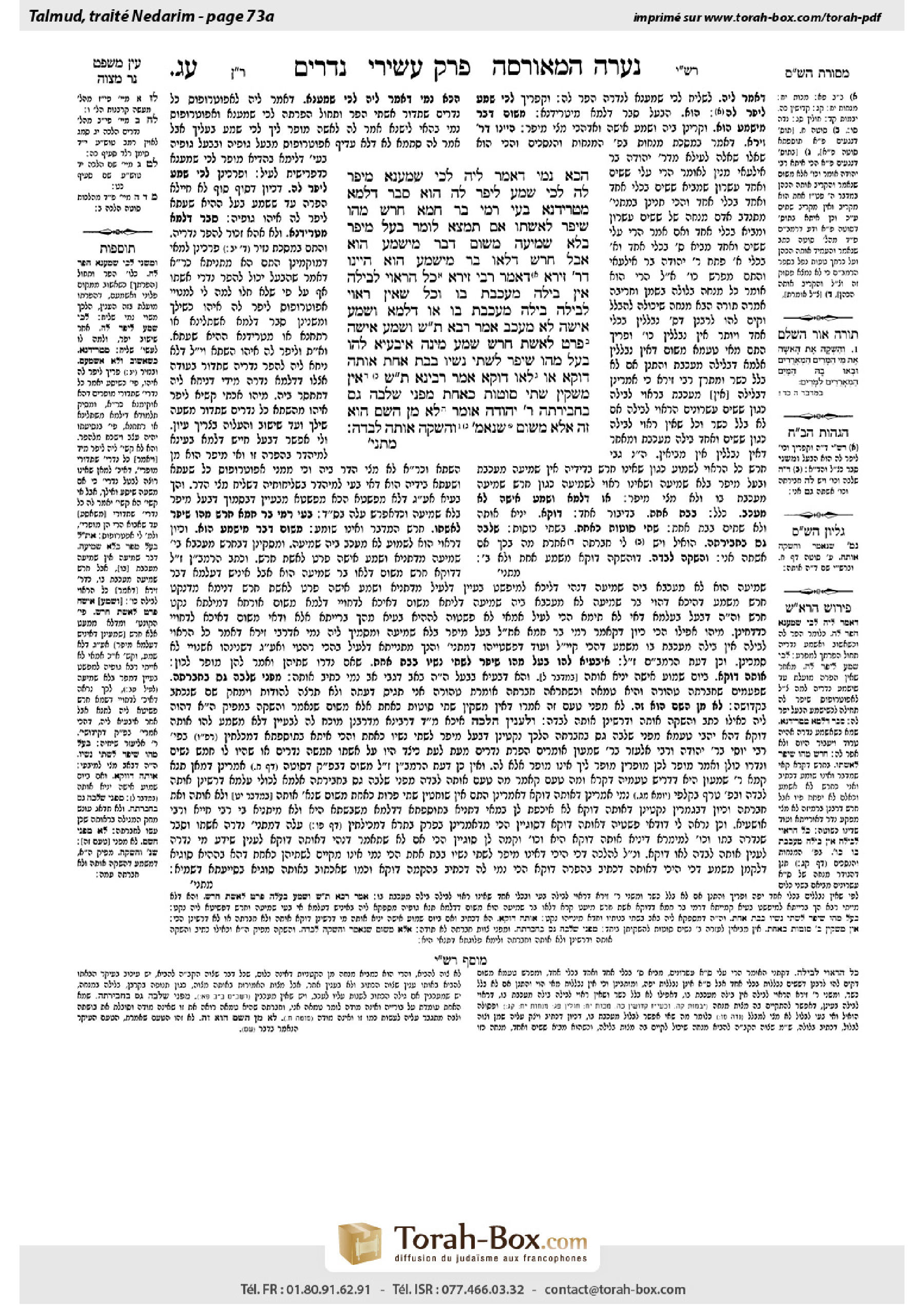
Nedarim 73a: Talmud study for Daf Yomi
Daf Yomi is the daily study of one Talmud folio. Explore 37 tractates with scans, Hebrew text, Sefaria English and AI-generated French translations where annotated.
Passage selection and English or AI-generated French translation are available where the scan has annotations. Daf Study is independent of Torah-Box and Sefaria.
Browse Nedarim · נדרים · All tractatesNedarim 73a text and translations
This page of Nedarim includes the Aramaic text, an English translation and an AI-generated French translation, alongside the scan above.
נדרים ע״ג א · Aramaic and Hebrew text
הָכָא נָמֵי, דְּאָמַר לֵיהּ: לְכִי שָׁמַעְנָא מֵיפַר לַהּ. לְכִי שָׁמַע לֵיפַר לַהּ? הוּא סָבַר: דִּלְמָא מִטְּרִידְנָא.
בָּעֵי רָמֵי בַּר חָמָא: חֵרֵשׁ, מַהוּ שֶׁיָּפֵר לְאִשְׁתּוֹ? אִם תִּמְצָא לוֹמַר בַּעַל מֵיפֵר בְּלֹא שְׁמִיעָה — מִשּׁוּם דְּבַר מִישְׁמַע הוּא, אֲבָל חֵרֵשׁ דְּלָאו בַּר מִישְׁמַע הוּא, הַיְינוּ דְּרַבִּי זֵירָא.
דְּאָמַר רַבִּי זֵירָא: כׇּל הָרָאוּי לְבִילָּה — אֵין בִּילָּה מְעַכֶּבֶת בּוֹ, וְכֹל שֶׁאֵין רָאוּי לְבִילָּה — בִּילָּה מְעַכֶּבֶת בּוֹ.
אוֹ דִלְמָא: ״וְשָׁמַע אִישָׁהּ״ לָא מְעַכֵּב. אָמַר רָבָא: תָּא שְׁמַע ״וְשָׁמַע אִישָׁהּ״ — פְּרָט לְאֵשֶׁת חֵרֵשׁ. שְׁמַע מִינַּהּ.
אִיבַּעְיָא לְהוּ: בַּעַל, מַהוּ שֶׁיָּפֵר לִשְׁתֵּי נָשָׁיו בְּבַת אַחַת? ״אוֹתָהּ״ דַּוְקָא, אוֹ לָאו דַּוְקָא?
אָמַר רָבִינָא, תָּא שְׁמַע: אֵין מַשְׁקִין שְׁתֵּי סוֹטוֹת כְּאַחַת, מִפְּנֵי שֶׁלִּבָּהּ גַּס בַּחֲבֶירְתָּהּ.
רַבִּי יְהוּדָה אוֹמֵר: לֹא מִן הַשֵּׁם הוּא זֶה, אֶלָּא מִשּׁוּם שֶׁנֶּאֱמַר ״וְהִשְׁקָהּ״ — אוֹתָהּ, לְבַדָּהּ.
Nedarim 73a · English translation
The Gemara rejects this conclusion as well: Here too, it is a case in which the husband says to the steward: When I hear the vow, then it will be nullified for her. The Gemara asks: Let him nullify the vows for her when he actually hears them. Why do so earlier? The Gemara answers: He reasons: Perhaps I will be preoccupied at that moment and will forget to nullify them. The question pertaining to nullification of vows without hearing them is left unresolved.
§ Rami bar Ḥama asks: With regard to a deaf man, what is the halakha with regard to his nullifying vows for his wife? If you say that a husband who is not deaf can nullify a vow without hearing it, then perhaps this is because he is capable of hearing. But with regard to a deaf man, who is not capable of hearing, perhaps this is an application of the principle derived from the statement of Rabbi Zeira.
As Rabbi Zeira said: For any amount of flour suitable for mingling with oil in a meal-offering, mingling is not indispensable for it. Even though it is a mitzva to mingle the flour and oil ab initio, if they were not mingled, the meal-offering is still valid. But for any amount of flour not suitable for mingling, mingling is indispensable for it, and such a meal-offering is invalid. The principle is: Ab initio requirements prevent the fulfillment of a mitzva in situations where they are not merely absent but impossible. In this case, the deaf man does not merely not hear the vow, it is impossible for him to do so.
Or perhaps the phrase “and her husband hears it” (Numbers 30:8) does not mean that hearing is indispensable to the nullification of a vow, so that even a deaf man can nullify his wife’s vows. Rava said: Come and hear a baraita interpreting that verse: “And her husband hears it”; this excludes the wife of a deaf man. The Gemara concludes: Learn from this baraita that a deaf man cannot nullify his wife’s vows.
§ A dilemma was raised before the Sages: Concerning a husband, what is the halakha with regard to nullifying vows for his two wives simultaneously? Do the words “but if her husband disallows her on the day that he hears it, and he nullifies her vow which is upon her” (Numbers 30:9), stated in the singular, refer specifically to one wife? Or, perhaps it does not refer specifically to one wife, and a husband can nullify the vows of more than one wife simultaneously.
Ravina said: Come and hear a baraita: In the sota ritual, performed by women suspected by their husbands of having committed adultery, two sota women are not given to drink the bitter waters as one. This is because the heart of each becomes emboldened [gas] in the presence of the other woman, and if one is guilty she will lack the humility to confess.
Rabbi Yehuda says: This is not for that reason [lo min hashem hu zeh], but because it is stated: “And he shall make her drink” (Numbers 5:27), which indicates her by herself. Similarly, the words “disallows her” (Numbers 30:9) should be read as referring specifically to a single woman, indicating that a man cannot nullify the vows of two wives simultaneously.
Nedarim 73a · Traduction française (IA)
La Guemara rejette également cette conclusion : ici aussi, il s’agit d’un cas où le mari dit à l’intendant : « Quand j’entendrai le vœu, alors il sera annulé pour elle. » La Guemara demande : Qu’il annule ses vœux pour elle au moment où il les entend effectivement. Pourquoi le faire plus tôt ? La Guemara répond : Il se dit : « Peut-être serai-je occupé à ce moment-là et oublierai-je de les annuler. » La question de savoir si l’on peut annuler des vœux sans les avoir entendus reste sans réponse.
§ Rami bar Ḥama demande : Quelle est la halakha concernant la possibilité, pour un homme sourd, d’annuler les vœux de sa femme ? Si l’on dit qu’un mari qui n’est pas sourd peut annuler un vœu sans l’avoir entendu, c’est peut-être parce qu’il est capable d’entendre. Mais s’agissant d’un homme sourd, qui est incapable d’entendre, peut-être le principe énoncé par Rabbi Zeira s’applique-t-il.
Car Rabbi Zeira a dit : Pour toute quantité de farine qui peut être mélangée à l’huile dans une offrande végétale, le mélange n’est pas indispensable. Bien qu’il soit une mitsva de mélanger la farine et l’huile a priori, si elles n’ont pas été mélangées, l’offrande végétale reste valide. En revanche, pour toute quantité de farine qui ne peut pas être mélangée, le mélange est indispensable et l’offrande végétale est invalide. Le principe est le suivant : les exigences a priori empêchent l’accomplissement d’une mitsva lorsque leur absence ne résulte pas d’une simple omission, mais tient à leur impossibilité. Dans le cas présent, l’homme sourd ne se contente pas de ne pas entendre le vœu : il lui est impossible de l’entendre.
Ou peut-être l’expression « et son mari l’entend » (Nombres 30:8) ne signifie-t-elle pas que l’audition est indispensable à l’annulation d’un vœu, de sorte qu’un homme sourd peut lui aussi annuler les vœux de sa femme. Rava dit : Viens et entends une baraïta qui interprète ce verset : « Et son mari l’entend » ; cela exclut l’épouse d’un homme sourd. La Guemara conclut : Déduis de cette baraïta qu’un homme sourd ne peut pas annuler les vœux de sa femme.
§ Une question fut posée aux Sages : quelle est la halakha concernant la possibilité, pour un mari, d’annuler simultanément les vœux de ses deux femmes ? Les mots « mais si son mari s’oppose à elle le jour où il l’entend, et annule le vœu qu’elle a contracté » (Nombres 30:9), énoncés au singulier, se rapportent-ils spécifiquement à une seule femme ? Ou bien ne se rapportent-ils pas spécifiquement à une seule femme, de sorte qu’un mari peut annuler simultanément les vœux de plusieurs femmes ?
Ravina dit : Viens et entends une baraïta : dans le rituel de la sota, pratiqué pour les femmes que leurs maris soupçonnent d’avoir commis l’adultère, on ne fait pas boire simultanément les eaux amères à deux femmes sota. C’est parce que le cœur de chacune prend de l’assurance [gas] en présence de l’autre femme et que, si l’une est coupable, elle manquera d’humilité pour avouer.
Rabbi Yehuda dit : Ce n’est pas pour cette raison [lo min hashem hu zeh], mais parce qu’il est dit : « Et il la fera boire » (Nombres 5:27), ce qui indique qu’elle doit boire seule. De même, les mots « s’oppose à elle » (Nombres 30:9) doivent se lire comme se rapportant spécifiquement à une seule femme, ce qui indique qu’un homme ne peut pas annuler simultanément les vœux de deux femmes.
Traduction française générée par IA à partir de l’édition anglaise de Sefaria. Vérifie toujours un passage avec le texte source.
Text from Sefaria: William Davidson Edition - Vocalized Aramaic (CC BY NC); William Davidson Edition - English (CC BY NC).