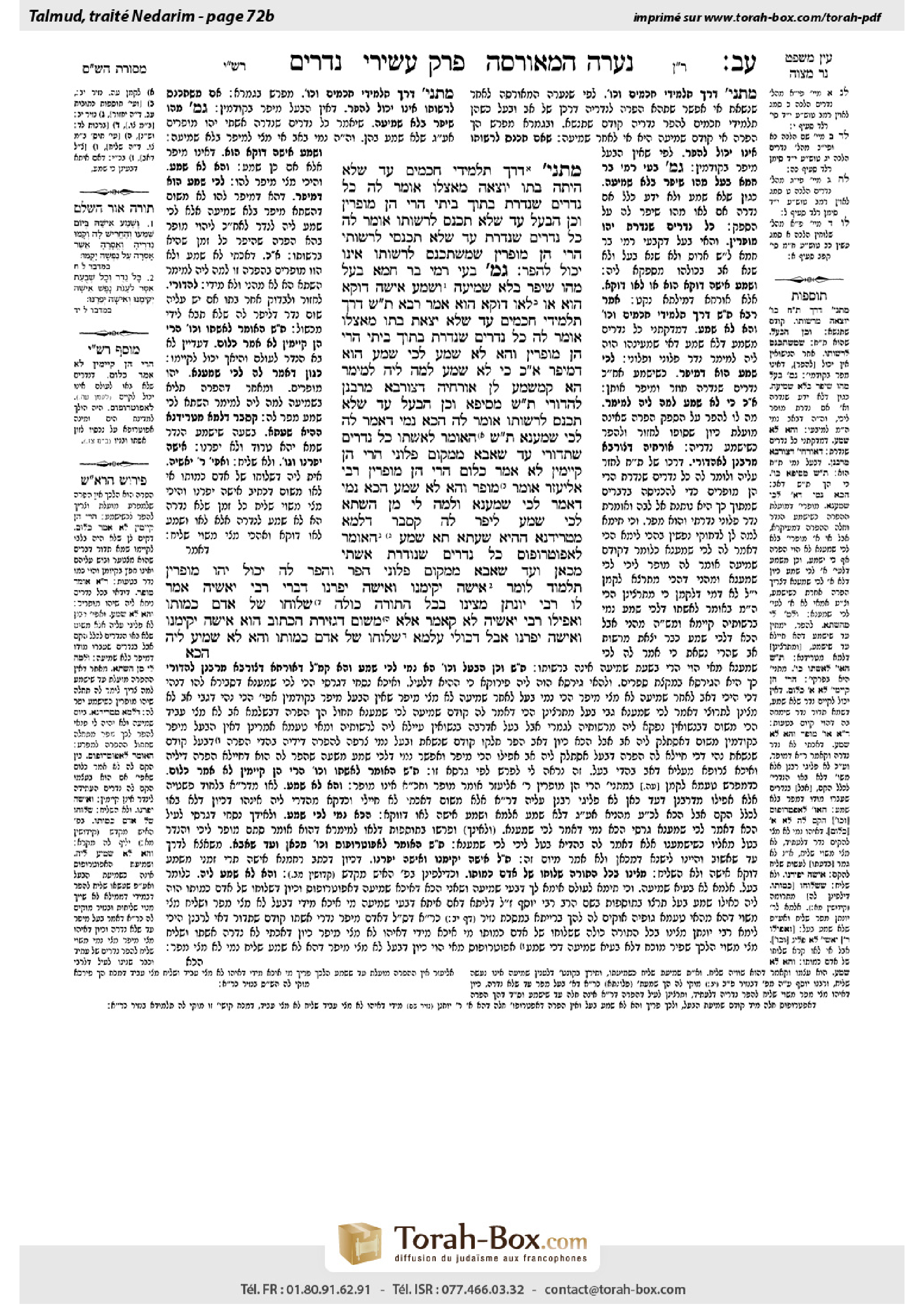
Nedarim 72b: Talmud study for Daf Yomi
Daf Yomi is the daily study of one Talmud folio. Explore 37 tractates with scans, Hebrew text, Sefaria English and AI-generated French translations where annotated.
Passage selection and English or AI-generated French translation are available where the scan has annotations. Daf Study is independent of Torah-Box and Sefaria.
Browse Nedarim · נדרים · All tractatesNedarim 72b text and translations
This page of Nedarim includes the Aramaic text, an English translation and an AI-generated French translation, alongside the scan above.
נדרים ע״ב ב · Aramaic and Hebrew text
מַתְנִי׳ דֶּרֶךְ תַּלְמִידֵי חֲכָמִים, עַד שֶׁלֹּא הָיְתָה בִּתּוֹ יוֹצְאָה מֵאֶצְלוֹ, אוֹמֵר לָהּ: כׇּל נְדָרִים שֶׁנָּדַרְתְּ בְּתוֹךְ בֵּיתִי — הֲרֵי הֵן מוּפָרִין. וְכֵן הַבַּעַל, עַד שֶׁלֹּא תִּכָּנֵס לִרְשׁוּתוֹ, אוֹמֵר לָהּ: כׇּל נְדָרִים שֶׁנָּדַרְתְּ עַד שֶׁלֹּא תִּכָּנְסִי לִרְשׁוּתִי — הֲרֵי הֵן מוּפָרִין. שֶׁמִּשֶּׁתִּכָּנֵס לִרְשׁוּתוֹ — אֵינוֹ יָכוֹל לְהָפֵר.
גְּמָ׳ בָּעֵי רָמֵי בַּר חָמָא: בַּעַל, מַהוּ שֶׁיָּפֵר בְּלֹא שְׁמִיעָה? ״וְשָׁמַע אִישָׁהּ״ דַּוְקָא הוּא, אוֹ לָאו דַּוְקָא הוּא?
אָמַר רָבָא, תָּא שְׁמַע: דֶּרֶךְ תַּלְמִידֵי חֲכָמִים, עַד שֶׁלֹּא יָצָאת בִּתּוֹ מֵאֶצְלוֹ, אוֹמֵר לָהּ: כׇּל נְדָרִים שֶׁנָּדַרְתְּ בְּתוֹךְ בֵּיתִי — הֲרֵי הֵן מוּפָרִין, וְהָא לָא שְׁמַע!
לְכִי שָׁמַע הוּא דְּמֵיפַר. אִם כֵּן, כִּי לָא שְׁמַע, לְמָה לֵיהּ לְמֵימַר? הָא קָמַשְׁמַע לַן: אוֹרְחֵיהּ דְּצוּרְבָּא מֵרַבָּנַן לְהַדּוֹרֵי.
תָּא שְׁמַע מִסֵּיפָא: וְכֵן הַבַּעַל, עַד שֶׁלֹּא תִּכָּנֵס לִרְשׁוּתוֹ, אוֹמֵר לָהּ. הָכָא נָמֵי, דְּאָמַר לַהּ: ״לְכִי שָׁמַעְנָא״.
תָּא שְׁמַע: הָאוֹמֵר לְאִשְׁתּוֹ ״כׇּל נְדָרִים שֶׁתִּדּוֹרִי עַד שֶׁאָבֹא מִמָּקוֹם פְּלוֹנִי הֲרֵי הֵן קַיָּימִין״ — לֹא אָמַר כְּלוּם. ״הֲרֵי הֵן מוּפָרִין״, רַבִּי אֱלִיעֶזֶר אוֹמֵר: מוּפָר. וְהָא לָא שְׁמַע.
הָכָא נָמֵי, דְּאָמַר: ״לְכִי שָׁמַעְנָא״. וּלְמָה לִי מִן הַשְׁתָּא? לְכִי שָׁמַע לֵיפַר לַהּ! קָסָבַר: דִּלְמָא מִטְּרִידְנָא הָהִיא שַׁעְתָּא.
תָּא שְׁמַע: הָאוֹמֵר לְאַפּוֹטְרוֹפּוֹס ״כׇּל נְדָרִים שֶׁנּוֹדֶרֶת אִשְׁתִּי מִכָּאן וְעַד שֶׁאָבֹא מִמָּקוֹם פְּלוֹנִי הָפֵר״, וְהֵפֵר לֵהּ, יָכוֹל יְהוּ מוּפָרִין — תַּלְמוּד לוֹמַר: ״אִישָׁהּ יְקִימֶנּוּ וְאִישָׁהּ יְפֵרֶנּוּ״. דִּבְרֵי רַבִּי יֹאשִׁיָּה.
אָמַר לוֹ רַבִּי יוֹנָתָן: מָצִינוּ בְּכׇל הַתּוֹרָה כּוּלָּהּ שְׁלוּחוֹ שֶׁל אָדָם כְּמוֹתוֹ?
וַאֲפִילּוּ רַבִּי יֹאשִׁיָּה לָא קָאָמַר אֶלָּא מִשּׁוּם דִּגְזֵירַת הַכָּתוּב הוּא ״אִישָׁהּ יְקִימֶנּוּ וְאִישָׁהּ יְפֵרֶנּוּ״, אֲבָל דְּכוּלֵּי עָלְמָא שְׁלוּחוֹ שֶׁל אָדָם כְּמוֹתוֹ. וְהָא לָא שְׁמִיעַ לֵיהּ!
Nedarim 72b · English translation
MISHNA: The practice of Torah scholars is to ensure that a woman about to be married should not be encumbered by any vows. A father, before his daughter would leave him through marriage, would say to her: All vows that you vowed in my house are hereby nullified. And similarly, the husband, before she would enter his jurisdiction, i.e., while they were still betrothed, would say to her: All vows that you vowed before you entered my jurisdiction are hereby nullified. This was necessary because once she enters his jurisdiction he cannot nullify the vows she made before that.
GEMARA: Rami bar Ḥama asks: Concerning a husband, what is the halakha with regard to his nullifying a vow without hearing it? In other words, can a husband state a general nullification of his wife’s vows without being aware of any particular vow? When the verse states: “And her husband hears it, on the day that he hears it, and holds his peace at her, then her vows shall be ratified” (Numbers 30:8), is that referring specifically to a situation where he actually heard of a vow, and only then he can nullify it? Or is it not specifically referring to such a situation, and the mention of hearing is merely because the ordinary situation is that the husband nullifies a vow once he hears it?
Rava said: Come and hear the mishna: The practice of Torah scholars is that a father, before his daughter would leave him through marriage, would say to her: All vows that you vowed in my house are hereby nullified. Rava points out: But the father did not hear her vows, so it must be that one can nullify vows without knowledge that they were actually made.
The Gemara rejects this conclusion: The mishna means that the father states a preemptive nullification that when he will hear a particular vow is when he nullifies it. The vow is not actually nullified until he hears it. The Gemara asks: If so, when he has not actually heard those vows yet, why is it necessary for him to state preemptively that the vows will be nullified; why not wait until he actually hears the vow? The Gemara answers: This teaches us that it is the practice of a Torah scholar to pursue such matters, in order to prompt his daughter or his betrothed to inform him of vows she took, which will then be nullified when he hears of them.
The Gemara suggests: Come and hear from the latter clause of the mishna: And similarly, the husband, before she would enter his jurisdiction, i.e., while they were still betrothed, would say to her: All vows that you vowed before you entered my jurisdiction are hereby nullified. This implies that he can nullify vows without hearing them. The Gemara responds: Here too, it means that he says to her: When I hear the particular vow, then it will be nullified.
Come and hear another mishna to answer the question (Nedarim 75a): One who says to his wife: All vows that you vow until I arrive from such and such a place are hereby ratified, has not said anything, i.e., the vows are not ratified. If he says: All vows that you vow until then are hereby nullified, Rabbi Eliezer says: They are nullified. The Gemara comments: But he did not actually hear the particular vows, so one can infer from this that he need not hear her vows in order to nullify them.
The Gemara rejects this suggestion: Here too, one can understand the situation to be that he says: When I hear the particular vow, it will be nullified. The Gemara asks: But if so, why do I need, i.e., why must the husband state his nullification, from now; let him nullify them for her when he actually hears them. The Gemara answers: He reasons: Perhaps I will be preoccupied at that moment and will forget to nullify them. He therefore nullifies the vows beforehand, so that the nullification will take effect automatically when he hears them.
Come and hear a baraita: In the case of one who says to a steward [apotropos] appointed to manage his affairs in his absence: All vows that my wife vows from now until I arrive from such and such a place you should nullify, and the steward nullified the vows for her, one might have thought that they would be nullified. Therefore, the verse states: “Her husband may ratify it, or her husband may nullify it” (Numbers 30:14). The repetition of “her husband” teaches that it is the husband alone who may nullify his wife’s vows; this is the statement of Rabbi Yoshiya.
Rabbi Yonatan said to him: We have found everywhere in the Torah that the legal status of a person’s agent is like that of himself. Therefore, a steward can nullify the vows on the husband’s behalf.
The Gemara points out: And even Rabbi Yoshiya says that a steward cannot nullify the wife’s vows only because it is a Torah edict, based upon the words “her husband may ratify it, or her husband may nullify it” (Numbers 30:14). But according to everyone, the principle that the legal status of a person’s agent is like that of himself is generally valid. The only objection to the steward nullifying the vows is the Torah edict. The Gemara asks: But these vows were not heard by the steward? This indicates that not having heard the vows is not an obstacle to nullification.
Nedarim 72b · Traduction française (IA)
MICHNA : Les sages de la Torah ont pour pratique de veiller à ce qu’une femme qui va se marier ne soit entravée par aucun vœu. Avant que sa fille ne le quitte par son mariage, le père lui disait : « Tous les vœux que tu as prononcés dans ma maison sont dès à présent annulés. » De même, avant qu’elle n’entre sous l’autorité de son mari, c’est-à-dire alors qu’ils étaient encore fiancés, le mari lui disait : « Tous les vœux que tu as prononcés avant d’entrer sous mon autorité sont dès à présent annulés. » Cela était nécessaire, car, une fois qu’elle était sous son autorité, il ne pouvait plus annuler les vœux prononcés auparavant.
GUEMARA : Rami bar Ḥama demande : Quelle est la halakha concernant un mari qui annule un vœu sans l’avoir entendu ? Autrement dit, un mari peut-il déclarer de manière générale qu’il annule les vœux de sa femme sans avoir connaissance d’un vœu particulier ? Lorsque le verset dit : « Son mari l’entend, le jour où il l’entend, et garde le silence à son égard ; alors ses vœux sont confirmés » (Nombres 30, 8), cela vise-t-il précisément le cas où il a effectivement entendu parler d’un vœu, de sorte qu’il ne peut l’annuler qu’après l’avoir entendu ? Ou bien le verset ne vise-t-il pas précisément un tel cas, et la mention de l’écoute s’explique-t-elle seulement par le fait qu’en général, le mari annule un vœu après en avoir entendu parler ?
Rava dit : Viens et écoute la Michna : Les sages de la Torah ont pour pratique que, avant que sa fille ne le quitte par son mariage, le père lui dise : « Tous les vœux que tu as prononcés dans ma maison sont dès à présent annulés. » Rava fait remarquer : Or, le père n’a pas entendu ses vœux ; il faut donc en conclure qu’on peut annuler des vœux sans savoir qu’ils ont effectivement été prononcés.
La Guemara rejette cette conclusion : La Michna signifie que le père prononce une annulation anticipée, qui ne prendra effet que lorsqu’il entendra parler d’un vœu particulier. Le vœu n’est effectivement annulé qu’après qu’il l’a entendu. La Guemara demande : Si tel est le cas, puisqu’il n’a pas encore entendu ces vœux, pourquoi doit-il déclarer à l’avance qu’ils seront annulés ? Pourquoi ne pas attendre d’entendre effectivement le vœu ? La Guemara répond : Cela nous enseigne qu’un sage de la Torah a pour pratique de s’enquérir de telles questions, afin d’inciter sa fille ou sa fiancée à l’informer des vœux qu’elle a prononcés ; ceux-ci seront alors annulés lorsqu’il en entendra parler.
La Guemara suggère : Viens et écoute la dernière partie de la Michna : De même, avant qu’elle n’entre sous son autorité, c’est-à-dire alors qu’ils étaient encore fiancés, le mari lui disait : « Tous les vœux que tu as prononcés avant d’entrer sous mon autorité sont dès à présent annulés. » Cela implique qu’il peut annuler des vœux sans les avoir entendus. La Guemara répond : Ici aussi, cela signifie qu’il lui dit : « Lorsque j’entendrai parler de ce vœu particulier, il sera annulé. »
Viens et écoute une autre Michna pour répondre à la question (Nedarim 75a) : Celui qui dit à sa femme : « Tous les vœux que tu prononceras jusqu’à mon retour de tel ou tel endroit sont dès à présent confirmés », n’a rien dit, c’est-à-dire que les vœux ne sont pas confirmés. S’il dit : « Tous les vœux que tu prononceras d’ici là sont dès à présent annulés », Rabbi Eliezer dit : « Ils sont annulés. » La Guemara fait remarquer : Or, il n’a pas effectivement entendu les vœux particuliers ; on peut donc en déduire qu’il n’est pas nécessaire qu’il entende les vœux de sa femme pour les annuler.
La Guemara rejette cette proposition : Ici aussi, on peut comprendre qu’il dit : « Lorsque j’entendrai parler de ce vœu particulier, il sera annulé. » La Guemara demande : Mais si tel est le cas, pourquoi le mari doit-il prononcer dès maintenant son annulation ? Qu’il les annule pour elle lorsqu’il les entendra effectivement. La Guemara répond : Il se dit : « Peut-être serai-je préoccupé à ce moment-là et oublierai-je de les annuler. » Il annule donc les vœux à l’avance, afin que l’annulation prenne automatiquement effet lorsqu’il en entendra parler.
Viens et écoute une baraïta : Dans le cas de celui qui dit à un intendant [apotropos] chargé de gérer ses affaires en son absence : « Tous les vœux que ma femme prononcera à partir de maintenant et jusqu’à mon retour de tel ou tel endroit, tu les annuleras », et que l’intendant les annule pour elle, on aurait pu penser qu’ils seraient annulés. C’est pourquoi le verset dit : « Son mari peut le confirmer, ou son mari peut l’annuler » (Nombres 30, 14). La répétition de « son mari » enseigne que seul le mari peut annuler les vœux de sa femme ; telle est l’opinion de Rabbi Yoshiya.
Rabbi Yonatan lui dit : Partout dans la Torah, nous trouvons que le statut juridique du mandataire d’une personne est le même que celui de cette personne. Par conséquent, un intendant peut annuler les vœux au nom du mari.
La Guemara fait remarquer : Même Rabbi Yoshiya ne dit qu’un intendant ne peut pas annuler les vœux de la femme qu’en raison d’un décret de la Torah, fondé sur les mots : « Son mari peut le confirmer, ou son mari peut l’annuler » (Nombres 30, 14). Mais, selon tous, le principe selon lequel le statut juridique du mandataire d’une personne est le même que celui de cette personne est généralement valable. La seule objection à ce que l’intendant annule les vœux est le décret de la Torah. La Guemara demande : Mais l’intendant n’a pas entendu ces vœux ! Cela indique que le fait de ne pas avoir entendu les vœux n’empêche pas leur annulation.
Traduction française générée par IA à partir de l’édition anglaise de Sefaria. Vérifie toujours un passage avec le texte source.
Text from Sefaria: William Davidson Edition - Vocalized Aramaic (CC BY NC); William Davidson Edition - English (CC BY NC).