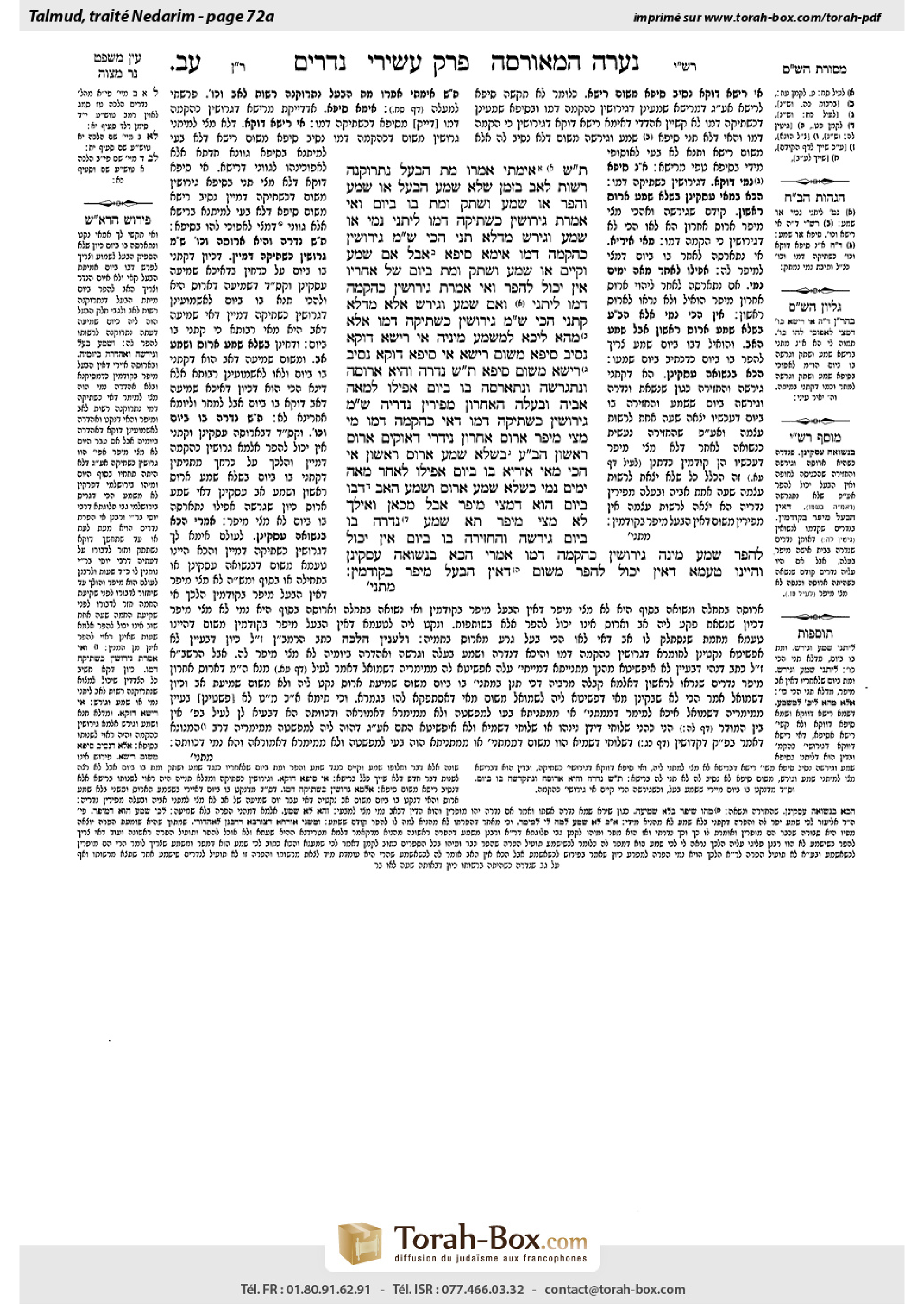
Nedarim 72a: Talmud study for Daf Yomi
Daf Yomi is the daily study of one Talmud folio. Explore 37 tractates with scans, Hebrew text, Sefaria English and AI-generated French translations where annotated.
Passage selection and English or AI-generated French translation are available where the scan has annotations. Daf Study is independent of Torah-Box and Sefaria.
Browse Nedarim · נדרים · All tractatesNedarim 72a text and translations
This page of Nedarim includes the Aramaic text, an English translation and an AI-generated French translation, alongside the scan above.
נדרים ע״ב א · Aramaic and Hebrew text
תָּא שְׁמַע: אֵימָתַי אָמְרוּ ״מֵת הַבַּעַל, נִתְרוֹקְנָה רְשׁוּת לָאָב״ — בִּזְמַן שֶׁלֹּא שָׁמַע הַבַּעַל, אוֹ שָׁמַע וְהֵפֵר, אוֹ שָׁמַע וְשָׁתַק וּמֵת בּוֹ בַּיּוֹם. וְאִי אָמְרַתְּ גֵּירוּשִׁין כִּשְׁתִיקָה דָּמוּ, לִיתְנֵי נָמֵי ״אוֹ שָׁמַע וְגֵירַשׁ״! מִדְּלָא תָּנֵי הָכִי — שְׁמַע מִינַּהּ גֵּירוּשִׁין כַּהֲקָמָה דָּמוּ.
אֵימָא סֵיפָא: אֲבָל אִם שָׁמַע וְקַיָּים, אוֹ שָׁמַע וְשָׁתַק וּמֵת בְּיוֹם שֶׁל אַחֲרָיו — אֵין יָכוֹל לְהָפֵר. וְאִי אָמְרַתְּ גֵּירוּשִׁין כַּהֲקָמָה דָּמוּ, לִיתְנֵי ״וְאִם שָׁמַע וְגֵירֵשׁ״! אֶלָּא מִדְּלָא קָתָנֵי הָכִי, שְׁמַע מִינַּהּ: גֵּירוּשִׁין כִּשְׁתִיקָה דָּמוּ.
אֶלָּא מֵהָא לֵיכָּא לְמִשְׁמַע מִינֵּיהּ. אִי רֵישָׁא דַּוְקָא — נָסֵיב סֵיפָא מִשּׁוּם רֵישָׁא. אִי סֵיפָא דַּוְקָא — נָסֵיב רֵישָׁא מִשּׁוּם סֵיפָא.
תָּא שְׁמַע: נָדְרָה וְהִיא אֲרוּסָה, וְנִתְגָּרְשָׁה וְנִתְאָרְסָה בּוֹ בַּיּוֹם, אֲפִילּוּ לְמֵאָה — אָבִיהָ וּבַעְלָהּ הָאַחֲרוֹן מְפִירִין נְדָרֶיהָ. שְׁמַע מִינַּהּ גֵּירוּשִׁין כִּשְׁתִיקָה דָּמוּ, דְּאִי כַּהֲקָמָה דָּמוּ — מִי מָצֵי מֵיפַר אָרוּס אַחֲרוֹן נִידְרֵי דְּאוֹקֵים אָרוּס רִאשׁוֹן?
הָכָא בְּמַאי עָסְקִינַן, בְּשֶׁלֹּא שָׁמַע אָרוּס רִאשׁוֹן. אִי הָכִי, מַאי אִירְיָא בּוֹ בַּיּוֹם? אֲפִילּוּ לְאַחַר מֵאָה יָמִים נָמֵי!
כְּשֶׁלֹּא שָׁמַע אָרוּס וְשָׁמַע הָאָב, דְּבוֹ בַּיּוֹם הוּא דְּמָצֵי מֵיפַר, אֲבָל מִכָּאן וְאֵילָךְ לֹא מָצֵי מֵיפַר.
תָּא שְׁמַע: נָדְרָה בּוֹ בַּיּוֹם, גֵּירְשָׁהּ וְהֶחְזִירָהּ בּוֹ בַּיּוֹם — אֵין יָכוֹל לְהָפֵר. שְׁמַע מִינַּהּ: גֵּירוּשִׁין כַּהֲקָמָה דָּמוּ.
אָמְרִי: הָכָא בִּנְשׂוּאָה עָסְקִינַן, וְהַיְינוּ טַעְמָא דְּאֵין יָכוֹל לְהָפֵר, מִשּׁוּם דְּאֵין הַבַּעַל מֵיפֵר בְּקוֹדְמִין.
Nedarim 72a · English translation
Come and hear a resolution of the dilemma from the following baraita: When did they say that if the husband died the authority to nullify a young woman’s vows reverts to the father? When the husband did not hear the vow; or he heard the vow and nullified it; or heard it, and was silent, and died on that day. And if you say that divorce is like silence, let the tanna of the baraita also teach with regard to the husband: Or he heard the vow and divorced her. From the fact that he did not teach this case, learn from the baraita that divorce is like ratification.
The Gemara rejects the proof from the baraita: State the latter clause of the baraita: But if he heard it and ratified it; or he heard it, and was silent, and died on the following day, then the father cannot nullify the vow. But according to this clause, if you say that divorce is like ratification, let the tanna of the baraita also teach: And if he heard the vow and divorced her. Rather, from the fact that the baraita does not teach this, learn from the baraita that divorce is like silence.
Rather, one cannot learn anything from this baraita about the effect of divorce on her vows. The Gemara explains that the discrepancy between the two clauses is stylistic and can be explained either way: If the cases in the first clause are chosen precisely, allowing for the inference that divorce is like ratification, then one must say that the tanna formulates the last clause of the baraita as he does because of the first clause, i.e., in the same style, although it does not add anything. If the cases in the last clause are chosen precisely, allowing for the inference that divorce is like silence, then one must say that the tanna formulates the first clause of the baraita as he does because of the last clause, i.e., in the same style, although it does not add anything.
Come and hear a mishna (71a): If she took a vow while she was betrothed, and was divorced, and was betrothed again on the same day, even to one hundred men, her father and her final husband nullify her vows. Learn from this mishna that divorce is like silence, because if it were like ratification, could the final betrothed nullify vows that the first betrothed had already ratified?
The Gemara rejects this proof: With what are we dealing here? We are dealing with a case in which the first betrothed man did not hear the vow, and for that reason his divorcing her does not constitute ratification. The Gemara then asks: If so, why mention specifically that the divorce occurred on that day? The same would hold true even after one hundred days as well. Since the first husband never heard the vow, the final husband can nullify it on whichever day he hears it.
The Gemara answers: It is referring to a situation in which the betrothed man did not hear the vow but the father heard it. As in that case, it is only on the same day that he can nullify the vow, but he cannot nullify it from this point forward. Once her father has already heard the vow, her betrothed cannot nullify it on a different day. Therefore, one cannot infer from the mishna that divorce is like silence.
Come and hear a resolution of the dilemma from a mishna (89a): If she took a vow on that day, and he divorced her and remarried her on the same day, he cannot nullify her vow. Learn from the mishna that divorce is like ratification.
The Gemara rejects this proof: Say that here, i.e., in the mishna cited, we are dealing with a married woman, and that is the reason that he cannot nullify the vow. It is not because it has been ratified by divorce but because the husband cannot nullify his wife’s vows that precede their marriage. The dilemma remains unresolved.
Nedarim 72a · Traduction française (IA)
Viens et entends une réponse à la difficulté à partir de la baraïta suivante : Dans quels cas a-t-on dit que, si le mari mourait, le pouvoir d’annuler les vœux d’une jeune fille revenait au père ? Lorsque le mari n’avait pas entendu le vœu ; ou qu’il l’avait entendu et annulé ; ou qu’il l’avait entendu, était resté silencieux, puis était mort ce jour-là. Et si tu dis que le divorce équivaut au silence, que le tanna de la baraïta enseigne aussi, à propos du mari : « Ou bien il a entendu le vœu et l’a répudiée » ? Puisqu’il n’a pas enseigné ce cas, déduis de la baraïta que le divorce équivaut à une ratification.
La Guemara rejette la preuve tirée de la baraïta : Considère la dernière clause de la baraïta : « Mais s’il l’a entendu et ratifié ; ou s’il l’a entendu, est resté silencieux, puis est mort le lendemain, le père ne peut pas annuler le vœu. » Or, selon cette clause, si tu dis que le divorce équivaut à une ratification, que le tanna de la baraïta enseigne aussi : « Et s’il a entendu le vœu et l’a répudiée » ? Au contraire, puisque la baraïta n’enseigne pas ce cas, déduis-en que le divorce équivaut au silence.
Au contraire, on ne peut rien déduire de cette baraïta quant à l’effet du divorce sur ses vœux. La Guemara explique que la différence entre les deux clauses relève du style et peut s’expliquer dans les deux sens : si les cas de la première clause ont été choisis avec précision, ce qui permet de déduire que le divorce équivaut à une ratification, il faut alors dire que le tanna formule la dernière clause de la baraïta ainsi en raison de la première clause, c’est-à-dire dans le même style, bien que cela n’ajoute rien. Si les cas de la dernière clause ont été choisis avec précision, ce qui permet de déduire que le divorce équivaut au silence, il faut alors dire que le tanna formule la première clause de la baraïta ainsi en raison de la dernière clause, c’est-à-dire dans le même style, bien que cela n’ajoute rien.
Viens et entends une Michna (71a) : Si elle a prononcé un vœu alors qu’elle était fiancée, puis a été répudiée et s’est fiancée de nouveau le même jour, même à cent hommes, son père et son dernier fiancé peuvent annuler ses vœux. Déduis de cette Michna que le divorce équivaut au silence, car, s’il équivalait à une ratification, le dernier fiancé pourrait-il annuler des vœux que le premier fiancé avait déjà ratifiés ?
La Guemara rejette cette preuve : De quel cas s’agit-il ici ? D’un cas où le premier fiancé n’a pas entendu le vœu ; c’est pourquoi le fait qu’il la répudie ne constitue pas une ratification. La Guemara demande alors : Si tel est le cas, pourquoi préciser que le divorce a eu lieu ce jour-là ? Il en serait de même même après cent jours. Puisque le premier mari n’a jamais entendu le vœu, le dernier mari peut l’annuler quel que soit le jour où il l’entend.
La Guemara répond : Il s’agit d’une situation où le fiancé n’a pas entendu le vœu, mais où le père l’a entendu. Dans ce cas, il ne peut annuler le vœu que le même jour ; passé ce jour, il ne peut plus l’annuler. Une fois que son père a déjà entendu le vœu, son fiancé ne peut pas l’annuler un autre jour. On ne peut donc pas déduire de la Michna que le divorce équivaut au silence.
Viens et entends une réponse à la difficulté à partir d’une Michna (89a) : Si elle a prononcé un vœu ce jour-là, et qu’il l’a répudiée puis épousée de nouveau le même jour, il ne peut pas annuler son vœu. Déduis de cette Michna que le divorce équivaut à une ratification.
La Guemara rejette cette preuve : Disons qu’ici, c’est-à-dire dans la Michna citée, il s’agit d’une femme mariée, et que c’est pour cette raison qu’il ne peut pas annuler le vœu. Ce n’est pas parce que le divorce a valu ratification, mais parce qu’un mari ne peut pas annuler les vœux de son épouse qui précèdent leur mariage. La difficulté reste sans réponse.
Traduction française générée par IA à partir de l’édition anglaise de Sefaria. Vérifie toujours un passage avec le texte source.
Text from Sefaria: William Davidson Edition - Vocalized Aramaic (CC BY NC); William Davidson Edition - English (CC BY NC).