Nedarim 71b: Talmud study for Daf Yomi
Daf Yomi is the daily study of one Talmud folio. Explore 37 tractates with scans, Hebrew text, Sefaria English and AI-generated French translations where annotated.
Passage selection and English or AI-generated French translation are available where the scan has annotations. Daf Study is independent of Torah-Box and Sefaria.
Browse Nedarim · נדרים · All tractatesNedarim 71b text and translations
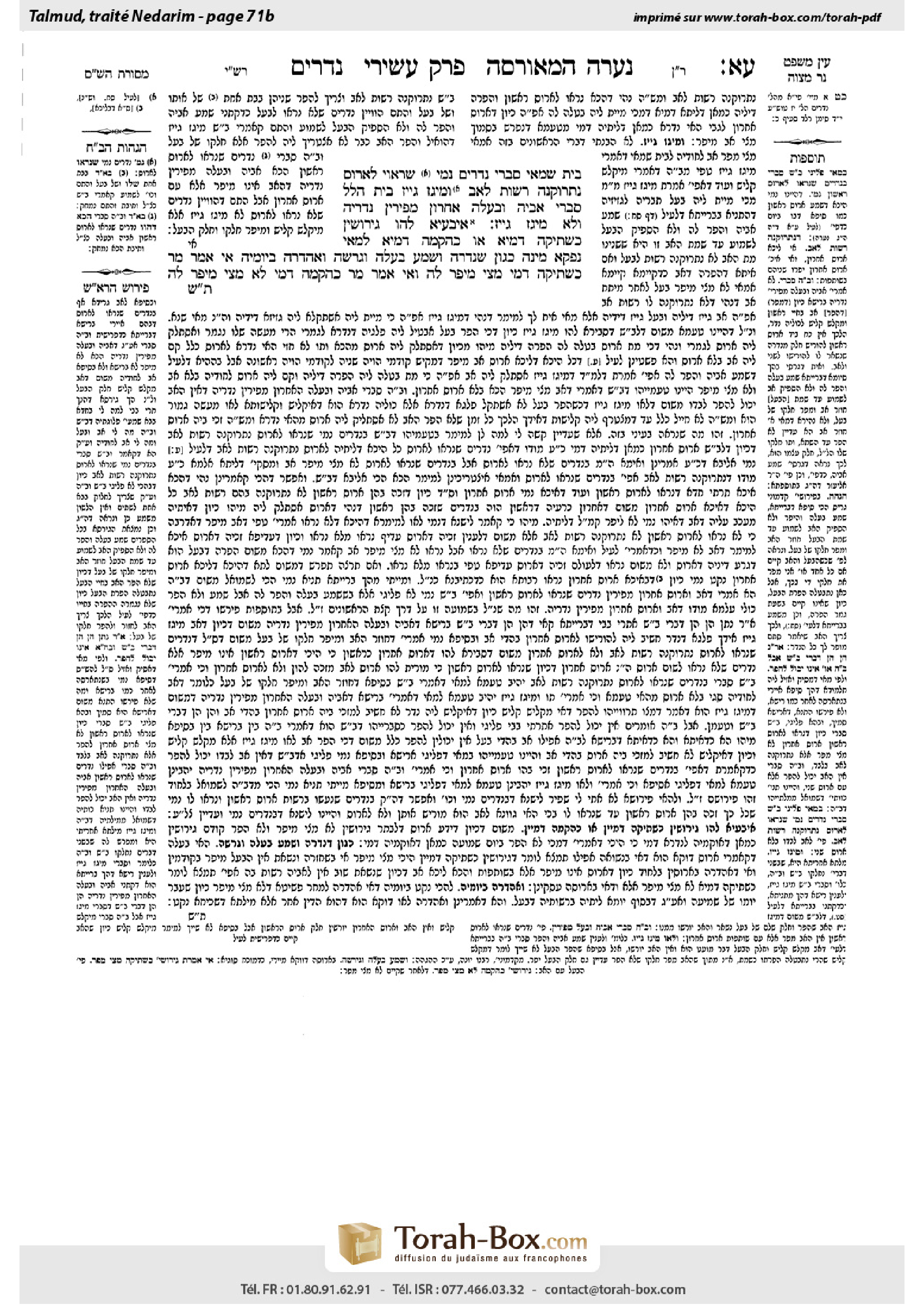
This page of Nedarim includes the Aramaic text, an English translation and an AI-generated French translation, alongside the scan above.
נדרים ע״א ב · Aramaic and Hebrew text
בֵּית שַׁמַּאי סָבְרִי: נְדָרִים נָמֵי שֶׁרָאוּי לָאָרוּס, נִתְרוֹקְנָה רְשׁוּת לָאָב, וּמִיגָּז גָּיֵיז. בֵּית הִלֵּל סָבְרִי: אָבִיהָ וּבַעְלָהּ אַחֲרוֹן מְפִירִין נְדָרֶיהָ, וְלָא מִיגָּז גָּיֵיז.
אִיבַּעְיָא לְהוּ: גֵּירוּשִׁין כִּשְׁתִיקָה דָּמְיָא, אוֹ כַּהֲקָמָה דָּמְיָא?
לְמַאי נָפְקָא מִינַּהּ? כְּגוֹן שֶׁנָּדְרָה וְשָׁמַע בַּעְלָהּ וְגֵרְשָׁהּ, וְאַהְדְּרַהּ בְּיוֹמֵיהּ. אִי אָמַר מָר כִּשְׁתִיקָה דָּמֵי, מָצֵי מֵיפַר לַהּ. וְאִי אָמַר מָר כַּהֲקָמָה דָּמֵי, לָא מָצֵי מֵיפַר לַהּ.
Nedarim 71b · English translation
The Gemara answers: Beit Shammai hold: Even with regard to vows that were disclosed to the betrothed, in the event of his death, his authority reverts to the father. In addition, when the father or husband of a young woman nullifies her vow, he severs his portion of it, enabling the father to nullify her vow on his own after the death of the betrothed. Beit Hillel hold that her father and her final husband together nullify her vows, and he who nullifies her vow does not sever it, but rather weakens its force. Even if the first betrothed was aware of the vow before his death, the father can nullify it in conjunction with another betrothed. This ruling is in accordance with the ruling of Shmuel that her final betrothed can nullify even those vows that she took while betrothed to the first man.
§ A dilemma was raised before the Sages: Is a husband’s divorce of his wife after she took a vow considered like silence, or is it considered like ratification of the vow?
The Gemara asks: What is the difference between the two possibilities? In any case, he did not nullify her vow before the divorce, and once he has divorced her he can no longer do so. The Gemara answers: There is a difference in a case where she took a vow, and her husband heard the vow, and divorced her, and he remarried her on the same day. If the Master says that divorce is like silence, the husband can now nullify the vow for her, since it is the same day. But if the Master says that divorce is like ratification, he cannot nullify the vow for her, as he has ratified it by divorcing her.
Nedarim 71b · Traduction française (IA)
La Guemara répond : Beit Shammaï considère que, même pour les vœux dont le fiancé a eu connaissance, à sa mort, son autorité revient au père. De plus, lorsque le père ou le mari d’une jeune femme annule son vœu, il en détache sa part, ce qui permet au père d’annuler seul le vœu après la mort du fiancé. Beit Hillel considère que son père et son dernier mari annulent ensemble ses vœux, et que celui qui annule son vœu ne le détache pas, mais en affaiblit plutôt la force. Même si le premier fiancé avait eu connaissance du vœu avant sa mort, le père peut l’annuler avec un autre fiancé. Cette décision est conforme à l’avis de Shmuel, selon lequel son dernier fiancé peut annuler même les vœux qu’elle a prononcés alors qu’elle était fiancée au premier homme.
§ Une question fut posée aux Sages : Le fait qu’un mari divorce sa femme après qu’elle a fait un vœu est-il considéré comme un silence ou comme une ratification du vœu ?
La Guemara demande : Quelle est la différence entre ces deux possibilités ? Dans tous les cas, il n’a pas annulé son vœu avant le divorce et, une fois qu’il a divorcé sa femme, il ne peut plus le faire. La Guemara répond : La différence apparaît dans le cas où elle a fait un vœu, où son mari l’a entendu, l’a divorcée, puis l’a reprise pour femme le même jour. Si le Maître dit que le divorce équivaut à un silence, le mari peut alors annuler le vœu, puisque c’est le même jour. Mais si le Maître dit que le divorce équivaut à une ratification, il ne peut pas annuler le vœu, car il l’a ratifié en la divorçant.
Traduction française générée par IA à partir de l’édition anglaise de Sefaria. Vérifie toujours un passage avec le texte source.
Text from Sefaria: William Davidson Edition - Vocalized Aramaic (CC BY NC); William Davidson Edition - English (CC BY NC).