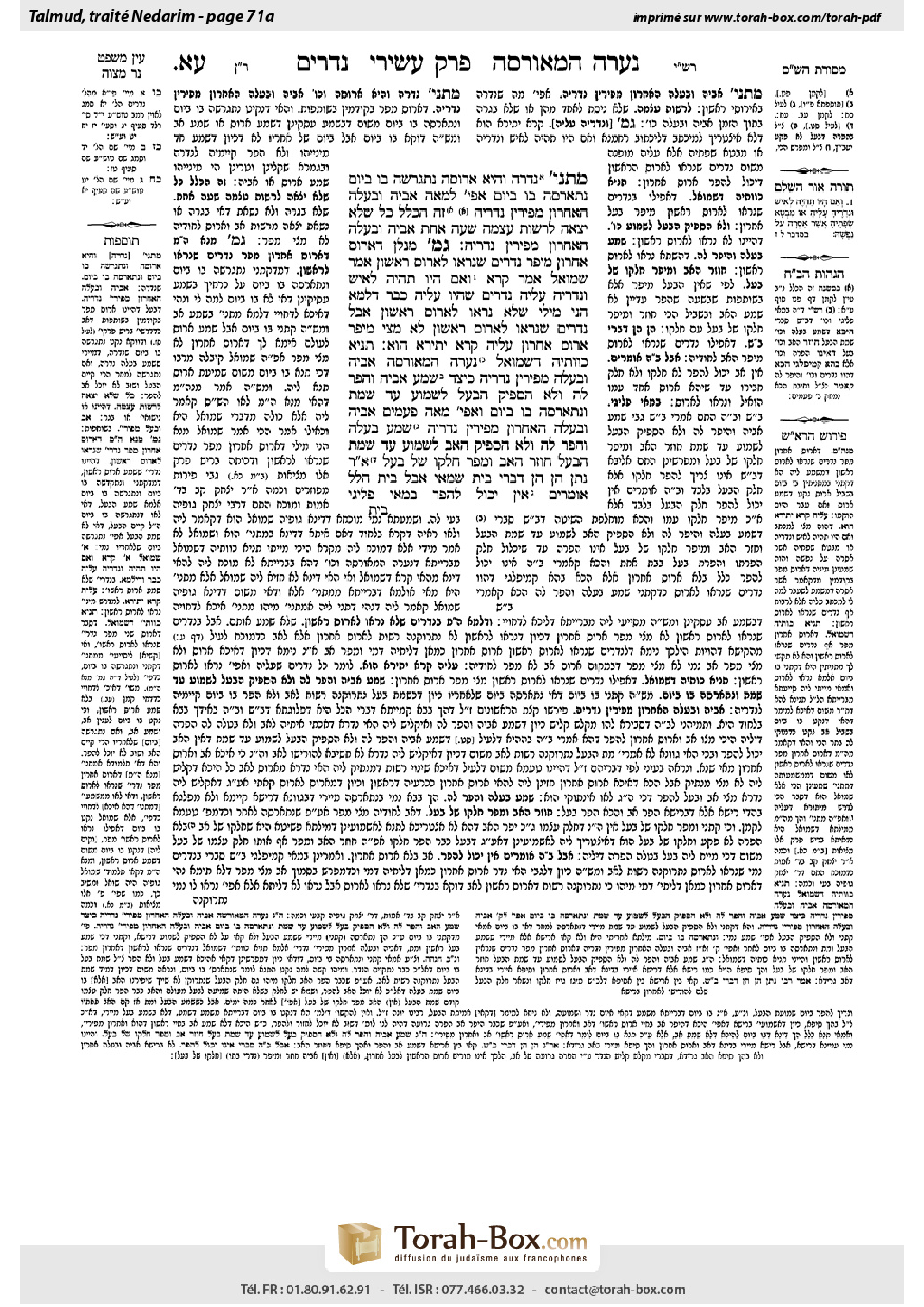
Nedarim 71a: Talmud study for Daf Yomi
Daf Yomi is the daily study of one Talmud folio. Explore 37 tractates with scans, Hebrew text, Sefaria English and AI-generated French translations where annotated.
Passage selection and English or AI-generated French translation are available where the scan has annotations. Daf Study is independent of Torah-Box and Sefaria.
Browse Nedarim · נדרים · All tractatesNedarim 71a text and translations
This page of Nedarim includes the Aramaic text, an English translation and an AI-generated French translation, alongside the scan above.
נדרים ע״א א · Aramaic and Hebrew text
מַתְנִי׳ נָדְרָה וְהִיא אֲרוּסָה. נִתְגָּרְשָׁה בּוֹ בַּיּוֹם, נִתְאָרְסָה בּוֹ בַּיּוֹם, אֲפִילּוּ לְמֵאָה — אָבִיהָ וּבַעְלָהּ הָאַחֲרוֹן מְפִירִין נְדָרֶיהָ. זֶה הַכְּלָל: כֹּל שֶׁלֹּא יָצְאָה לִרְשׁוּת עַצְמָהּ שָׁעָה אַחַת — אָבִיהָ וּבַעְלָהּ הָאַחֲרוֹן מְפִירִין נְדָרֶיהָ.
גְּמָ׳ מְנָלַן דְּאָרוּס אַחֲרוֹן מֵיפֵר נְדָרִים שֶׁנִּרְאוּ לְאָרוּס רִאשׁוֹן? אָמַר שְׁמוּאֵל, אָמַר קְרָא: ״וְאִם הָיוֹ תִהְיֶה לְאִישׁ וּנְדָרֶיהָ עָלֶיהָ״. נְדָרִים שֶׁהָיוּ עָלֶיהָ כְּבָר. דִּלְמָא הָנֵי מִילֵּי שֶׁלֹּא נִרְאוּ לְאָרוּס רִאשׁוֹן, אֲבָל נְדָרִים שֶׁנִּרְאוּ לְאָרוּס רִאשׁוֹן — לָא מָצֵי מֵיפַר אָרוּס אַחֲרוֹן!
״עָלֶיהָ״ קְרָא יַתִּירָא הוּא.
תַּנְיָא כְּווֹתֵיהּ דִּשְׁמוּאֵל: נַעֲרָה הַמְאוֹרָסָה — אָבִיהָ וּבַעְלָהּ מְפִירִין נְדָרֶיהָ, כֵּיצַד? שָׁמַע אָבִיהָ וְהֵפֵר לָהּ, וְלֹא הִסְפִּיק הַבַּעַל לִשְׁמוֹעַ עַד שֶׁמֵּת, וְנִתְאָרְסָה בּוֹ בַּיּוֹם, וַאֲפִילּוּ מֵאָה פְּעָמִים — אָבִיהָ וּבַעְלָהּ הָאַחֲרוֹן מְפִירִין נְדָרֶיהָ. שָׁמַע בַּעְלָהּ וְהֵפֵר לָהּ, וְלֹא הִסְפִּיק הָאָב לִשְׁמוֹעַ עַד שֶׁמֵּת הַבַּעַל — חוֹזֵר הָאָב וּמֵפֵר חֶלְקוֹ שֶׁל בַּעַל.
אָמַר רַבִּי נָתָן: הֵן הֵן דִּבְרֵי בֵּית שַׁמַּאי. אֲבָל בֵּית הִלֵּל אוֹמְרִים: אֵין יָכוֹל לְהָפֵר. בְּמַאי פְּלִיגִי?
Nedarim 71a · English translation
MISHNA: If she took a vow as a betrothed woman and then was divorced on the same day, and she was again betrothed on the same day to another man, or even to one hundred men, one after the other, on a single day, her father and her last husband nullify her vows. This is the principle: With regard to any young woman who has not left her father’s jurisdiction and entered into her own jurisdiction for at least one moment, through full marriage or reaching majority, her father and her final husband nullify her vows.
GEMARA: From where do we derive that her final betrothed can nullify her vows that were disclosed to the first betrothed? Shmuel said that the verse states: “And if she be to a husband and her vows are upon her…and he nullifies her vow” (Numbers 30:7–9), indicating that he can nullify vows that were upon her already. The Gemara asks: Perhaps this statement applies only to vows that were not discerned by the first betrothed, but vows that were discerned by the first betrothed, the final betrothed cannot nullify.
The Gemara answers: The phrase “upon her” is a superfluous part of the verse. One can derive from it that all her vows, including those of which an earlier betrothed had been aware, can be nullified by the final betrothed.
It is taught in a baraita in accordance with the opinion of Shmuel: With regard to a betrothed young woman, her father and her husband together nullify her vows. How so? If her father heard and nullified the vow for her, and the husband did not manage to hear it before he died, and she was betrothed on the same day to another man, or even one hundred times on the same day, her father and her final husband nullify her vows. If her husband heard and nullified the vow for her, and the father did not manage to hear it before the husband died, the father may go back and nullify the husband’s portion.
Rabbi Natan said: This is the statement of Beit Shammai, that each of them nullifies half of the betrothed young woman’s vow. However, Beit Hillel say that the father cannot nullify the vow on his own. The Gemara asks: About what do Beit Shammai and Beit Hillel disagree?
Nedarim 71a · Traduction française (IA)
Michna : Si elle a fait un vœu alors qu’elle était fiancée, puis qu’elle a été divorcée le même jour et qu’elle s’est de nouveau fiancée le même jour à un autre homme — ou même à cent hommes, l’un après l’autre, en une seule journée — son père et son dernier mari annulent ses vœux. Voici le principe : toute jeune femme qui n’a pas quitté l’autorité de son père pour entrer sous sa propre autorité, ne serait-ce qu’un instant, par un mariage pleinement accompli ou en atteignant la majorité, voit ses vœux annulés par son père et son dernier mari.
Guemara : D’où savons-nous que son dernier fiancé peut annuler les vœux dont le premier fiancé avait connaissance ? Chemouel dit que le verset déclare : « Et si elle appartient à un mari et que ses vœux sont sur elle… et qu’il annule son vœu » (Nombres 30, 7-9), ce qui indique qu’il peut annuler des vœux qu’elle avait déjà faits. La Guemara demande : peut-être cette déclaration ne s’applique-t-elle qu’aux vœux dont le premier fiancé n’avait pas connaissance, tandis que le dernier fiancé ne peut pas annuler ceux dont le premier fiancé avait connaissance ?
La Guemara répond : l’expression « sur elle » est une partie superflue du verset. On peut en déduire que tous ses vœux, y compris ceux dont un fiancé précédent avait connaissance, peuvent être annulés par le dernier fiancé.
Il est enseigné dans une baraïta, conformément à l’opinion de Chemouel : lorsqu’une jeune femme est fiancée, son père et son mari annulent ensemble ses vœux. Comment cela ? Si son père a entendu le vœu et l’a annulé pour elle, mais que le mari n’a pas eu le temps de l’entendre avant de mourir, et qu’elle s’est fiancée le même jour à un autre homme — ou même cent fois le même jour —, son père et son dernier mari annulent ses vœux. Si son mari a entendu le vœu et l’a annulé pour elle, mais que le père n’a pas eu le temps de l’entendre avant la mort du mari, le père peut revenir sur la question et annuler la part du mari.
Rabbi Natan dit : telle est l’opinion de Beit Chammaï, selon laquelle chacun d’eux annule la moitié du vœu de la jeune femme fiancée. Beit Hillel, cependant, disent que le père ne peut pas annuler le vœu à lui seul. La Guemara demande : sur quoi Beit Chammaï et Beit Hillel sont-ils en désaccord ?
Traduction française générée par IA à partir de l’édition anglaise de Sefaria. Vérifie toujours un passage avec le texte source.
Text from Sefaria: William Davidson Edition - Vocalized Aramaic (CC BY NC); William Davidson Edition - English (CC BY NC).