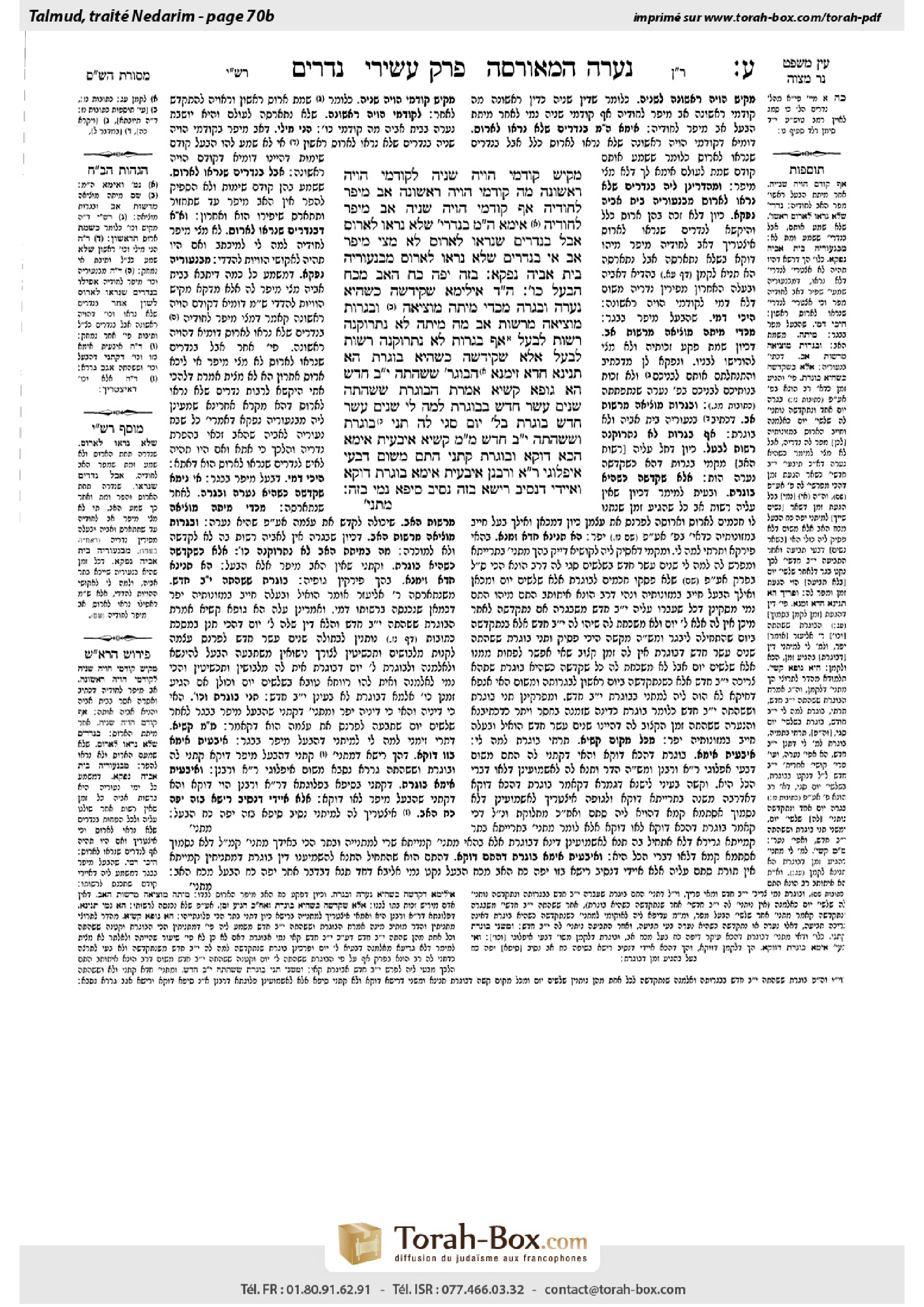
Nedarim 70b: Talmud study for Daf Yomi
Daf Yomi is the daily study of one Talmud folio. Explore 37 tractates with scans, Hebrew text, Sefaria English and AI-generated French translations where annotated.
Passage selection and English or AI-generated French translation are available where the scan has annotations. Daf Study is independent of Torah-Box and Sefaria.
Browse Nedarim · נדרים · All tractatesNedarim 70b text and translations
This page of Nedarim includes the Aramaic text, an English translation and an AI-generated French translation, alongside the scan above.
נדרים ע׳ ב · Aramaic and Hebrew text
מַקִּישׁ קוֹדְמֵי הֲוָיָה שְׁנִיָּה לְקוֹדְמֵי הֲוָיָה רִאשׁוֹנָה. מָה קוֹדְמֵי הֲוָיָה רִאשׁוֹנָה — אָב מֵיפַר לְחוֹדֵיהּ, אַף קוֹדְמֵי הֲוָיָה שְׁנִיָּה — אָב מֵיפַר לְחוֹדֵיהּ.
אֵימָא הָנֵי מִילֵּי בִּנְדָרִים שֶׁלֹּא נִרְאוּ לָאָרוּס. אֲבָל בִּנְדָרִים שֶׁנִּרְאוּ לָאָרוּס — לָא מָצֵי מֵיפַר אָב!
אִי בִּנְדָרִים שֶׁלֹּא נִרְאוּ לָאָרוּס — מִ״בִּנְעֻרֶיהָ בֵּית אָבִיהָ״ נָפְקָא.
בָּזֶה יִפָּה כֹּחַ הָאָב מִכֹּחַ הַבַּעַל כּוּ׳. הֵיכִי דָּמֵי?
אִילֵּימָא שֶׁקִּידְּשָׁהּ כְּשֶׁהִיא נַעֲרָה, וּבָגְרָה. מִכְּדֵי מִיתָה מוֹצִיאָה, וּבַגְרוּת מוֹצִיאָה מֵרְשׁוּת אָב. מָה מִיתָה — לֹא נִתְרוֹקְנָה רְשׁוּת לַבַּעַל, אַף בַּגְרוּת — לֹא נִתְרוֹקְנָה רְשׁוּת לַבַּעַל!
אֶלָּא שֶׁקִּידְּשָׁהּ כְּשֶׁהִיא בּוֹגֶרֶת — הָא תְּנֵינָא חֲדָא זִימְנָא: הַבּוֹגֶרֶת שֶׁשָּׁהֲתָה שְׁנֵים עָשָׂר חֹדֶשׁ?
הָא גוּפָא קַשְׁיָא: אָמְרַתְּ הַבּוֹגֶרֶת שֶׁשָּׁהֲתָה שְׁנֵים עָשָׂר חֹדֶשׁ, בְּבוֹגֶרֶת לְמָה לִי שְׁנֵים עָשָׂר חֹדֶשׁ? בּוֹגֶרֶת בִּשְׁלֹשִׁים יוֹם סַגִּי לַהּ! תָּנֵי: בּוֹגֶרֶת, וְשֶׁשָּׁהֲתָה שְׁנֵים עָשָׂר חֹדֶשׁ.
מִכׇּל מָקוֹם קַשְׁיָא! אִיבָּעֵית אֵימָא: הָכָא דַּוְקָא, וּבוֹגֶרֶת קָתָנֵי הָתָם מִשּׁוּם דְּבָעֵי אִיפְּלוֹגֵי רַבִּי אֱלִיעֶזֶר וְרַבָּנַן.
אִיבָּעֵית אֵימָא: בּוֹגֶרֶת דַּוְקָא. וְאַיְּידֵי דְּנָסֵיב רֵישָׁא ״בָּזֶה״ — נָסֵיב סֵיפָא נָמֵי ״בָּזֶה״.
Nedarim 70b · English translation
This verse juxtaposes the vows preceding her second instance of being betrothed, i.e., those that she took after her first husband’s death but before her second betrothal, to those vows preceding her first instance of being betrothed. Just as with regard to the vows preceding her first instance of being betrothed, her father nullifies them on his own, so too, with regard to those vows preceding her second instance of being betrothed, her father nullifies them on his own.
The Gemara asks: Say that this halakha that the father nullifies vows on his own after the death of the betrothed applies only to vows that were not disclosed to the betrothed, i.e., those that he did not have the opportunity to either ratify or nullify, but with regard to vows that were disclosed to the betrothed, the father cannot nullify them on his own.
The Gemara answers: If the verse is referring only to vows that were not disclosed to the betrothed, it would be unnecessary to teach that halakha, as that is derived from the words “being in her youth, in her father’s house” (Numbers 30:17). As long as the young woman is in her father’s house, even after the death of her betrothed, her father has the authority to nullify her vows.
§ The mishna states: In this matter, the power of the father is enhanced relative to the power of the husband. In another matter, the power of the husband is enhanced relative to the power of the father, as the husband nullifies vows during the woman’s adulthood, whereas the father does not nullify vows during her adulthood. The Gemara asks: What are the circumstances under which a husband can nullify his adult wife’s vows?
If we say that the mishna is referring to a case where he betrothed her when she was a young woman, and she took a vow, and then she reached majority, that cannot be the halakha: After all, both the death of her father removes her from the father’s authority and attaining her majority removes her from the father’s authority, so the halakha in the two cases should be the same. Just as with the death of the father, his authority does not revert to the husband and the woman’s betrothed cannot nullify her vows on his own, so too, upon attaining majority the authority the father possessed when she was a young woman does not revert to the husband.
Rather, it is referring to a case in which he betrothed her when she was a grown woman, and then she took a vow. The Gemara asks: Didn’t we already learn that on another occasion, in a later mishna that states (73b): With regard to a grown woman who waited twelve months after her betrothal and then requested that her betrothed marry her, Rabbi Eliezer says: Since her husband is already obligated to provide for her sustenance, as he is obligated to have married her by then, he can nullify her vows by himself, as if he were fully married to her.
The Gemara explains the cited mishna: This cited mishna is itself difficult: You said that a grown woman who waited twelve months is entitled to support. With regard to a grown woman, why do I need a twelve-month waiting period before her betrothed is obligated to marry her? For a grown woman, thirty days suffice for her to prepare what she needs for her marriage after she is betrothed. The Gemara answers: The mishna should be revised. Teach the mishna: A grown woman who waited thirty days and a young woman who waited twelve months.
The Gemara returns to the question: In any case, the fact that the mishna here teaches a halakha that is addressed in a different mishna is difficult. The Gemara answers: If you wish, say that the mishna here is actually the primary source of this halakha, and the reference to a grown woman is taught there because it wants to present how Rabbi Eliezer and the Rabbis disagree.
Alternatively, if you wish, say that the mishna that begins: A grown woman, is actually the source for this halakha. The mishna here repeats the halakha incidentally, since it needs to cite the first clause: In this matter the power of the father is enhanced relative to the power of the husband, therefore the mishna cites the latter clause as well, by writing: In this other matter, the power of the husband is enhanced relative to the power of the father.
Nedarim 70b · Traduction française (IA)
Ce verset met en parallèle les vœux prononcés avant sa seconde période de fiançailles, c’est-à-dire ceux qu’elle a formulés après la mort de son premier mari, mais avant ses secondes fiançailles, avec les vœux prononcés avant ses premières fiançailles. De même que son père peut annuler seul les vœux prononcés avant ses premières fiançailles, il peut également annuler seul ceux prononcés avant ses secondes fiançailles.
La Guemara demande : Peut-être cette halakha, selon laquelle le père annule seul les vœux après la mort du fiancé, ne s’applique-t-elle qu’aux vœux dont le fiancé n’a pas été informé, c’est-à-dire ceux qu’il n’a pas eu l’occasion de ratifier ou d’annuler ; mais, pour les vœux dont le fiancé a été informé, le père ne peut pas les annuler seul.
La Guemara répond : Si le verset ne faisait référence qu’aux vœux dont le fiancé n’a pas été informé, il serait inutile d’enseigner cette halakha, car on la déduit des mots : « Tant qu’elle est jeune, dans la maison de son père » (Nombres 30, 17). Tant que la jeune femme se trouve dans la maison de son père, même après la mort de son fiancé, son père a le pouvoir d’annuler ses vœux.
§ La Michna enseigne : Sur ce point, le pouvoir du père est supérieur à celui du mari. Sur un autre point, le pouvoir du mari est supérieur à celui du père, car le mari annule les vœux de sa femme lorsqu’elle est adulte, tandis que le père ne les annule pas lorsqu’elle est adulte. La Guemara demande : Dans quelles circonstances un mari peut-il annuler les vœux de sa femme adulte ?
Si l’on dit que la Michna fait référence au cas où il l’a fiancée alors qu’elle était jeune, qu’elle a prononcé un vœu, puis qu’elle a atteint sa majorité, cela ne peut pas être la halakha. En effet, la mort de son père, qui la soustrait à l’autorité de celui-ci, et l’accession à la majorité, qui la soustrait également à cette autorité, devraient entraîner la même halakha. De même qu’à la mort du père, son autorité ne passe pas au mari et que le fiancé de la femme ne peut pas annuler seul ses vœux, de même, lorsqu’elle atteint sa majorité, l’autorité que son père exerçait sur elle lorsqu’elle était jeune ne passe pas au mari.
Il s’agit plutôt du cas où il l’a fiancée alors qu’elle était adulte, puis où elle a prononcé un vœu. La Guemara demande : N’avons-nous pas déjà appris cela ailleurs, dans une Michna ultérieure qui enseigne (73b) : À propos d’une femme adulte qui a attendu douze mois après ses fiançailles, puis a demandé à son fiancé de l’épouser, Rabbi Eliezer dit : Puisque son mari est déjà tenu de pourvoir à sa subsistance, car il aurait dû l’épouser à ce stade, il peut annuler seul ses vœux, comme s’il était pleinement marié avec elle.
La Guemara explique la Michna citée : Cette Michna pose elle-même une difficulté. Tu as dit qu’une femme adulte qui a attendu douze mois a droit à un entretien. Pourquoi faut-il, pour une femme adulte, une période d’attente de douze mois avant que son fiancé soit tenu de l’épouser ? Trente jours suffisent à une femme adulte pour préparer ce dont elle a besoin en vue de son mariage après ses fiançailles. La Guemara répond : Il faut corriger la Michna. Il faut enseigner : une femme adulte qui a attendu trente jours, et une jeune femme qui a attendu douze mois.
La Guemara revient à la question : Quoi qu’il en soit, il est difficile que la Michna d’ici enseigne une halakha abordée dans une autre Michna. La Guemara répond : Si tu veux, tu peux dire que la Michna d’ici est en réalité la source principale de cette halakha, et que la référence à une femme adulte y est enseignée parce qu’elle veut présenter le désaccord entre Rabbi Eliezer et les Rabbins.
Sinon, si tu veux, tu peux dire que la Michna qui commence par « Une femme adulte » est en réalité la source de cette halakha. La Michna d’ici répète cette halakha incidemment, puisqu’elle doit citer la première partie : « Sur ce point, le pouvoir du père est supérieur à celui du mari. » C’est pourquoi elle cite également la seconde partie : « Sur cet autre point, le pouvoir du mari est supérieur à celui du père. »
Traduction française générée par IA à partir de l’édition anglaise de Sefaria. Vérifie toujours un passage avec le texte source.
Text from Sefaria: William Davidson Edition - Vocalized Aramaic (CC BY NC); William Davidson Edition - English (CC BY NC).