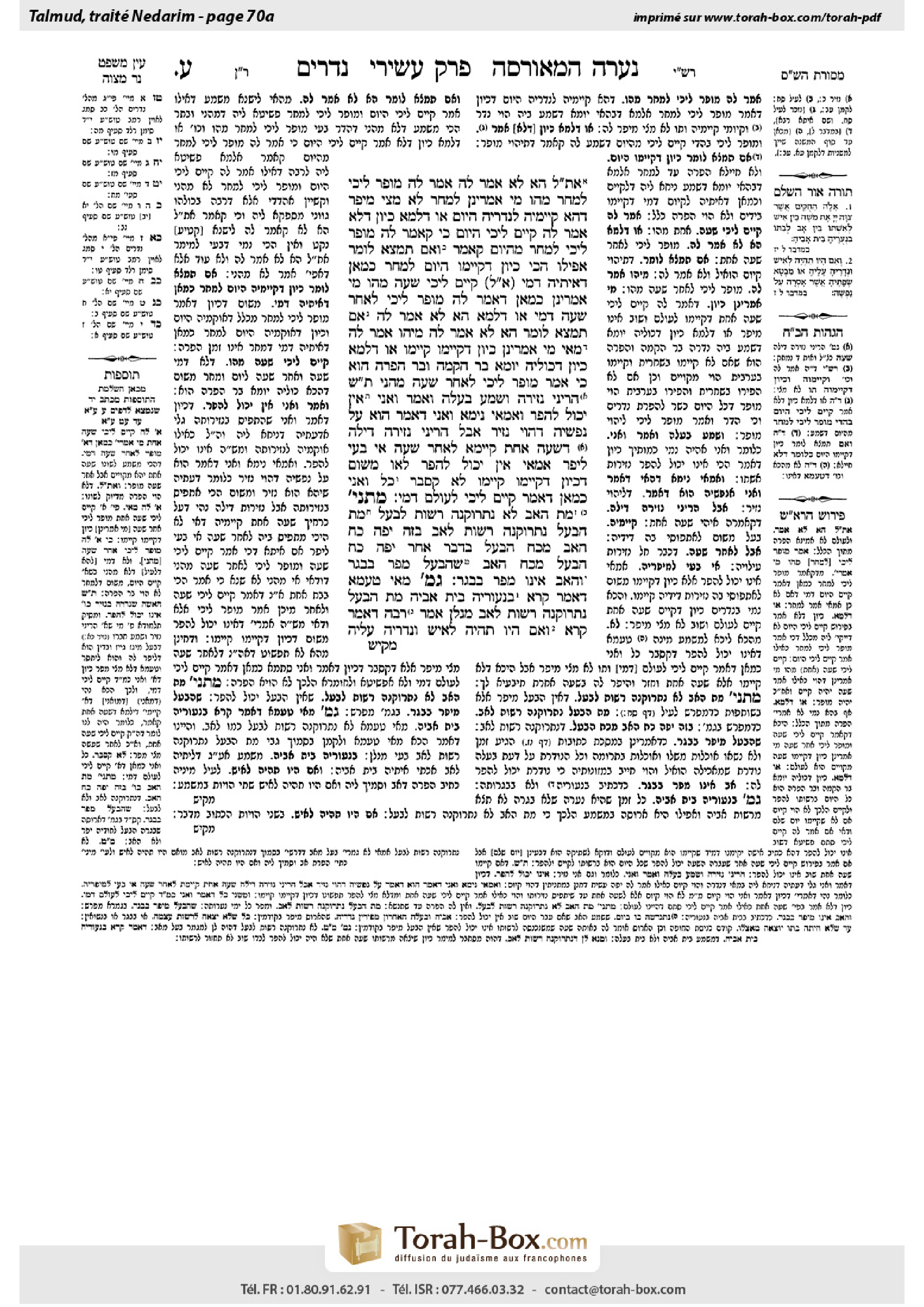
Nedarim 70a: Talmud study for Daf Yomi
Daf Yomi is the daily study of one Talmud folio. Explore 37 tractates with scans, Hebrew text, Sefaria English and AI-generated French translations where annotated.
Passage selection and English or AI-generated French translation are available where the scan has annotations. Daf Study is independent of Torah-Box and Sefaria.
Browse Nedarim · נדרים · All tractatesNedarim 70a text and translations
This page of Nedarim includes the Aramaic text, an English translation and an AI-generated French translation, alongside the scan above.
נדרים ע׳ א · Aramaic and Hebrew text
אִם תִּמְצָא לוֹמַר הָא לָא אֲמַר לַהּ, אֲמַר לַהּ ״מוּפָר לִיכִי לְמָחָר״, מַהוּ? מִי אָמְרִינַן: לִמְחַר לָא מָצֵי מֵיפַר, דְּהָא קַיְּימֵיהּ לְנִדְרַיהּ הַיּוֹם, אוֹ דִלְמָא: כֵּיוָן דְּלָא אֲמַר לַהּ ״קַיָּים לִיכִי הַיּוֹם״, כִּי קָאָמַר לַהּ ״מוּפָר לִיכִי לְמָחָר״, מֵהַיּוֹם קָאָמַר.
וְאִם תִּמְצָא לוֹמַר אֲפִילּוּ הָכִי, כֵּיוָן דְּקִיְּימוֹ הַיּוֹם — לִמְחַר כְּמַאן דְּאִיתֵיהּ דָּמֵי, אֲמַר לַהּ ״קַיָּים לִיכִי שָׁעָה״, מַהוּ? מִי אָמְרִינַן: כְּמַאן דַּאֲמַר לַהּ ״מוּפָר לִיכִי לְאַחַר שָׁעָה״ דָּמֵי, אוֹ דִלְמָא: הָא לָא אֲמַר לָהּ?
אִם תִּמְצָא לוֹמַר הָא לָא אֲמַר לַהּ, מִיהוּ אֲמַר לַהּ, מַאי? מִי אָמְרִינַן: כֵּיוָן דְּקִיְּימוֹ קִיְּימוֹ, אוֹ דִלְמָא: כֵּיוָן דְּכוּלֵּיהּ יוֹמָא בַּר הֲקָמָה וּבַר הֲפָרָה הוּא, כִּי אָמַר ״מוּפָר לִיכִי לְאַחַר שָׁעָה״ מַהְנֵי?
תָּא שְׁמַע: ״הֲרֵינִי נְזִירָה״, וְשָׁמַע בַּעְלָהּ וְאָמַר ״וַאֲנִי״ — אֵין יָכוֹל לְהָפֵר. וְאַמַּאי? נֵימָא ״וַאֲנִי״ דְּאָמַר הוּא עַל נַפְשֵׁיהּ דְּהָוֵי נָזִיר, אֲבָל ״הֲרֵינִי נְזִירָה״ דִּילַהּ, דְּשָׁעָה אַחַת קַיְּימָא, לְאַחַר שָׁעָה אִי בָּעֵי — לֵיפַר, אַמַּאי אֵין יָכוֹל לְהָפֵר? לָאו מִשּׁוּם דְּכֵיוָן שֶׁקִּיְּימוֹ — קִיְּימוֹ? לָא, קָסָבַר: כֹּל ״וַאֲנִי״ — כְּמַאן דְּאָמַר ״קַיָּים לִיכִי לְעוֹלָם״ דָּמֵי.
מַתְנִי׳ מֵת הָאָב — לֹא נִתְרוֹקְנָה רְשׁוּת לַבַּעַל. מֵת הַבַּעַל — נִתְרוֹקְנָה רְשׁוּת לָאָב. בָּזֶה יִפָּה כֹּחַ הָאָב מִכֹּחַ הַבַּעַל.
בְּדָבָר אַחֵר יִפָּה כֹּחַ הַבַּעַל מִכֹּחַ הָאָב: שֶׁהַבַּעַל מֵפֵר בִּבְגָר, וְהָאָב אֵינוֹ מֵפֵר בִּבְגָר.
גְּמָ׳ מַאי טַעְמָא — דְּאָמַר קְרָא ״בִּנְעֻרֶיהָ בֵּית אָבִיהָ״.
מֵת הַבַּעַל נִתְרוֹקְנָה רְשׁוּת לָאָב מְנָלַן? אָמַר רַבָּה: דְּאָמַר קְרָא ״וְאִם הָיוֹ תִהְיֶה לְאִישׁ וּנְדָרֶיהָ עָלֶיהָ״ —
Nedarim 70a · English translation
If you say that since he did not explicitly say to her that the vow is nullified, this means that it remains in force, then if he said to her: It is nullified for you tomorrow, what is the halakha? Do we say that on the following day he cannot nullify it, as he has already ratified the vow today, in that he did not nullify it “on the day that he hears it” (Numbers 30:8)? Or perhaps, since he did not explicitly say to her: It is ratified for you today, then when he says to her: It is nullified for you tomorrow, he is actually saying that the nullification begins from today, so that the vow is nullified.
And if you say: Nevertheless, since he ratified it today, as he said that it is nullified only tomorrow, on the following day it is considered already in force and he cannot nullify it, then if he said to her: It is ratified for you for an hour, what is the halakha? Do we say that it is like one who said to her: It is nullified for you after an hour has passed? Or perhaps, since he did not say this to her explicitly, it is not nullified?
If you say that since he did not say so to her explicitly, therefore the vow is not nullified after an hour, still, if he explicitly said to her that it is nullified after an hour, what is the halakha? Do we say that since he has ratified this vow, in that he explicitly withheld nullification for an hour, he has ratified it and can no longer nullify it? Or, perhaps since the entire day is valid for ratification and valid for nullification, when he says: It is nullified for you after an hour, it is effective.
The Gemara cites a mishna (Nazir 20b) to resolve this last question: Come and hear: If a woman said: I am hereby a nazirite, and her husband heard her vow and said: And I, meaning that he intends to become a nazirite as well, he can no longer nullify his wife’s vow. And why not? Let us say that the words: And I, that he said referred to himself, that he should be a nazirite. But her vow of: I am hereby a nazirite, exists for one hour, i.e., the time until the husband took his own vow based on hers. After an hour, if he wants to nullify it, why can he not nullify it? Is it not because once he has ratified it by basing his vow on hers, even for one hour, he has ratified it permanently and can no longer nullify it? The Gemara rejects this suggestion. No, that is not the explanation. The tanna of that mishna holds that anyone who says the words: And I, in response to his wife’s vow, is like one who says: It is ratified for you forever. All the aforementioned questions are therefore left unresolved.
MISHNA: If the father of a betrothed young woman dies, his authority does not revert to the husband, and the husband cannot nullify the young woman’s vows by himself. However, if the husband dies, his authority reverts to the father, who can now nullify her vows on his own. In this matter, the power of the father is enhanced relative to the power of the husband.
In another matter, the power of the husband is enhanced relative to the power of the father, as the husband nullifies vows during the woman’s adulthood, once they are fully married, whereas the father does not nullify her vows during her adulthood.
GEMARA: What is the reason, i.e., what is the source for the fact that the authority over the young woman’s vows does not revert to the husband if her father dies? The source is that the verse states: “Being in her youth, in her father’s house” (Numbers 30:17). As long as she is a young woman “in her youth,” she is considered to be “in her father’s house” and under his jurisdiction, even if she is betrothed. Even if her father passes away, she is still considered to be in his house, and her betrothed does not assume authority over her vows.
The Gemara asks: From where do we derive that if the husband died his authority reverts to the father? Rabba said: We derive it from the fact that the verse states: “And if she be [hayo tihyeh] to a husband, and her vows are upon her” (Numbers 30:7). The phrase hayo tihyeh is a doubled usage of the verb to be. The Gemara understands this as referring to two different instances of being betrothed to a man, e.g., the woman’s first betrothed dies and then she is betrothed to another man.
Nedarim 70a · Traduction française (IA)
Si tu dis que, puisqu’il ne lui a pas dit explicitement que le vœu était annulé, cela signifie qu’il reste en vigueur, alors, s’il lui a dit : « Ton vœu sera annulé demain », quelle est la halakha ? Disons-nous que le lendemain, il ne peut pas l’annuler, puisqu’il a déjà confirmé le vœu aujourd’hui en ne l’annulant pas « le jour où il en prend connaissance » (Nombres 30:8) ? Ou peut-être que, puisqu’il ne lui a pas dit explicitement : « Ton vœu est confirmé aujourd’hui », lorsqu’il lui dit : « Ton vœu sera annulé demain », il signifie en réalité que l’annulation prend effet dès aujourd’hui, de sorte que le vœu est annulé ?
Et si tu dis que, malgré tout, puisqu’il l’a confirmé aujourd’hui en disant qu’il ne serait annulé que demain, le lendemain le vœu est considéré comme étant déjà en vigueur et il ne peut pas l’annuler, alors, s’il lui a dit : « Ton vœu est confirmé pendant une heure », quelle est la halakha ? Disons-nous que cela équivaut à lui dire : « Ton vœu sera annulé au bout d’une heure » ? Ou peut-être que, puisqu’il ne le lui a pas dit explicitement, le vœu n’est pas annulé ?
Si tu dis que, puisqu’il ne le lui a pas dit explicitement, le vœu n’est donc pas annulé au bout d’une heure, néanmoins, s’il lui a dit explicitement qu’il serait annulé au bout d’une heure, quelle est la halakha ? Disons-nous que, puisqu’il a confirmé ce vœu en s’abstenant explicitement de l’annuler pendant une heure, il l’a confirmé et ne peut plus l’annuler ? Ou peut-être que, comme toute la journée permet aussi bien de confirmer que d’annuler, lorsqu’il dit : « Ton vœu sera annulé au bout d’une heure », cela prend effet ?
La Guemara cite une Michna (Nazir 20b) pour trancher cette dernière question : Viens et entends. Si une femme a dit : « Me voici naziréenne », et que son mari a entendu son vœu et a dit : « Et moi », c’est-à-dire qu’il entend lui aussi devenir nazir, il ne peut plus annuler le vœu de son épouse. Et pourquoi pas ? Disons que les mots « Et moi », qu’il a prononcés, se rapportaient à lui-même et signifiaient qu’il serait nazir. Mais son vœu à elle, « Me voici naziréenne », reste en vigueur pendant une heure, c’est-à-dire jusqu’au moment où le mari a formulé son propre vœu en se fondant sur le sien. Au bout d’une heure, s’il veut annuler le vœu de son épouse, pourquoi ne le peut-il pas ? N’est-ce pas parce qu’en le confirmant, puisqu’il a fondé son vœu sur le sien, même pendant une heure, il l’a confirmé définitivement et ne peut plus l’annuler ? La Guemara rejette cette proposition : non, telle n’est pas l’explication. Le tanna de cette Michna considère que quiconque dit « Et moi » en réponse au vœu de son épouse est comme s’il lui disait : « Ton vœu est confirmé pour toujours. » Toutes les questions précédentes restent donc sans réponse.
MICHNA : Si le père d’une jeune fille fiancée meurt, son autorité ne revient pas au mari, et celui-ci ne peut pas annuler seul les vœux de la jeune fille. En revanche, si le mari meurt, son autorité revient au père, qui peut alors annuler seul ses vœux. À cet égard, le pouvoir du père est supérieur à celui du mari.
À un autre égard, le pouvoir du mari est supérieur à celui du père : le mari annule les vœux de la femme lorsqu’elle est adulte, une fois qu’ils sont pleinement mariés, tandis que le père n’annule pas ses vœux lorsqu’elle est adulte.
GUEMARA : Quelle est la raison, c’est-à-dire quelle est la source du fait que l’autorité sur les vœux de la jeune fille ne revient pas au mari si son père meurt ? La source se trouve dans le verset : « Dans sa jeunesse, dans la maison de son père » (Nombres 30:17). Tant qu’elle est une jeune fille « dans sa jeunesse », elle est considérée comme étant « dans la maison de son père » et sous son autorité, même si elle est fiancée. Même si son père meurt, elle est toujours considérée comme étant dans sa maison, et son fiancé n’acquiert pas autorité sur ses vœux.
La Guemara demande : D’où déduisons-nous que, si le mari meurt, son autorité revient au père ? Rabba dit : Nous le déduisons du fait que le verset dit : « Et si elle est [hayo tihyeh] à un homme, et que ses vœux pèsent sur elle » (Nombres 30:7). L’expression hayo tihyeh emploie deux fois le verbe « être ». La Guemara comprend qu’elle fait référence à deux cas différents où une femme est fiancée à un homme, par exemple lorsque son premier fiancé meurt, puis qu’elle se fiance avec un autre homme.
Traduction française générée par IA à partir de l’édition anglaise de Sefaria. Vérifie toujours un passage avec le texte source.
Text from Sefaria: William Davidson Edition - Vocalized Aramaic (CC BY NC); William Davidson Edition - English (CC BY NC).