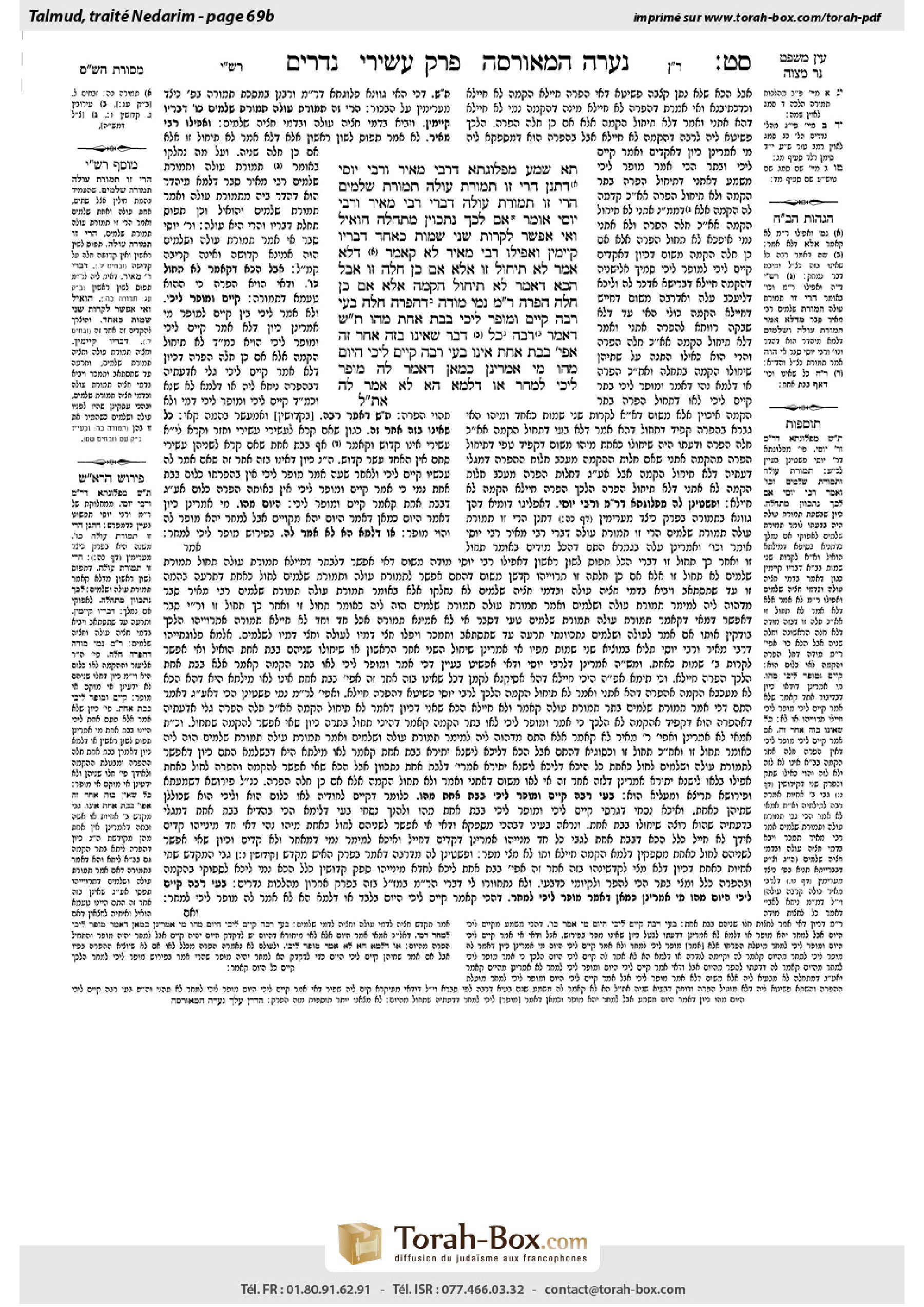
Nedarim 69b: Talmud study for Daf Yomi
Daf Yomi is the daily study of one Talmud folio. Explore 37 tractates with scans, Hebrew text, Sefaria English and AI-generated French translations where annotated.
Passage selection and English or AI-generated French translation are available where the scan has annotations. Daf Study is independent of Torah-Box and Sefaria.
Browse Nedarim · נדרים · All tractatesNedarim 69b text and translations
This page of Nedarim includes the Aramaic text, an English translation and an AI-generated French translation, alongside the scan above.
נדרים ס״ט ב · Aramaic and Hebrew text
תָּא שְׁמַע מִפְּלוּגְתָּא דְּרַבִּי מֵאִיר וְרַבִּי יוֹסֵי. דִּתְנַן: ״הֲרֵי זוֹ תְּמוּרַת עוֹלָה תְּמוּרַת שְׁלָמִים״ — הֲרֵי זוֹ תְּמוּרַת עוֹלָה, דִּבְרֵי רַבִּי מֵאִיר. וְרַבִּי יוֹסֵי אוֹמֵר: אִם לְכָךְ נִתְכַּוֵּין מִתְּחִלָּה, הוֹאִיל וְאִי אֶפְשָׁר לִקְרוֹת שְׁנֵי שֵׁמוֹת כְּאֶחָד — דְּבָרָיו קַיָּימִין.
וַאֲפִילּוּ רַבִּי מֵאִיר לָא קָאָמַר, דְּלָא אָמַר ״לָא תֵּיחוּל זוֹ אֶלָּא אִם כֵּן חָלָה זוֹ״, אֲבָל הָכָא דְּאָמַר ״לֹא תֵּיחוּל הֲקָמָה אֶלָּא אִם כֵּן חָלָה הֲפָרָה״ — רַבִּי מֵאִיר נָמֵי מוֹדֶה דַּהֲפָרָה חָלָה.
בָּעֵי רַבָּה: ״קַיָּים וּמוּפָר לִיכִי״ בְּבַת אַחַת, מַהוּ? תָּא שְׁמַע דְּאָמַר רַבָּה: כׇּל דָּבָר שֶׁאֵינוֹ בְּזֶה אַחַר זֶה, אֲפִילּוּ בְּבַת אַחַת אֵינוֹ.
בָּעֵי רַבָּה: ״קַיָּים לִיכִי הַיּוֹם״, מַהוּ? מִי אָמְרִינַן: כְּמַאן דַּאֲמַר לַהּ ״מוּפָר לִיכִי לְמָחָר״, אוֹ דִלְמָא הָא לָא אֲמַר לַהּ?
Nedarim 69b · English translation
The Gemara answers: Come and hear a resolution of this dilemma from the dispute between Rabbi Meir and Rabbi Yosei, as we learned in a mishna (Temura 25b): If one said about an animal: This is hereby a substitute for a burnt-offering, a substitute for a peace-offering, the halakha is that it becomes a substitute only for a burnt-offering; this is the statement of Rabbi Meir, who holds that one’s initial statement is determinant. And Rabbi Yosei says: If this is what he intended from the outset, that it should be a substitute for both a burnt-offering and a peace-offering, then since it is impossible to give it two names at once and he could not have said burnt-offering and peace-offering simultaneously, his statement is effective, and the animal is a substitute for both of them at once. Similarly, it is possible for him to intend to both ratify and nullify the vow and the vow is nullified, despite the fact that his first statement was to ratify it.
The Gemara adds: And even Rabbi Meir says that the first part of one’s statement is determinant only where he did not state: This will not take effect unless this also takes effect. Here, however, where he expressly said: The ratification of the vow will not take effect unless the nullification takes effect, even Rabbi Meir concedes that the nullification takes effect.
Rabba further asks: If he said: It is ratified and nullified for you simultaneously, what is the halakha? The Gemara answers: Come and hear that which Rabba himself said: Any two halakhic statuses that one is not able to implement sequentially are not realized even when one attempts to bring them about simultaneously. Since one cannot ratify a vow and subsequently nullify it, one can also not ratify and nullify a vow simultaneously.
Rabba raises another dilemma: If one says to his wife or daughter: Your vow is ratified for you today, what is the halakha? Do we say that he is like one who said to her: It is nullified for you tomorrow? Or perhaps, since he did not explicitly say to her that the vow is nullified, it remains in force.
Nedarim 69b · Traduction française (IA)
La Guemara répond : Viens entendre un élément de réponse à cette question à partir du désaccord entre Rabbi Meïr et Rabbi Yossi, comme nous l’avons appris dans une Michna (Temoura 25b) : Si quelqu’un dit au sujet d’un animal : « Voici un substitut à un holocauste, un substitut à un sacrifice de paix », la halakha est qu’il ne devient substitut que d’un holocauste. Telle est l’opinion de Rabbi Meïr, qui considère que les premiers mots prononcés déterminent son intention. Rabbi Yossi dit : Si telle était son intention dès le départ, à savoir que l’animal soit substitut à la fois d’un holocauste et d’un sacrifice de paix, alors, puisqu’il est impossible de lui donner deux noms à la fois et qu’il ne pouvait pas dire simultanément « holocauste » et « sacrifice de paix », sa déclaration est effective et l’animal devient simultanément le substitut des deux. De même, il est possible qu’il ait eu l’intention à la fois de confirmer et d’annuler le vœu, et que celui-ci soit annulé, bien que ses premiers mots aient été de le confirmer.
La Guemara ajoute : Même Rabbi Meïr ne considère que la première partie d’une déclaration comme déterminante que lorsque son auteur n’a pas précisé : « Ceci ne prendra pas effet à moins que cela ne prenne également effet. » Ici, cependant, puisqu’il a expressément dit : « La confirmation du vœu ne prendra pas effet à moins que son annulation ne prenne effet », même Rabbi Meïr admet que l’annulation prend effet.
Rabba demande en outre : S’il a dit : « Il est confirmé et annulé pour toi simultanément », quelle est la halakha ? La Guemara répond : Viens entendre ce que Rabba lui-même a dit : Deux statuts halakhiques qu’on ne peut pas appliquer l’un après l’autre ne peuvent pas non plus être réalisés lorsqu’on tente de les faire advenir simultanément. Puisqu’on ne peut pas confirmer un vœu et l’annuler ensuite, on ne peut pas non plus le confirmer et l’annuler simultanément.
Rabba soulève une autre question : Si quelqu’un dit à son épouse ou à sa fille : « Ton vœu est confirmé pour toi aujourd’hui », quelle est la halakha ? Dit-on qu’il est comme quelqu’un qui lui aurait dit : « Il est annulé pour toi demain » ? Ou peut-être que, puisqu’il ne lui a pas dit explicitement que le vœu est annulé, celui-ci demeure en vigueur.
Traduction française générée par IA à partir de l’édition anglaise de Sefaria. Vérifie toujours un passage avec le texte source.
Text from Sefaria: William Davidson Edition - Vocalized Aramaic (CC BY NC); William Davidson Edition - English (CC BY NC).