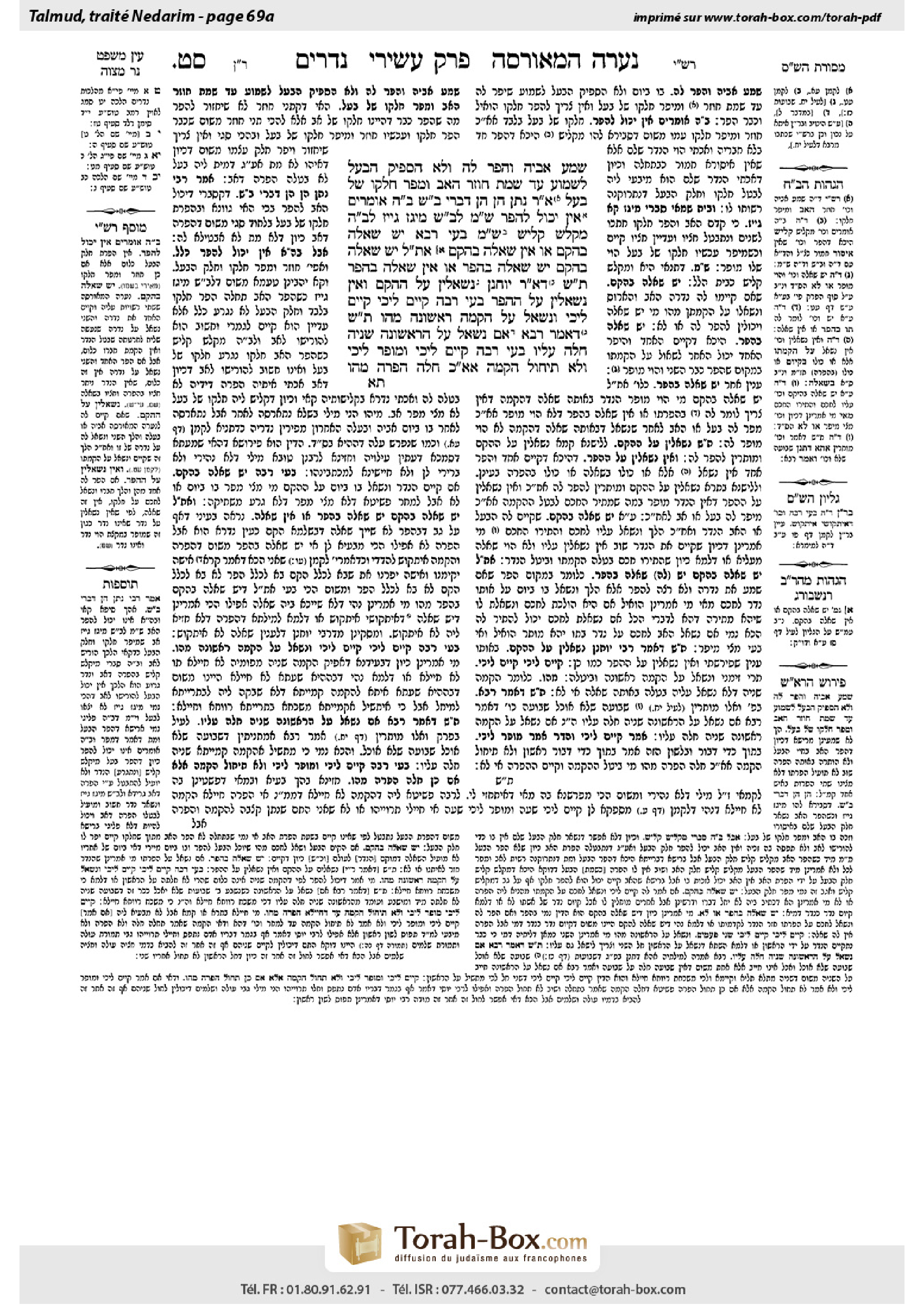
Nedarim 69a: Talmud study for Daf Yomi
Daf Yomi is the daily study of one Talmud folio. Explore 37 tractates with scans, Hebrew text, Sefaria English and AI-generated French translations where annotated.
Passage selection and English or AI-generated French translation are available where the scan has annotations. Daf Study is independent of Torah-Box and Sefaria.
Browse Nedarim · נדרים · All tractatesNedarim 69a text and translations
This page of Nedarim includes the Aramaic text, an English translation and an AI-generated French translation, alongside the scan above.
נדרים ס״ט א · Aramaic and Hebrew text
שָׁמַע אָבִיהָ וְהֵפֵר לָהּ, וְלֹא הִסְפִּיק הַבַּעַל לִשְׁמוֹעַ עַד שֶׁמֵּת — חוֹזֵר הָאָב וּמֵפֵר חֶלְקוֹ שֶׁל בַּעַל. אָמַר רַבִּי נָתָן: הֵן הֵן דִּבְרֵי בֵּית שַׁמַּאי. בֵּית הִלֵּל אוֹמְרִים: אֵין יָכוֹל לְהָפֵר.
שְׁמַע מִינַּהּ: לְבֵית שַׁמַּאי מִיגָּז גָּיֵיז, לְבֵית הִלֵּל מִקְלָשׁ קָלֵישׁ. שְׁמַע מִינַּהּ.
בָּעֵי רָבָא: יֵשׁ שְׁאֵלָה בְּהָקֵם, אוֹ אֵין שְׁאֵלָה בְּהָקֵם? אִם תִּמְצָא לוֹמַר יֵשׁ שְׁאֵלָה בְּהָקֵם: יֵשׁ שְׁאֵלָה בְּהָפֵר, אוֹ אֵין שְׁאֵלָה בְּהָפֵר?
תָּא שְׁמַע דְּאָמַר רַבִּי יוֹחָנָן: נִשְׁאָלִין עַל הֶהָקֵם, וְאֵין נִשְׁאָלִין עַל הֶהָפֵר.
בָּעֵי רַבָּה: ״קַיָּים לִיכִי, קַיָּים לִיכִי״, וְנִשְׁאַל עַל הֲקָמָה רִאשׁוֹנָה, מַהוּ?
תָּא שְׁמַע, דְּאָמַר רָבָא: אִם נִשְׁאַל עַל הָרִאשׁוֹנָה — שְׁנִיָּה חָלָה עָלָיו. בָּעֵי רַבָּה: ״קַיָּים לִיכִי, וּמוּפָר לִיכִי, וְלָא תֵּיחוּל הֲקָמָה אֶלָּא אִם כֵּן חָלָה הֲפָרָה״, מַהוּ?
Nedarim 69a · English translation
If her father heard and nullified the vow for her, and the husband did not manage to hear of the vow before he died, the father may go back and nullify the husband’s portion, and that will complete the nullification of her vow. Rabbi Natan said: This last ruling is the statement of Beit Shammai, but Beit Hillel say that he cannot nullify only the husband’s share of the vow but must also nullify his own share again.
Having completed its citation of the baraita, the Gemara now states its proof: Conclude from this that, according to the opinion of Beit Shammai, whoever nullifies the vow first completely severs his half of the vow, and therefore the father needed only to nullify the part left by the husband. However, according to the opinion of Beit Hillel, his nullification weakens the general force of the vow, so the father’s subsequent nullification must address the whole vow. The Gemara rules: Conclude from this baraita that the husband’s nullification weakens the general force of the vow, as the halakha is in accordance with Beit Hillel.
§ Rava raises a dilemma: Is there the possibility of a request to a halakhic authority about dissolving the ratification of one’s wife’s vow, or is there no possibility of a request to a halakhic authority about dissolving his ratification of one’s wife’s vow? One might seek to dissolve one’s ratification if he now desires to nullify the vow. Furthermore, if you say that there is the possibility of a request to dissolve his ratification, is there the possibility of a request to a halakhic authority about dissolving nullification of his wife’s vow, to allow him to ratify the vow in place of nullifying it? Or is there no possibility of a request to dissolve the nullification of his wife’s vow?
The Gemara answers: Come and hear that which Rabbi Yoḥanan says: A halakhic authority may be requested to dissolve ratification of one’s wife’s vow but may not be requested to dissolve nullification.
Rabba asks: If, after hearing one’s wife or one’s daughter’s vow, one said: It is ratified for you, it is ratified for you, and then a halakhic authority was requested about the first ratification and dissolved it, but one did not request dissolution of the second ratification, what is the halakha? Is the second ratification in force, or is it irrelevant, as it was performed on an vow that was already ratified and consequently never took effect?
The Gemara answers: Come and hear that which Rava said with regard to one who said: I take an oath that I will not eat, I take an oath that I will not eat: If a halakhic authority was requested to dissolve the first oath and dissolved it, the second oath goes into effect for him. Similarly, the second ratification goes into effect. Rabba further asks: If he said to her: The vow is ratified for you and nullified for you, and the ratification will not take effect unless the nullification takes effect, what is the halakha?
Nedarim 69a · Traduction française (IA)
Si son père a entendu le vœu et l’a annulé pour elle, et que son mari n’a pas eu le temps d’en entendre parler avant de mourir, le père peut revenir et annuler la part du mari, ce qui achèvera l’annulation du vœu. Rabbi Natan a dit : « Cette dernière règle est l’avis de Beit Shammaï, mais Beit Hillel disent qu’il ne peut pas annuler uniquement la part du mari dans le vœu : il doit aussi annuler de nouveau sa propre part. »
Ayant achevé de citer la baraïta, la Guemara présente maintenant sa preuve : déduis de là que, selon Beit Shammaï, celui qui annule le vœu en premier détache complètement sa moitié du vœu ; le père n’avait donc qu’à annuler la part laissée par le mari. En revanche, selon Beit Hillel, son annulation affaiblit la force générale du vœu ; l’annulation ultérieure du père doit donc porter sur le vœu tout entier. La Guemara conclut : déduis de cette baraïta que l’annulation du mari affaiblit la force générale du vœu, car la halakha est conforme à Beit Hillel.
§ Rava soulève un dilemme : peut-on demander à une autorité halakhique de délier la ratification du vœu de son épouse, ou est-il impossible de demander à une autorité halakhique de délier cette ratification ? On pourrait chercher à faire délier sa ratification s’il souhaite maintenant annuler le vœu. En outre, si tu dis qu’il est possible de demander à faire délier sa ratification, peut-on demander à une autorité halakhique de délier l’annulation du vœu de son épouse, afin de lui permettre de ratifier le vœu au lieu de l’annuler ? Ou bien est-il impossible de demander à faire délier l’annulation du vœu de son épouse ?
La Guemara répond : viens et écoute ce que dit Rabbi Yoḥanan : on peut demander à une autorité halakhique de délier la ratification du vœu de son épouse, mais on ne peut pas lui demander de délier une annulation.
Rabba demande : si, après avoir entendu le vœu de son épouse ou de sa fille, un homme a dit : « Je le ratifie pour toi, je le ratifie pour toi », puis qu’il a demandé à une autorité halakhique de délier la première ratification et que celle-ci l’a déliée, mais qu’il n’a pas demandé à faire délier la seconde ratification, quelle est la halakha ? La seconde ratification est-elle en vigueur, ou est-elle sans effet, puisqu’elle a été prononcée sur un vœu déjà ratifié et n’a donc jamais pris effet ?
La Guemara répond : viens et écoute ce que dit Rava au sujet de celui qui a dit : « Je fais le serment de ne pas manger, je fais le serment de ne pas manger » : si une autorité halakhique a été saisie pour délier le premier serment et l’a délié, le second serment entre en vigueur pour lui. De même, la seconde ratification entre en vigueur. Rabba demande encore : s’il lui a dit : « Le vœu est ratifié pour toi et annulé pour toi », et que la ratification ne prend effet que si l’annulation prend effet, quelle est la halakha ?
Traduction française générée par IA à partir de l’édition anglaise de Sefaria. Vérifie toujours un passage avec le texte source.
Text from Sefaria: William Davidson Edition - Vocalized Aramaic (CC BY NC); William Davidson Edition - English (CC BY NC).