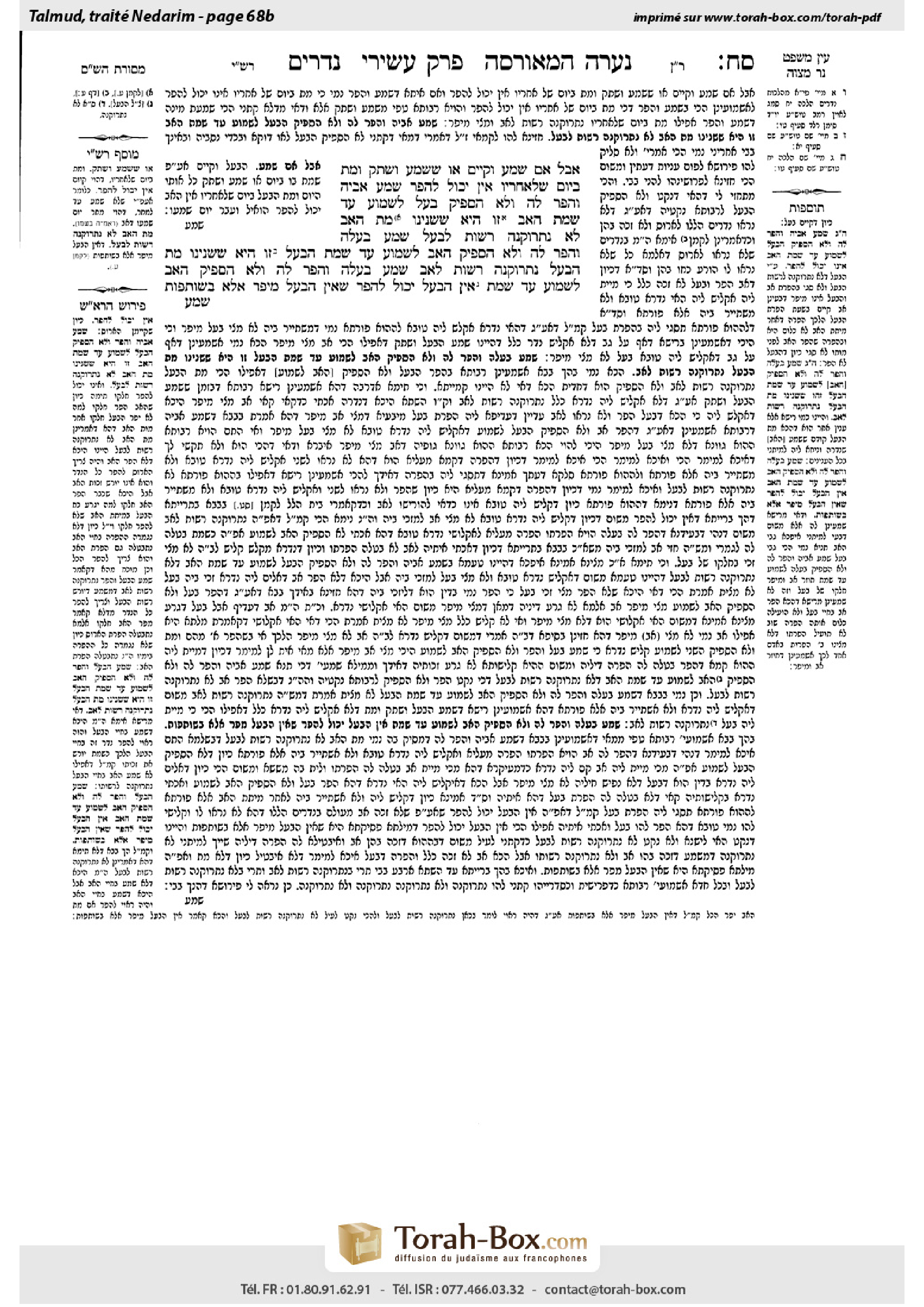
Nedarim 68b: Talmud study for Daf Yomi
Daf Yomi is the daily study of one Talmud folio. Explore 37 tractates with scans, Hebrew text, Sefaria English and AI-generated French translations where annotated.
Passage selection and English or AI-generated French translation are available where the scan has annotations. Daf Study is independent of Torah-Box and Sefaria.
Browse Nedarim · נדרים · All tractatesNedarim 68b text and translations
This page of Nedarim includes the Aramaic text, an English translation and an AI-generated French translation, alongside the scan above.
נדרים ס״ח ב · Aramaic and Hebrew text
אֲבָל אִם שָׁמַע וְקִיֵּים, אוֹ שֶׁשָּׁמַע וְשָׁתַק וּמֵת בַּיּוֹם שֶׁלְּאַחֲרָיו — אֵין יָכוֹל לְהָפֵר.
שָׁמַע אָבִיהָ וְהֵפֵר לָהּ, וְלֹא הִסְפִּיק בַּעַל לִשְׁמוֹעַ עַד שֶׁמֵּת הָאָב — זוֹ הִיא שֶׁשָּׁנִינוּ: מֵת הָאָב, לֹא נִתְרוֹקְנָה רְשׁוּת לַבַּעַל. שָׁמַע בַּעְלָהּ וְהֵפֵר לָהּ, וְלֹא הִסְפִּיק הָאָב לִשְׁמוֹעַ עַד שֶׁמֵּת הַבַּעַל — זוֹ הִיא שֶׁשָּׁנִינוּ: מֵת הַבַּעַל, נִתְרוֹקְנָה רְשׁוּת לָאָב.
שָׁמַע בַּעְלָהּ וְהֵפֵר לָהּ, וְלֹא הִסְפִּיק הָאָב לִשְׁמוֹעַ עַד שֶׁמֵּת — אֵין הַבַּעַל יָכוֹל לְהָפֵר, שֶׁאֵין הַבַּעַל מֵיפֵר אֶלָּא בְּשׁוּתָּפוּת.
Nedarim 68b · English translation
But if it is a case where the husband of a betrothed young woman heard and ratified the vow, or where he heard, and was silent, and died on the following day, in which case his silence is considered ratification of the vow, then the father cannot nullify the vow.
If her father heard or was made aware of the vow and nullified it for her but the husband did not manage to hear of the vow before the father died, this is what we learned in the same mishna (70a): If the father dies, the authority over her vows does not revert to the husband, i.e., a young woman’s betrothed cannot nullify her vows alone, without the father. If her husband heard the vow and nullified it for her, and the father did not manage to hear of the vow before the husband died, this is what we learned in the mishna: If the husband dies, the authority reverts to the father.
If her husband heard and nullified the vow for her, and the father did not manage to hear of the vow before he died, the husband cannot nullify it, although she no longer has a father, as the husband can nullify vows only in partnership with the father.
Nedarim 68b · Traduction française (IA)
Mais si le mari d’une jeune femme fiancée a entendu le vœu et l’a confirmé, ou s’il l’a entendu, est resté silencieux et est mort le lendemain — auquel cas son silence est considéré comme une confirmation du vœu —, le père ne peut pas annuler le vœu.
Si son père a entendu le vœu ou en a été informé, et l’a annulé pour elle, mais que le mari n’a pas eu le temps d’entendre parler du vœu avant la mort du père, c’est ce que nous avons appris dans la même Michna (70a) : si le père meurt, l’autorité sur ses vœux ne revient pas au mari, c’est-à-dire que le fiancé d’une jeune femme ne peut pas annuler seul ses vœux, sans le père. Si son mari a entendu le vœu et l’a annulé pour elle, mais que le père n’a pas eu le temps d’entendre parler du vœu avant la mort du mari, c’est ce que nous avons appris dans la Michna : si le mari meurt, l’autorité revient au père.
Si son mari a entendu le vœu et l’a annulé pour elle, mais que le père n’a pas eu le temps d’entendre parler du vœu avant de mourir, le mari ne peut pas l’annuler, bien qu’elle n’ait plus de père, car le mari ne peut annuler les vœux qu’en partenariat avec le père.
Traduction française générée par IA à partir de l’édition anglaise de Sefaria. Vérifie toujours un passage avec le texte source.
Text from Sefaria: William Davidson Edition - Vocalized Aramaic (CC BY NC); William Davidson Edition - English (CC BY NC).