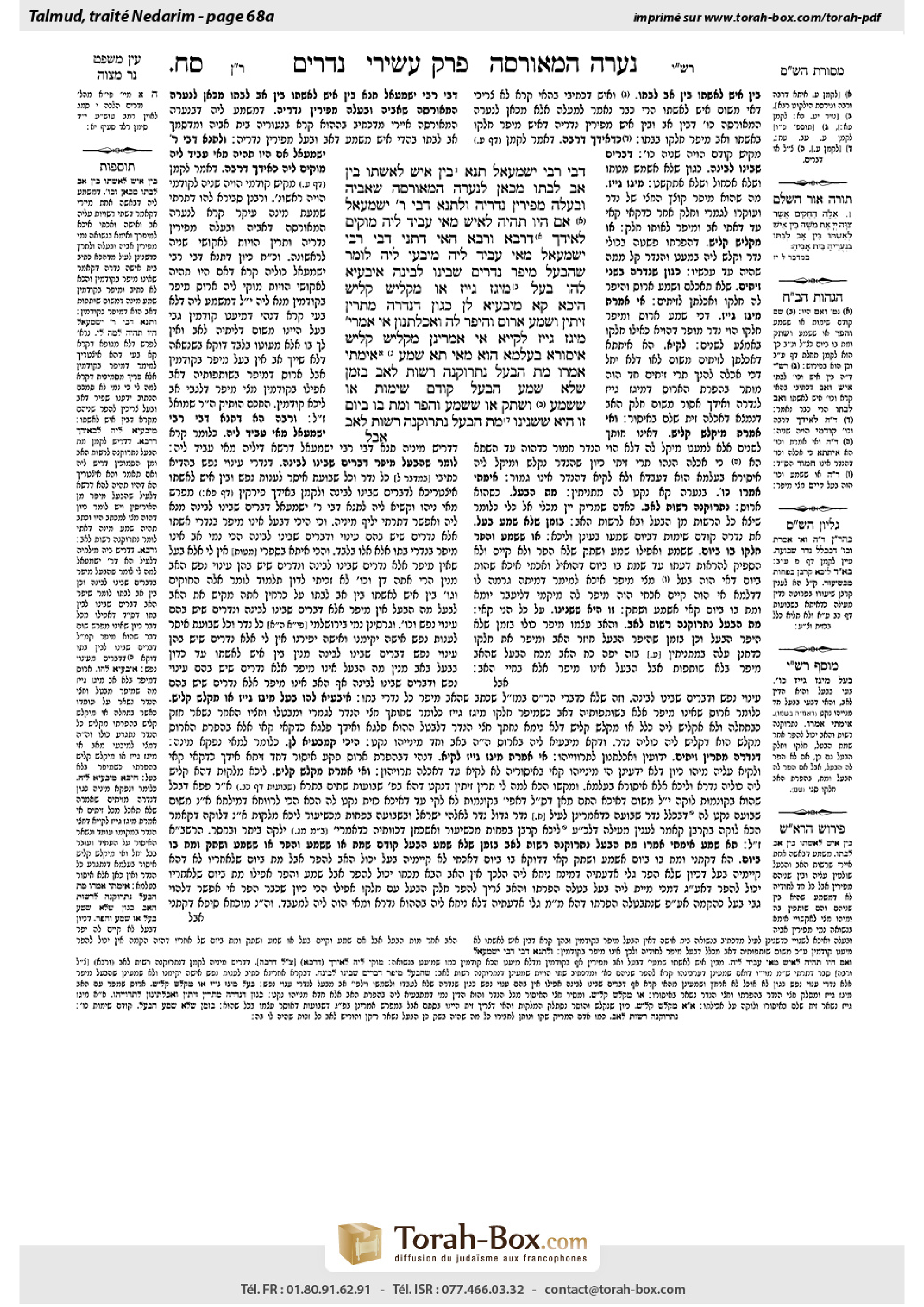
Nedarim 68a: Talmud study for Daf Yomi
Daf Yomi is the daily study of one Talmud folio. Explore 37 tractates with scans, Hebrew text, Sefaria English and AI-generated French translations where annotated.
Passage selection and English or AI-generated French translation are available where the scan has annotations. Daf Study is independent of Torah-Box and Sefaria.
Browse Nedarim · נדרים · All tractatesNedarim 68a text and translations
This page of Nedarim includes the Aramaic text, an English translation and an AI-generated French translation, alongside the scan above.
נדרים ס״ח א · Aramaic and Hebrew text
דְּבֵי רַבִּי יִשְׁמָעֵאל תָּנָא: ״בֵּין אִישׁ לְאִשְׁתּוֹ בֵּין אָב לְבִתּוֹ״, מִכָּאן לְנַעֲרָה הַמְאוֹרָסָה שֶׁאָבִיהָ וּבַעְלָהּ מְפִירִין נְדָרֶיהָ. וּלְתָנָא דְּבֵי רַבִּי יִשְׁמָעֵאל, ״אִם הָיוֹ תִהְיֶה לְאִישׁ״ מַאי עָבֵיד לֵיהּ?
מוֹקֵים לְאִידַּךְ דְּרָבָא. וְרָבָא, הַאי דְּתָנֵי דְּבֵי רַבִּי יִשְׁמָעֵאל מַאי עָבֵיד לֵיהּ? מִיבְּעֵי לֵיהּ לוֹמַר שֶׁהַבַּעַל מֵיפֵר נְדָרִים שֶׁבֵּינוֹ לְבֵינָהּ.
אִיבַּעְיָא לְהוּ: בַּעַל מִיגָּז גָּיֵיז, אוֹ מִקְלָישׁ קָלֵישׁ? הֵיכָא קָא מִיבַּעְיָא לַן: כְּגוֹן דִּנְדַרָה מִתְּרֵין זֵיתִין וּשְׁמַע אָרוּס וְהֵיפֵר לַהּ, וַאֲכַלְתִּנּוּן.
אִי אָמְרִינַן מִיגָּז גָּיֵיז — לָקְיָיא. אִי אָמְרִינַן מִקְלָישׁ קָלֵישׁ — אִיסּוּרָא בְּעָלְמָא הוּא. מַאי?
תָּא שְׁמַע: אֵימָתַי אָמְרוּ מֵת הַבַּעַל נִתְרוֹקְנָה רְשׁוּת לָאָב — בִּזְמַן שֶׁלֹּא שָׁמַע הַבַּעַל קוֹדֶם שֶׁיָּמוּת, אוֹ שֶׁשָּׁמַע וְשָׁתַק, אוֹ שֶׁשָּׁמַע וְהֵפֵר וּמֵת בּוֹ בַּיּוֹם. זוֹ הִיא שֶׁשָּׁנִינוּ: מֵת הַבַּעַל נִתְרוֹקְנָה רְשׁוּת לָאָב.
Nedarim 68a · English translation
The school of Rabbi Yishmael taught a different source for the halakha in the mishna: The Torah states with regard to vows: “These are the statutes, which the Lord commanded Moses, between a man and his wife, between a father and his daughter, being in her youth, in her father’s house” (Numbers 30:17). From here it is derived with regard to a betrothed young woman that her father and her husband nullify her vows. The Gemara asks: And according to the tanna of the school of Rabbi Yishmael, what does he do with the words “and if she be to a husband” (Numbers 30:7)?
The Gemara answers: According to him, he establishes it to teach the other statement of Rava: If her betrothed died without ratifying the vow, her father can nullify it on his own. The Gemara then asks: And Rava, who derives the halakha that the father and the betrothed of the young woman together nullify her vows from the phrase “and if she be to a husband” (Numbers 30:7), what does he do with this verse that the school of Rabbi Yishmael taught as the source for the father and the betrothed nullifying the young woman’s vows? The Gemara answers: He requires that phrase: “Between a man and his wife” (Numbers 30:17), in order to say that the husband can nullify only vows that are between him and her, i.e., vows that negatively impact their marital relationship, but he cannot nullify any other type of vow.
§ A dilemma was raised before the Sages: If a husband nullifies his betrothed’s vow, does he sever his share of the vow or does he weaken the force of the entire vow? The Gemara clarifies: Under which circumstances do we raise the dilemma, i.e., what is the practical difference between these two possibilities? In a case where she vowed not to derive benefit from two olives, and her betrothed heard and nullified the vow for her, and she ate those two olives before her father nullified the vow, there is a practical difference.
If we say that he severs his share of the vow, nullifying half of the prohibition, then one of the olives remains completely forbidden, and she is flogged for violating her vow. If we say that he weakens its force, she is not liable to be flogged, as eating the olives is now merely a prohibition that she has violated. If so, what is the ruling with regard to this question?
The Gemara now cites a lengthy baraita, ultimately stating a proof to answer the previous question. Come and hear a baraita that will resolve the dilemma: When did they say that if the husband of a betrothed young woman dies, the authority to nullify her vows reverts to the father, who can then nullify her vows on his own? This occurs in a case when the husband had not heard her vow before he died; or in a case where he heard and was silent; or where he heard and nullified it and died on the same day. This is what we learned in the mishna, concerning a case of this kind (70a): If the husband dies, the authority to nullify vows reverts to the father.
Nedarim 68a · Traduction française (IA)
L’école de Rabbi Yishmael enseigna une autre source pour la halakha de la Michna : au sujet des vœux, la Torah dit : « Telles sont les lois que l’Éternel a ordonnées à Moïse, entre un homme et sa femme, entre un père et sa fille, lorsqu’elle est jeune et dans la maison de son père » (Nombres 30,17). On en déduit que, lorsqu’une jeune femme est fiancée, son père et son fiancé annulent ses vœux. La Guemara demande : Et selon le tanna de l’école de Rabbi Yishmael, que fait-il des mots « et si elle est à un homme » (Nombres 30,7) ?
La Guemara répond : selon lui, ce verset enseigne l’autre déclaration de Rava : si son fiancé meurt sans avoir ratifié le vœu, son père peut l’annuler à lui seul. La Guemara demande ensuite : Et Rava, qui déduit de l’expression « et si elle est à un homme » (Nombres 30,7) que le père et le fiancé de la jeune femme annulent ensemble ses vœux, que fait-il de ce verset que l’école de Rabbi Yishmael a enseigné comme source permettant au père et au fiancé d’annuler les vœux de la jeune femme ? La Guemara répond : il a besoin de l’expression « entre un homme et sa femme » (Nombres 30,17) pour enseigner que l’époux ne peut annuler que les vœux qui concernent leur relation conjugale, c’est-à-dire ceux qui nuisent à celle-ci, mais qu’il ne peut annuler aucun autre type de vœu.
§ Les Sages posèrent le dilemme suivant : si un époux annule le vœu de sa fiancée, retranche-t-il sa part du vœu, ou bien affaiblit-il la force de l’ensemble du vœu ? La Guemara précise : Dans quelles circonstances pose-t-on ce dilemme, c’est-à-dire quelle différence pratique y a-t-il entre ces deux possibilités ? La question se pose dans le cas où elle a fait le vœu de ne tirer aucun profit de deux olives, où son fiancé a entendu le vœu et l’a annulé pour elle, et où elle a mangé ces deux olives avant que son père n’annule le vœu.
Si l’on dit qu’il retranche sa part du vœu, annulant ainsi la moitié de l’interdiction, alors l’une des olives reste entièrement interdite et elle est passible de flagellation pour avoir transgressé son vœu. Si l’on dit qu’il en affaiblit la force, elle n’est pas passible de flagellation, car manger les olives ne constitue désormais qu’une simple interdiction qu’elle a transgressée. Alors, quelle est la décision concernant ce dilemme ?
La Guemara cite maintenant une longue baraïta, qui fournit finalement une preuve pour répondre à la question précédente. Viens et entends une baraïta qui tranchera le dilemme : quand a-t-on enseigné que, si l’époux d’une jeune femme fiancée meurt, le pouvoir d’annuler ses vœux revient au père, qui peut alors les annuler à lui seul ? C’est le cas lorsque l’époux n’avait pas entendu son vœu avant de mourir ; ou lorsqu’il l’avait entendu et était resté silencieux ; ou lorsqu’il l’avait entendu, l’avait annulé et était mort le même jour. C’est ce que nous avons appris dans la Michna, à propos d’un cas de ce genre (70a) : si l’époux meurt, le pouvoir d’annuler les vœux revient au père.
Traduction française générée par IA à partir de l’édition anglaise de Sefaria. Vérifie toujours un passage avec le texte source.
Text from Sefaria: William Davidson Edition - Vocalized Aramaic (CC BY NC); William Davidson Edition - English (CC BY NC).