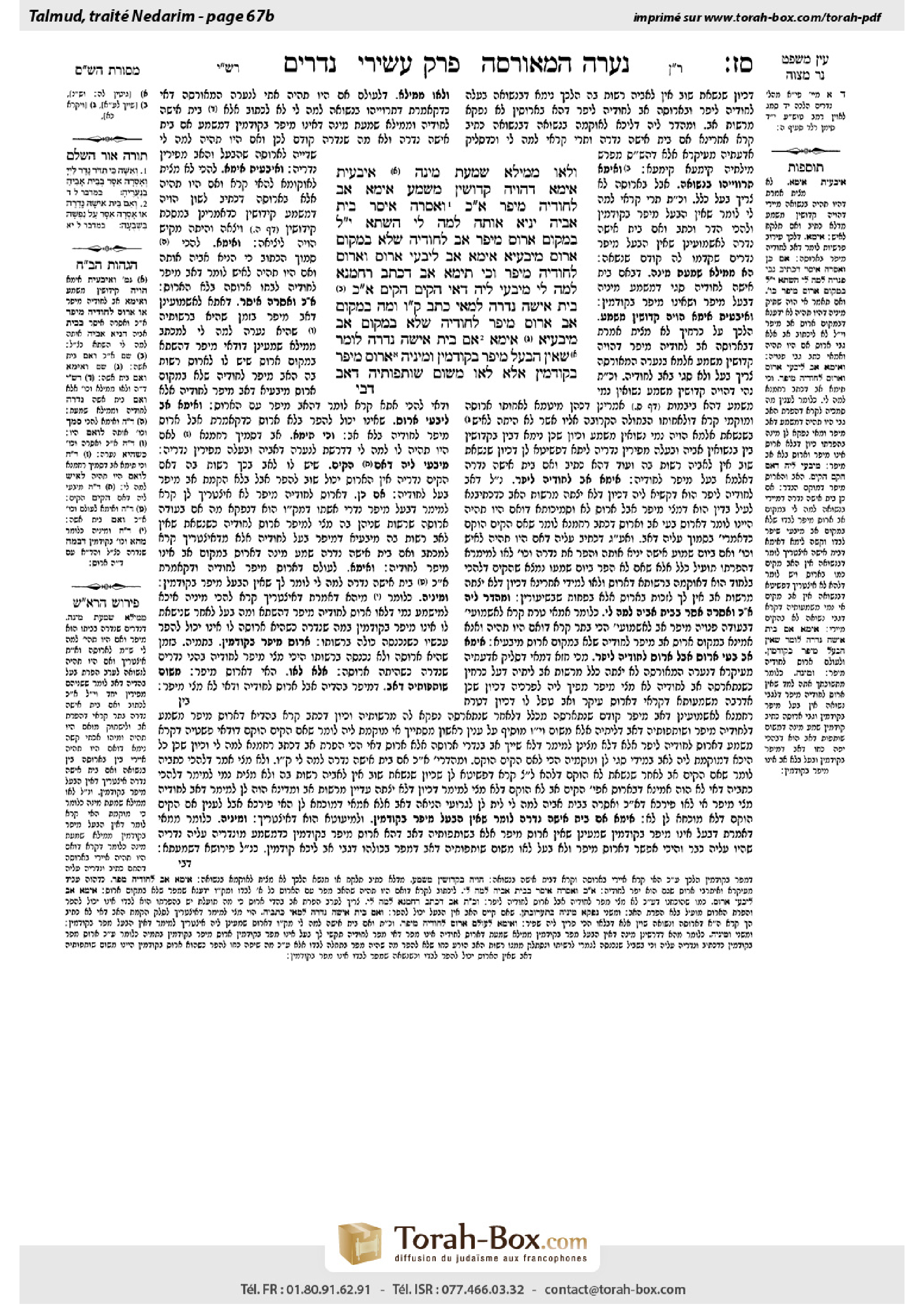
Nedarim 67b: Talmud study for Daf Yomi
Daf Yomi is the daily study of one Talmud folio. Explore 37 tractates with scans, Hebrew text, Sefaria English and AI-generated French translations where annotated.
Passage selection and English or AI-generated French translation are available where the scan has annotations. Daf Study is independent of Torah-Box and Sefaria.
Browse Nedarim · נדרים · All tractatesNedarim 67b text and translations
This page of Nedarim includes the Aramaic text, an English translation and an AI-generated French translation, alongside the scan above.
נדרים ס״ז ב · Aramaic and Hebrew text
וְלָאו מִמֵּילָא שָׁמְעַתְּ מִינַּהּ?
אִיבָּעֵית אֵימָא, דַּהֲוָיָה קִדּוּשִׁין מַשְׁמַע.
אֵימָא אָב לְחוֹדֵיהּ מֵיפֵר! אִם כֵּן ״וְאָסְרָה אִסָּר בֵּית אָבִיהָ״, ״יָנִיא אוֹתָהּ״ לְמָה לִי? הַשְׁתָּא יֵשׁ לוֹמַר בִּמְקוֹם אָרוּס מֵיפֵר אָב לְחוֹדֵיהּ, שֶׁלֹּא בִּמְקוֹם אָרוּס, מִיבַּעְיָא?
אֵימָא אָב לִיבְעֵי אָרוּס, וְאָרוּס לְחוֹדֵיהּ מֵיפֵר. וְכִי תֵּימָא: אָב דִּכְתַב רַחֲמָנָא לְמָה לִי, מִיבְּעֵי לֵיהּ דְּאִי הֵקִים — הֵקִים!
אִם כֵּן, ״בֵּית אִישָׁהּ נָדָרָה״ לְמַאי כְּתִב? קַל וָחוֹמֶר: וּמָה בִּמְקוֹם אָב אָרוּס מֵיפֵר לְחוֹדֵיהּ, שֶׁלֹּא בִּמְקוֹם אָב מִיבַּעְיָא?!
אֵימָא: ״אִם בֵּית אִישָׁהּ נָדָרָה״, לוֹמַר שֶׁאֵין הַבַּעַל מֵיפֵר בְּקוֹדְמִין!
וּמִינֵּיהּ, אָרוּס מֵיפֵר בְּקוֹדְמִין.
אֶלָּא לָאו מִשּׁוּם שׁוּתָּפוּתֵיהּ דְּאָב.
Nedarim 67b · English translation
The Gemara rejects this, stating: And do you not learn it by itself, from the words “And if she vowed in her husband’s house” (Numbers 30:11)? As the verse indicates that her husband can nullify only vows made after the couple is fully married, and not those made beforehand, the earlier verse is unnecessary.
The Gemara suggests an alternative method of demonstrating that the first verse is referring to a betrothed woman: Or if you wish, say that the words “and if she be to a husband” (Numbers 30:7) must be referring to a betrothed woman, since the usage of the term “she be” indicates betrothal rather than marriage.
The Gemara proposes: Say that a father can nullify the vows of his betrothed daughter on his own. The Gemara responds: If so, why do I need the verse to teach that in a case where she binds herself with a bond in her father’s house, her father can disallow her, i.e., nullify her vow (see Numbers 30:4–6). Now when it can be said that in the presence of a betrothed, i.e., when she is betrothed, the father nullifies his daughter’s vows on his own, is it necessary to state that he can do so where there is no betrothed? Therefore, the fact that the Torah specifically states that the father nullifies her vows by himself when she is not betrothed indicates that he does not have that power when she is betrothed.
The Gemara suggests: Say that the father requires the betrothed’s participation in order to nullify his daughter’s vows but that the betrothed can nullify them on his own. And if you would say: If the woman’s betrothed can nullify them on his own, why do I need the reference to the father that the Merciful One writes with regard to the vows of a betrothed young woman, implying that the participation of the father is necessary to nullify her vows. One can explain that the need to mention the father is necessary in order to teach us that if the father ratified the vow, it is ratified, and her betrothed can no longer nullify it.
The Gemara rejects this suggestion: If so, for what purpose did the Torah write “And if she vowed in her husband’s house” (Numbers 30:11), which indicates that a married woman’s husband nullifies her vows on his own? That could be derived by an a fortiori inference: If in the presence of the father, a betrothed man nevertheless nullifies her vows on his own, then when she is no longer in the presence of the father, i.e., she is married and no longer subject to his authority, is it necessary to state that her husband nullifies her vows on his own?
The Gemara suggests: Say that the betrothed can nullify her vows by himself, and the words “And if she vowed in her husband’s house” (Numbers 30:11) are in fact not necessary to teach that a fully married husband can nullify her vows on his own. Rather, they come to say, i.e., to teach, that the husband cannot nullify vows that preceded the betrothal.
The Gemara answers: But from that, i.e., from the fact that the verse precludes only the full-fledged husband from nullifying vows that preceded the betrothal, one may infer that the betrothed can nullify by himself vows that preceded the betrothal. Such a conclusion is unreasonable, as the fully married man has greater authority over her than the betrothed.
Rather, is it not the case that the betrothed cannot nullify vows on his own, and his ability to do so is only because of his partnership with the father?
Nedarim 67b · Traduction française (IA)
La Guemara rejette cette explication : « Ne l’apprenez-vous pas directement des mots : “Et si elle a fait un vœu dans la maison de son mari” (Nombres 30,11) ? » Puisque le verset indique que son mari ne peut annuler que les vœux prononcés après leur mariage, et non ceux prononcés auparavant, le verset précédent est superflu.
La Guemara propose une autre manière de montrer que le premier verset parle d’une femme fiancée : ou bien, si tu préfères, dis que les mots « et si elle est à un mari » (Nombres 30,7) doivent désigner une femme fiancée, puisque l’expression « elle est » indique des fiançailles plutôt que le mariage.
La Guemara propose : Disons qu’un père peut annuler seul les vœux de sa fille fiancée. La Guemara répond : Dans ce cas, pourquoi ai-je besoin du verset qui enseigne que, lorsqu’elle se lie par un engagement dans la maison de son père, celui-ci peut la délier, c’est-à-dire annuler son vœu (voir Nombres 30,4-6) ? Or, dès lors qu’on peut dire qu’en présence d’un fiancé — c’est-à-dire lorsqu’elle est fiancée —, le père annule seul les vœux de sa fille, est-il nécessaire de préciser qu’il peut le faire en l’absence de fiancé ? Par conséquent, le fait que la Torah précise que le père annule seul ses vœux lorsqu’elle n’est pas fiancée indique qu’il ne détient pas ce pouvoir lorsqu’elle est fiancée.
La Guemara propose : Disons que le père doit participer à l’annulation des vœux de sa fille, mais que le fiancé peut les annuler seul. Et si tu dis : Si le fiancé de la femme peut les annuler seul, pourquoi le Miséricordieux mentionne-t-il le père à propos des vœux d’une jeune fille fiancée, ce qui implique que le père doit participer à leur annulation ? On peut expliquer que la mention du père est nécessaire pour nous enseigner que si le père a confirmé le vœu, celui-ci est confirmé, et son fiancé ne peut plus l’annuler.
La Guemara rejette cette proposition : Dans ce cas, dans quel but la Torah a-t-elle écrit « Et si elle a fait un vœu dans la maison de son mari » (Nombres 30,11), ce qui indique que le mari d’une femme mariée annule seul ses vœux ? Cela pourrait se déduire a fortiori : si, en présence du père, un homme fiancé annule néanmoins seul ses vœux, alors, lorsqu’elle n’est plus sous l’autorité de son père — c’est-à-dire lorsqu’elle est mariée —, est-il nécessaire de préciser que son mari annule seul ses vœux ?
La Guemara propose : Disons que le fiancé peut annuler seul ses vœux et que les mots « Et si elle a fait un vœu dans la maison de son mari » (Nombres 30,11) ne sont en fait pas nécessaires pour enseigner qu’un mari peut annuler seul les vœux de sa femme une fois le mariage pleinement établi. Ils viennent plutôt enseigner que le mari ne peut pas annuler les vœux prononcés avant les fiançailles.
La Guemara répond : Mais de cela — c’est-à-dire du fait que le verset exclut seulement le mari proprement dit de l’annulation des vœux prononcés avant les fiançailles —, on peut déduire que le fiancé peut annuler seul les vœux prononcés avant les fiançailles. Une telle conclusion est déraisonnable, car le mari a davantage d’autorité sur elle que le fiancé.
N’est-il pas plutôt vrai que le fiancé ne peut pas annuler seul les vœux et qu’il ne peut le faire que conjointement avec le père ?
Traduction française générée par IA à partir de l’édition anglaise de Sefaria. Vérifie toujours un passage avec le texte source.
Text from Sefaria: William Davidson Edition - Vocalized Aramaic (CC BY NC); William Davidson Edition - English (CC BY NC).