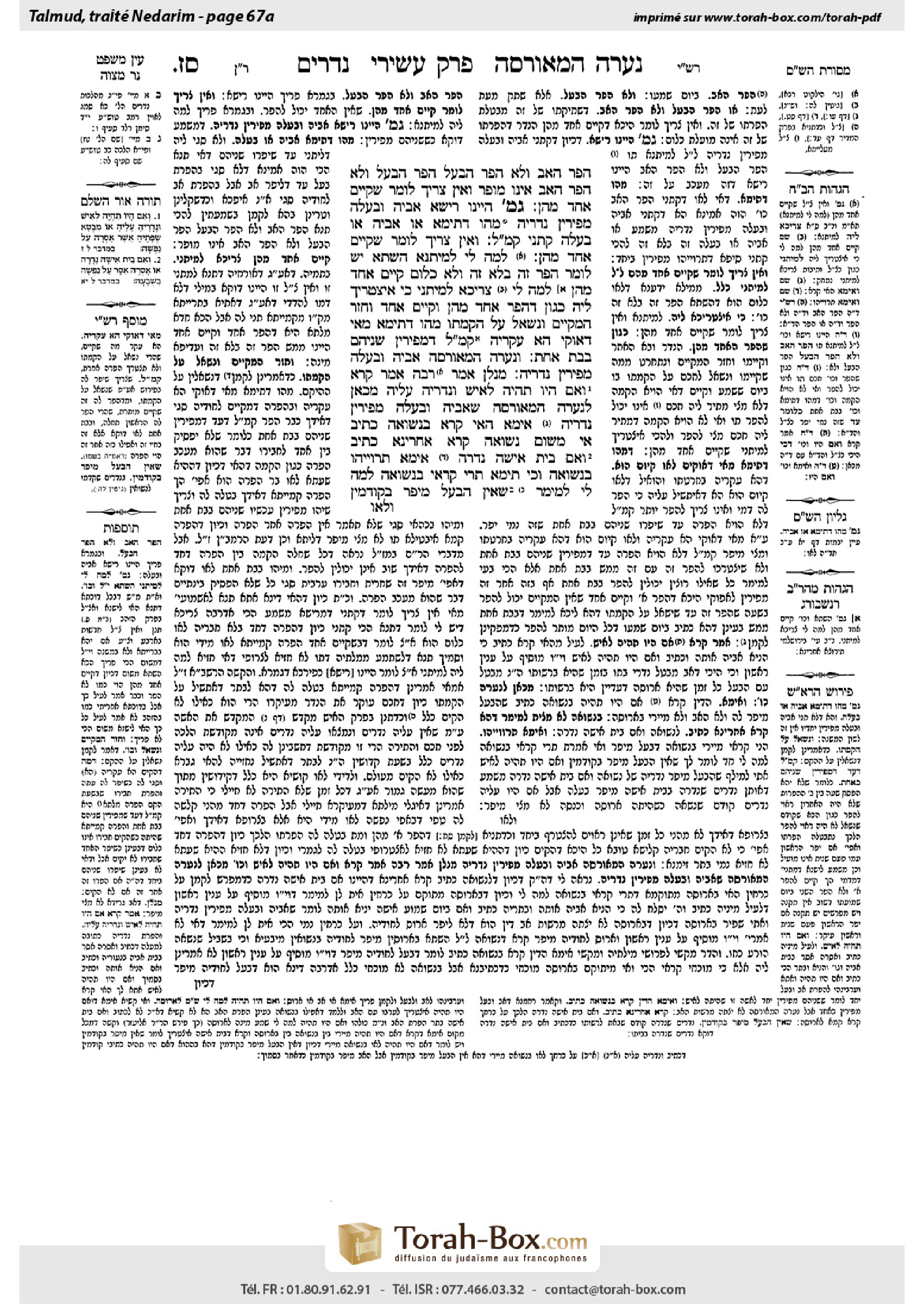
Nedarim 67a: Talmud study for Daf Yomi
Daf Yomi is the daily study of one Talmud folio. Explore 37 tractates with scans, Hebrew text, Sefaria English and AI-generated French translations where annotated.
Passage selection and English or AI-generated French translation are available where the scan has annotations. Daf Study is independent of Torah-Box and Sefaria.
Browse Nedarim · נדרים · All tractatesNedarim 67a text and translations
This page of Nedarim includes the Aramaic text, an English translation and an AI-generated French translation, alongside the scan above.
נדרים ס״ז א · Aramaic and Hebrew text
הֵפֵר הָאָב וְלֹא הֵפֵר הַבַּעַל, הֵפֵר הַבַּעַל וְלֹא הֵפֵר הָאָב — אֵינוֹ מוּפָר. וְאֵין צָרִיךְ לוֹמַר שֶׁקִּיֵּים אֶחָד מֵהֶן.
גְּמָ׳ הַיְינוּ רֵישָׁא: אָבִיהָ וּבַעְלָהּ מְפִירִין נְדָרֶיהָ! מַהוּ דְּתֵימָא: אוֹ אָבִיהָ אוֹ בַעְלָהּ קָתָנֵי, קָא מַשְׁמַע לַן.
וְאֵין צָרִיךְ לוֹמַר שֶׁקִּיֵּים אֶחָד מֵהֶן. לְמָה לִי לְמִיתְנָא? הַשְׁתָּא יֵשׁ לוֹמַר הֵפֵר זֶה בְּלֹא זֶה — וְלֹא כְּלוּם, קִיֵּים אֶחָד מֵהֶן לְמָה לִי? צְרִיכָא לְמִיתְנֵי?!
כִּי אִיצְטְרִיךְ לֵיהּ כְּגוֹן דְּהֵפֵר אֶחָד מֵהֶן וְקִיֵּים אֶחָד, וְחָזַר הַמְקַיֵּים וְנִשְׁאַל עַל הֲקָמָתוֹ. מַהוּ דְּתֵימָא: מַאי דְּאוֹקִי הָא עַקְרֵיהּ, קָא מַשְׁמַע לַן דִּמְפִירִין שְׁנֵיהֶם בְּבַת אַחַת.
וְנַעֲרָה הַמְאוֹרָסָה אָבִיהָ וּבַעְלָהּ מְפִירִין נְדָרֶיהָ, מְנָלַן? אָמַר רַבָּה, אָמַר קְרָא: ״וְאִם הָיוֹ תִהְיֶה לְאִישׁ וּנְדָרֶיהָ עָלֶיהָ״. מִכָּאן לְנַעֲרָה הַמְאוֹרָסָה שֶׁאָבִיהָ וּבַעְלָהּ מְפִירִין נְדָרֶיהָ. אֵימָא הַאי קְרָא בִּנְשׂוּאָה כְּתִיב!
אִי מִשּׁוּם נְשׂוּאָה, קְרָא אַחֲרִינָא כְּתִיב: ״וְאִם בֵּית אִישָׁהּ נָדָרָה״. אֵימָא תַּרְוַיְיהוּ בִּנְשׂוּאָה?! וְכִי תֵּימָא תְּרֵי קְרָאֵי בִּנְשׂוּאָה לְמָה לִי — לְמֵימַר שֶׁאֵין הַבַּעַל מֵיפֵר בְּקוֹדְמִין.
Nedarim 67a · English translation
If the father nullified her vow and the husband did not nullify it, or if the husband nullified it and the father did not nullify it, then the vow is not nullified. And needless to say, it is not nullified if one of them ratified the vow.
GEMARA: The mishna states that if the father nullified her vow and the husband did not nullify it, or if the husband nullified it and the father did not nullify it, then the vow is not nullified. The Gemara asks: Is this not the same as the first clause of the mishna, which states: Her father and her husband nullify her vows? The Gemara answers: The second clause is necessary, lest you say: The mishna is teaching that either her father or her husband can nullify her vows, but there is no need for both of them to do so, which is also a possible interpretation of the Hebrew phrase used. Therefore, the mishna teaches us that it means that both of them must nullify the vow.
At the end of the mishna it is stated: And needless to say, it is not nullified if one of them ratified the vow. The Gemara asks: Why do I need the mishna to teach this? Now, it was stated that if one of them nullified the vow without the other, it is nothing, her vow is not nullified. If one of them ratified it, why do I need it to state that her vow is not nullified? Is it necessary to teach this?
The Gemara answers: It was necessary for the mishna to mention this in a case where one of them nullified the vow and the other one ratified it, and the one who ratified the woman’s vow retracted and requested dissolution of his ratification from a halakhic authority, who dissolved it. Lest you say: That which he ratified is what he uprooted, by asking the halakhic authority to dissolve his ratification, and therefore the vow is no more, the mishna teaches us that they both must nullify it together.
§ The mishna teaches: And with regard to a betrothed young woman, her father and her husband nullify her vows. The Gemara asks: From where do we derive this halakha? Since she is still in her father’s house, he should be authorized to nullify her vows by himself. Rabba said: The verse states: “And if she be to a husband, and her vows are upon her…But if her husband disallows her on the day that he hears it” (Numbers 30:7–9). From here can be derived with regard to a betrothed young woman that her father and her husband nullify her vows. The Gemara asks: Is it not possible to say that this verse is written with regard to a married woman?
The Gemara answers: No, if you say that it is written due to a need to teach the halakha of a married woman, it cannot be, as a different verse is written for that purpose: “And if a woman vowed in her husband’s house” (Numbers 30:11). The earlier verses therefore refer to a betrothed young woman, who is not yet in her husband’s house. The Gemara suggests: Say that both sets of verses are written with regard to a married woman. And if you would say: Why do I need two verses written with regard to a married woman? It is to say that the husband cannot nullify earlier vows made before her marriage but only those made “in her husband’s house.”
Nedarim 67a · Traduction française (IA)
Si le père a annulé son vœu et que le mari ne l’a pas annulé, ou si le mari l’a annulé et que le père ne l’a pas annulé, le vœu n’est pas annulé. À plus forte raison, il ne l’est pas si l’un d’eux a confirmé le vœu.
GUEMARA : La Michna enseigne que si le père a annulé son vœu et que le mari ne l’a pas annulé, ou si le mari l’a annulé et que le père ne l’a pas annulé, le vœu n’est pas annulé. La Guemara demande : Cela ne revient-il pas au même que la première partie de la Michna, qui enseigne : « Son père et son mari annulent ses vœux » ? La Guemara répond : La seconde partie est nécessaire, de peur que tu ne dises que la Michna enseigne que son père ou son mari peut annuler ses vœux, sans qu’il soit nécessaire que tous deux le fassent — ce qui est également une interprétation possible de la formule hébraïque employée. La Michna nous enseigne donc que tous deux doivent annuler le vœu.
À la fin de la Michna, il est dit : « À plus forte raison, le vœu n’est pas annulé si l’un d’eux l’a confirmé. » La Guemara demande : Pourquoi la Michna doit-elle nous enseigner cela ? Il a déjà été dit que si l’un d’eux a annulé le vœu sans que l’autre le fasse, cela ne vaut rien : son vœu n’est pas annulé. Si l’un d’eux l’a confirmé, pourquoi faut-il préciser que son vœu n’est pas annulé ? Est-il nécessaire de l’enseigner ?
La Guemara répond : Il était nécessaire que la Michna mentionne le cas où l’un d’eux a annulé le vœu et l’autre l’a confirmé, puis où celui qui a confirmé le vœu de la femme s’est rétracté et a demandé à une autorité halakhique de délier sa confirmation, ce que celle-ci a fait. De peur que tu ne dises que, en demandant à l’autorité halakhique de délier sa confirmation, il a défait ce qu’il avait confirmé et que, par conséquent, le vœu a disparu, la Michna nous enseigne que tous deux doivent l’annuler ensemble.
§ La Michna enseigne : « Et en ce qui concerne une jeune femme fiancée, son père et son mari annulent ses vœux. » La Guemara demande : D’où déduisons-nous cette halakha ? Puisqu’elle se trouve encore dans la maison de son père, celui-ci devrait être autorisé à annuler seul ses vœux. Rabba dit : Le verset dit : « Et si elle est liée à un mari, et que ses vœux sont sur elle… Mais si son mari les désavoue le jour où il les entend » (Nombres 30, 7–9). On peut en déduire que, pour une jeune femme fiancée, son père et son mari annulent ses vœux. La Guemara demande : Ne peut-on pas dire que ce verset concerne une femme mariée ?
La Guemara répond : Non, on ne peut pas dire que ce passage ait été écrit pour enseigner la halakha concernant une femme mariée, car un autre verset est écrit à cette fin : « Et si une femme a fait un vœu dans la maison de son mari » (Nombres 30, 11). Les versets précédents concernent donc une jeune femme fiancée, qui ne se trouve pas encore dans la maison de son mari. La Guemara propose : Dis plutôt que les deux ensembles de versets concernent une femme mariée. Et si tu demandes : Pourquoi faut-il deux ensembles de versets au sujet d’une femme mariée ? C’est pour enseigner que le mari ne peut pas annuler les vœux prononcés avant son mariage, mais seulement ceux prononcés « dans la maison de son mari ».
Traduction française générée par IA à partir de l’édition anglaise de Sefaria. Vérifie toujours un passage avec le texte source.
Text from Sefaria: William Davidson Edition - Vocalized Aramaic (CC BY NC); William Davidson Edition - English (CC BY NC).