Nedarim 80b: Talmud study for Daf Yomi
Daf Yomi is the daily study of one Talmud folio. Explore 37 tractates with scans, Hebrew text, Sefaria English and AI-generated French translations where annotated.
Passage selection and English or AI-generated French translation are available where the scan has annotations. Daf Study is independent of Torah-Box and Sefaria.
Browse Nedarim · נדרים · All tractatesNedarim 80b text and translations
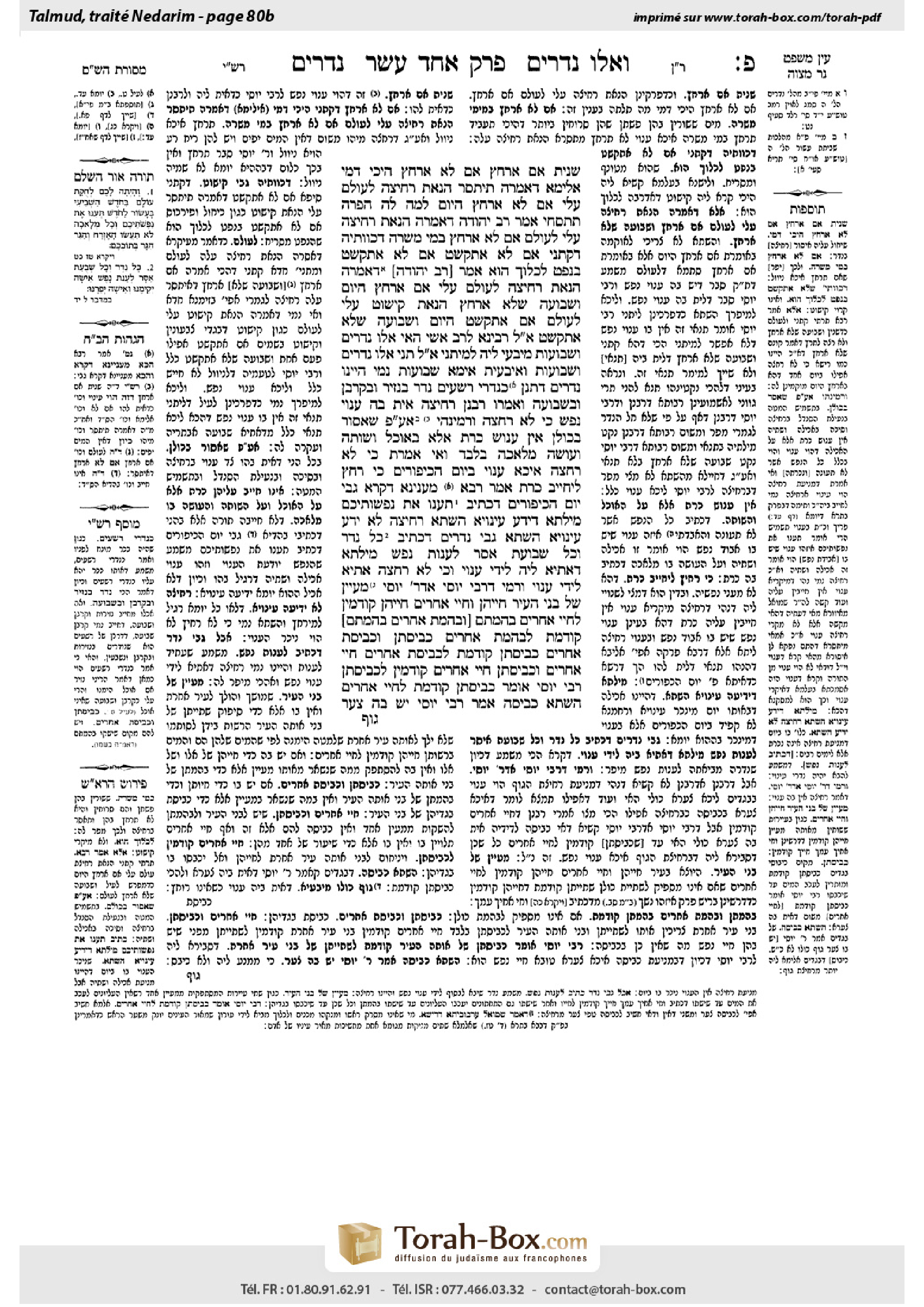
This page of Nedarim includes the Aramaic text, an English translation and an AI-generated French translation, alongside the scan above.
נדרים פ׳ ב · Aramaic and Hebrew text
שַׁנֵּית ״אִם אֶרְחַץ״. ״אִם לֹא אֶרְחַץ״ הֵיכִי דָּמֵי? אִלֵּימָא דְּאָמְרָה: ״תִּיתְּסַר הֲנָאַת רְחִיצָה לְעוֹלָם עָלַי אִם לֹא אֶרְחַץ הַיּוֹם״ — לְמָה לָהּ הֲפָרָה? תִּתְסְחֵי! אָמַר רַב יְהוּדָה: דְּאָמְרָה ״הֲנָאַת רְחִיצָה עָלַי לְעוֹלָם אִם לֹא אֶרְחַץ בְּמֵי מִשְׁרָה״.
דִּכְווֹתֵיהּ דְּקָתָנֵי ״אִם לֹא אֶתְקַשֵּׁט״ — אִם לֹא אֶתְקַשֵּׁט בְּנֵפְטְ. לִכְלוּךְ הוּא!
אָמַר [רַב יְהוּדָה], דְּאָמְרָה: ״הֲנָאַת רְחִיצָה לְעוֹלָם עָלַי אִם אֶרְחַץ הַיּוֹם, וּשְׁבוּעָה שֶׁלֹּא אֶרְחַץ״, ״הֲנָאַת קִישּׁוּט עָלַי לְעוֹלָם אִם אֶתְקַשֵּׁט הַיּוֹם, וּשְׁבוּעָה שֶׁלֹּא אֶתְקַשֵּׁט״.
אֲמַר לֵיהּ רָבִינָא לְרַב אָשֵׁי: הַאי ״אֵלּוּ נְדָרִים וּשְׁבוּעוֹת״ מִיבְּעֵי לֵיהּ לְמִיתְנֵי! אֲמַר לֵיהּ, תְּנִי: אֵלּוּ נְדָרִים וּשְׁבוּעוֹת. וְאִיבָּעֵית אֵימָא: שְׁבוּעוֹת נָמֵי הַיְינוּ נְדָרִים. דִּתְנַן: ״כְּנִדְרֵי רְשָׁעִים״ — נָדַר בְּנָזִיר וּבְקׇרְבָּן וּבִשְׁבוּעָה.
וַאֲמַרוּ רַבָּנַן: רְחִיצָה אִית בַּהּ עִנּוּי נֶפֶשׁ כִּי לָא רָחֲצָה? וּרְמִינְהִי: אַף עַל פִּי שֶׁאָסוּר בְּכוּלָּן — אֵין עָנוּשׁ כָּרֵת אֶלָּא בְּאוֹכֵל וְשׁוֹתֶה וְעוֹשֶׂה מְלָאכָה בִּלְבַד. וְאִי אָמְרַתְּ כִּי לָא רָחֲצָה אִיכָּא עִנּוּי, בְּיוֹם הַכִּיפּוּרִים כִּי רָחַץ לִיחַיַּיב כָּרֵת!
אָמַר רָבָא: מֵעִנְיָנָא דִקְרָא. גַּבֵּי יוֹם הַכִּיפּוּרִים דִּכְתִיב ״תְּעַנּוּ אֶת נַפְשׁוֹתֵיכֶם״ — מִילְּתָא דְּיָדַע עִינּוּיָא הַשְׁתָּא. רְחִיצָה לָא יָדַע עִינּוּיָא הַשְׁתָּא. גַּבֵּי נְדָרִים דִּכְתִיב ״כׇּל נֵדֶר וְכׇל שְׁבוּעַת אִסָּר לְעַנּוֹת נָפֶשׁ״ — מִילְּתָא דְּאָתְיָא לֵיהּ לִידֵי עִנּוּי, וְכִי לָא רָחֲצָה אָתְיָא לִידֵי עִנּוּי.
וְרָמֵי דְּרַבִּי יוֹסֵי אַדְּרַבִּי יוֹסֵי: מַעְיָין שֶׁל בְּנֵי הָעִיר, חַיֵּיהֶן וְחַיֵּי אֲחֵרִים — חַיֵּיהֶן קוֹדְמִין לְחַיֵּי אֲחֵרִים. בְּהֶמְתָּם [וּבֶהֱמַת אֲחֵרִים — בְּהֶמְתָּם] קוֹדֶמֶת לְבֶהֱמַת אֲחֵרִים. כְּבִיסָתָן וּכְבִיסַת אֲחֵרִים — כְּבִיסָתָן קוֹדֶמֶת לִכְבִיסַת אֲחֵרִים. חַיֵּי אֲחֵרִים וּכְבִיסָתָן — חַיֵּי אֲחֵרִים קוֹדְמִין לִכְבִיסָתָן.
רַבִּי יוֹסֵי אוֹמֵר: כְּבִיסָתָן קוֹדֶמֶת לְחַיֵּי אֲחֵרִים. הַשְׁתָּא כְּבִיסָה אָמַר רַבִּי יוֹסֵי יֵשׁ בָּהּ צַעַר,
Nedarim 80b · English translation
The Gemara asks: You have adequately answered the expression: If I bathe, but as for the vow: If I do not bathe, what are the circumstances? If we say that she said: The benefit of bathing shall be forbidden to me forever if I do not bathe today, why does she need nullification at all? Let her bathe today and nothing will be forbidden. Rav Yehuda said: The mishna is referring to a case where she said: The benefit of bathing is forbidden to me forever if I do not bathe in foul water in which flax was soaked. The husband can nullify this vow, as it will make her repulsive, which is a form of disfigurement.
The Gemara raises an objection: In that case, you must similarly explain that which the tanna teaches: If I do not adorn myself, to mean: The benefit of adorning myself is forbidden to me forever if I do not do something repulsive, e.g., if I do not adorn myself with naphtha [neft]. But this cannot be, as such a substance is filthy and the term adornment cannot be applied to it at all.
Rather, Rav Yehuda said that the mishna is referring to a case where she said: The benefit of bathing is forbidden to me forever if I bathe today, and I take an oath that I will not bathe today. Through a combination of her vow and her oath she has rendered it prohibited for her to bathe forever. The situation is similar if she said: The benefit of adornment is forbidden to me forever if I adorn myself today, and I take an oath that I will not adorn myself today.
Ravina said to Rav Ashi: According to this explanation, this tanna of the mishna should have taught: These are the vows and oaths that he can nullify. Rav Ashi said to him: Teach so in the mishna: These are the vows and oaths. And if you wish, say instead that oaths are also included in the category of vows. As we learned in a mishna (9a): If one said: Like the vows of the wicked, he has vowed with respect to becoming a nazirite, and with regard to bringing an offering, and with regard to taking an oath. This shows that an oath can also be called a vow.
§ The Gemara asks: And do the Rabbis, i.e., the first tanna, mean to say with regard to bathing that when she does not bathe it involves affliction? The Gemara raises a contradiction from a baraita that states: Although one is prohibited from performing any of the five activities associated with affliction on Yom Kippur, i.e., eating or drinking, bathing, anointing, engaging in sexual intercourse, and wearing leather shoes, one is punished with karet only when one eats or drinks or performs prohibited labor alone. And if you say that when a woman does not bathe there is affliction, and for this reason a husband may nullify such a vow taken by his wife, then if one bathes on Yom Kippur, he should be liable to receive karet, in accordance with the verse “For whatever person shall not be afflicted on that same day, he shall be cut off [venikhreta] from his people” (Leviticus 23:29), as he has failed to observe this form of affliction.
Rava said: The meaning of the affliction in each case may be learned from the context of the verse. With regard to Yom Kippur, where it is written: “On the tenth of the month you shall afflict your souls” (Leviticus 16:29), the reference is to a matter for which one knows and feels the affliction right now, on Yom Kippur itself, i.e., abstention from food and drink, which is felt within a short period of time. One who abstains from bathing, however, does not know and feel the affliction now, but only later. By contrast, with regard to vows, where it is written: “Every vow and every binding oath to afflict the soul, her husband may uphold it, or her husband may nullify it” (Numbers 30:14), the reference is to a matter that leads to affliction, and if she does not bathe for an extended period of time, it eventually leads to affliction.
§ The Gemara raises a contradiction between this statement of Rabbi Yosei and another statement of Rabbi Yosei. It was taught in a baraita: In the case of a spring belonging to the residents of a city, if the water was needed for their own lives, i.e., the city’s residents required the spring for drinking water, and it was also needed for the lives of others, their own lives take precedence over the lives of others. Likewise, if the water was needed for their own animals and also for the animals of others, their own animals take precedence over the animals of others. And if the water was needed for their own laundry and also for the laundry of others, their own laundry takes precedence over the laundry of others. However, if the spring water was needed for the lives of others and their own laundry, the lives of others take precedence over their own laundry.
Rabbi Yosei disagrees and says: Even their own laundry takes precedence over the lives of others, as the wearing of unlaundered clothes can eventually cause suffering and pose a danger. The Gemara clarifies the difficulty presented by this baraita: Now, if with regard to laundry, Rabbi Yosei said that refraining from laundering one’s clothes involves pain and affliction,
Nedarim 80b · Traduction française (IA)
La Guemara demande : Tu as répondu de façon satisfaisante au cas de l’expression « Si je me baigne », mais, concernant le vœu « Si je ne me baigne pas », quelles sont les circonstances ? Si nous disons qu’elle a dit : « Le bénéfice du bain me sera interdit à jamais si je ne me baigne pas aujourd’hui », pourquoi aurait-elle besoin d’une annulation ? Qu’elle se baigne aujourd’hui, et rien ne lui sera interdit. Rav Yehouda a dit : La Michna parle d’un cas où elle a dit : « Le bénéfice du bain me sera interdit à jamais si je ne me baigne pas dans de l’eau fétide où l’on a fait tremper du lin. » Le mari peut annuler ce vœu, car cela la rendrait repoussante, ce qui constitue une forme de défiguration.
La Guemara soulève une objection : Dans ce cas, il faut expliquer de la même manière ce que le tanna enseigne : « Si je ne me pare pas », à savoir : « Le bénéfice de me parer me sera interdit à jamais si je ne fais pas quelque chose de repoussant », par exemple si je ne me pare pas avec du naphte [neft]. Mais cela ne peut pas être, car une telle substance est répugnante et le terme « parure » ne peut absolument pas s’appliquer à elle.
Rav Yehouda a plutôt dit que la Michna parle d’un cas où elle a dit : « Le bénéfice du bain me sera interdit à jamais si je me baigne aujourd’hui », et a prêté serment de ne pas se baigner aujourd’hui. Par la combinaison de son vœu et de son serment, elle s’est interdit de se baigner à jamais. Il en va de même si elle a dit : « Le bénéfice de me parer me sera interdit à jamais si je me pare aujourd’hui », et a prêté serment de ne pas se parer aujourd’hui.
Ravina dit à Rav Ashi : Selon cette explication, ce tanna de la Michna aurait dû enseigner : « Voici les vœux et les serments qu’il peut annuler. » Rav Ashi lui dit : Enseigne ainsi dans la Michna : « Voici les vœux et les serments. » Ou bien, si tu préfères, dis plutôt que les serments sont également inclus dans la catégorie des vœux. Car nous avons appris dans une Michna (9a) : Si quelqu’un dit : « Comme les vœux des méchants », il a fait un vœu concernant le fait de devenir nazir, d’apporter une offrande et de prêter serment. Cela montre qu’un serment peut également être appelé un vœu.
§ La Guemara demande : Les rabbins, c’est-à-dire le premier tanna, veulent-ils dire que, concernant le bain, le fait de ne pas se baigner entraîne une souffrance ? La Guemara soulève une contradiction à partir d’une baraïta qui enseigne : Bien qu’il soit interdit de pratiquer chacune des cinq activités associées à l’affliction à Yom Kippour — manger ou boire, se baigner, s’enduire d’huile, avoir des relations sexuelles et porter des chaussures en cuir —, on n’encourt la peine de karet que si l’on mange, si l’on boit ou si l’on accomplit seul un travail interdit. Si tu dis que le fait pour une femme de ne pas se baigner entraîne une souffrance, et que c’est pour cette raison qu’un mari peut annuler un tel vœu prononcé par sa femme, alors celui qui se baigne à Yom Kippour devrait encourir la peine de karet, conformément au verset : « Car toute personne qui ne s’affligera pas en ce même jour sera retranchée [venikhreta] de son peuple » (Lévitique 23:29), puisqu’elle n’a pas observé cette forme d’affliction.
Rava a dit : Le sens de l’affliction dans chaque cas peut être établi à partir du contexte du verset. Concernant Yom Kippour, où il est écrit : « Le dixième jour du mois, vous affligerez vos âmes » (Lévitique 16:29), il s’agit d’une chose dont on connaît et ressent l’affliction immédiatement, le jour même de Yom Kippour, c’est-à-dire de s’abstenir de manger et de boire, ce qui se fait sentir au bout de peu de temps. En revanche, celui qui s’abstient de se baigner ne connaît ni ne ressent l’affliction sur le moment, mais seulement plus tard. À l’inverse, concernant les vœux, où il est écrit : « Tout vœu et tout serment contraignant qui afflige l’âme, son mari peut le maintenir ou son mari peut l’annuler » (Nombres 30:14), il s’agit d’une chose qui entraîne une affliction : si elle ne se baigne pas pendant une période prolongée, cela finit par causer une affliction.
§ La Guemara soulève une contradiction entre cette déclaration de Rabbi Yossi et une autre déclaration de Rabbi Yossi. Il a été enseigné dans une baraïta : Dans le cas d’une source appartenant aux habitants d’une ville, si l’eau est nécessaire à leur propre vie, c’est-à-dire que les habitants de la ville ont besoin de cette source pour boire, et qu’elle est également nécessaire à la vie d’autres personnes, leur vie passe avant celle des autres. De même, si l’eau est nécessaire à leurs propres animaux ainsi qu’aux animaux d’autrui, leurs animaux passent avant ceux d’autrui. Et si l’eau est nécessaire pour leur propre lessive ainsi que pour celle d’autrui, leur lessive passe avant celle d’autrui. Toutefois, si l’eau de la source est nécessaire à la vie d’autrui et à leur propre lessive, la vie d’autrui passe avant leur lessive.
Rabbi Yossi n’est pas d’accord et dit : Même leur propre lessive passe avant la vie d’autrui, car le fait de porter des vêtements non lavés peut, à la longue, causer une souffrance et présenter un danger. La Guemara précise la difficulté soulevée par cette baraïta : Or, si, concernant la lessive, Rabbi Yossi a dit que s’abstenir de laver ses vêtements entraîne douleur et affliction,
Traduction française générée par IA à partir de l’édition anglaise de Sefaria. Vérifie toujours un passage avec le texte source.
Text from Sefaria: William Davidson Edition - Vocalized Aramaic (CC BY NC); William Davidson Edition - English (CC BY NC).